A backyard orchard can be five apple trees on a lawn corner, a pear trained flat against a fence, or a Meyer lemon in a pot on the patio, and any of them puts real fruit on the table. Fall is a good time to plan one, because many nurseries take bare-root orders now for planting in late winter. The ideas below show what that looks like in real yards.
Contents
- 01. Five-Tree Mini Orchard on a Lawn Corner
- 02. Espaliered Apples Along a Sunny Fence
- 03. Columnar Apples Lining a Path
- 04. A Pollination Pair: Apple and Crabapple
- 05. Four-in-One Apple Tree for a Tiny Yard
- 06. Meyer Lemon in a Pot on the Patio
- 07. Asian Pear Trained on a Trellis
- 08. Open-Center Peach in the Warmest Corner
- 09. Tart Cherry for Cold Winters
- 10. American Plum Thicket for Wildlife and Jam
- 11. Fig Against a Warm Wall
- 12. Persimmon for Fall Fruit and Color
- 13. Pawpaw Patch in Part Shade
- 14. Serviceberry and Cornelian Cherry Edible Screen
- 15. Blueberry Hedge With Fall Color
- 16. Grape Arbor Over a Seating Spot
- 17. Hardy Kiwi on a Pergola
- 18. Strawberry Bed at the Orchard’s Edge
- 19. Currants and Gooseberries on the Shady Side
- 20. Thornless Blackberries on a Trellis
- 21. Satsuma Mandarin Planted in the Ground
- 22. Orchard on a Gentle Slope
- 23. Mounded Planting for Heavy Clay
- 24. Clover Understory Under the Trees
- 25. Trunk Guards and a Deer Fence
The range is wide. There are ideas for tree fruit, vines and berries, for Zone 3 winters and Zone 10 heat, and for a full lawn corner or a single wall. Some, like tart cherries and blueberries, suit a first orchard, and others, like espalier and hardy kiwi, ask more of you.
Fruit growing is more work than most garden jobs, so each idea says plainly what the plant needs: a pollination partner, a spacing, a pH, a pest to watch. Look up your USDA zone and your average last spring frost date, then pick the ideas that fit your climate and your space.
01. Five-Tree Mini Orchard on a Lawn Corner
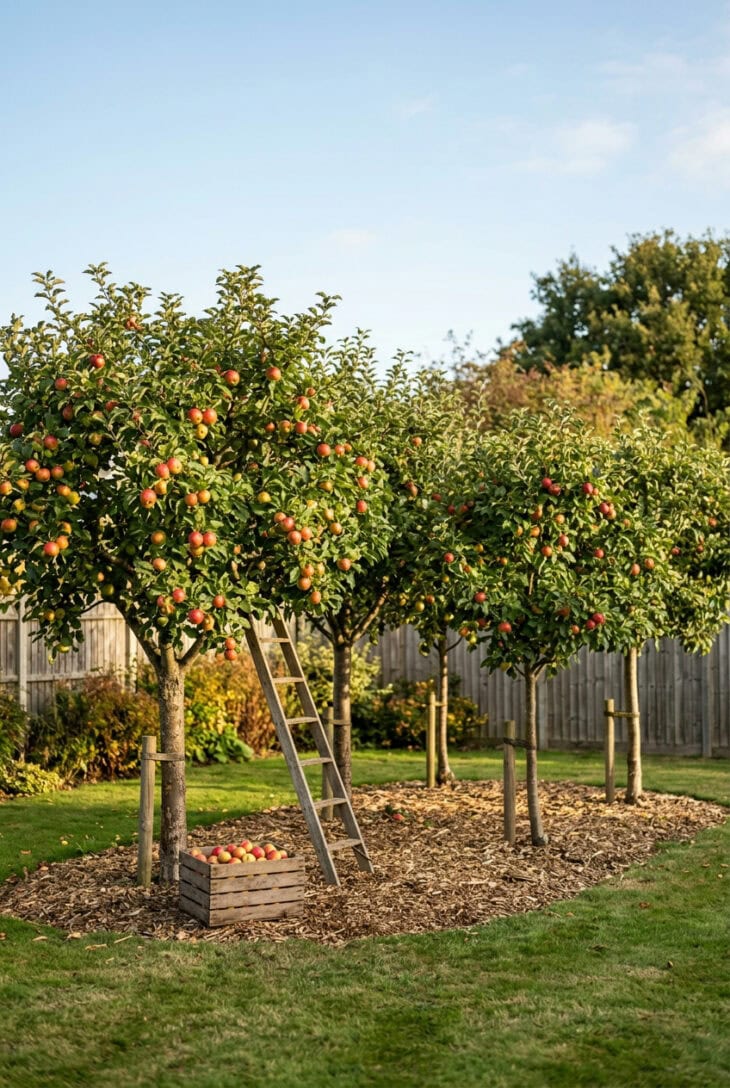
What you see A corner of an ordinary lawn holds five apple trees in a loose group, each about 12ft tall and heavy with red and yellow fruit. Every trunk sits in a circle of wood-chip mulch with a short stake beside it. A crate of picked apples and a wooden ladder lean under the nearest tree, and low morning sun picks out the fruit.
Why it works Five trees is the point where a lawn corner starts to behave like an orchard, with enough variety to cross-pollinate and to spread the harvest over several weeks. Semi-dwarf trees stay at a size you can prune and pick from the ground or a short ladder. Standard trees would claim around 25ft (760cm) each and take longer to bear, which is more room than most backyards can spare. This also works as one of the simpler backyard garden ideas for using an unloved corner.
How to get it Space semi-dwarf apples (Malus domestica) about 12 to 15ft (365 to 450cm) apart, and follow the nursery tag, since spacing shifts with rootstock and cultivar. Apples grow in Zones 4–9, and the fruit appears 2 to 6 years after planting depending on the rootstock. Order bare-root trees now for late winter delivery, soak the roots before planting and set the graft union a few inches above the soil line. Skip fertilizer in the planting hole, and keep a 2 to 3ft (60 to 90cm) circle around each trunk free of grass, because young trees compete badly with turf. Choose at least two cultivars that bloom together (see idea 4).
02. Espaliered Apples Along a Sunny Fence
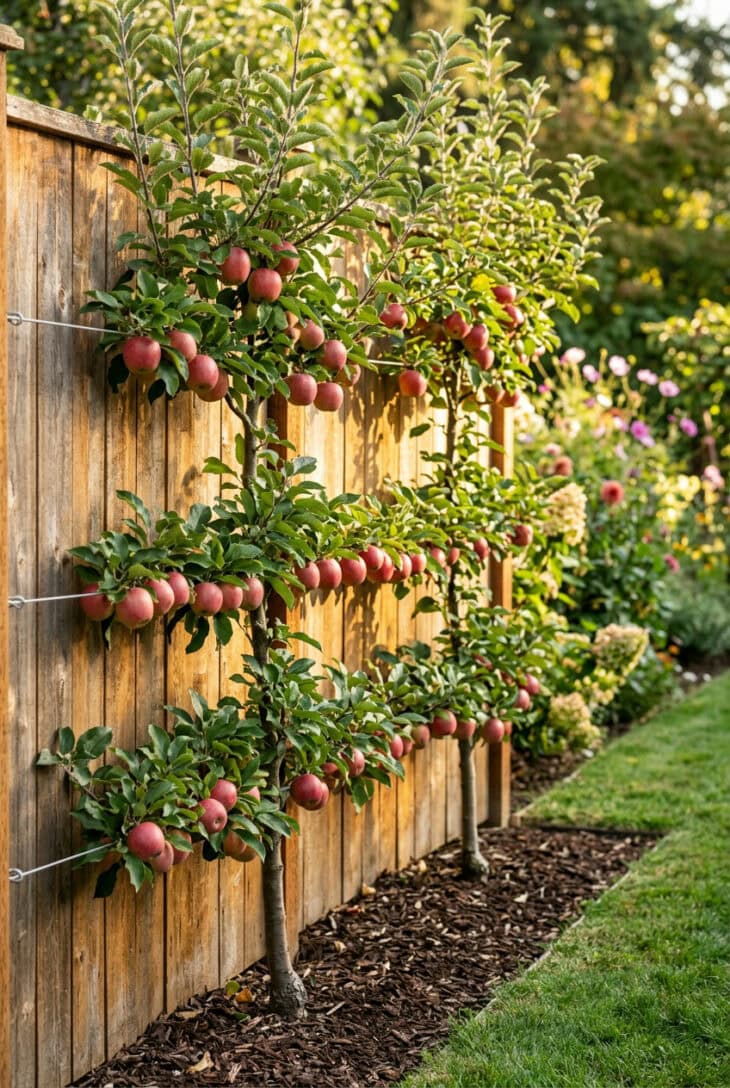
What you see Two apple trees grow completely flat against a sunny fence, their branches stretched along three neat horizontal tiers of wire. Red apples hang in a line along each tier, all within arm’s reach from the ground. The lawn in front is barely 3ft wide, and warm light bounces off the boards onto the fruit.
Why it works Espalier turns a fence into a fruit wall where a free-standing tree would never fit, which makes it a smart move in small gardens. The flat shape lets sun and air reach every branch, which helps ripening and keeps leaf diseases down. It is also easy to thin, bag and pick, and in winter the bare branch pattern is the whole show.
How to get it Start with one- or two-year-old dwarf trees of a spur-type cultivar, because spur bearers fruit on old wood and are the easiest to train. Set posts about 8ft (240cm) apart, run heavy 12-gauge galvanized wire with the first wire 18in (45cm) off the ground and two more at 18in intervals, and plant in late winter. Keep the trunk at least 8in (20cm) off the fence for airflow. Plan on several light prunings through the growing season, cutting side shoots back to about three leaves to build fruiting spurs. After thinning, a zip-top bag slipped over each small apple about 2 weeks after petal fall blocks codling moth, apple maggot and several fruit diseases, according to University of Wisconsin Extension.
03. Columnar Apples Lining a Path
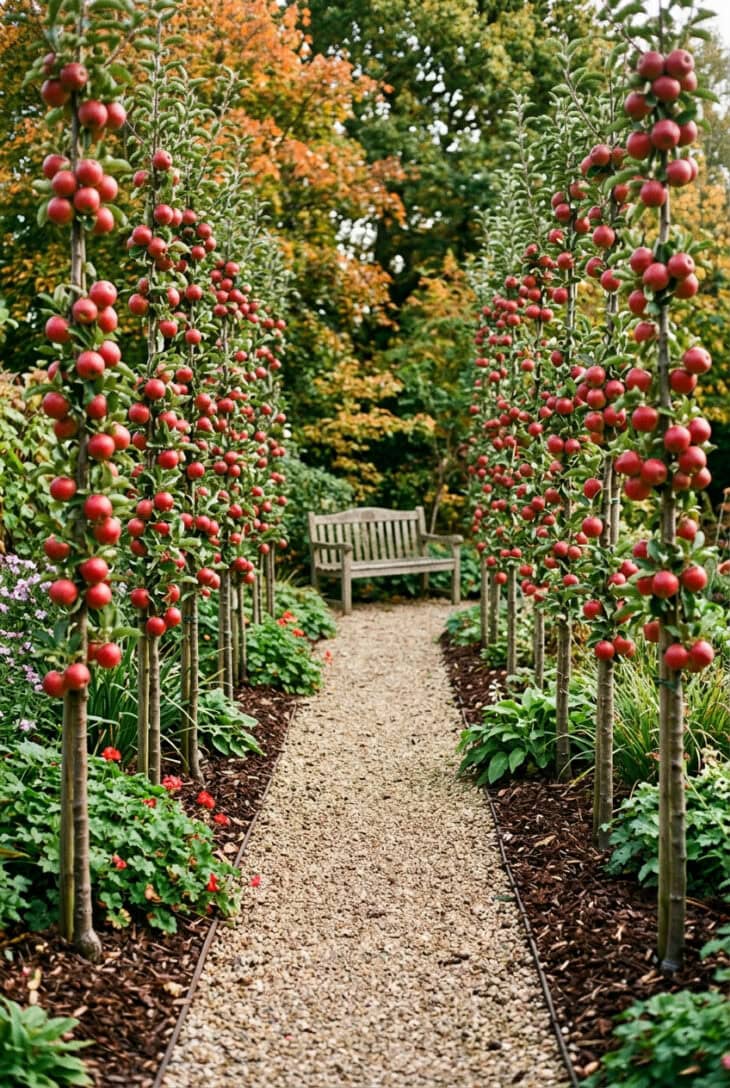
What you see Slender apple trees line both sides of a gravel path like living posts, each barely 2ft wide and wrapped in short fruiting branches. Red apples cling to the trunk-hugging limbs all the way up. A bench waits at the far end, lit by low early-fall sun.
Why it works Columnar apples give you an orchard’s worth of variety in the footprint of a shrub border. Because they are so narrow, you can plant four or six cultivars where one standard tree would stand, which gives every tree a pollination partner and stretches the harvest. They are also among the easiest apple trees to net, thin and pick.
How to get it Look for columnar apples (Malus domestica) sold as Urban or Stark Spire types. Mature size varies by source, roughly 7 to 15ft (210 to 450cm) tall and 2 to 3ft (60 to 90cm) wide, so check the tag. Plant a few feet apart in full sun, give each a deep hole because the roots still need room, and put in at least two compatible cultivars for pollination. Choose scab-, rust- and fire blight-resistant types where you can. Gravel, stepping stones or mown grass all work as the surface, so borrow from these garden path ideas for the layout.
04. A Pollination Pair: Apple and Crabapple
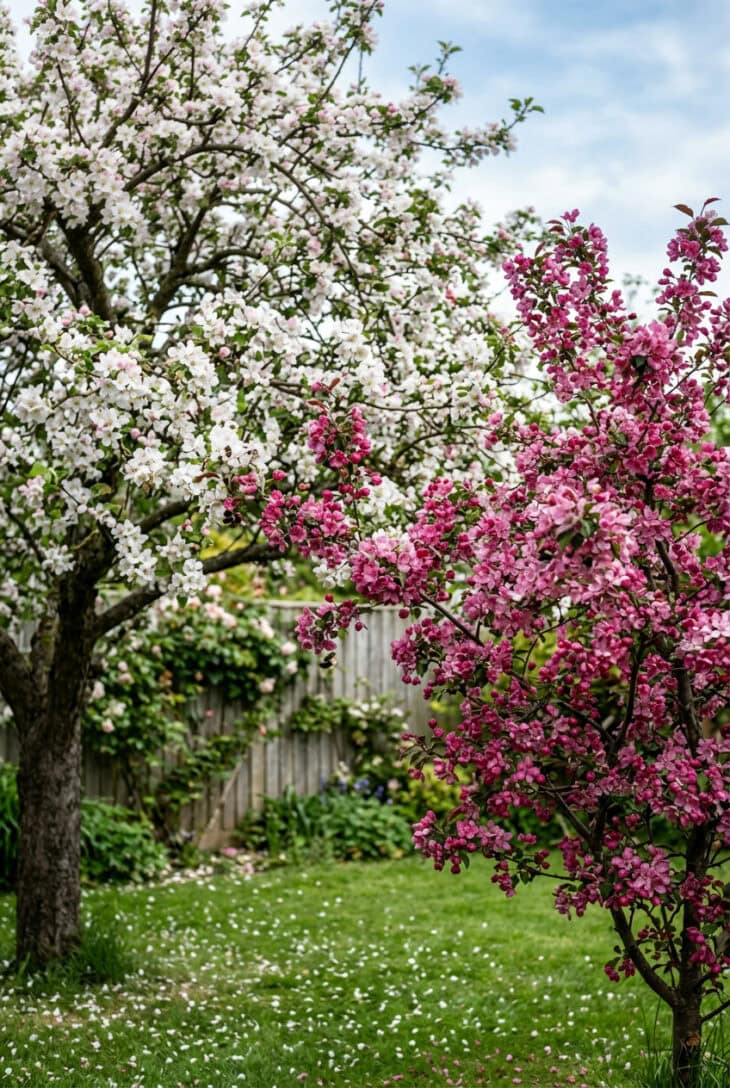
What you see In mid-spring an apple tree in white and pale pink blossom stands next to a smaller crabapple covered in deep pink flowers, their branches almost touching. Bumblebees and honeybees travel from one tree to the other. The grass below is dusted with fallen petals.
Why it works Most apples set a poor crop on their own pollen. They need a different cultivar blooming at the same time, so a lone tree can flower beautifully and then give you almost nothing. Crabapples are widely used as pollinizers, and a small one is the cheapest, most compact insurance for a yard with room for only one or two apples.
How to get it Match bloom time first, since an early bloomer and a late bloomer never meet. Washington State University’s cross-compatibility table lists ‘Honeycrisp’ and ‘Gala’ with a shared S-allele, so they are only partly compatible; pair ‘Honeycrisp’ with ‘Fuji’ or a crabapple instead, and confirm with your nursery. Keep partners within 50 to 100ft (15 to 30m), and a neighbor’s crabapple counts. Triploid apples such as ‘Jonagold’ and ‘Mutsu’ cannot pollinate anything, so they need two other cultivars nearby. An ornamental option is the Purple Prince crabapple (Malus ‘Purple Prince’), but check that its bloom overlaps your apple.
05. Four-in-One Apple Tree for a Tiny Yard
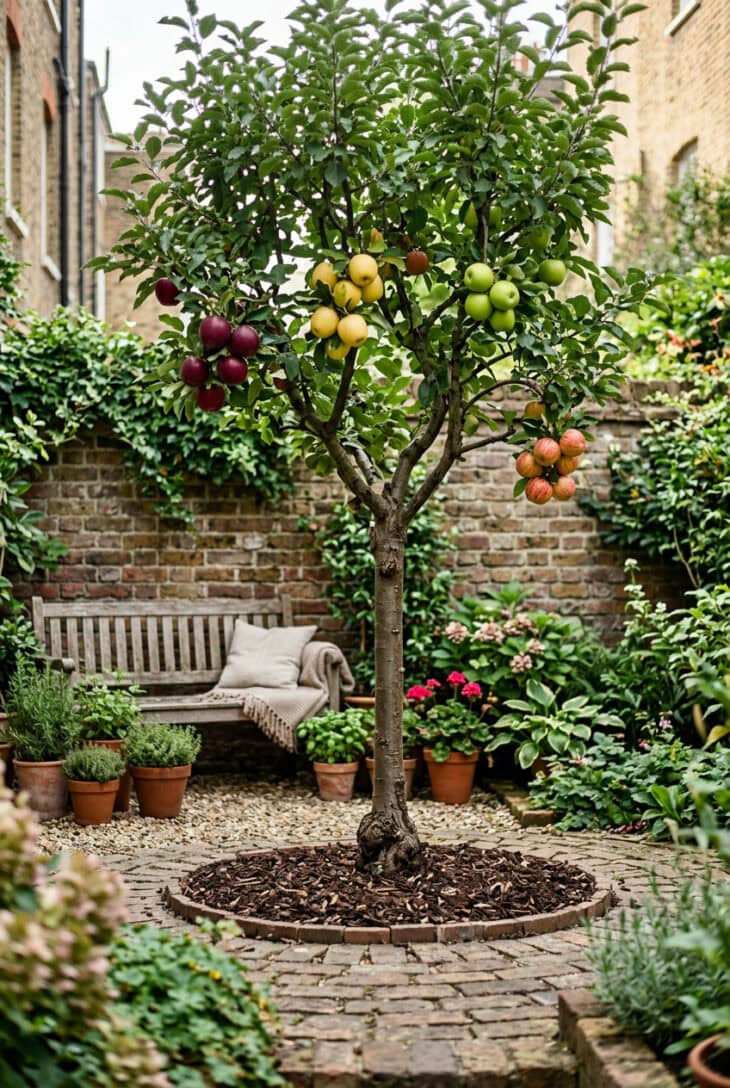
What you see A single apple tree stands in the middle of a small walled yard with four different kinds of fruit hanging from its branches: red, yellow, green and striped. A mulched circle surrounds the trunk and a bench sits against the brick behind it. The tree is about 8ft tall, so every apple can be reached by hand.
Why it works A multi-graft tree puts several cultivars on one trunk, so a yard with room for exactly one tree still gets built-in cross-pollination and a harvest that runs over several weeks. That is a real advantage in a small space. The catch is upkeep: University of Maryland Extension advises against them unless you are experienced, warning of extra maintenance and the loss of an entire cultivar’s crop.
How to get it Buy a tree with all one fruit, such as four apples, not a mix of apples and pears. Choose cultivars with overlapping bloom times, and never mix Asian and European pears or early- and late-blooming apples, which may not pollinate each other. One cultivar often outgrows the others, so prune the strongest limb a little harder and the weakest lightly. Keep the labels, or draw a map of which branch is which, because after a few years nobody remembers. Plant it in full sun and give it the same weed-free circle as any young apple.
06. Meyer Lemon in a Pot on the Patio
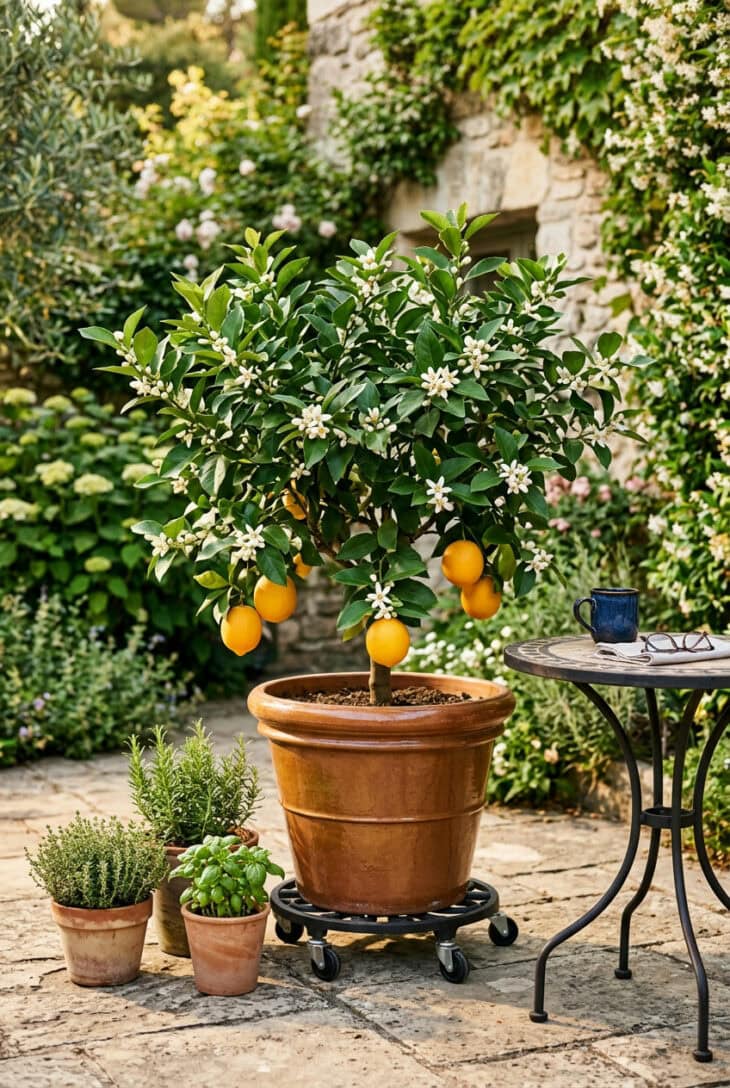
What you see A Meyer lemon in a big glazed pot stands on a sunny stone patio next to a bistro table. Glossy leaves, a few white blossoms and several rounded yellow-orange lemons share the same branches. The pot rides on a wheeled stand, and the afternoon sun warms the stone.
Why it works Among patio garden ideas, a potted lemon is the one that gives scent, evergreen foliage and fruit together. A pot is also how you grow citrus outside Zones 9–11, where Meyer lemon is hardy according to NC State. The wheels are the real feature: University of Florida IFAS says to protect Meyer lemon from temperatures below 20°F (-7°C), and it is unlikely to fruit as a year-round houseplant, so it needs its summers outdoors.
How to get it Where winters freeze, treat the tree as a seasonal patio plant. Bring it inside when nights approach 50°F (10°C), because Iowa State says citrus can drop leaves below that, and put it in a south or west window with 6 to 8 hours of direct light. Clemson suggests keeping it around 55 to 65°F (13 to 18°C) indoors. Use a pot with drainage holes and a fast-draining mix, and move it back out gradually in spring. The container garden ideas cover pot materials and mixes in more detail.
07. Asian Pear Trained on a Trellis
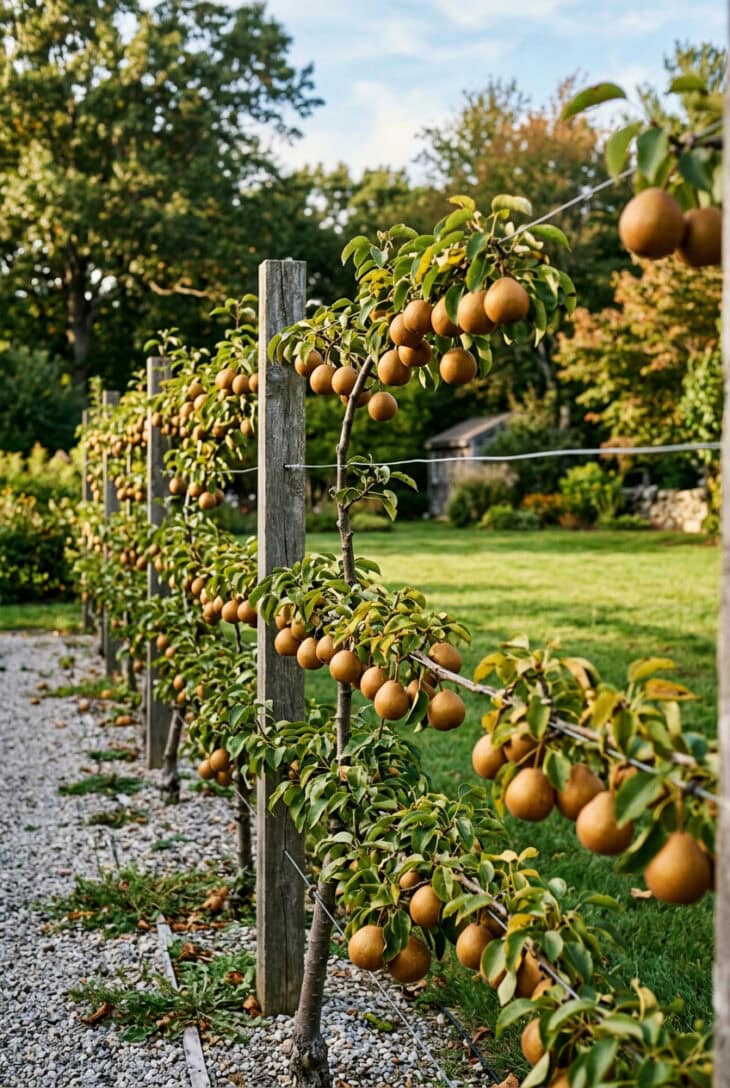
What you see Round, golden-brown Asian pears hang in rows along a post-and-wire trellis, each branch trained flat and level. The fruit is the size and shape of a small apple, with dull russeted skin that glows in the low light. Gravel runs along the base of the trellis, and the rest of the yard stays open.
Why it works Asian pears (Pyrus pyrifolia) are crisp and juicy, and they ripen on the tree, so you pick them ready to eat. Trained against a trellis, a tree needs only a few feet of depth, one of the vertical garden ideas where height does the work. The big drawback is fire blight, a bacterial disease that Penn State calls the biggest problem with Asian pears.
How to get it Plant two Asian pear cultivars, because many are self-incompatible, and do not count on a European pear (Pyrus communis) to pollinate them. Hardiness depends on the cultivar, roughly Zones 5–8. Clemson lists ‘Shinko’, ‘Shin Li’, ‘Olympic’ and ‘Seuri’ as more resistant to fire blight, and Penn State flags ‘Twentieth Century’ as one of the most susceptible. Thin fruit 2 to 3 weeks after bloom to one pear per 6 to 8in (15 to 20cm) of branch, cutting rather than pulling. If you see blackened shoots, cut them out in the dormant season well below the damage, and sanitize your pruners between cuts.
08. Open-Center Peach in the Warmest Corner
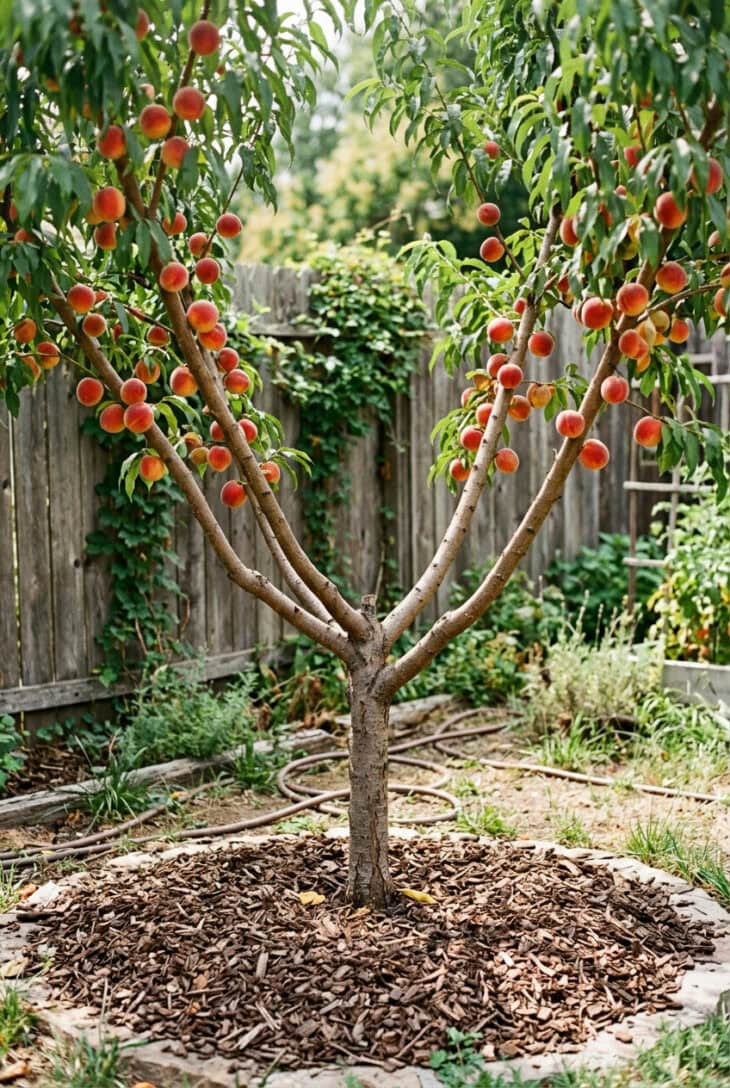
What you see A peach tree opens like a vase, with four sturdy limbs reaching outward and the center left clear for light. Peaches blushed red and gold hang along the limbs in strong summer sun. The tree stands in a warm corner of the yard, ringed with wood-chip mulch.
Why it works Open-center training lets light into the middle of the tree, which ripens fruit evenly and keeps the tree low enough to pick from the ground. Most peaches are self-fertile, so one tree is enough. The two risks are spring frost, which starts to kill open blossoms at about 27°F (-3°C), and peach leaf curl, a fungal disease that cannot be treated once the symptoms show in spring.
How to get it The peach tree (Prunus persica) grows in Zones 5–9, and ‘Reliance’ is among the hardiest cultivars at the cold end. Plant on higher ground rather than the low spot where cold air settles, and avoid south or west walls that push the tree to bloom early. Prune in late winter after the coldest weather and before bloom, keeping 3 to 5 main limbs. For leaf curl, University of California advises a dormant-season fungicide after leaf drop, and a second spray in late winter before bud break if needed, always following the product label. Peach pits contain cyanide compounds, so never crush or chew them, and keep dogs and cats away from fallen pits.
09. Tart Cherry for Cold Winters
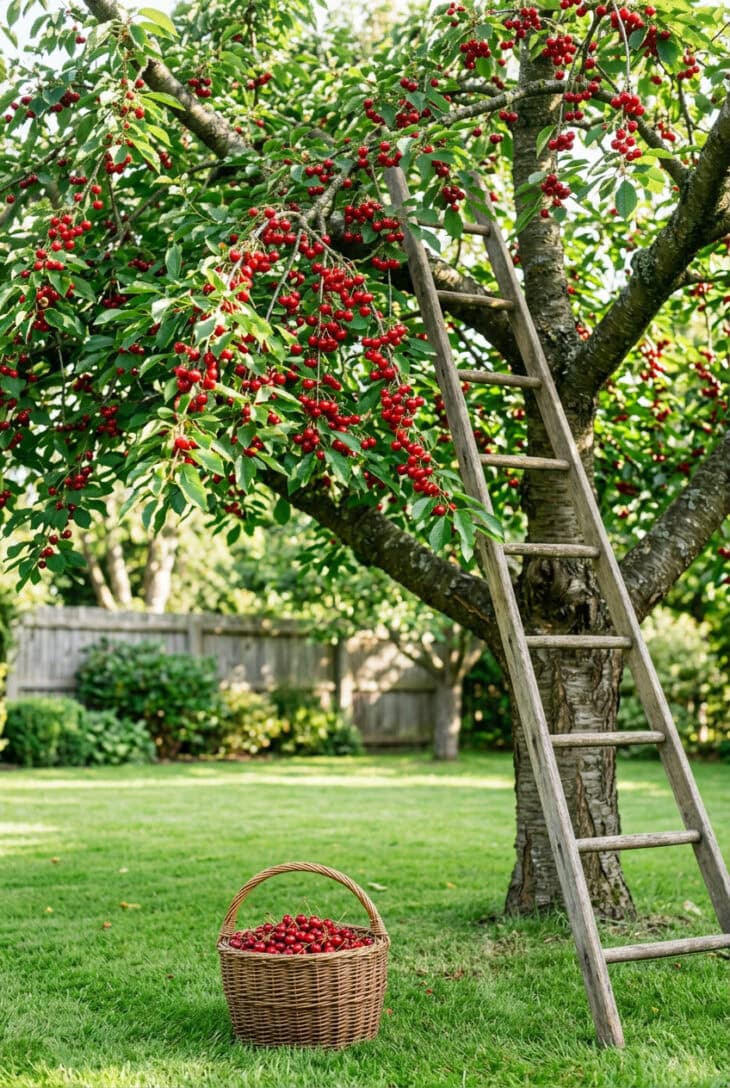
What you see A tart cherry tree is covered in clusters of bright red cherries on glossy green leaves. A ladder leans in the branches, and a wicker basket of picked fruit sits on the grass below. The light is bright and early, and the lawn is still damp.
Why it works Tart cherries are the easiest cherries for most yards. ‘Montmorency’ is self-fertile, so one tree is enough, it grows in Zones 4–8, and Virginia Tech notes that tart cherries bloom later than other stone fruit, which helps them dodge frost. Birds bother them less than sweet cherries. If you would rather grow eating-fresh fruit, the sweet cherry varieties guide shows which ones need a pollinator.
How to get it Plant in full sun. A standard tree reaches 15 to 20ft (450 to 600cm) with a spread of 14 to 18ft (425 to 550cm), and dwarfing rootstocks make it smaller and easier to net. Expect a first crop in 3 to 5 years, then pie, jam and juice cherries by midsummer. Netting is still worth it, since birds will take what they can reach. The pros and cons of cherry trees lay out the upkeep before you commit.
10. American Plum Thicket for Wildlife and Jam
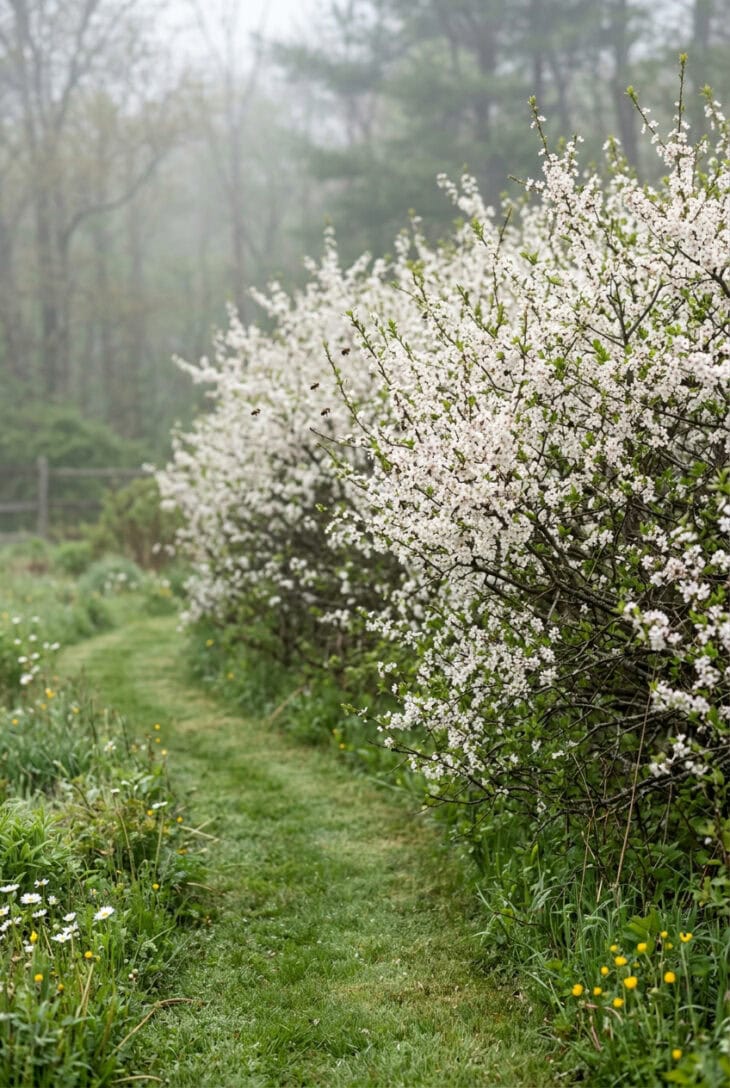
What you see A loose hedge of American plum runs along the back of the yard, every branch covered in small white flowers with bees working the blossoms. A mown path curves along the front of the thicket. In July and August the same branches carry round red-purple plums.
Why it works American plum (Prunus americana) does three jobs at once: spring bloom, edible 1in (2.5cm) plums in July and August, and dense cover for songbirds and small mammals all year, according to NC State. It tolerates dry soil and grows in Zones 3–9. For a wilder yard it fits the same thinking as wildlife garden ideas.
How to get it Plant a group of nursery-grown trees in full sun to part shade. As a shrub it suckers freely and forms thickets, so give it room, mow around it, and pull suckers where they stray. The twigs are spiny, which makes a decent barrier but is not kind to bare arms at harvest. Wait until the plums are fully ripe, because they become sweet only at maturity. The leaves, stems and pits contain cyanide compounds, so never crush or chew pits, and keep pets and horses away from the leaves.
11. Fig Against a Warm Wall
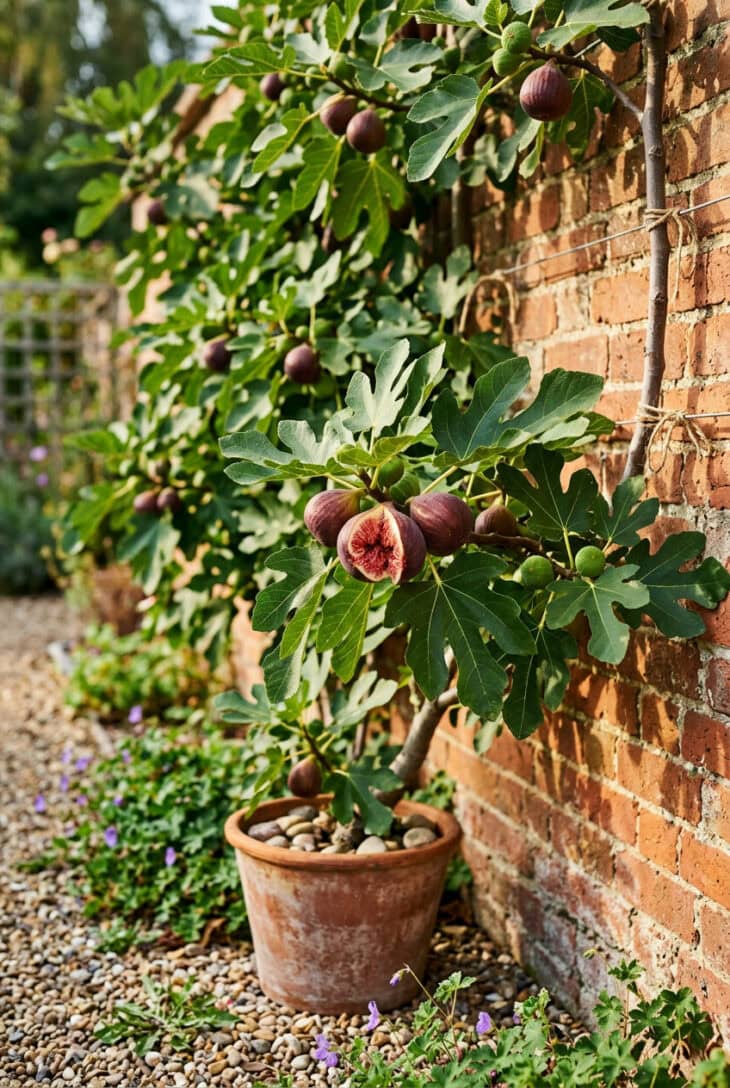
What you see A fig tree spreads its large lobed leaves flat against a sunny brick wall. Plump purple-brown figs hang among them, and one has split open to show the pink flesh inside. A terra-cotta pot and a strip of gravel sit at the base of the wall.
Why it works The wall stores heat and radiates it at night, which suits a fruit that loves warmth, and the leaves of a fig are a sight in themselves. It is a staple of Mediterranean garden ideas. Fig (Ficus carica) is rated Zones 7–10 by NC State, and ‘Hardy Chicago’ is rated 5–10 by Iowa State, though Penn State reports in-ground trees cut to the base after severe winters.
How to get it In the ground, treat ‘Hardy Chicago’ as a Zones 6–9 plant with protection, and grow it in a container in Zone 5. Rutgers suggests wrapping trees in burlap or tar paper, or building a chicken-wire cage filled with hay or composted mulch. Potted figs can overwinter in a cool, sheltered spot above freezing, like a garage or basement, watered about weekly and moved back out gradually in spring. Wear gloves when pruning or picking: the milky sap irritates skin, and in sun it can cause a rash.
12. Persimmon for Fall Fruit and Color
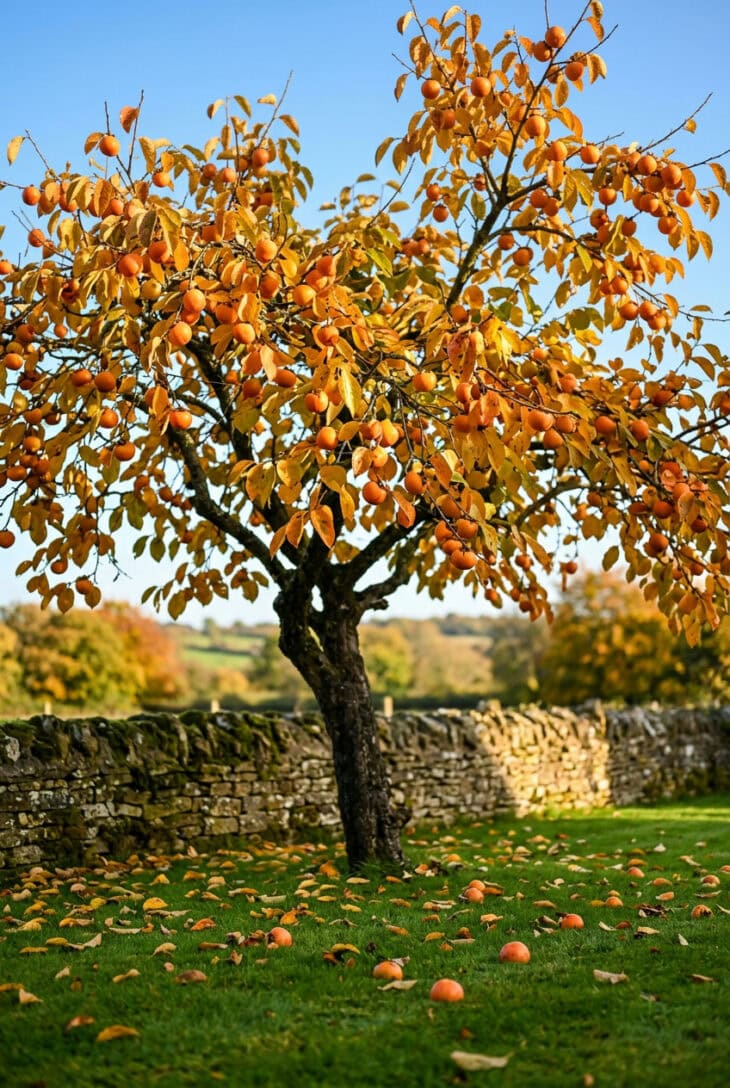
What you see Bright orange persimmons hang among golden-yellow leaves on a tree in late October, with a few fallen fruits on the grass below. The sky behind is clear blue. The light is crisp, low and slightly cold.
Why it works A persimmon puts ripe fruit and fall color on the same tree, which fits neatly with fall garden ideas. American persimmon (Diospyros virginiana) is hardy in Zones 4–9, and the University of Wisconsin reports one selection, ‘Meader’, surviving temperatures as low as -31°F (-35°C). Asian persimmon (Diospyros kaki) is hardy only in Zones 7–10.
How to get it American persimmons are mostly dioecious, with separate male and female trees, so buy ‘Meader’, which is reliably self-fertile, or plant one male for every group of females. The tree grows large, 30 to 80ft (9 to 24m) tall, so give it room. Unripe fruit is powerfully astringent, and the better test is a soft, fully colored fruit, not the calendar. Asian ‘Fuyu’ (Zones 7–10) is non-astringent and can be eaten while still firm, which makes it more forgiving for first-time growers.
13. Pawpaw Patch in Part Shade
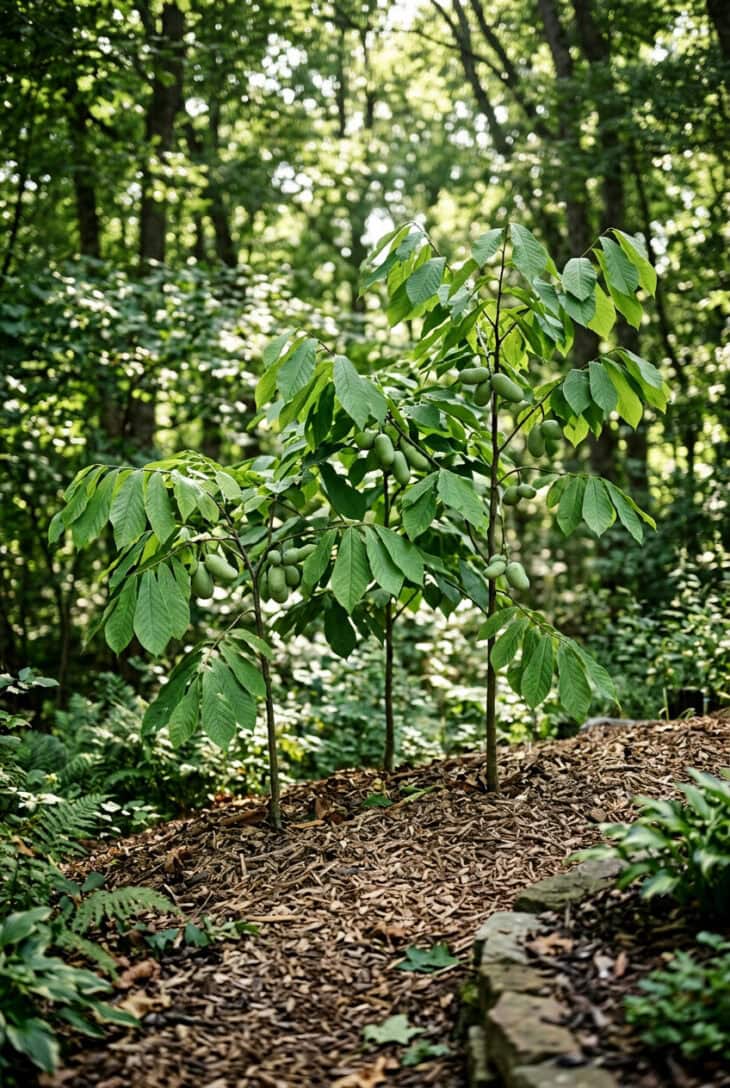
What you see Three young pawpaw trees spread large drooping leaves in dappled shade at the edge of the yard. Clusters of green, mango-shaped fruit hang among the leaves in late summer. Wood chips cover the ground and light falls through the canopy behind.
Why it works Pawpaw (Asimina triloba) is a native fruit tree that grows in part shade, where most orchard fruit sulks. It has a tropical look, with big leaves and custardy fruit often compared to banana and mango. It is hardy in Zones 5–8 according to Kentucky State University.
How to get it Plant at least two genetically different trees, because pawpaws are self-incompatible, and consider brushing pollen between flowers by hand with a small brush, since flies and beetles are the natural pollinators. Young trees need shade in the first year, and sometimes the second, since full sun can kill them. Plant small trees in spring, because the long taproot resents disturbance, and space them about 8ft (240cm) apart. Ripe fruit gives like a ripe peach and smells fruity, in late summer to early fall. Eat only fully ripe flesh and in moderation, never the seeds, because some people get a reaction.
14. Serviceberry and Cornelian Cherry Edible Screen
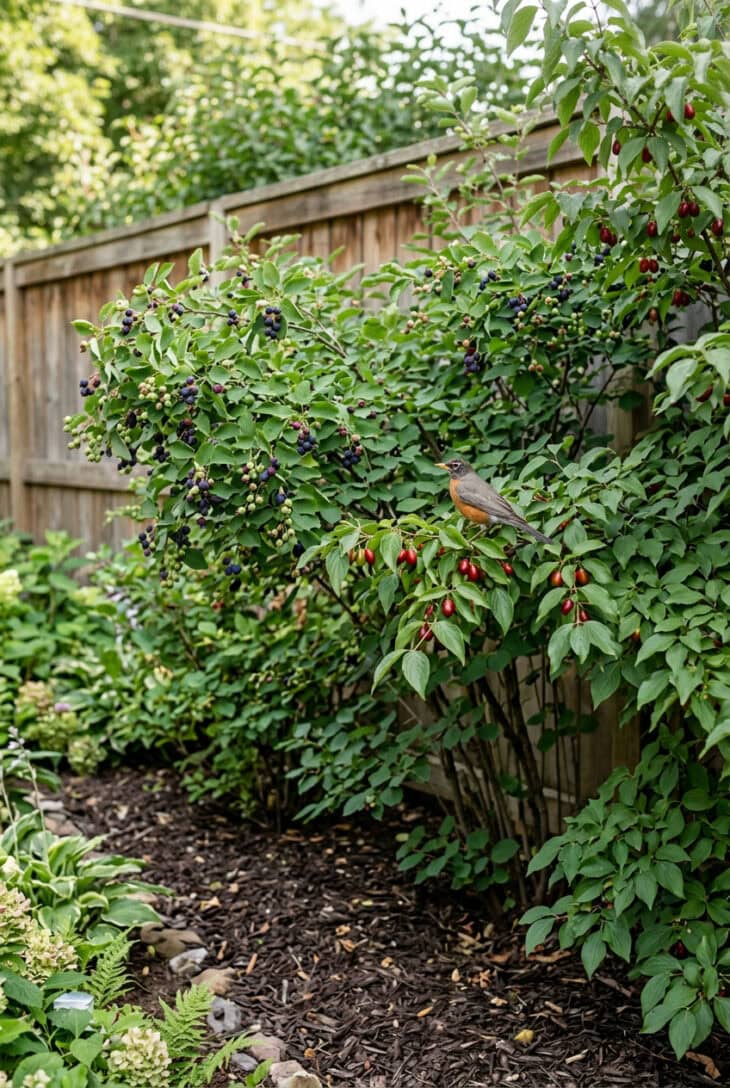
What you see A screen of multi-stemmed shrubs runs along the side fence, hung with dark purple-blue berries and ripening red, olive-shaped fruit. A songbird perches on one of the branches. The strip beneath is mulched and tidy.
Why it works A planting for garden privacy can also feed you. Allegheny serviceberry (Amelanchier laevis) and cornelian cherry (Cornus mas) both grow 15 to 25ft (450 to 760cm) tall in Zones 4–8, and both have edible fruit. Serviceberry berries ripen in June and resemble blueberries, while cornelian cherries color mid-summer and may be eaten once dark red.
How to get it For fruit quality, Penn State and Iowa State point to Saskatoon-type serviceberries (Amelanchier alnifolia) such as ‘Regent’ and ‘Smokey’, while ‘Autumn Brilliance’ is valued more for flowers and fall color. Plant nursery-grown shrubs in full sun to part shade, and net them, because birds will strip the fruit. Cornelian cherry throws suckers that NC State says need prompt removal to control its spread, so check them each spring. Birds and squirrels love both fruits, so plant extra if you want to share.
15. Blueberry Hedge With Fall Color
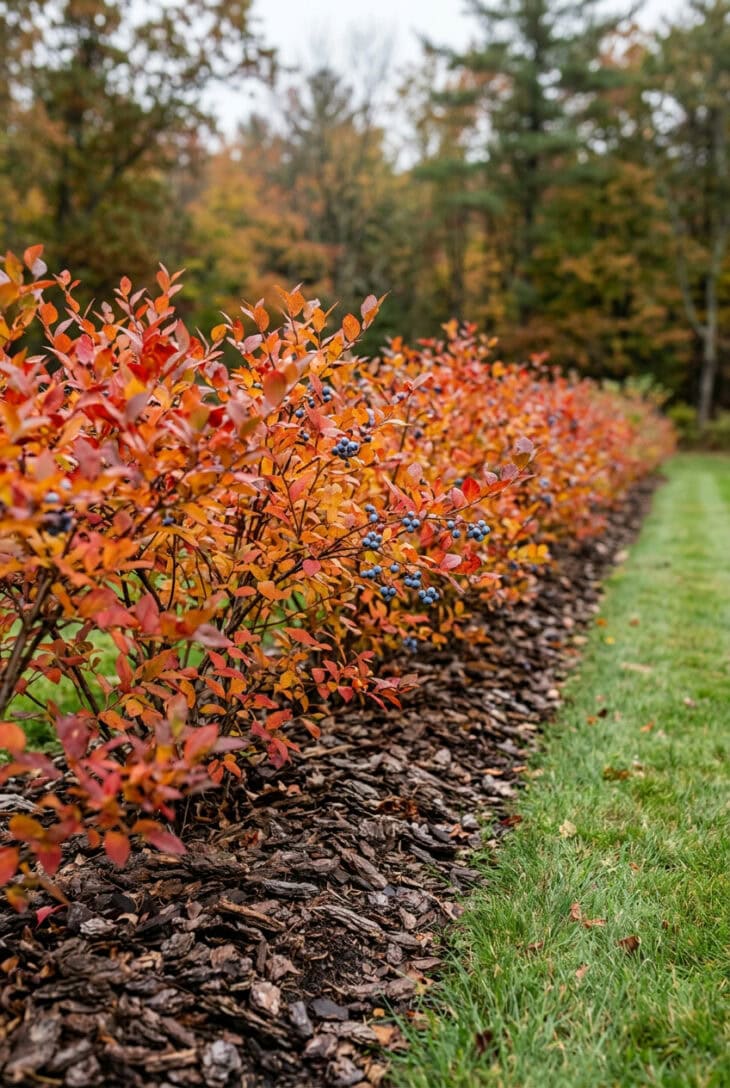
What you see A line of highbush blueberry shrubs forms a low hedge, their leaves turned bright red and orange. A few late blue berries still hang from the twigs. Pine bark mulch lies deep beneath them and a grass path runs alongside.
Why it works Blueberry (Vaccinium corymbosum) works as a fruiting hedge, with white spring flowers, summer fruit and some of the best fall color of any shrub in the yard. It grows in Zones 3–8 according to NC State and reaches 6 to 12ft (180 to 365cm) tall. The catch is the soil: blueberries need acid soil, and most yards are not.
How to get it Aim for a soil pH of 4.5 to 5.0, up to 5.5 at most, and test before you plant. If your soil is higher, grow them in raised beds or large pots, and University of Wisconsin suggests a peat and pine bark mix for containers. Space plants 4 to 5ft (120 to 150cm) apart with 8 to 10ft (240 to 300cm) between rows, and mulch with 3 to 4in (8 to 10cm) of pine bark or pine needles. Plant at least two cultivars for bigger berries and bigger crops, pick off the flowers in the first year, and net the bushes before the fruit colors.
16. Grape Arbor Over a Seating Spot
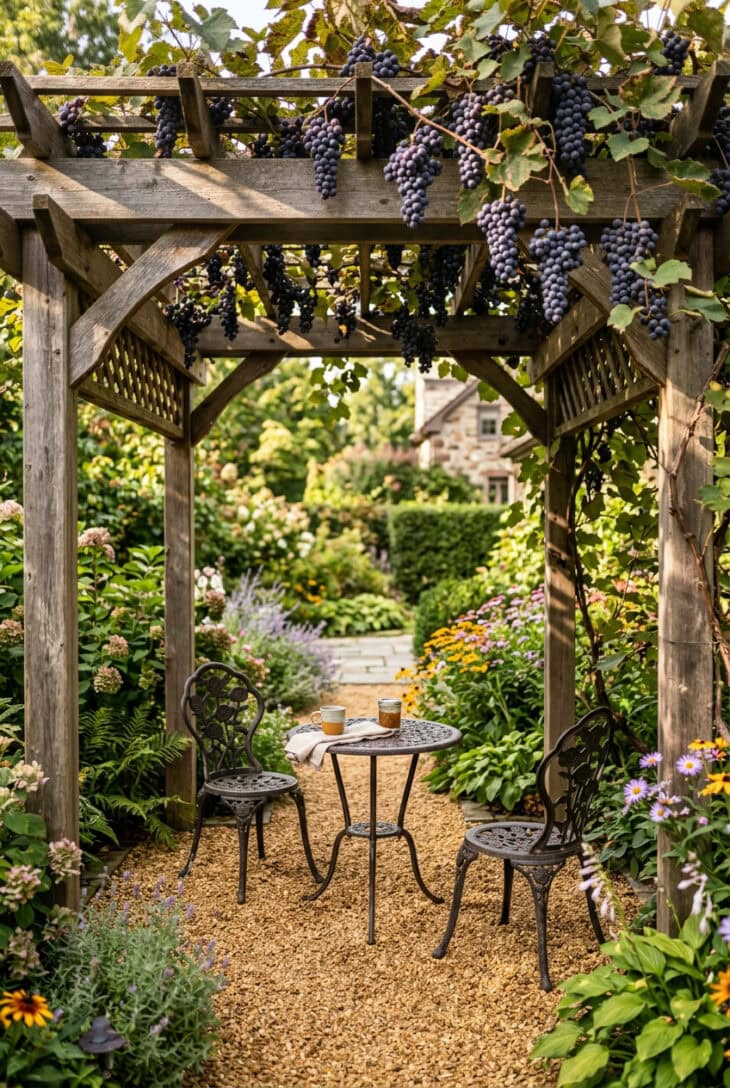
What you see A cedar arbor shades a small seating area, its roof thick with grapevine leaves. Heavy bunches of purple-blue grapes hang overhead, within reach of the two chairs. Dappled sun lands on the table and the gravel below.
Why it works A grape arbor gives you shade, a roof of leaves and a harvest in one structure. It rewards a sturdy build: grapevines are heavy, and a flimsy arbor will sag or fail. The vines are also pruned hard each winter, which keeps them tidy over the seating area.
How to get it Utah State University lists ‘Concord’ as hardy in Zone 4 and ‘Concord Seedless’ and ‘Reliance’ as Zone 5. Space American and hybrid vines about 8ft (240cm) apart. Grapes fruit on one-year-old wood, so prune hard in the dormant season, removing most of last year’s growth, and expect a first harvest in the third year. Skip wild riverbank grape (Vitis riparia), which NC State says can reach 75ft (23m) and turn weedy.
17. Hardy Kiwi on a Pergola
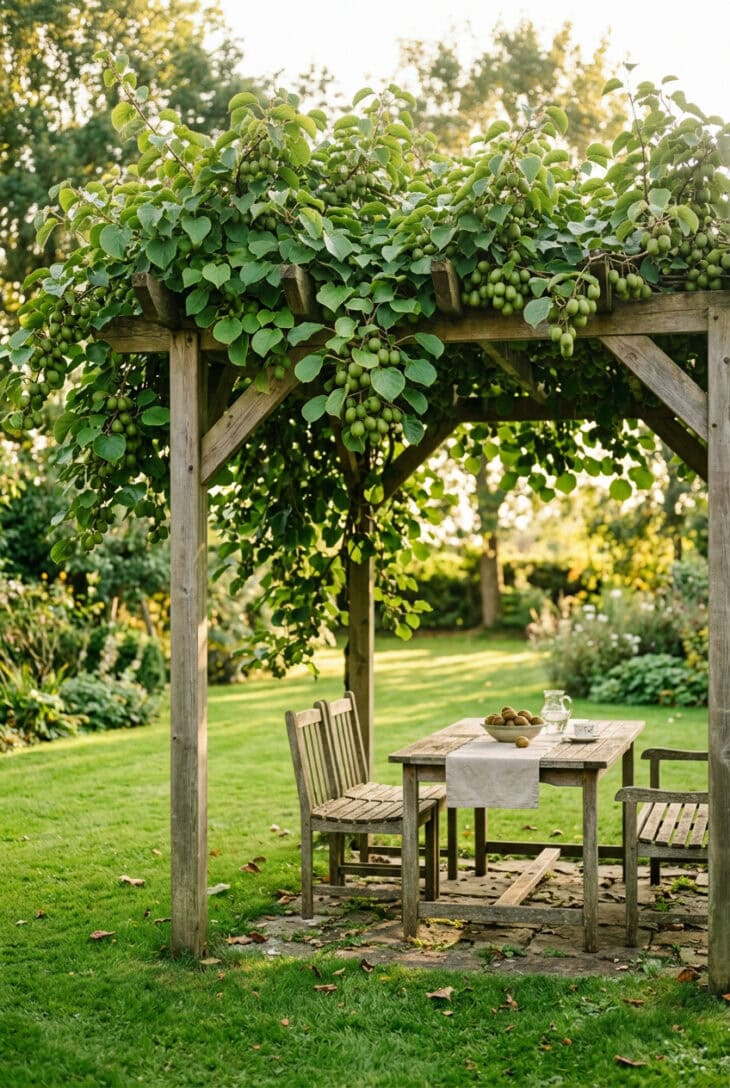
What you see A pergola is draped in hardy kiwi vines, with clusters of grape-sized, smooth-skinned green fruit hanging beneath the heart-shaped leaves. A wooden table sits in the dappled light under it. The lawn around is mown and the sun is low.
Why it works Hardy kiwi (Actinidia arguta) makes fruit the size of a grape that you eat whole, skin and all, with no fuzz to peel. It survives -25°F (-32°C) according to Ohio State, and sources put it in roughly Zones 4–8. The vine is vigorous, reaching 25 to 30ft (760 to 910cm).
How to get it Most hardy kiwis need a male and a female plant, about one male for every six to eight females. ‘Issai’ is sold as self-fruitful, but Penn State says it has not performed well in Pennsylvania, and ‘Ananasnaya’ is the vigorous standard. Build a strong support: Ohio State describes T-bar posts 15 to 18ft (4.5 to 5.5m) apart with five 12-gauge wires. Expect fruit anywhere from year 3 to year 9, harvest in late September while still firm, and ripen it indoors. Cats are drawn to kiwi vines and can damage foliage and roots, so cage young plants.
18. Strawberry Bed at the Orchard’s Edge
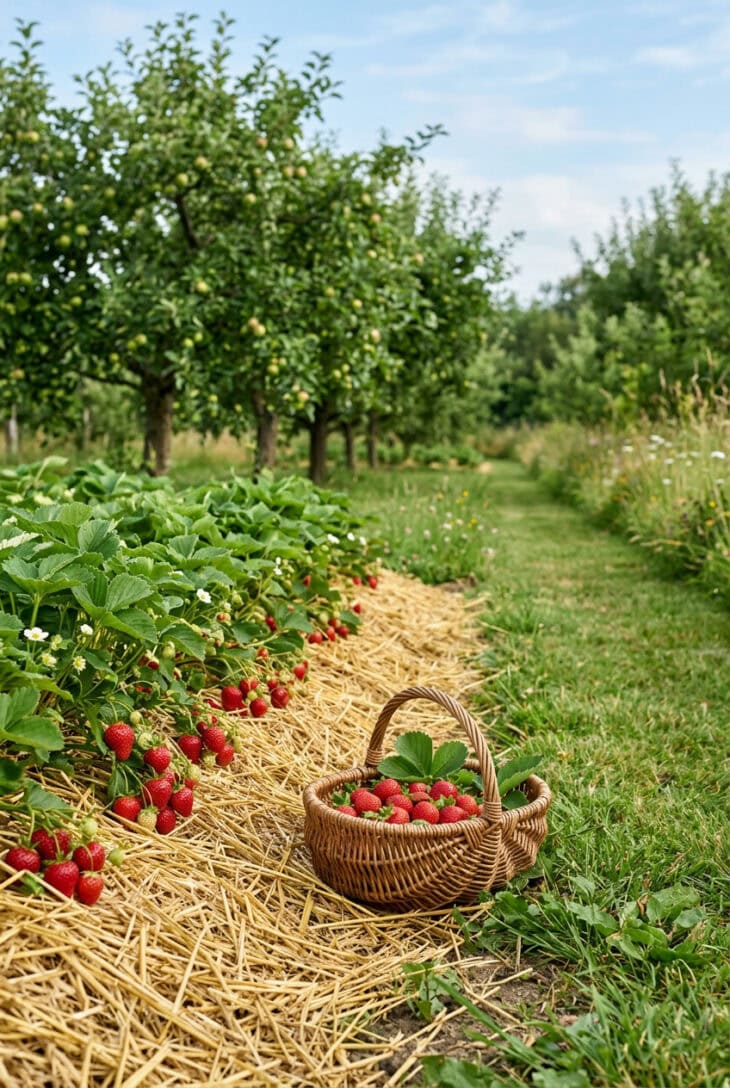
What you see A strawberry bed mulched with golden straw runs along the edge of a small orchard. Ripe red berries hang over the straw, and apple trees stand behind. A wicker basket waits at the end of the row.
Why it works Strawberries (Fragaria × ananassa) give the orchard a fruit that ripens early, ahead of most tree fruit. Strawberry plants are small, so they fit in a bed at the orchard’s edge, in Zones 5–9 according to NC State. They stay out of the trees’ way, which matters: young apple trees compete poorly with other plants for water and nutrients, according to the University of Vermont.
How to get it Choose a type to match your harvest: June-bearers give one big crop, everbearers two smaller ones, and day-neutral types fruit through much of the season. Mulch with 2 to 3in (5 to 8cm) of clean straw, and renovate June-bearers right after harvest by mowing, narrowing the rows and thinning the plants. Avoid ground where tomatoes, potatoes, peppers or eggplant grew in the past four years, because of Verticillium wilt. Keep the plants outside the 2 to 3ft (60 to 90cm) weed-free circle around each young tree, and expect a bed to last 3 to 5 years.
19. Currants and Gooseberries on the Shady Side
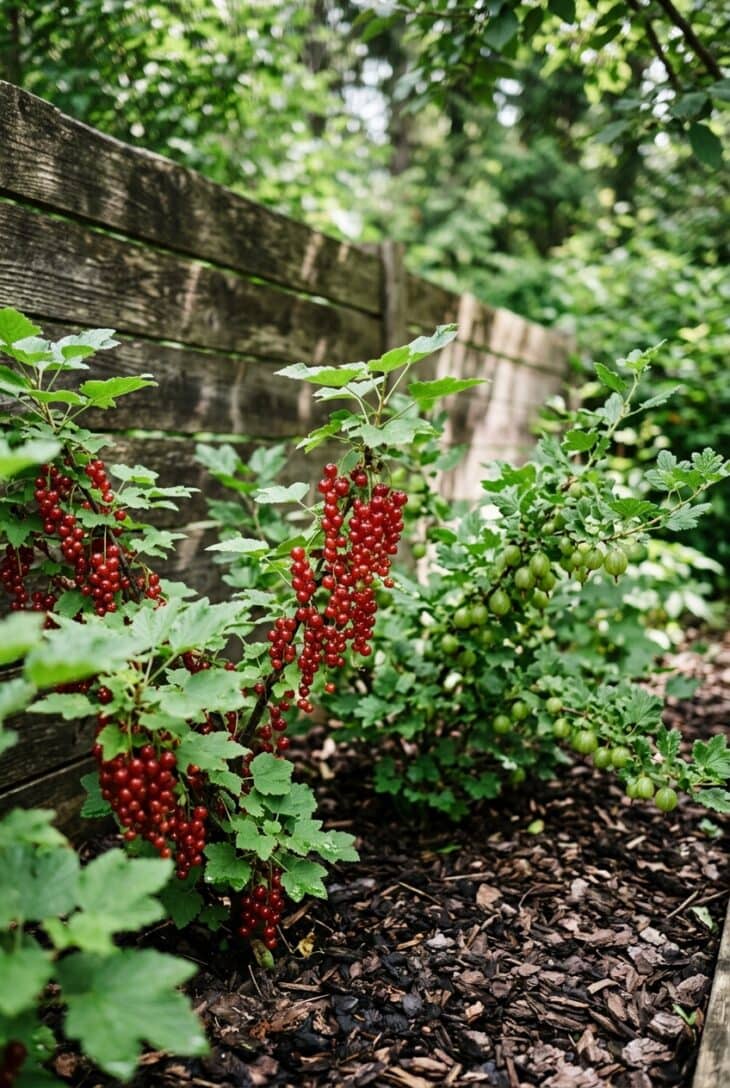
What you see Red currant bushes grow in dappled shade along the north side of a fence. Long strings of translucent red fruit hang from the branches, glowing where the light reaches them. Gooseberry bushes stand beside them above a mulched strip.
Why it works Currants and gooseberries (Ribes) take part shade, which makes them useful for the one spot in the orchard where an apple would struggle. Penn State says they tolerate partial shade, stay 3 to 6ft (90 to 180cm) tall, and are hardy to roughly -22 to -31°F (-30 to -35°C). They also suit a bed in shade garden ideas with edible fruit as a bonus.
How to get it Check your state’s rules before you buy. Ribes can carry white pine blister rust, a disease of white pines. The federal ban ended in the 1960s, but some states still restrict black currants: New York bans planting them except for rust-resistant types, and Maine bans European black currant statewide. Ask your state agriculture department. Red currant ‘Red Lake’ and gooseberry ‘Pixwell’ are among the cultivars Iowa State lists. Space plants 3 to 4ft (90 to 120cm) apart, and note that resistant does not mean immune.
20. Thornless Blackberries on a Trellis
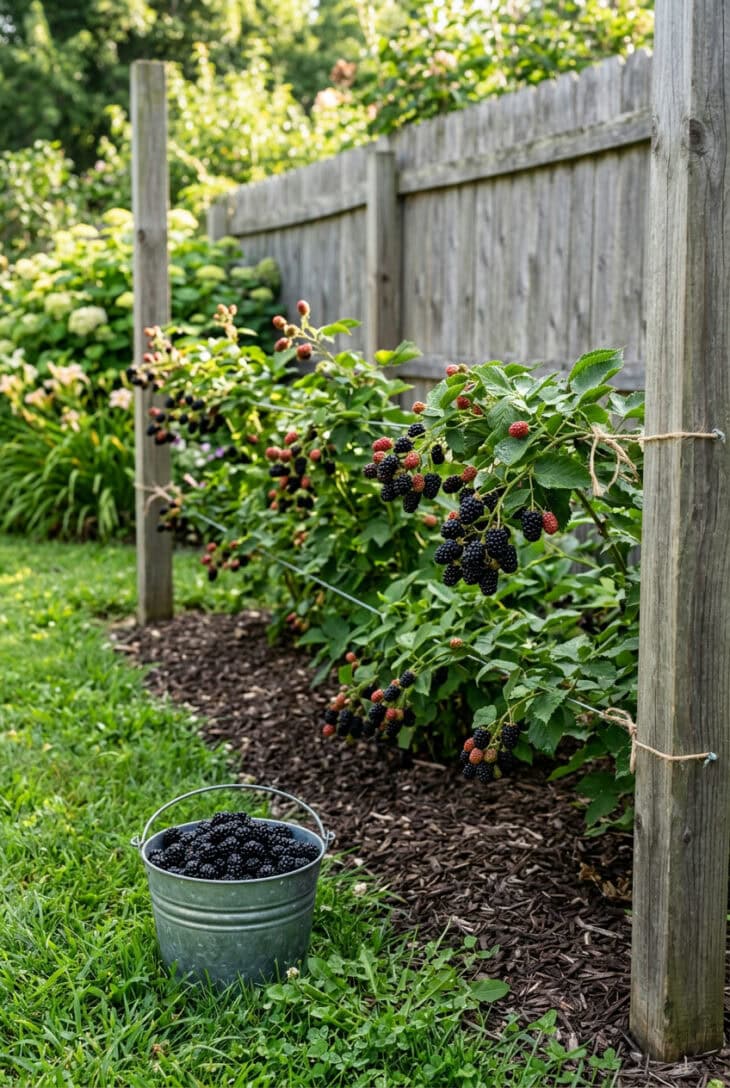
What you see Blackberry canes are tied along two horizontal wires between sturdy posts, hung with glossy black berries and a few red ones. The strip below is neatly mulched. A bucket of picked fruit sits on the grass.
Why it works A trellis keeps blackberries off the ground and out of the paths, and thornless cultivars take the pain out of picking. They fruit sooner than most tree fruit, though not at once, because floricane types fruit on second-year canes and the first real crop comes the summer after planting.
How to get it University of Maryland Extension lists ‘Apache’ and ‘Navaho’ (erect) and ‘Triple Crown’ and ‘Chester’ (semi-erect) as thornless choices. Plant 3 to 4ft (90 to 120cm) apart with 8ft (240cm) between rows, and train canes between two horizontal wires. Floricane types fruit in June on second-year canes, so leave the new canes and cut out the old ones after they fruit. Hardiness varies with the cultivar: erect types are the most cold hardy and trailing types the least, so check the tag against your zone.
21. Satsuma Mandarin Planted in the Ground
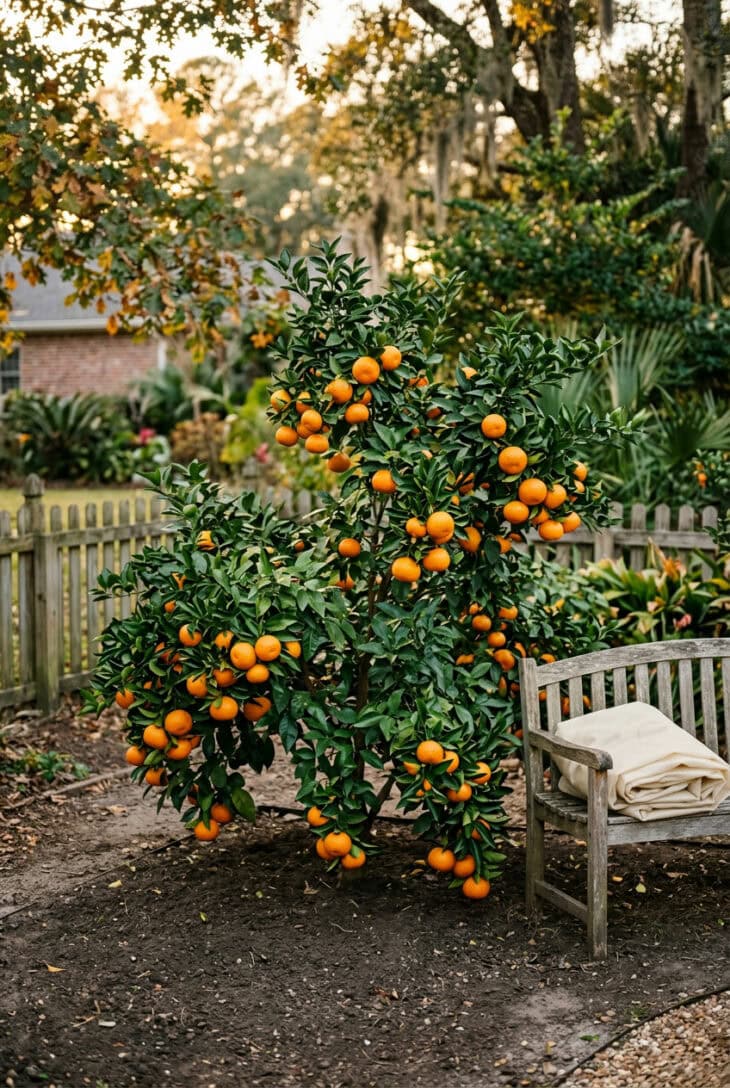
What you see A satsuma mandarin tree is covered in bright orange fruit and glossy dark green leaves. The soil under it is bare and clean. A folded frost cloth lies on a bench nearby, ready for the first cold night.
Why it works For Zones 9–11, citrus can live in the ground instead of a pot. Satsuma mandarins are the most cold-hardy edible citrus, taking temperatures as low as 14 to 15°F (-10 to -9°C) when mature according to the University of Florida and Clemson, and they are typically grafted on trifoliate orange rootstock.
How to get it Even a hardy citrus needs a freeze plan. Water the tree before a freeze, mound soil around young trunks, and cover the whole tree with cloth that reaches the ground, never plastic. Keep the soil beneath bare of grass and mulch, as University of Florida advises, which helps it hold heat. Young trees are much less hardy than mature ones. Plant in full sun in the warmest, most sheltered spot you have.
22. Orchard on a Gentle Slope
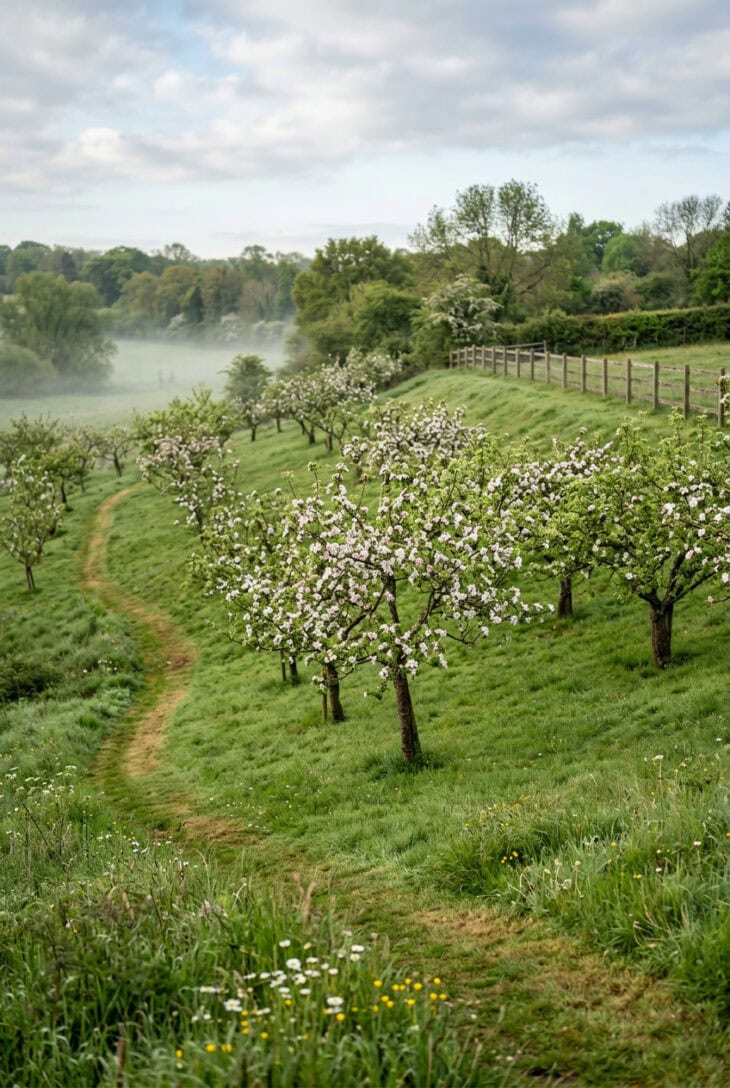
What you see Apple trees in white and pink bloom stand across a gentle grassy slope. A thin mist has settled in the hollow at the bottom of the hill. A mown path follows the contour and a fence marks the top of the yard.
Why it works Cold air flows downhill like water and pools in the lowest spot, which makes the bottom of a slope the worst place for blossoms. Penn State puts the damage point for open apple blossoms at 28°F (-2°C) for 10 percent kill and 25°F (-4°C) for 90 percent. NC State notes that a difference of 3 to 4°F can decide the crop. If you already have a hillside, the sloped garden ideas are a useful companion.
How to get it Plant on the mid to upper slope, never in the hollow at the bottom. The University of Vermont calls a slope of 4 to 8 percent ideal, and anything over 10 percent hard to mow. Do not let a dense hedge, fence or building at the bottom of the slope block the cold air from draining away, since it will pool behind it. Keep the trees in a row along the contour so you can mow between them.
23. Mounded Planting for Heavy Clay
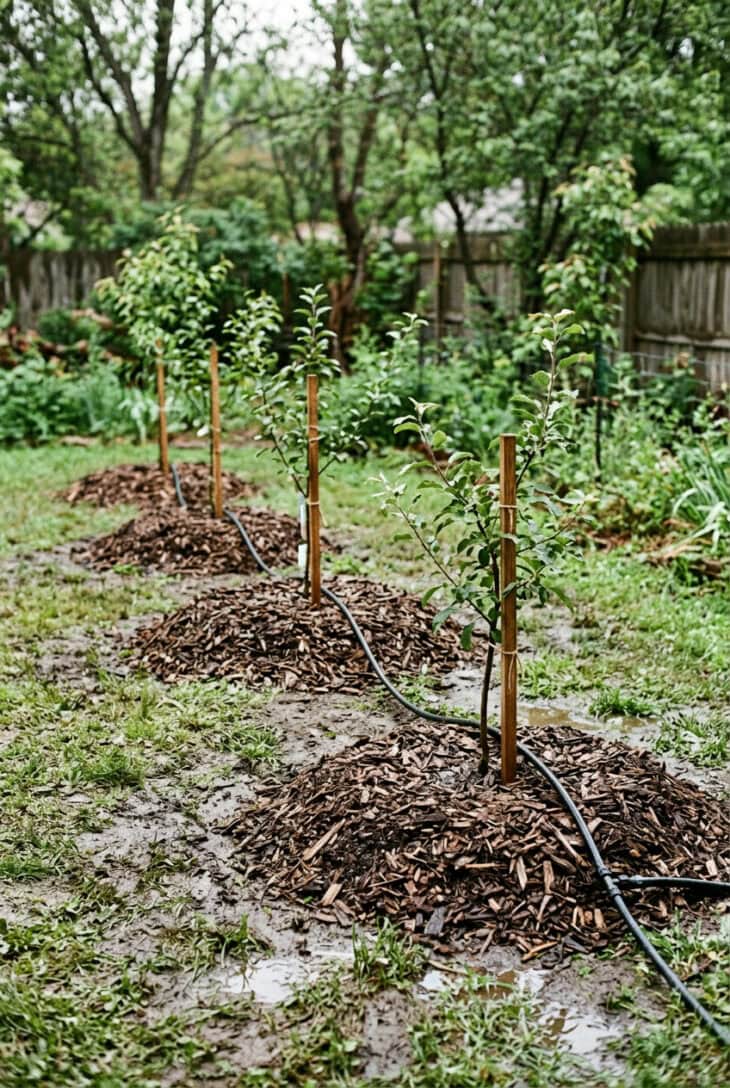
What you see Young fruit trees stand on broad, low mounds of soil, each mulched with wood chips. A drip hose runs along the row. Puddles stand in the lawn between the mounds, where the water has nowhere to go.
Why it works Fruit trees hate wet roots, and clay soil that holds water is a common reason a young tree struggles. A mound lifts the root zone above the water. It works on the same principle as raised beds, only on a larger scale and for trees.
How to get it NC State recommends mounds 18 to 24in (45 to 60cm) high and 4 to 8ft (120 to 240cm) wide for tree fruit in clay or poorly drained soil. A mound dries out faster than flat ground, so plan on summer irrigation. Dwarf M.9 rootstocks want deep, well-drained soil according to New Mexico State University, and always need a stake, so ask your nursery which rootstock suits wet ground, since sources disagree on some. Keep the graft union a few inches above the soil on the mound.
24. Clover Understory Under the Trees
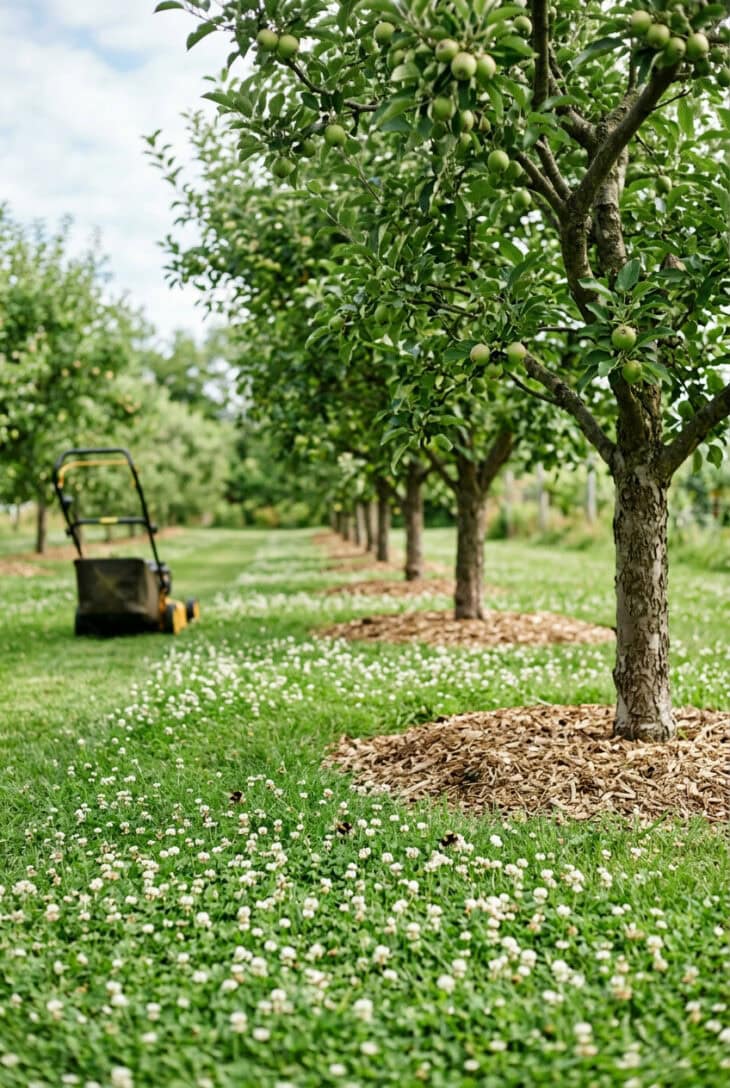
What you see A green carpet of white clover runs between and beneath a row of fruit trees, dotted with small white flowers. Bumblebees visit the blooms. A bare ring of wood chips surrounds each trunk and young green apples hang overhead.
Why it works White clover (Trifolium repens) grows in Zones 3–10, fixes nitrogen, and feeds bees, which suits an orchard that depends on pollination. It also keeps the floor green without much work. The same thinking runs through pollinator garden ideas.
How to get it Grow clover in the alleys between trees, not up against them. The University of Vermont warns that young trees compete poorly with vegetation, so keep a clear ring of 2 to 4ft (60 to 120cm) at each trunk. Mow the clover several times a season, because tall cover lets voles build up. Use wood chips for the ring rather than straw, which makes vole habitat, and keep the mulch a few inches from the bark. Do not spray insecticides on trees in bloom, since bees will be working the flowers and the clover.
25. Trunk Guards and a Deer Fence
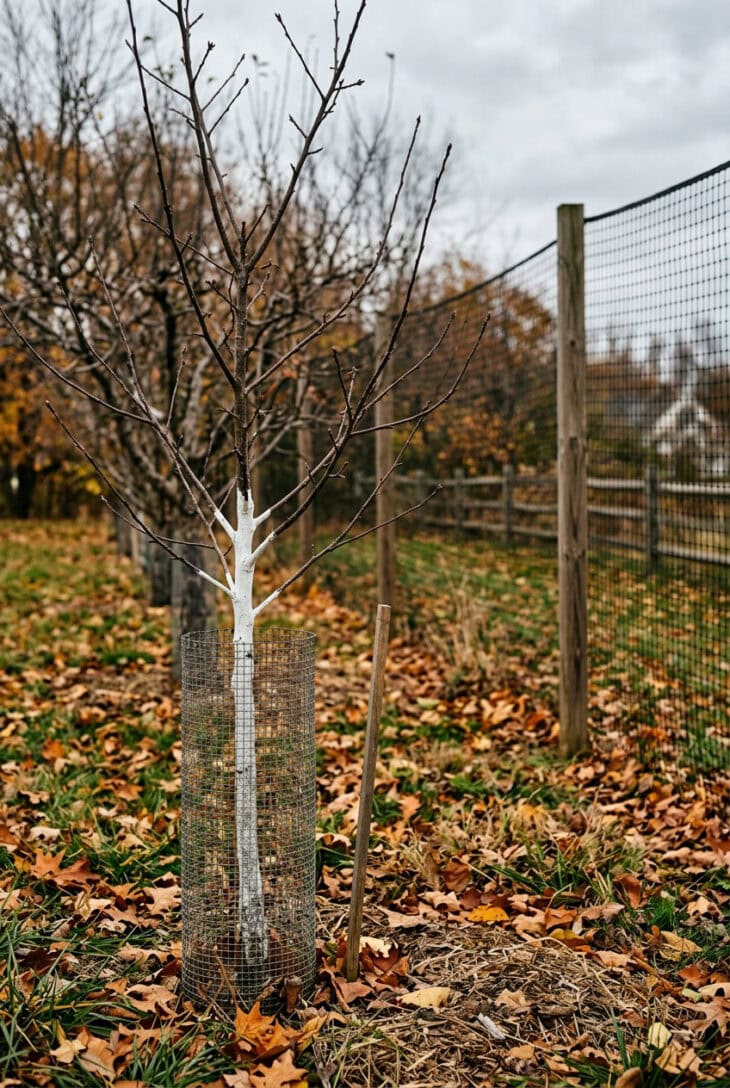
What you see A young apple tree stands in a bare winter-ready orchard with a cylinder of galvanized hardware cloth wrapped loosely around its lower trunk. The trunk above is painted white. A tall dark fence encloses the orchard behind it, and leaves lie on the grass.
Why it works Voles and rabbits gnaw bark in winter, and a girdled trunk can kill a young fruit tree in a single season. Deer browse the branches and rub antlers on trunks. For the fence itself, the garden fence ideas cover materials and styles.
How to get it Wrap each trunk with galvanized hardware cloth of 1/4in (6mm) mesh, 12 to 18in (30 to 45cm) high and buried 4 to 6in (10 to 15cm), loose enough that the trunk can grow, and tall enough to clear snow. University of Maine Extension says an 8ft (240cm) fence is the most effective protection against deer. Paint the trunks of young trees, especially peach, plum and cherry, with white interior latex paint against sunscald. Remove plastic spiral guards each spring, and keep mulch a few inches off the bark.