A tropical garden is the one style that hits you physically. You step through a gap in the planting, the air goes still and humid, the light turns green, and a leaf the size of a dustbin lid is hanging over your head. It is theatre, and the surprising part is how much of it you can build in a climate that gets frost every winter.
Contents
- 01. Layer the Planting Like a Real Jungle
- 02. Make a Hardy Banana the Centerpiece
- 03. Grow Elephant Ears for the Biggest Leaves
- 04. Use a Windmill Palm for Hardy Height
- 05. Fill a Shady Corner With Tree Ferns
- 06. Blast Hot Color Through With Cannas
- 07. Screen the Boundary With Bamboo
- 08. Cut a Narrow Path Into the Planting
- 09. Add Water and Let It Reflect the Leaves
- 10. Punctuate With Cordyline Spikes
- 11. Contrast Giant Leaves With Fine Ones
- 12. Build a Jungle in Pots on a Patio
- 13. Add Hibiscus for the Flower Everyone Recognizes
- 14. Plant Ginger Lilies for Late Scent
- 15. Paint the Back Wall a Deep Jungle Green
- 16. Mount Bromeliads and Orchids on the Trees
- 17. Feed and Water Like You Mean It
- 18. Uplight the Leaves After Dark
- 19. Sink a Container Pond in a Small Space
- 20. Go All In on Hot Color
- 21. Fake the Tropics With Hardy Look-Alikes
- 22. Run a Passion Flower Over the Fence
- 23. Open a Clearing to Sit In
- 24. Grow Big Leaves in Deep Shade
- 25. Have a Winter Plan Before You Plant
The 25 ideas below cover the full range, from a genuinely subtropical plot to a cold, damp back garden that will never grow a coconut. Some are whole-garden strategies (layering the planting, feeding hard, building a jungle path), others are single moves you can make this weekend with three pots and a wall. Several rely on hardy plants that merely look tender, which is the trick behind almost every convincing temperate jungle.
Read the first few in order, because they explain how the style actually works. After that, take whatever suits the space, the light and the amount of winter protection you are honestly willing to do.
01. Layer the Planting Like a Real Jungle
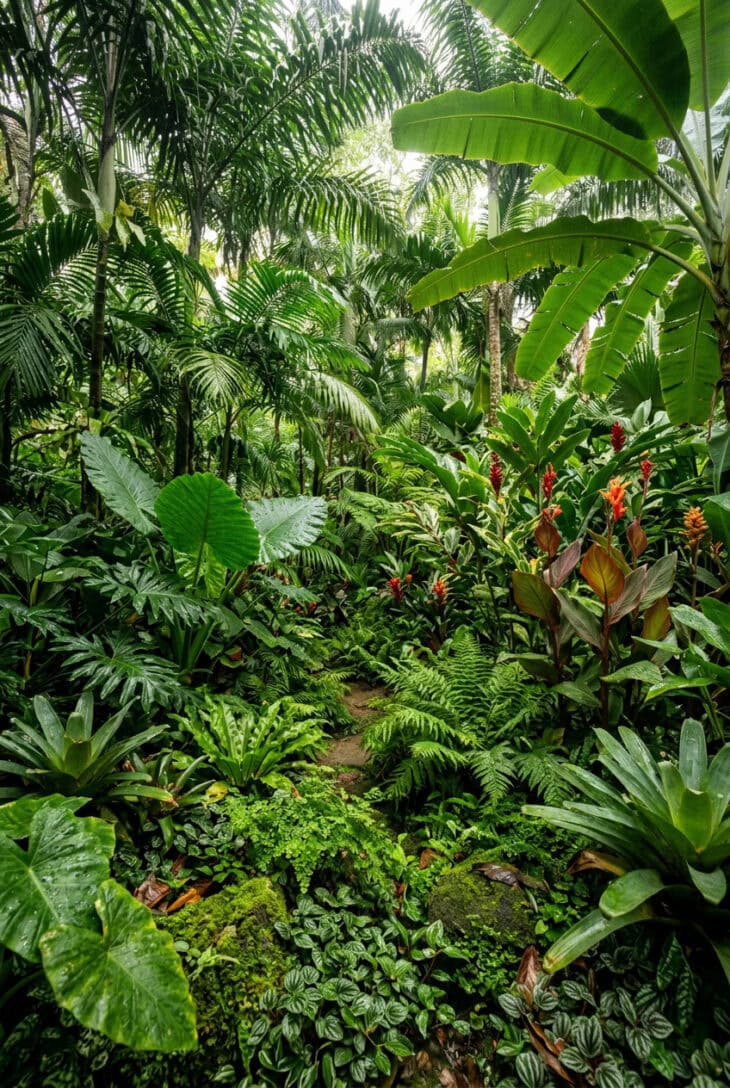
What you see Green above you, green beside you, green at your feet. A canopy of palm fronds and banana leaves cuts the sky into pieces, glossy shrubs and cannas fill the middle, and ferns cover every inch of ground. There is no soil visible anywhere and no gap for the eye to escape through. The light that reaches you has been through three layers of leaf and arrives green.
Why it works Every other garden style is looked at. A jungle is stood inside, and the difference comes entirely from planting in vertical layers rather than in a border you view from one side. Once something is over your head and something else is brushing your legs, your brain reads the space as enclosed and wild regardless of what the plants actually are. Layering is also what creates the humidity and shelter the plants themselves want.
How to get it Work in three tiers. Canopy: windmill palm (Trachycarpus fortunei), hardy banana (Musa basjoo) or a multi-stem tree you already have. Middle: cannas, elephant ears, fatsia, bamboo, cordyline, at 4 to 6ft (120 to 180cm). Floor: ferns, hostas, mind-your-own-business, at ankle height and packed tight. Plant far closer than the labels tell you, roughly 30 percent tighter than normal, because density is the whole point, and accept that you will be dividing and thinning every few years.
02. Make a Hardy Banana the Centerpiece
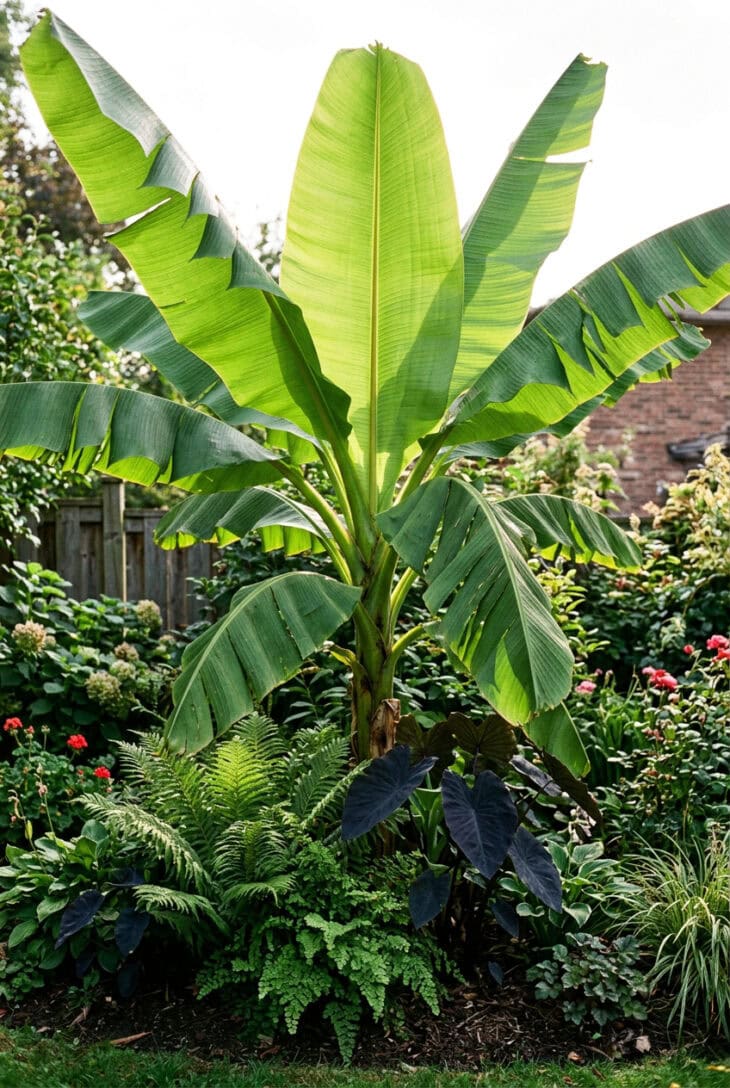
What you see Leaves the size of a person, fresh green, split into ribbons along their edges by the wind. The sun comes through them from behind and they glow, every vein showing like a lit map. Below, ferns and dark elephant ears sit in the shade the banana casts. It is a plant that changes the scale of the whole garden.
Why it works Nothing else delivers the tropical effect this fast or this cheaply. A banana puts out a new leaf every week or two through summer, so a single plant goes from knee height to over 8ft (240cm) in one season, and the leaf is so unmistakably tropical that it carries the entire style on its own. The shredding, incidentally, is not damage: in the wild the leaves tear along their veins deliberately, which is how the plant survives wind.
How to get it Musa basjoo is the hardy one and survives to about 5F (-15C) at the root with protection. It will not fruit and that is not the point. Give it the most sheltered spot you have, since wind is what ruins the leaves, plus deep rich soil and more water and feed than feels reasonable. In late autumn, cut the stem down to 3ft (90cm), wrap it in a cage of chicken wire packed with dry straw or leaves, and cap it so rain cannot get in. For a red-flushed alternative, Ensete ventricosum ‘Maurelii’ is stunning but must be lifted and brought inside.
03. Grow Elephant Ears for the Biggest Leaves
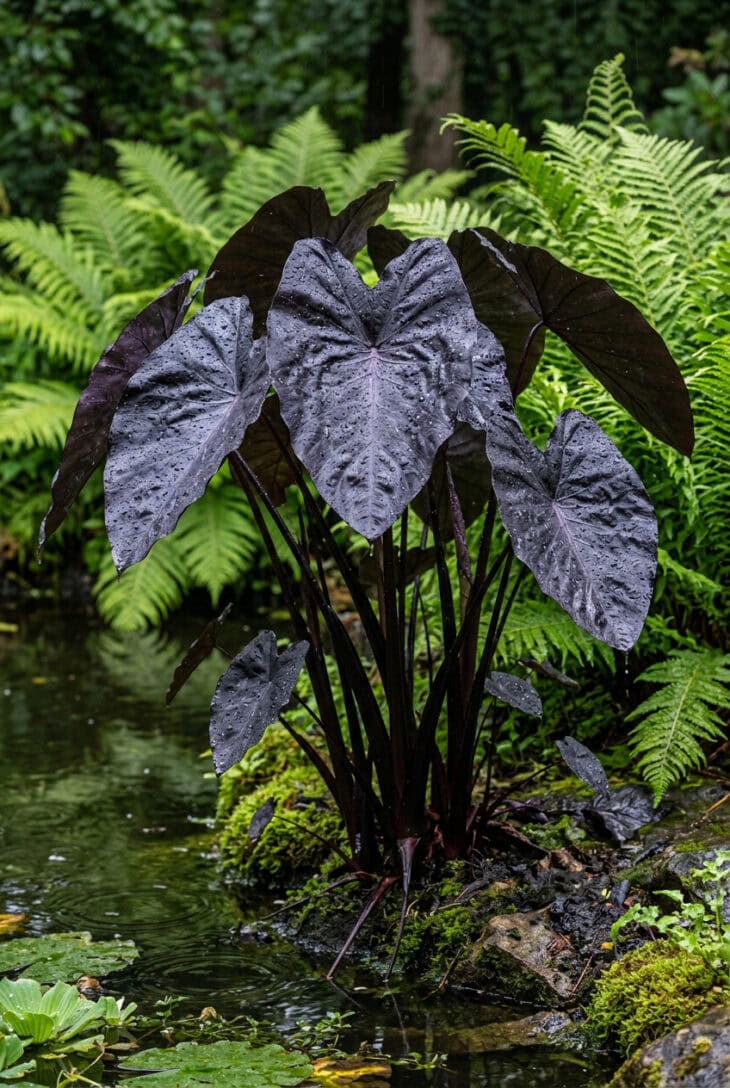
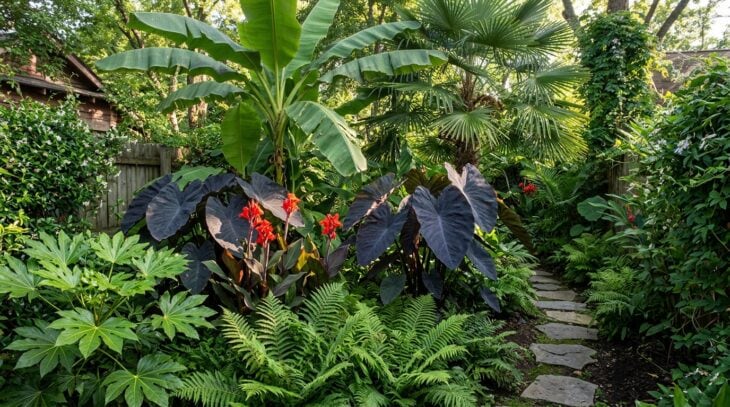
What you see Enormous heart-shaped leaves in a purple so dark it reads as black, held out on tall stems and beaded all over with rain. Behind them, bright green ferns make the darkness look darker. The leaves point downwards, which is why the water runs off them in beads, and the whole clump glistens.
Why it works A tropical garden lives or dies on leaf size and leaf shape, and nothing gives you both like an elephant ear. The dark cultivars do something extra: in a garden that is otherwise relentlessly green, a near-black leaf creates depth and shadow, and it makes every acid-green fern near it look twice as bright. They also love the two things most tropical-look plants hate, which is heavy wet soil and a pond edge.
How to get it Colocasia esculenta ‘Black Magic’ is the dark one and wants sun, moisture and heat; Alocasia has a more upright, arrow-shaped leaf and prefers shade. Neither is frost hardy, so lift the tubers after the first blackening frost, dry them off and store somewhere frost free and barely damp over winter, or grow them in pots you can carry in. Feed them weekly through summer. Note that the sap is an irritant and the leaves are toxic if eaten, so keep them away from small children.
04. Use a Windmill Palm for Hardy Height
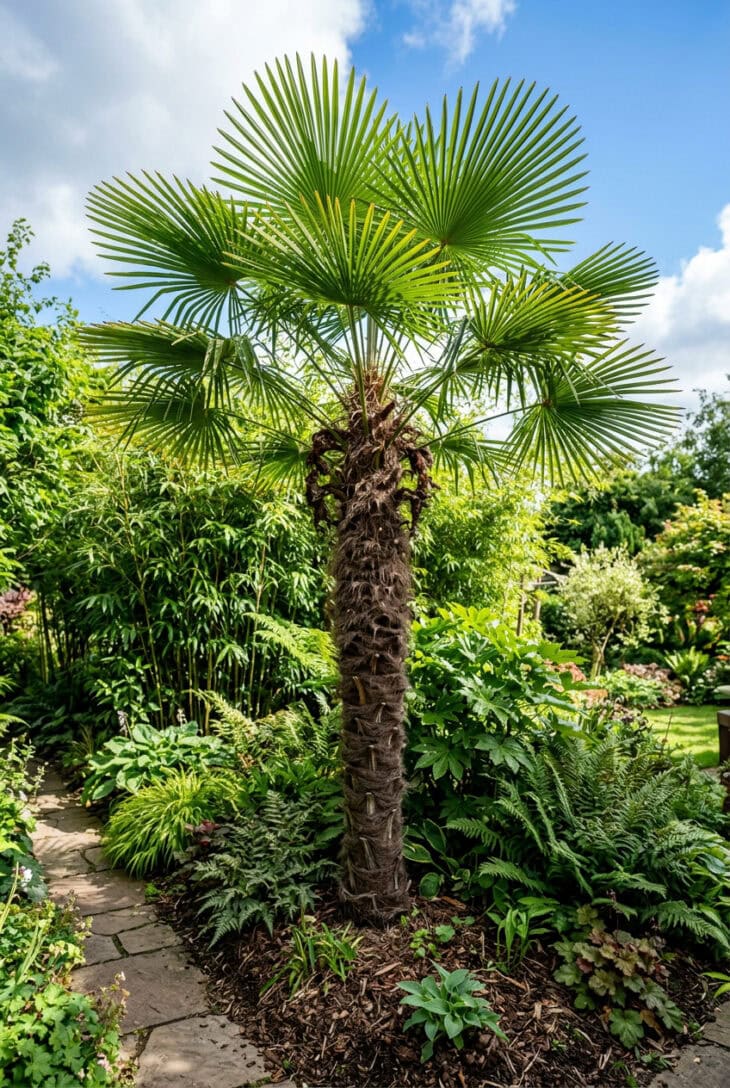
What you see A proper palm, with a shaggy brown fibrous trunk and a crown of stiff fan-shaped fronds held up against the sky. Ferns and bamboo grow around its feet. It looks like it belongs on a hotel terrace two thousand miles south, and it is standing in a garden that gets snow.
Why it works A palm silhouette is the single strongest tropical signal there is, and one hardy palm does more for a temperate jungle than a dozen tender plants you have to nurse. The windmill palm is the workhorse: it takes real cold, real wet and real wind, holds its shape all winter when everything else has gone, and grows a visible trunk over the years, which is what turns a planting into a landscape.
How to get it Windmill palm (Trachycarpus fortunei) is hardy to roughly 5F (-15C) and is the one to plant in the ground. Give it shelter from cold drying wind, which shreds the fronds, and free-draining soil, since it tolerates cold far better when it is not sitting wet. Plant it where you will see it against the sky rather than against a hedge, because the silhouette is the whole value. Cut old brown fronds off flush and leave the fibrous trunk alone, since it is the insulation.
05. Fill a Shady Corner With Tree Ferns
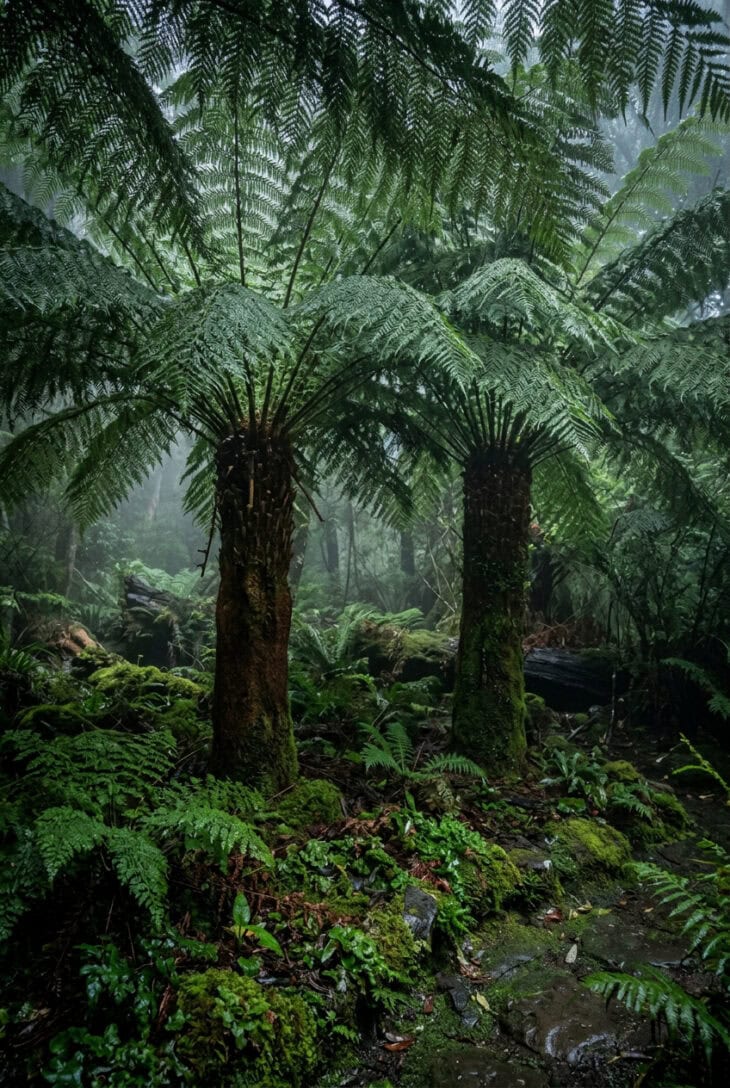
What you see Two thick fibrous trunks going straight up, and above them a canopy of enormous lacy fronds arching out and unfurling. The corner is dim, damp and cool, with moss on the ground and smaller ferns filling in. The air has a mist in it. It feels less like a garden than like the Jurassic.
Why it works Most gardens have one corner that is too shady and too damp to do anything with. That corner is a tree fern’s idea of paradise, and the plant that thrives there happens to be the most dramatic thing you can own. It also solves the tropical garden’s hardest problem, which is what to do with the parts of the plot that get no sun, since almost all the bold hot-color planting demands full light.
How to get it Dicksonia antarctica is the hardy one, taking around 23F (-5C). The single most important thing to understand is that the trunk is the root system: water it into the top of the trunk, not the ground, and keep it damp all summer. Buy from a certified sustainable source. In winter, stuff the crown with straw and fold the old fronds over it, and in a hard winter wrap the trunk in fleece. Plants grow only about 1in (2.5cm) of trunk a year, so buy the height you want.
06. Blast Hot Color Through With Cannas
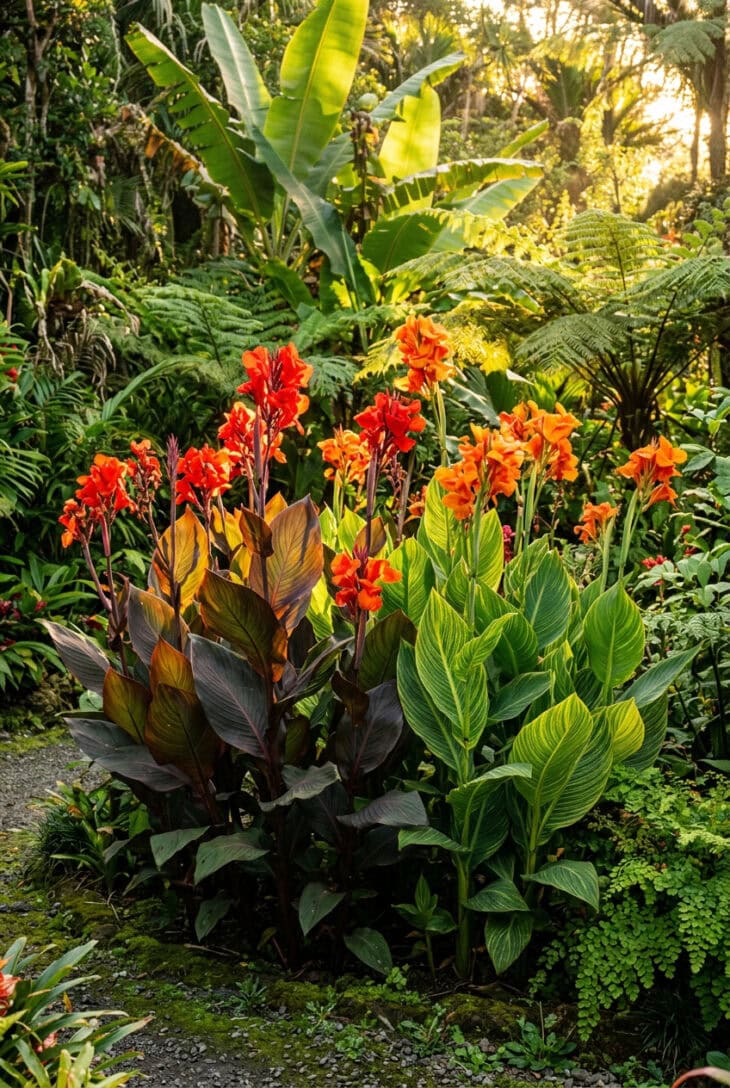
What you see Scarlet and orange flowers held high above big bold paddle leaves, some bronze-purple, some striped. The low sun is behind them and the leaves have gone translucent. Banana leaves and ferns fill in behind. It is the loudest thing in the garden and it is not remotely apologising for it.
Why it works A jungle planted entirely in green becomes a green blur, and what breaks it is not pastel flowers but pure saturated heat: scarlet, orange, magenta. Cannas deliver both halves of the job at once, since the foliage is as bold as the flower, so they earn their space from May onwards rather than only in bloom. They are also brutally easy, growing from a rhizome to 6ft (180cm) in a single season.
How to get it Canna ‘Wyoming’ (orange, bronze leaf) and ‘Durban’ (striped) are the two to start with. They are hungry and thirsty, unlike almost everything else people call tropical, so give them rich soil, full sun and water in dry spells. Start rhizomes indoors in March for a head start. After the first frost blackens them, cut them down, lift the rhizomes and store them in barely damp compost somewhere frost free, or in mild areas mulch them heavily and leave them in.
07. Screen the Boundary With Bamboo
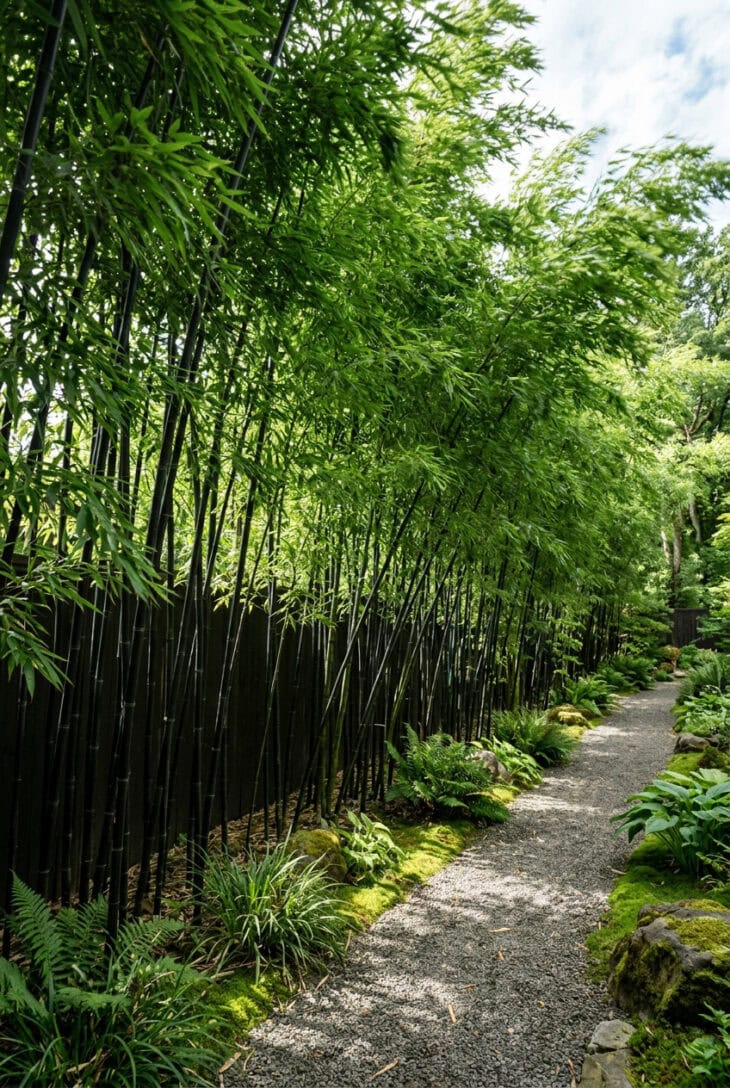
What you see A wall of bamboo along the boundary, tall enough that the fence behind it has vanished entirely. The canes are glossy and near-black, bare at the bottom so you can see through the stems, with a cloud of fine leaves above. It moves constantly and it makes a papery rustle that you can hear from the house.
Why it works Bamboo is the fastest tall screen there is, and it is one of very few that gives you height in two or three years rather than ten. In a tropical scheme it does double duty: it hides the boundary that would otherwise remind you which country you are in, and its sound and movement add the sense of a living wall around the space. Stripping the lower leaves off the canes is what turns a green mass into something elegant.
How to get it This is the one plant in the article where a mistake is genuinely expensive: plant a running bamboo unrestrained and it will be in your lawn, your neighbour’s lawn and your patio within five years. Choose clump-forming Fargesia (Fargesia murielae, Fargesia nitida), which does not run. If you must have black bamboo (Phyllostachys nigra), which does run, install a proper HDPE root barrier 24 to 30in (60 to 75cm) deep, angled outward at the top, all the way around. Thin the oldest canes out at the base each spring.
08. Cut a Narrow Path Into the Planting
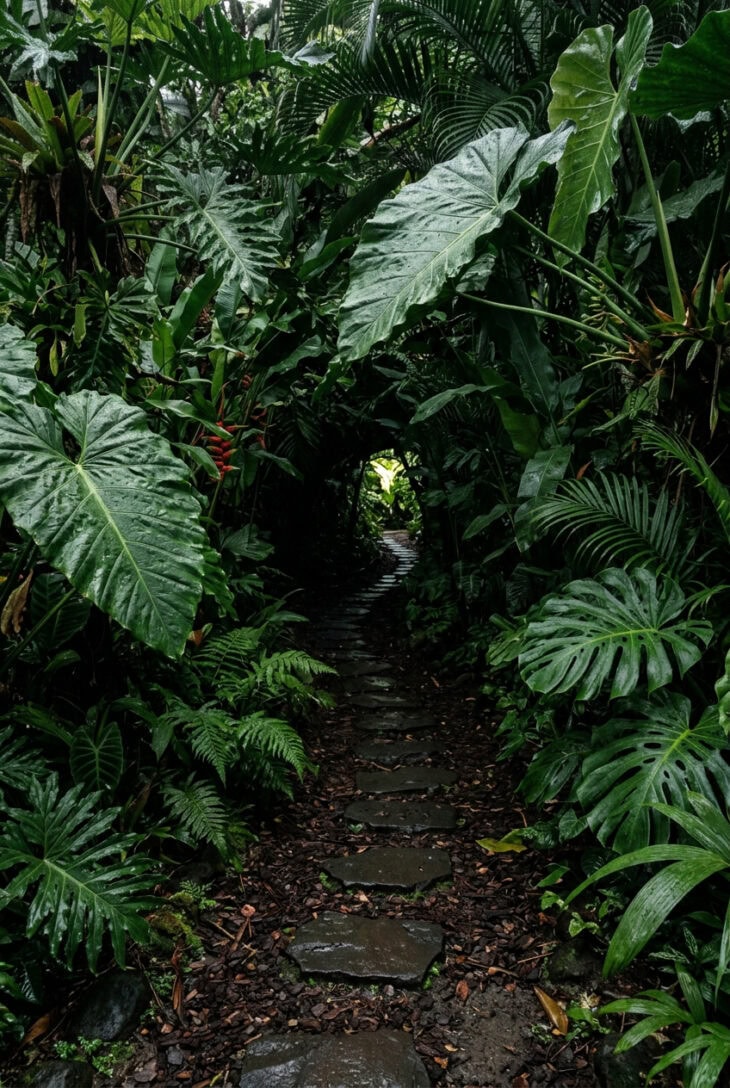
What you see A path barely wide enough for one person, made of dark stepping stones set into bark, going into the planting and immediately bending out of sight. Huge leaves lean in from both sides and meet overhead. There is one patch of light at the far end, and you cannot see what is under it.
Why it works A jungle path is an act of deliberate concealment, and concealment is what makes a small garden feel large. The moment a visitor cannot see the whole plot at once, they have to walk it, and a garden you walk through feels several times bigger than a garden you take in from the back door. Making the path deliberately narrow forces contact with the leaves, which is what supplies the physical, brushing-past sensation the style is really about.
How to get it Keep it to 18 to 24in (45 to 60cm) wide, which feels wrong on paper and right on the ground. Curve it so that no point on the path lets you see both ends. Use dark materials that disappear underfoot: bark mulch, dark riven stepping stones, or damp gravel, and never pale slabs, which draw the eye down and break the enclosure. Plant right up to the edges and let things flop, then trim just enough each summer to keep it passable.
09. Add Water and Let It Reflect the Leaves
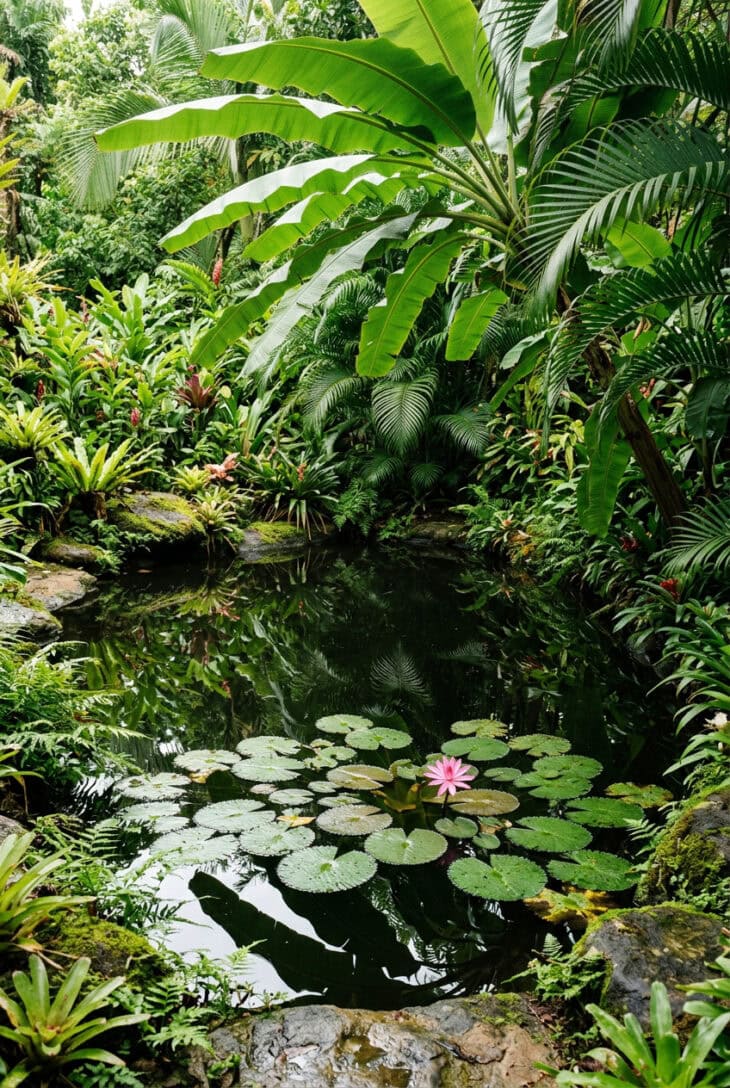
What you see A small pool of water so dark it is nearly black, with the banana and palm leaves above it reproduced perfectly on the surface. Lily pads float in a scatter, one pink flower open among them. The planting crowds right up to the edge with no stone rim, so the water simply appears out of the greenery.
Why it works Water does two things here that nothing else can. It doubles the planting by reflecting it, so a small jungle reads as twice the size, and it raises local humidity, which every big-leaved plant around it appreciates in a dry summer. Keeping the water dark rather than clear is what makes it mirror properly, and losing the hard edge is what stops it looking like a garden pond dropped into a jungle.
How to get it Line it with black butyl and hide every inch of the liner under overhanging planting and a few large flat stones, rather than a neat ring of cobbles. Aim for at least 18in (45cm) of depth in the middle so the water stays cool and clear. Hardy water lily (Nymphaea ‘Attraction’) will winter outside; lotus (Nelumbo nucifera) is the real showstopper but needs a long hot summer and deep, still, warm water. Cover about a third of the surface with leaves to keep algae down.
10. Punctuate With Cordyline Spikes
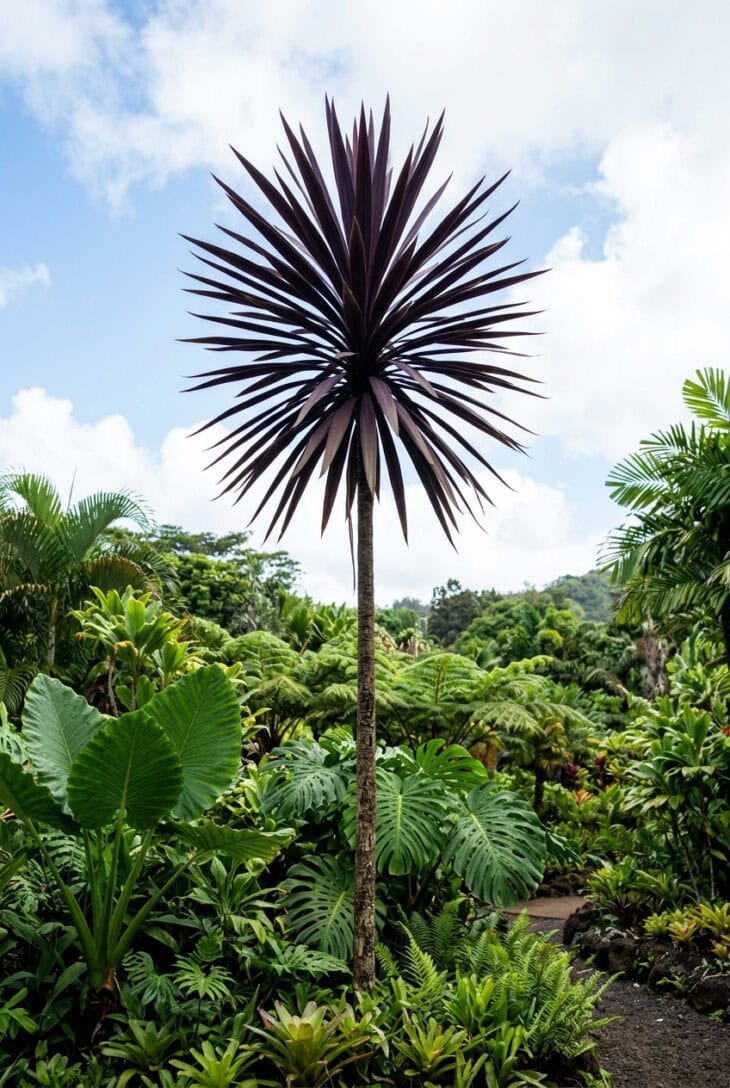
What you see A bare trunk with an explosion of long narrow sword leaves at the top, deep burgundy-purple, held above everything else in the border. Against the sky it is all spikes. Around it, everything else is round, broad and soft, which is exactly why it stands out.
Why it works Bold foliage gardens have one persistent failure mode: every leaf is big and round, and the eye finds nothing to fix on. A cordyline is the antidote, a hard spiky silhouette that reads instantly against a mass of paddles and fronds. The dark-leaved forms also carry color through winter in mild areas, when the tender stuff has gone and the border is otherwise bare.
How to get it Cabbage palm (Cordyline australis ‘Red Star’) is the toughest and takes around 14F (-10C) once it has a trunk, though young plants are more tender. Give it sharp drainage, since it rots at the crown in cold wet soil far sooner than it freezes. In a hard winter, tie the leaves up into a bundle over the growing point to keep water out. If it is cut to the ground by a bad freeze it usually resprouts from the base as a multi-stem, which is arguably better looking.
11. Contrast Giant Leaves With Fine Ones
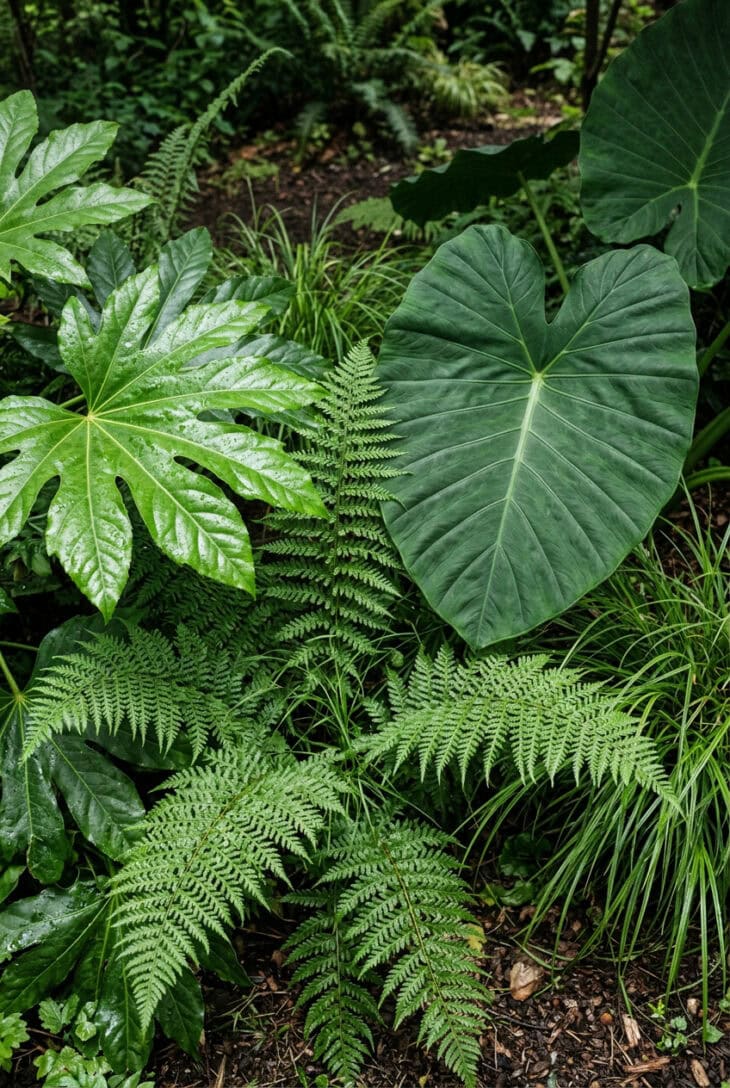
What you see Two extremes side by side. An enormous glossy fatsia leaf and a huge elephant ear, and right up against them the finest lacy fern fronds and thin grassy blades. Every green in the picture is a different green. There is not one flower anywhere and the combination is still doing all the work.
Why it works This is the central technique of the whole style, and it is worth stating plainly: in a foliage garden, contrast of texture replaces contrast of color. Put a dinner-plate leaf next to a filigree one and both become more interesting, because the eye reads the difference. Fill a border with big leaves only and it flattens into mush; fill it with fine ones and it looks weedy. The tension between the two is the design.
How to get it For the giants: fatsia (Fatsia japonica), elephant ears, hosta, rodgersia, gunnera if you have serious space and wet ground. For the fine: ferns, hakonechloa, bamboo, restio, carex. Aim for roughly one bold leaf to every three fine ones, since bold plants are exhausting in quantity. Repeat the same pairing at intervals down the border rather than inventing a new combination every yard, which is what turns a collection into a scheme.
12. Build a Jungle in Pots on a Patio
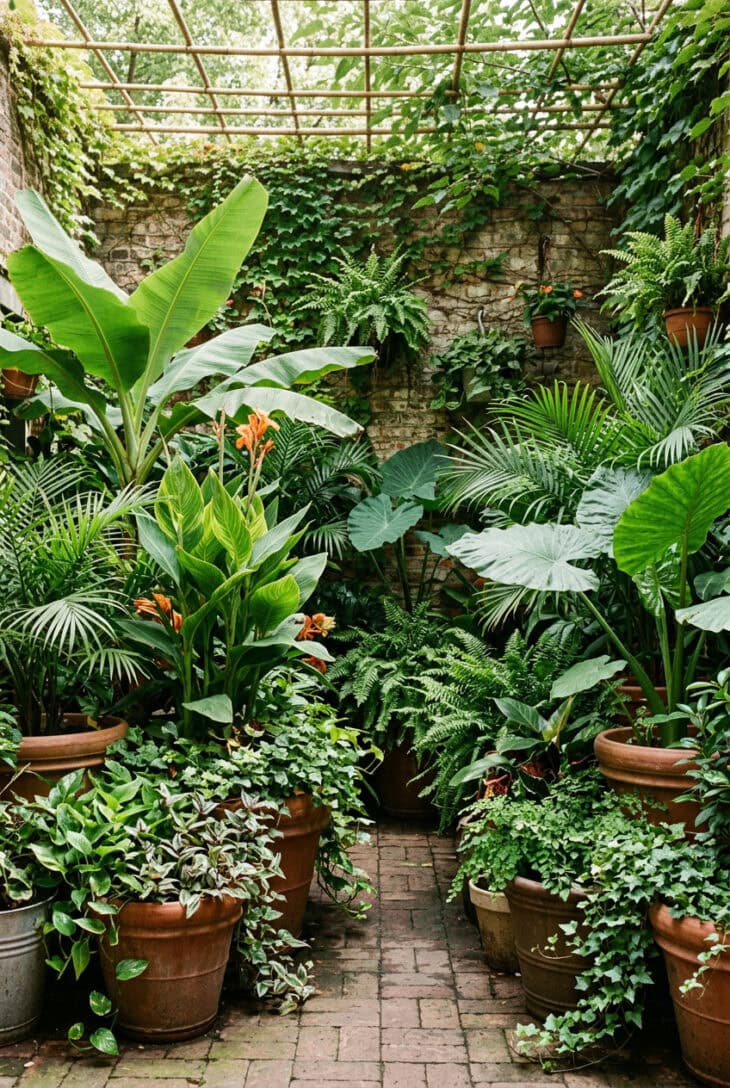
What you see A city patio with no soil in it at all, and yet you cannot see the paving. Big pots of banana, canna, palm, elephant ear and fern are jammed up against each other, plants spilling over rims and leaning into each other, and the brick wall behind has nearly disappeared. It is a jungle assembled entirely out of containers.
Why it works Pots are the tropical gardener’s secret weapon in a cold climate, because the whole problem with this style is that the best plants are tender. In a container, a tender plant is simply a summer visitor that goes into the garage in November, which means you can grow things that would be dead by Christmas in the ground. Packing the pots tightly hides the pots themselves and creates the humid, sheltered microclimate the plants want.
How to get it Go bigger than you think on pot size, since a 12in (30cm) pot will dry out by lunchtime in July with a banana in it. Use a soil-based compost with added grit for weight and stability, group pots in tight clusters so they shade each other’s roots, and stand the shade-lovers behind the tall ones. Expect to water daily in summer and feed weekly. Put the tender ones on pot trolleys now, before they are too heavy to move in October.
13. Add Hibiscus for the Flower Everyone Recognizes
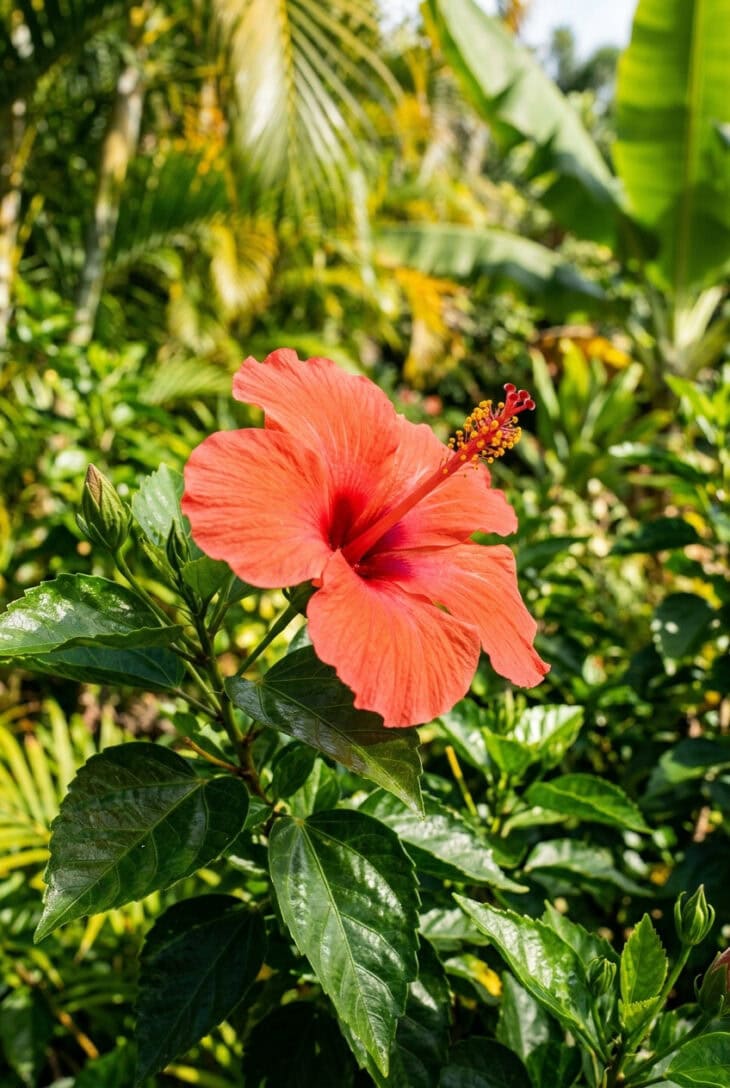
What you see One huge open flower in coral-red, its long stamen sticking straight out of the middle like an antenna, held against glossy dark leaves. Behind it, banana and palm foliage dissolves into a green blur. It lasts a single day and there is another one open tomorrow.
Why it works There is a shortcut in every style, an image so strongly associated with it that one example does all the explaining. For tropical gardens it is the hibiscus flower. Even people who cannot name a single plant recognise it, and one shrub in flower tells anyone standing in your garden exactly what they are looking at. The saturated flower color also breaks up the green in a way that pale flowers simply cannot.
How to get it The classic tropical hibiscus (Hibiscus rosa-sinensis) is tender and needs to be a container plant brought indoors below 50F (10C). For a plant that stays out all year, use hardy hibiscus (Hibiscus syriacus, the rose of Sharon), which is hardy to around -20F (-29C), or the hardy perennial Hibiscus moscheutos, whose flowers reach dinner-plate size. All of them want full sun, rich soil and steady moisture, and all of them come into growth late in spring, so do not assume yours has died in May.
14. Plant Ginger Lilies for Late Scent
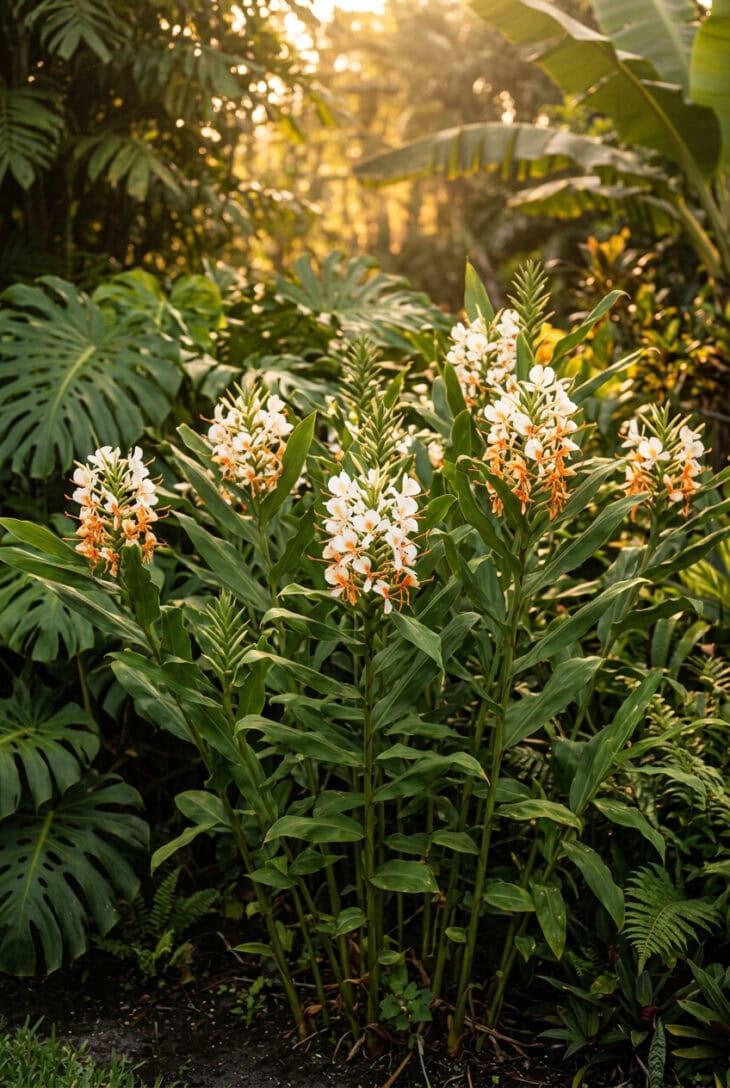
What you see Tall leafy stems with spikes of flowers at the top that look like a cluster of white and orange butterflies just landed. It is late August, the low sun is coming through sideways, and the scent, which is heavy and sweet, arrives before you get to the plant.
Why it works A tropical garden is at its most convincing in September, when everything has reached full size and the light has gone golden, but by then the flowers are mostly finished. Ginger lilies bloom exactly into that gap, and they bring the one thing this style otherwise lacks entirely, which is scent. Bold foliage gardens are visual and tactile; adding a heavy evening perfume completes the illusion.
How to get it Hedychium densiflorum ‘Assam Orange’ and Hedychium coccineum are the hardiest, taking a cold winter under a deep mulch in most temperate zones. Give them rich, moisture-retentive soil, sun or dappled shade, and shelter from wind. They emerge very late, often not until May, so mark the spot and do not dig there in spring. Mulch the crowns 6in (15cm) deep with bark or leaf mould in November, and divide the rhizome clumps every four years or so.
15. Paint the Back Wall a Deep Jungle Green
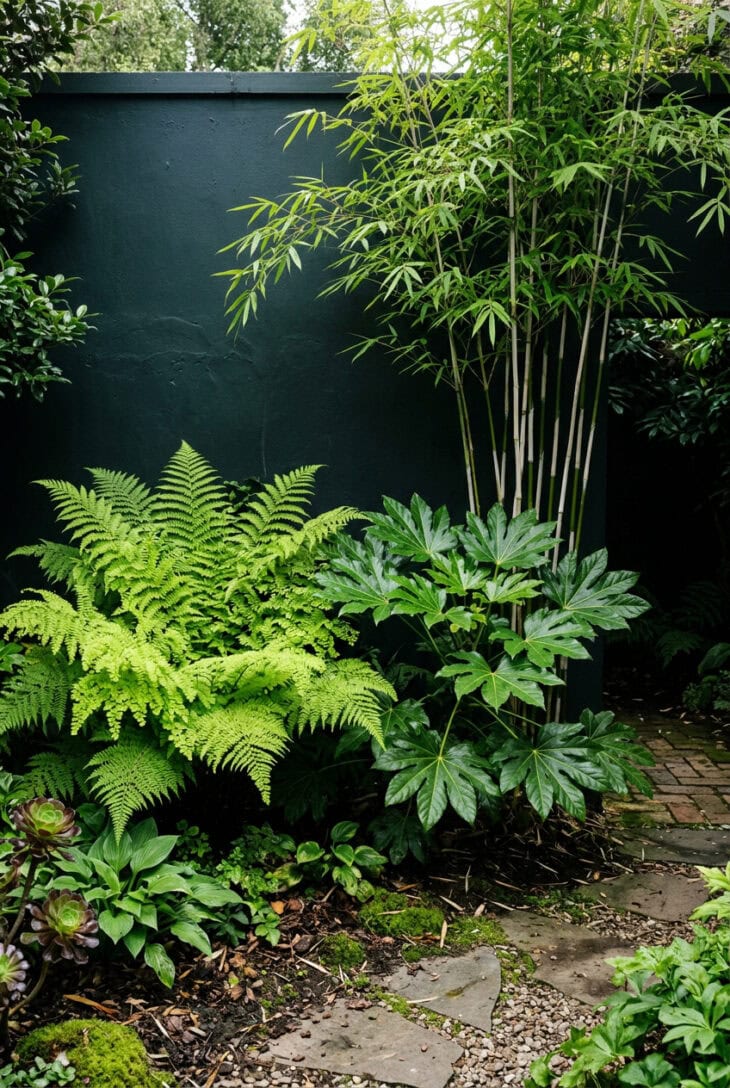
What you see A wall painted so dark a green that it is nearly black, and in front of it the planting has changed completely. Acid-green ferns look luminous, a glossy fatsia looks lacquered, a pale bamboo cane stands out like a drawn line. The wall itself has stopped being a wall and become a hole in the back of the garden.
Why it works A pale fence or a red brick wall is a hard stop that tells the eye exactly where the garden ends, which is fatal in a style built on depth and enclosure. Painting it very dark makes it recede into shadow, so the boundary reads as an absence rather than a limit, and the planting in front of it separates cleanly into layers. It is the cheapest way to make a small garden feel deeper, and it costs a weekend and two tins of paint.
How to get it Choose a very dark, slightly grey-green or near-black rather than a bright bottle green, which looks like a sports pavilion. Use exterior masonry paint on brick or render and a matt (never satin) opaque wood stain on timber, since any sheen catches light and defeats the point. Paint the whole surface, including behind the planting, and paint the fence posts and any rails the same color so nothing is left to catch the eye.
16. Mount Bromeliads and Orchids on the Trees
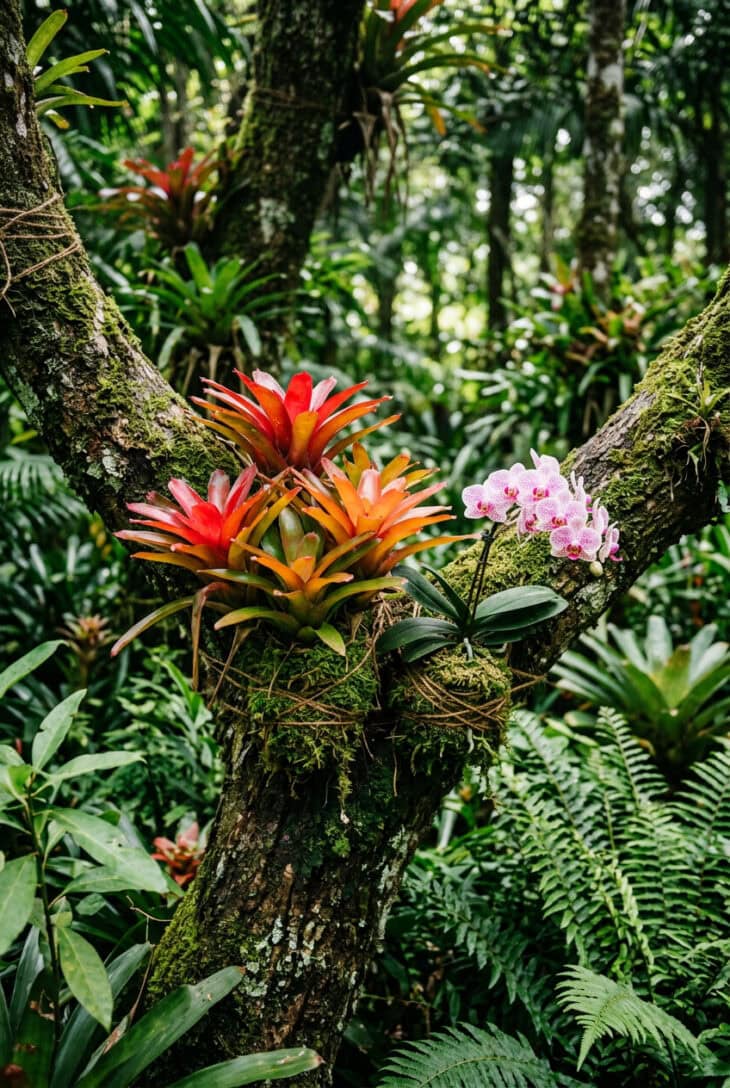
What you see Plants growing out of a tree. Bromeliad rosettes in red and orange are wedged into the fork of a mossy branch, their roots wrapped in moss and tied on, and an orchid is flowering from the trunk itself. There is no pot and no soil. It looks like the tree grew them.
Why it works In a real rainforest the most interesting plants are not on the ground, they are up in the canopy, and a garden that puts everything at ground level misses that entirely. Mounting epiphytes on trunks and branches fills the vertical space between the floor and the canopy, adds color at eye level and above, and produces the single most convincing detail in a temperate jungle, because nobody expects it.
How to get it Treat this as a summer display in any climate with frost. Wrap the root ball in damp sphagnum moss and tie it to a branch fork with fishing line or coir twine, choosing a rough-barked tree in dappled shade. Mist every day or two in dry weather, and fill the bromeliad’s central cup with rainwater, which is how it actually drinks. Bring them in before the first frost. Hardy bromeliads do exist, but the tender types are cheap enough to treat as annual theatre.
17. Feed and Water Like You Mean It
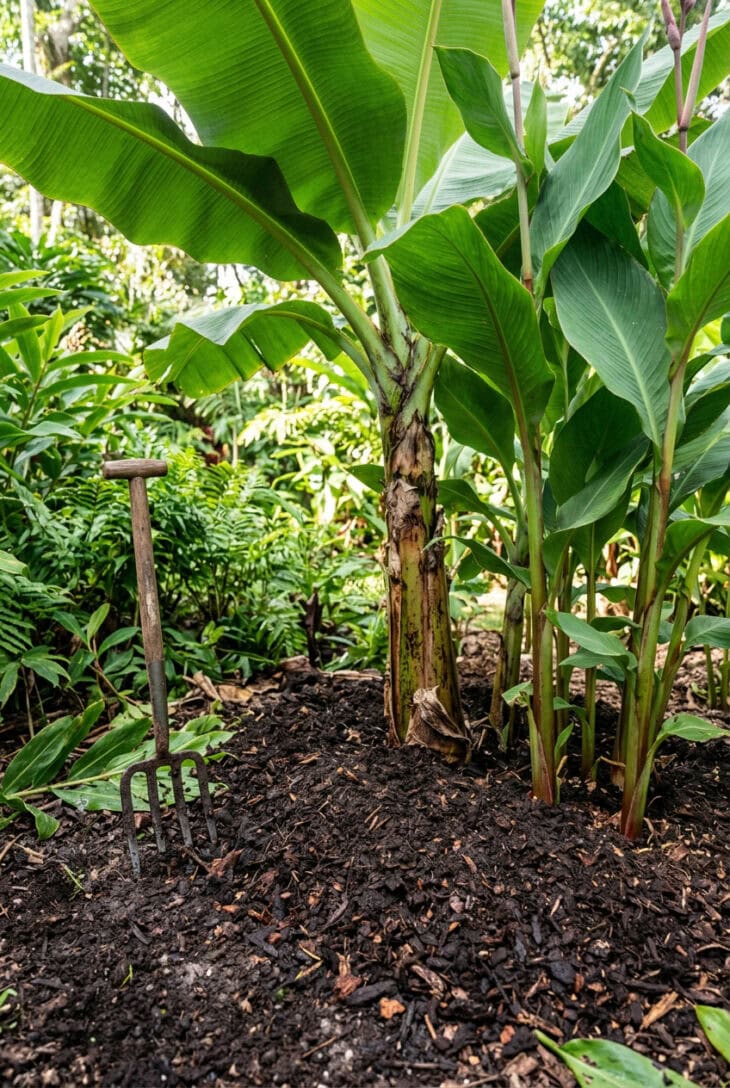
What you see Dark, crumbly, moist compost spread thickly around the base of fat banana and canna stems, and above it, leaves that are noticeably larger and greener than the same plants in the next garden. A fork is stuck in the ground where somebody stopped work. This is a bed that gets fed.
Why it works This is the idea people skip, and it is the reason most temperate jungles look thin. Almost every other garden style in fashion right now (gravel, Mediterranean, prairie, dry) is built on poor soil and no water, and gardeners have absorbed that as a general rule. Tropical planting is the exact opposite: these are plants racing to make an enormous amount of leaf in four months, and they cannot do it on a starvation diet. Leaf size is a direct function of feeding.
How to get it Mulch 3 to 4in (8 to 10cm) deep with well-rotted manure or compost every spring, keeping it clear of the stems themselves. Feed the heavy hitters (bananas, cannas, elephant ears, gingers) fortnightly through summer with a balanced liquid feed, switching to a high-potash one in August. Water deeply and less often rather than a daily sprinkle, and install a leaky hose under the mulch if the bed is big, because a dry July undoes a whole season of growth.
18. Uplight the Leaves After Dark
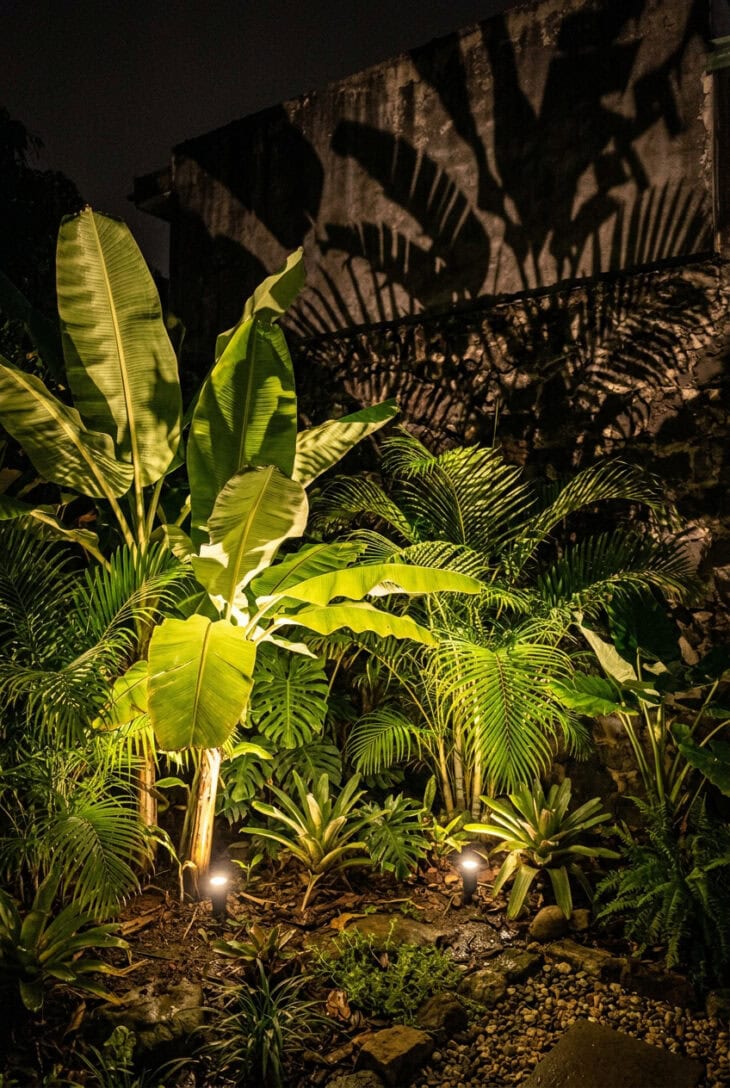
What you see Night, and the garden has doubled in drama. Small lights sit on the ground shining straight up through the banana and palm leaves, which glow translucent green from below, and their shadows are thrown four times life size onto the dark wall behind. Nothing is lit from above. Everything above the leaves is black.
Why it works Big leaves are the one thing in a garden that respond spectacularly to being lit from underneath, because they are translucent, and light passing through a banana leaf turns it into a lantern with the veins showing. It also throws a shadow, and the shadow is often better than the plant. No other planting style gets so much for so little from a couple of spike lights.
How to get it Use warm white (2700K or lower) spike lights set close to the base of the plant and angled up through the foliage rather than at it. Three or four well-placed fittings beat a dozen, since the darkness between them is what gives the drama. Aim at least one at a wall so you get the shadow play, and shield every fitting so you never see the bulb from the seating area. Low-voltage 12V kit is safe to install yourself and easy to move as the planting grows.
19. Sink a Container Pond in a Small Space
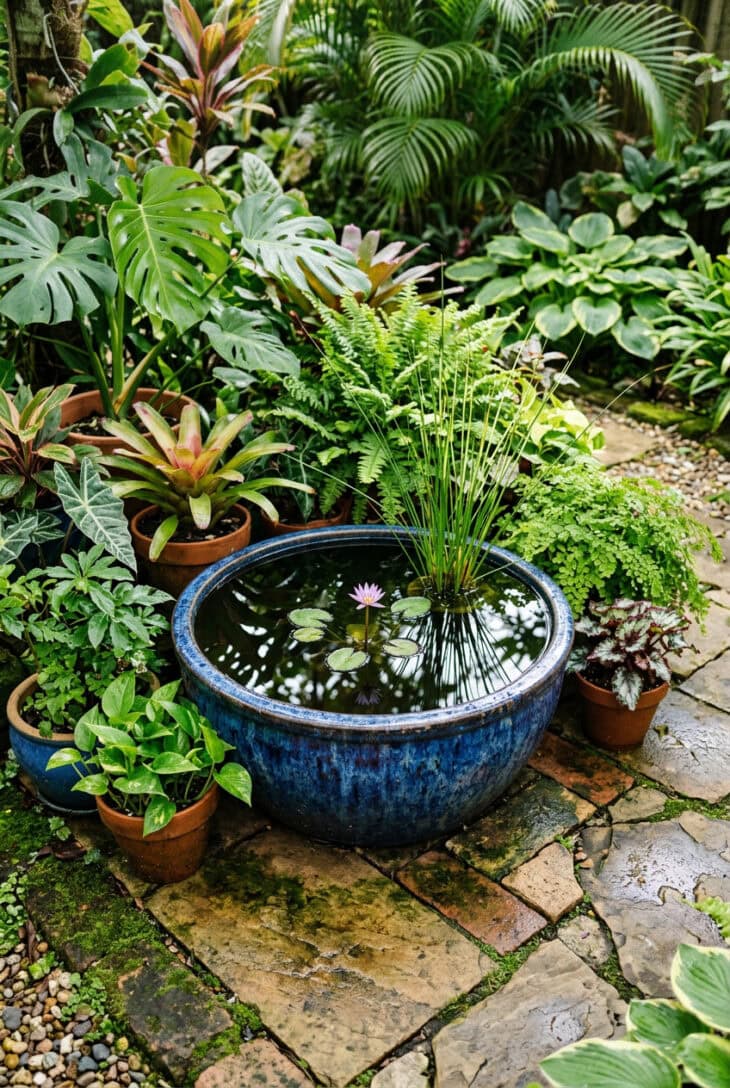
What you see A single big glazed bowl of water standing on a small patio, with one miniature water lily flowering on the surface and an upright rush standing out of it. Potted foliage crowds in around the rim. The water is still and dark, and it is reflecting the leaves hanging over it.
Why it works Not every garden has room for a pool, and the good news is that reflection has nothing to do with size. A 24in (60cm) bowl of still dark water gives you a piece of sky, doubles the plants above it, and draws birds and dragonflies to a patio, all for the price of the bowl. It is also the safest way to introduce water where a full pond would not be wise.
How to get it Use a glazed pot with no drainage hole, or plug the hole with a rubber bung and silicone, or use a half barrel with a butyl liner. Set it in place before filling, since it will be far too heavy afterwards. Plant a miniature water lily (Nymphaea ‘Pygmaea Helvola’) in an aquatic basket, add one upright marginal, and top up with rainwater. Keep it in part shade and drop in a small piece of barley straw to keep the water clear.
20. Go All In on Hot Color
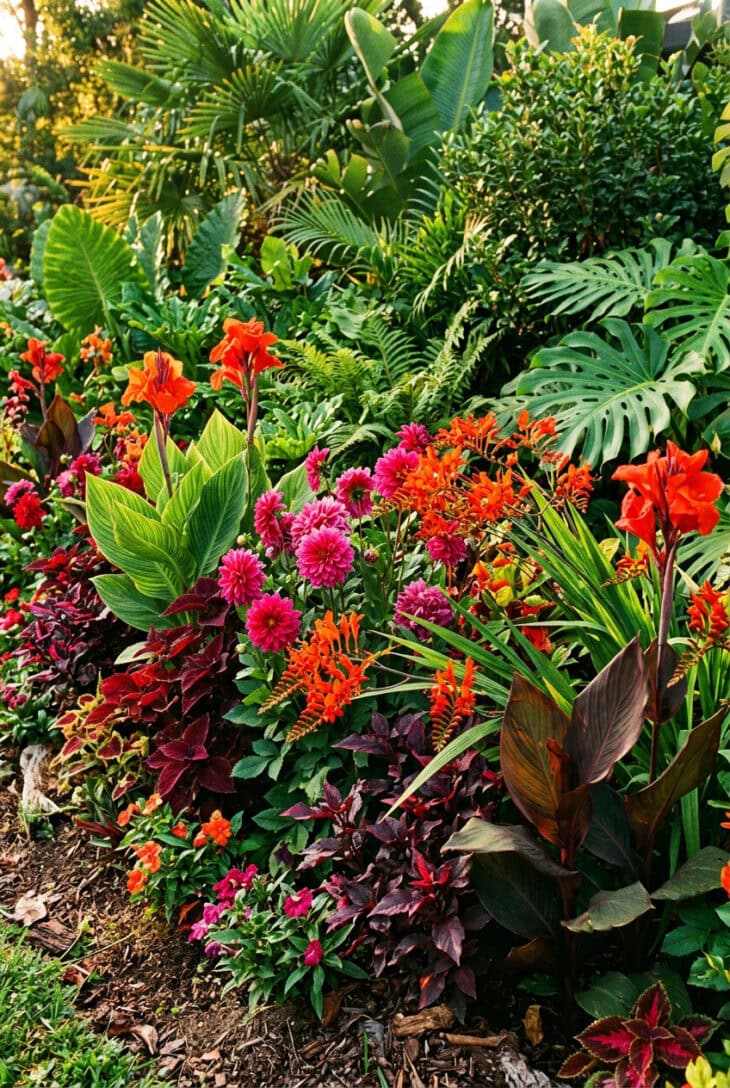
What you see Scarlet, magenta, burnt orange and deep blood-red, all crammed together with no pale colors anywhere to cool it down. Cannas, dahlias and crocosmia are competing for attention against a backdrop of big green leaves. In the late afternoon sun it is almost too loud to look at, which is the intention.
Why it works Hot colors are the ones that hold up in strong light, which is why they dominate in the tropics and look brash in a soft grey climate. Against a mass of dark green foliage, though, they behave: the green is a huge neutral field that absorbs the shouting and lets each flower read as a point of light. The trick is total commitment, since one pale pink in a hot border looks like a mistake, while fifty reds look like a decision.
How to get it Build it from cannas, dahlias (‘Bishop of Llandaff’ is the classic, with dark foliage), crocosmia ‘Lucifer’, red hot pokers (Kniphofia) and Salvia ‘Amistad’. Ban pastel pink, pale yellow and white, which sit awkwardly with saturated color and dilute the effect. Repeat each color at least three times through the border rather than using one of everything. Plant the dark-leaved forms wherever you can, since bronze and burgundy foliage makes red flowers look richer.
21. Fake the Tropics With Hardy Look-Alikes
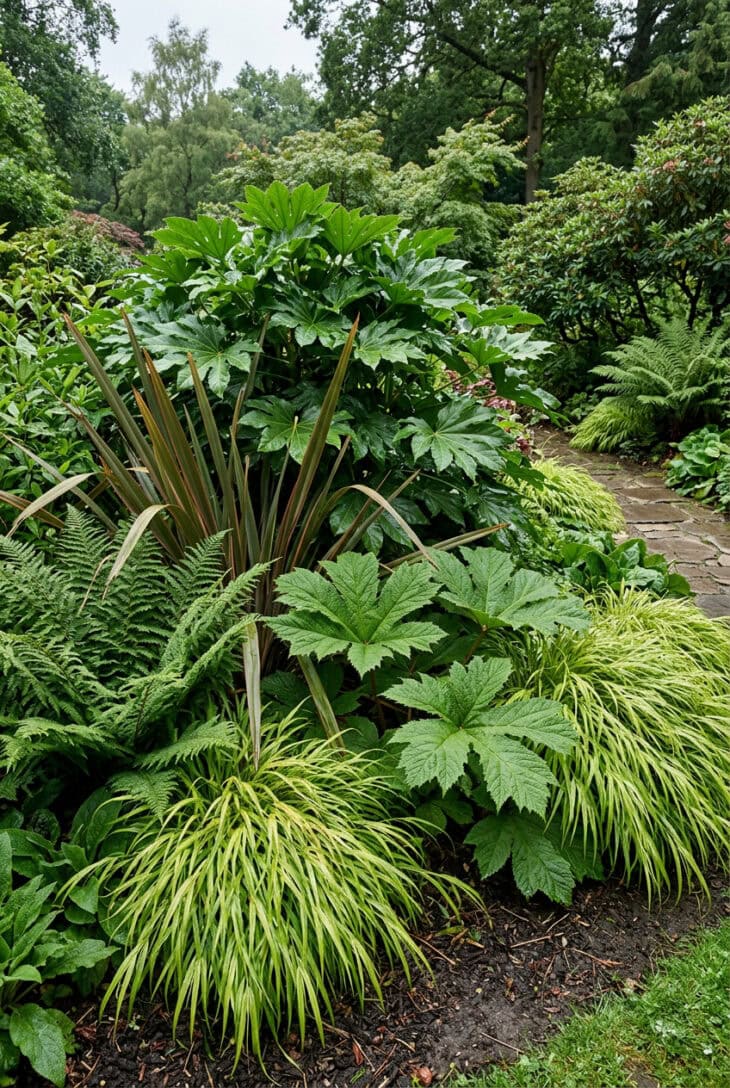
What you see A border that reads as jungle from ten feet away and turns out, on inspection, to contain nothing tender at all. A glossy fatsia the size of a small car, huge crinkled rodgersia leaves, ferns, phormium spikes, a fountain of hakonechloa. Nothing here needs lifting, wrapping or heating in winter.
Why it works The tropical effect comes from leaf size, leaf gloss and density, and none of those qualities is exclusive to tropical plants. Plenty of perfectly hardy temperate species have big, bold, glossy foliage, and a border built from them looks the same in July and needs none of the winter work. This is the single most useful realisation for anyone gardening in a cold climate: build the bones from hardy look-alikes, and spend your effort on a few tender show-offs.
How to get it The core cast is fatsia (Fatsia japonica), rodgersia, ligularia, hosta, hardy ferns (Dryopteris, Matteuccia), Japanese forest grass (Hakonechloa macra), phormium, bamboo and Persicaria. Add mahonia for a spiky evergreen and Aralia for real drama. Give most of them moist soil and part shade, which is exactly what the plants people think of as tropical would want anyway, and interplant the tender stars among them each June.
22. Run a Passion Flower Over the Fence
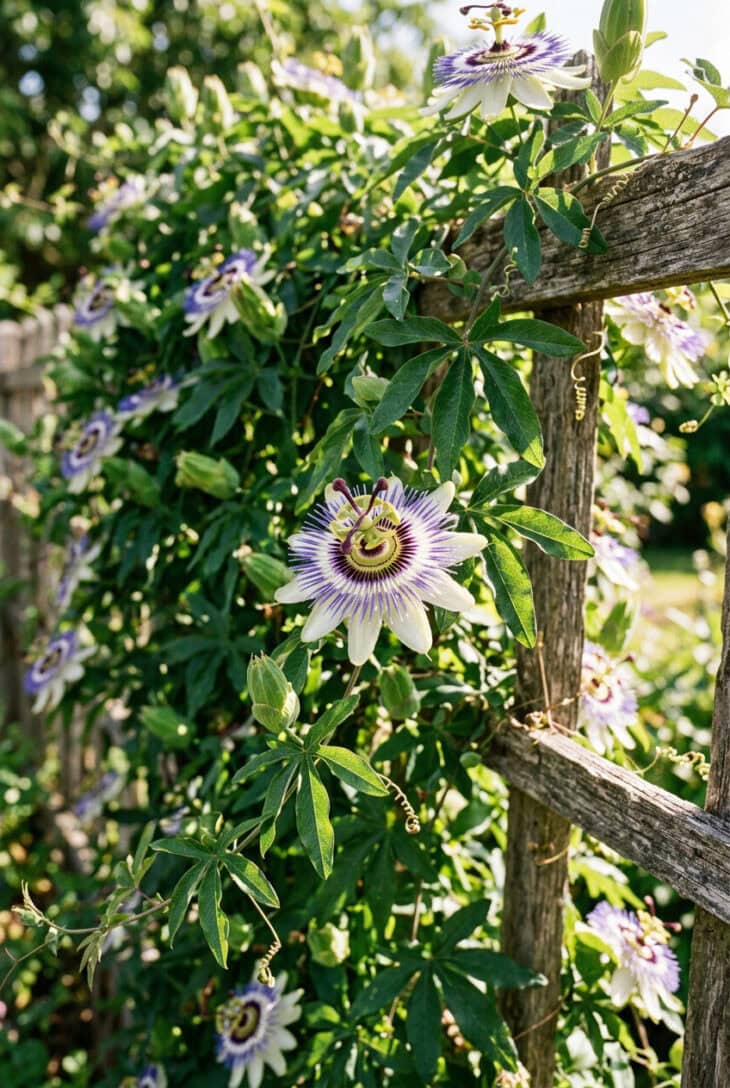
What you see A vine that has taken over a whole fence panel, its lobed leaves and curling tendrils covering the timber, and among them the flowers: purple and white, intricate, fringed, so strange up close that they look manufactured rather than grown. There are dozens open at once, and each lasts a day.
Why it works Vertical surfaces are wasted space in most gardens, and in a jungle they are the last piece of the enclosure. A vigorous climber covers a fence in a season, and the passion flower brings a bloom so exotic that it does the same job as a hibiscus: it announces the style instantly. It also flowers for months, from midsummer until the frosts, which very few climbers manage.
How to get it Blue passion flower (Passiflora caerulea) is the hardy one, taking around 14F (-10C), and it may be cut to the ground in a cold winter and resprout from the base in spring. Give it a sunny sheltered wall or fence, plus wires or trellis to grab, since its tendrils need something thin to grip. Prune hard in early spring back to a framework, or it becomes a tangled mass of bare stems with all the flowers on top. Be aware it can seed around freely in mild climates.
23. Open a Clearing to Sit In
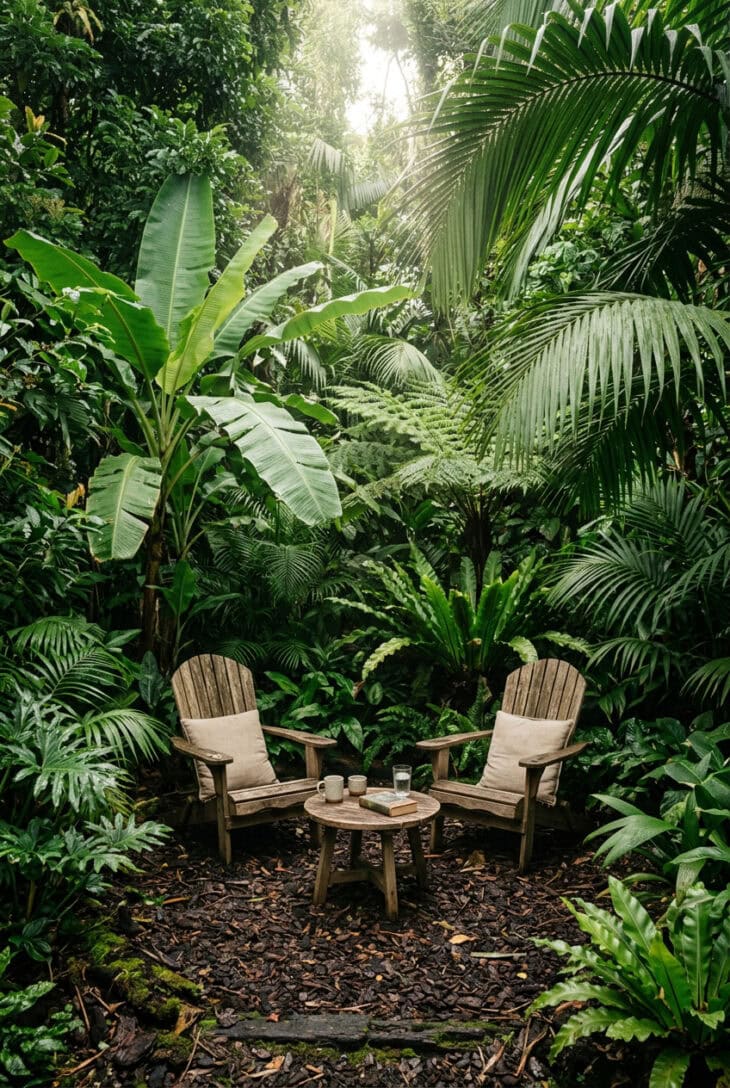
What you see A circle of open ground in the middle of the planting, just big enough for two chairs and a table, with banana leaves and palm fronds towering over it on every side. A single shaft of sunlight drops in from directly above. You cannot see the house from here, and nobody can see you.
Why it works Dense planting is worth nothing if you cannot get inside it. A clearing turns the jungle from a thing you look at into a place you occupy, and the contrast between the enclosure and the small pocket of open sky is precisely what makes it feel like a discovery. It is also the most private seat you will ever have, because the planting that hides the garden hides you.
How to get it Keep it small, around 8 to 10ft (240 to 300cm) across, since a large clearing is just a lawn with plants around it. Surface it with bark, gravel or a simple deck, and site it where it gets sun for part of the day rather than in permanent shade. Do not put it at the end of the garden where it is the obvious destination: tuck it to one side, so you come upon it. Leave one narrow gap as the entrance and plant everything else solid.
24. Grow Big Leaves in Deep Shade
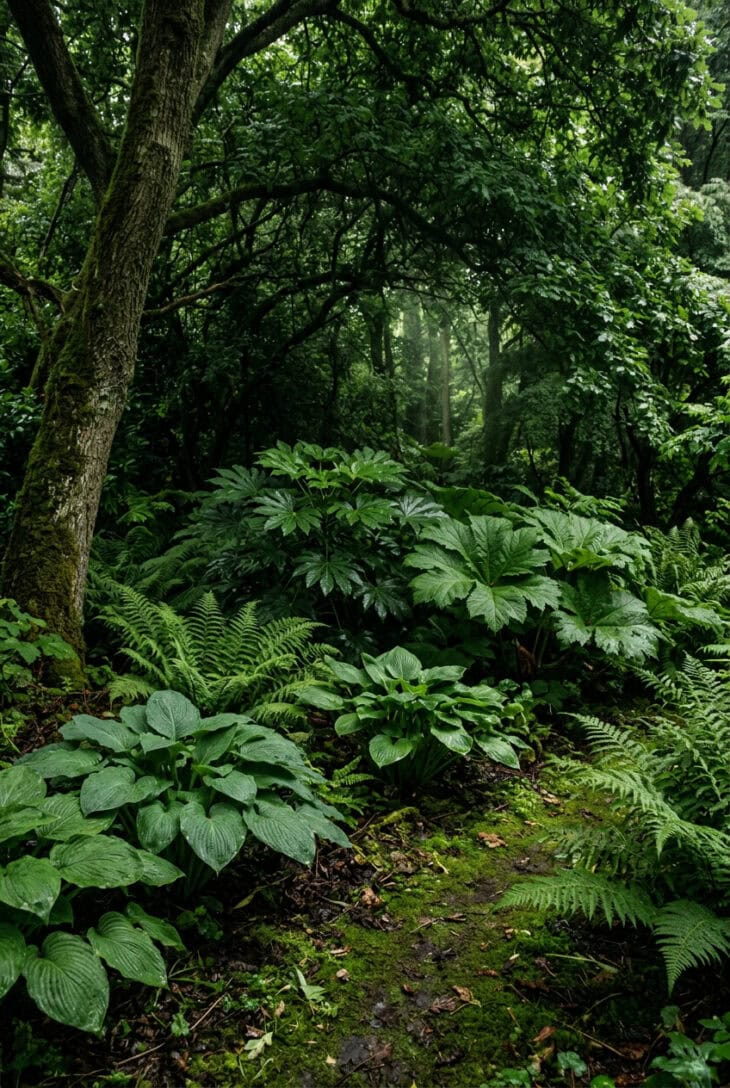
What you see The darkest part of the garden, under a tree canopy, and it is the lushest. Fatsia leaves the size of umbrellas, hostas in great blue-green mounds, crinkled rodgersia, ferns filling every gap. Moss on the dark damp ground. Not a flower anywhere, and nothing looks like it is struggling.
Why it works Big leaves are an adaptation to shade, not to sun. A plant living on the forest floor grows a large thin leaf precisely because it has to catch what little light gets through the canopy, which is why the most dramatic foliage in the world comes from the understory rather than the treetops. In practical terms, the shadiest corner of your garden is not a problem for this style, it is the best growing site you own.
How to get it Improve the soil first, since dry shade under a tree beats most plants: dig in plenty of compost and mulch annually, and water through the first two summers. Plant fatsia, hosta, rodgersia, ligularia, hardy ferns, Japanese spurge (Pachysandra terminalis) as ground cover, and hakonechloa for light. Use the pale and variegated forms deliberately, because in deep shade a lime-green or white-splashed leaf lifts the whole planting where a dark green one disappears.
25. Have a Winter Plan Before You Plant
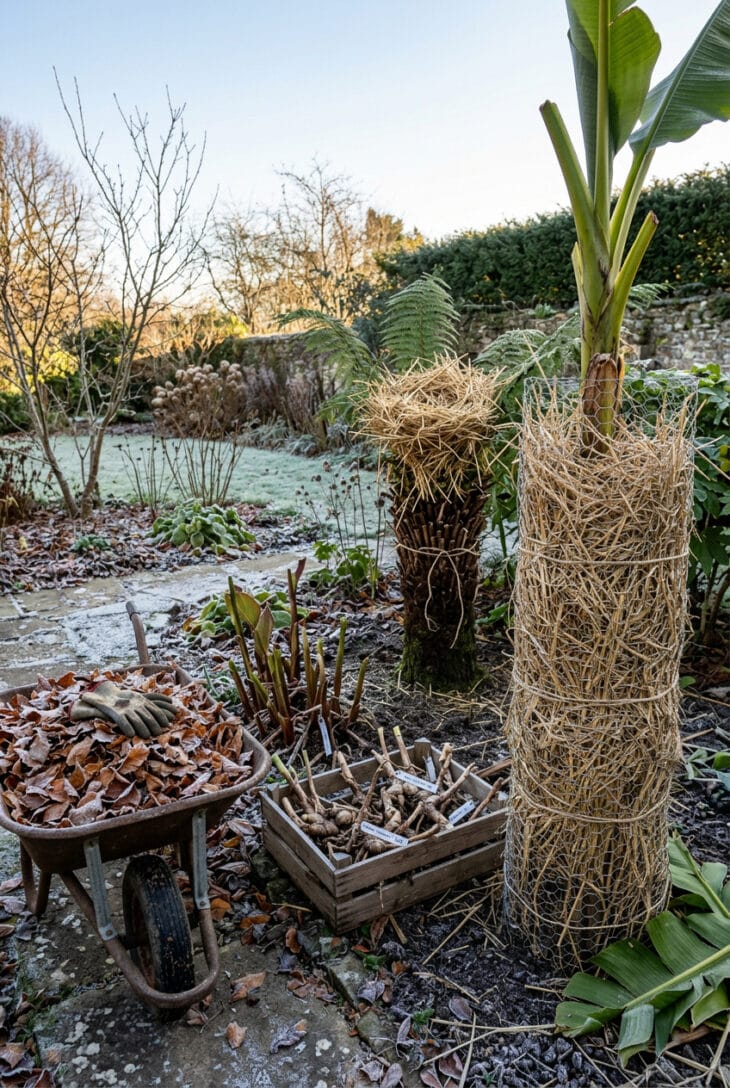
What you see The same garden in November, and it looks like a building site. A banana stem stands wrapped in a straw-packed cylinder of chicken wire, a tree fern crown is stuffed with straw, the cannas have been cut down and their rhizomes are sitting in a crate, and there is a barrow of dry leaves waiting. Frost on the ground. It is not pretty, and it is why the garden exists in July.
Why it works This is the honest one. A temperate jungle is not a low-maintenance garden, and the reason most of them fail is that somebody bought the plants in June without thinking about November. Deciding the winter strategy for each plant before you buy it (hardy, wrap it, lift it, or treat it as an annual) is what separates a garden that gets better every year from one that has to be replaced every spring.
How to get it Sort every plant into four groups. Hardy: needs nothing. Wrap in place: bananas and tree ferns, using a straw-packed wire cage capped against rain, since wet kills more than cold. Lift and store: cannas, dahlias, elephant ears, dried off and kept barely damp somewhere frost free. Bring inside: tender hibiscus, bromeliads, citrus. Do the work in one weekend after the first frost blackens the foliage, not before, and label everything, because a bare rhizome in March is unidentifiable.