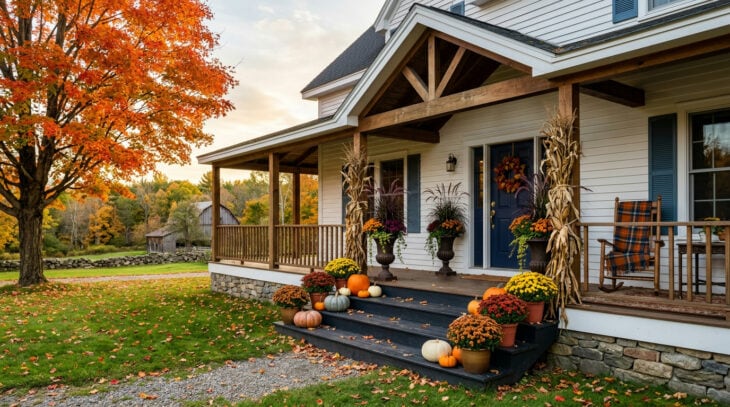
There is a weekend every September when the summer petunias finally look tired and the farm stands fill up with pumpkins. That is the signal to redo the porch. It is the first thing you see coming home and the first thing guests see, and a few well-chosen pots can make the whole house feel ready for sweaters, cider and shorter days.
Contents
- 01. Classic Mums and Pumpkins Up the Steps
- 02. Stacked Heirloom Pumpkins in Soft Colors
- 03. Tall Urns with Purple Fountain Grass
- 04. Ornamental Kale and Cabbage Planters
- 05. A Fall Window Box Under the Porch Window
- 06. Refresh Hanging Baskets for Fall
- 07. Corn Stalk Bundles on the Porch Posts
- 08. Straw Bale Farmhouse Display
- 09. Dried Hydrangea Door Wreath
- 10. Chinese Lantern Door Swag
- 11. Evergreen Porch Pots That Last to Christmas
- 12. Bold Foliage Planters for a Shady Porch
- 13. Celosia and Coleus for a Warm Southern Fall
- 14. A Modern Monochrome Porch
- 15. One Big Pot for a Small Stoop
- 16. Tiered Wooden Crate Display
- 17. Porch Rail Planters with Ornamental Peppers
- 18. Hyacinth Bean Vine Up the Porch Post
- 19. Potted Japanese Maples by the Door
- 20. Native Asters and Goldenrod Instead of Mums
- 21. Edible Planters of Chard, Kale and Herbs
- 22. Lantern-Lit Steps at Dusk
- 23. A Harvest Still Life on an Old Bench
- 24. A Cozy Seating Nook with Potted Grasses
- 25. A Late-Blooming Bed Along the Porch Front
The ideas below run from a classic line of mums and pumpkins up the steps to living planters that last through Thanksgiving and beyond. You will find setups for sunny porches and shady ones, for a narrow city stoop and a deep farmhouse veranda, for cold northern falls and hot southern Septembers. Some cost less than a trip to the grocery store; a few are a small investment that comes back year after year.
Each idea explains what you are looking at, why it works, and exactly which plants and materials to buy. Scroll through for inspiration, or jump to the ones that match your porch, your climate and how much time you have this fall.
01. Classic Mums and Pumpkins Up the Steps
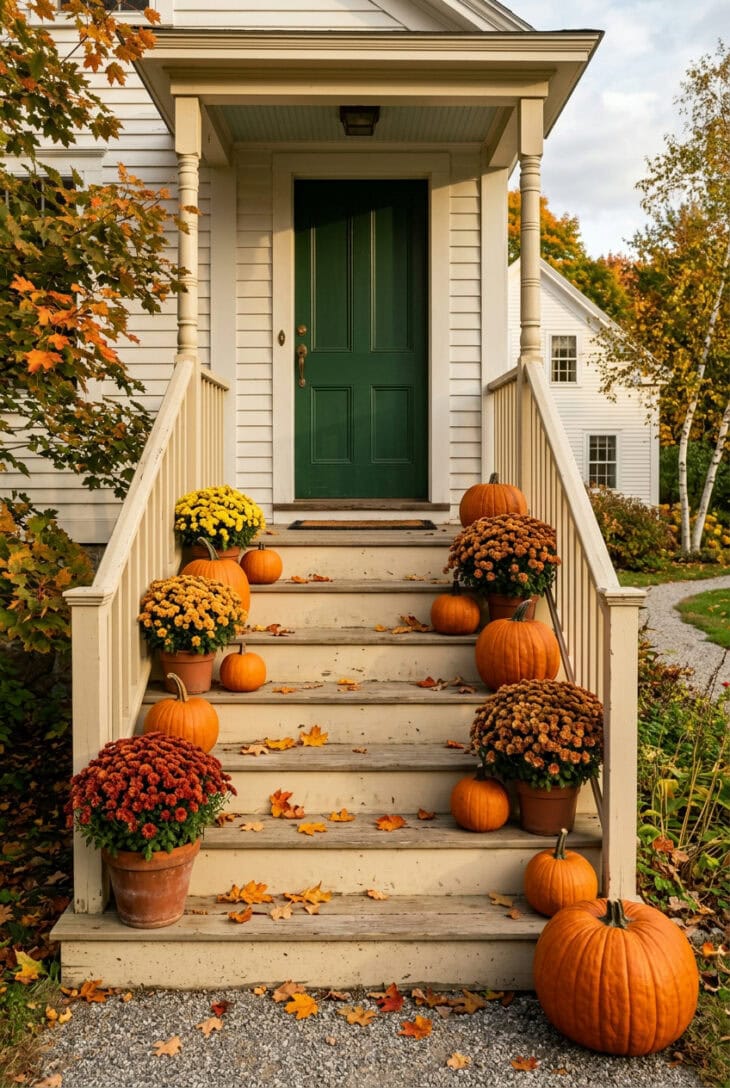
What you see A flight of painted steps climbing to a green front door, with round mums in bronze, brick red and gold set on alternating sides. Between them sit pumpkins in three sizes, from a fat one anchoring the bottom step to a small one tucked by the door. Fallen maple leaves catch the low sun, and the whole thing reads as warm, tidy and unmistakably October.
Why it works Staggering the pots, rather than lining both sides identically, pulls the eye up the steps in a gentle zigzag and leaves a clear walking line. Three pumpkin sizes create rhythm, and repeating just three mum colors keeps it from looking like a garden center display. It is the simplest fall porch there is, and it still looks good because the colors are the colors of the trees around it.
How to get it Buy garden mums (Chrysanthemum × morifolium) in tight bud rather than full flower, so the show lasts four to six weeks instead of two. Choose 8 to 12in (20 to 30cm) pots and water them every day in warm spells, because a root-bound mum wilts fast. Set each pumpkin on a cork trivet or a plant saucer so it does not stain the paint or start a rot ring on wooden treads. Keep at least 24in (60cm) of each step clear for feet. If you want the mums to come back next year, plant them in the ground by mid-September and leave the dead stems standing over winter; later plantings are best treated as a one-season display.
02. Stacked Heirloom Pumpkins in Soft Colors
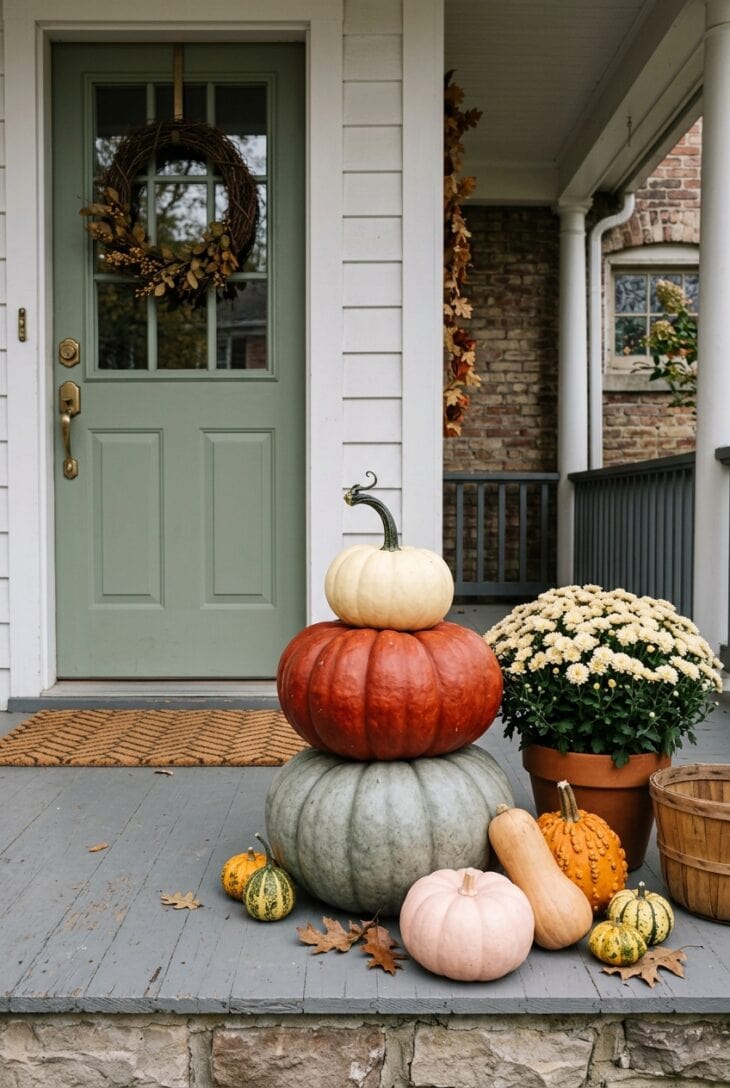
What you see A pumpkin totem by the front door: a wide, flattened blue-gray pumpkin at the base, a ribbed red-orange one on top of it and a small cream pumpkin with a curling stem crowning the stack. Around its feet sit more heirlooms in blush pink, buff tan and warty orange. Against a sage green door and a gray floor, the palette feels soft and a little vintage.
Why it works Heirloom pumpkins come in muted colors and interesting shapes that the standard carving pumpkin cannot match, and stacking them gives height without a single planter. The squat, flat-topped varieties sit on each other naturally. Because nothing is carved, the display lasts well past Halloween and slides straight into a Thanksgiving look.
How to get it For the base, pick ‘Jarrahdale’ (Cucurbita maxima), a slate-blue pumpkin that is wide and flat. Put ‘Cinderella’, also sold as ‘Rouge Vif d’Etampes’, in the middle, and a small white ‘Casper’ on top. Trim the stems on the lower two so the next pumpkin sits level, and keep the stem on the top one for its shape. Fill the base with ‘Long Island Cheese’ (Cucurbita moschata), pink ‘Porcelain Doll’ and a warty ‘Knucklehead’. Wipe each one with a solution of 1 part household bleach to 10 parts water before stacking to slow mold, and bring them indoors if a hard freeze is forecast, since frozen pumpkins turn soft within days.
03. Tall Urns with Purple Fountain Grass
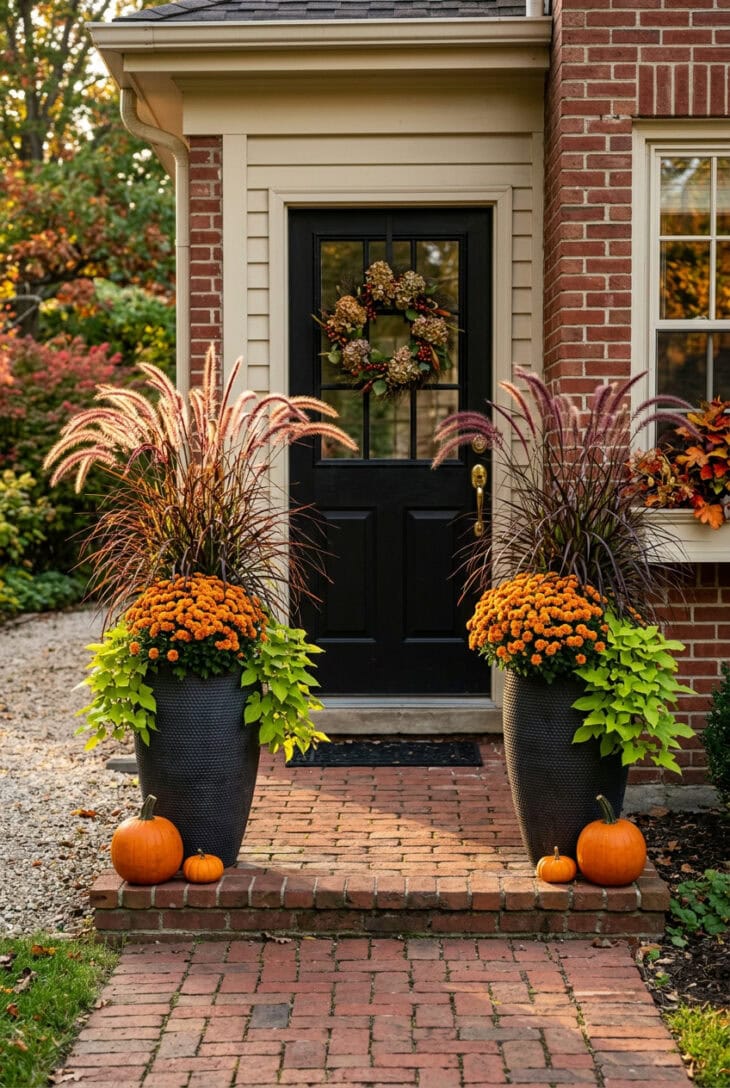
What you see Two tall charcoal urns stand guard at a black front door. Out of each rises a fountain of burgundy grass, its fluffy wine-red plumes glowing in the late sun. Below the grass sits a dome of orange mum, and bright chartreuse sweet potato vine spills over the rim and down the side. A small pumpkin at each foot finishes the pair.
Why it works This is the thriller, filler and spiller formula at porch scale: something tall, something round and something that trails. The grass adds height and movement that a mum alone cannot, and its purple tone makes the orange look even richer. A matched pair on either side of the door frames the entrance and makes even a plain house front look deliberate, a trick worth borrowing from any good set of container garden ideas.
How to get it Choose urns at least 20 to 24in (50 to 60cm) across, with drainage holes, and fill them with fresh potting mix rather than garden soil. Plant one purple fountain grass (Pennisetum setaceum ‘Rubrum’) in the center; it is a perennial only in zones 9 to 11 and an annual elsewhere. Add a mum in front and a chartreuse sweet potato vine (Ipomoea batatas ‘Marguerite’) at the edge. Aim for a thriller about one and a half to two times the height of the pot, or the proportions look squat. The grass and the vine both collapse at the first frost, so plan to swap in evergreen boughs and pinecones for the winter.
04. Ornamental Kale and Cabbage Planters
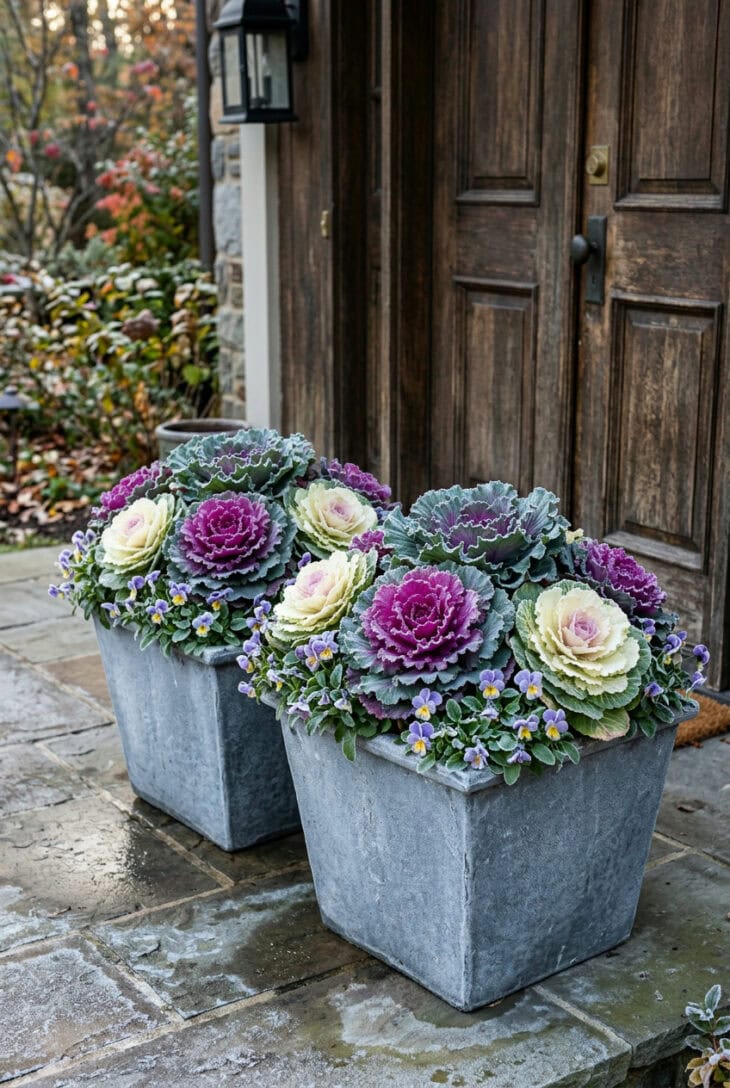
What you see Two square planters crammed with rosettes of ornamental kale and flowering cabbage, their centers blazing magenta and cream against blue-green outer leaves. Little purple and yellow violas peek out between them. A dusting of frost outlines every frilly edge in the cold morning light, and the whole planting looks more alive for it.
Why it works Ornamental kale is the one fall plant that actually gets better as the weather gets worse. The pink, purple and white centers only color up once nights turn cold, and the rosettes shrug off frosts that finish mums. In cold regions, this is how you keep a porch planter looking fresh from October until the snow, using a close cousin of the kale in your vegetable garden.
How to get it Wait to plant until nights are regularly below about 50°F (10°C); planted in late summer heat, ornamental kale (Brassica oleracea) stretches and stays green. Look for frilly ‘Nagoya’, feathery ‘Peacock’ and round ‘Osaka’ flowering cabbage. Set them shoulder to shoulder, since they hardly grow once it is cold and a gappy planter stays gappy. Tuck violas (Viola cornuta) around the edges for a little flower color. Check the undersides of leaves in early fall for green cabbageworms, and pick them off before they chew holes in the display.
05. A Fall Window Box Under the Porch Window
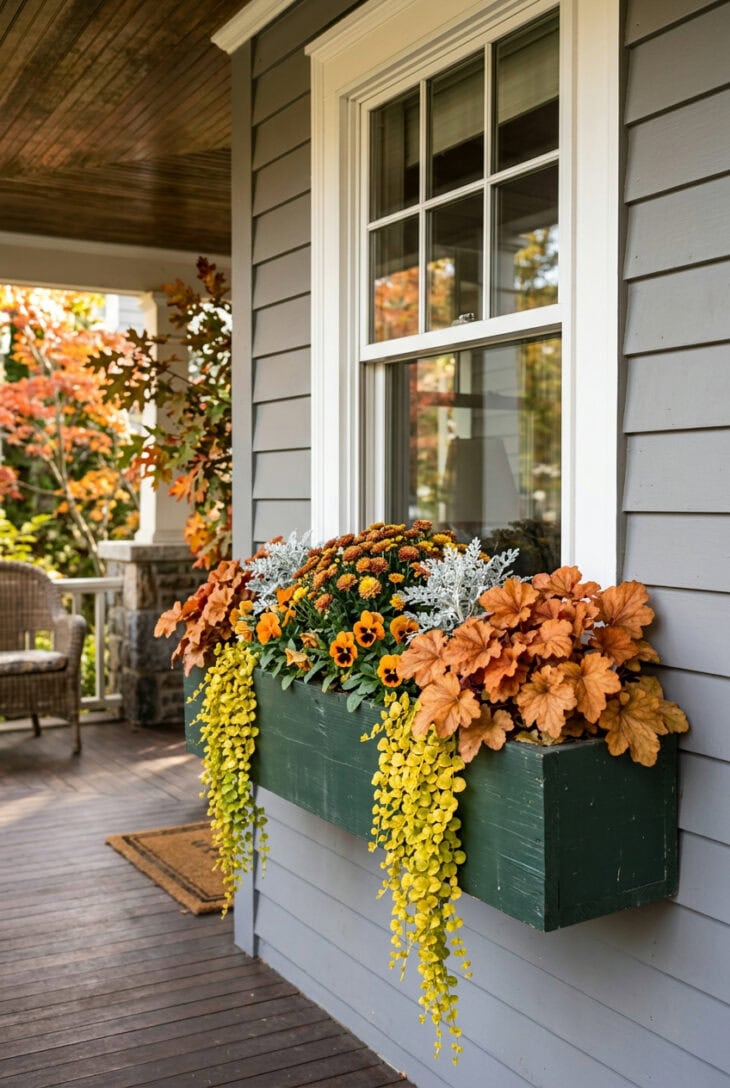
What you see A long green window box beneath a white-trimmed porch window, overflowing with fall color. Ruffled copper heuchera sits beside frosty silver dusty miller, little bronze and yellow button mums fill the gaps, and orange pansies turn their faces to the light. Golden creeping Jenny pours over the front edge against the gray siding.
Why it works A window box puts color at eye level, where you see it from inside the house as well as from the street. Copper, silver and gold are the whole fall palette in three leaves, so the box stays good-looking even between flushes of bloom. Most of these plants tolerate light frost, which buys you weeks beyond a mum-only box and adds a bit of polish to your curb appeal.
How to get it Use a box as long as the window and at least 8in (20cm) deep, with drainage holes. Plant a coppery heuchera such as ‘Caramel’ or ‘Marmalade’ at each end, then dusty miller (Jacobaea maritima ‘Silver Dust’) and small pot mums between them. Fill the front with pansies (Viola × wittrockiana) and golden creeping Jenny (Lysimachia nummularia ‘Aurea’), which is safest kept in a box because it spreads fast in damp ground. Plant tightly, as you would for a finished look, and water whenever the top inch is dry. When the box comes down, move the heuchera into a shady bed, where it will carry on for years.
06. Refresh Hanging Baskets for Fall
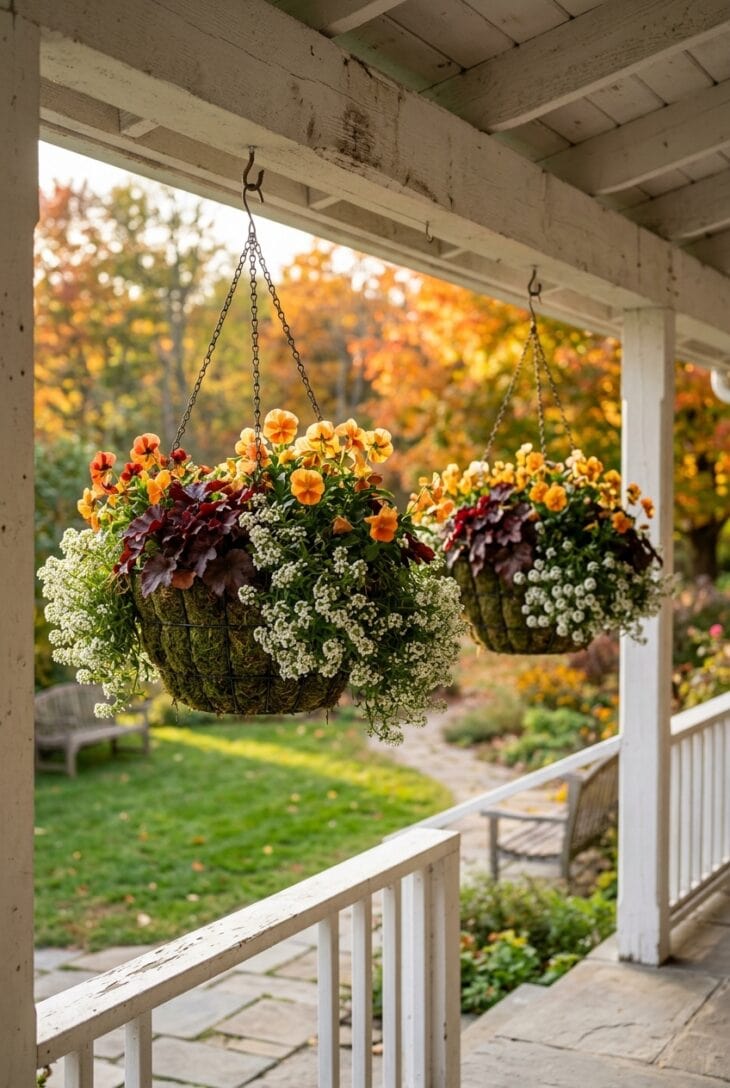
What you see Two mossy wire baskets hang from a white porch beam, spilling orange and yellow pansies down their sides. Burgundy heuchera leaves anchor the centers, and a froth of white sweet alyssum drips over the edges. Behind them the yard blurs into orange and gold, and the late sun shines straight through the pansy petals.
Why it works By September, summer baskets of petunias and calibrachoa are usually leggy and half bare, yet the hooks are already there. Swapping in cool-season plants gives you color at the height of the porch roof, which balances all the pumpkins down at floor level. Pansies and alyssum love cool nights, so the baskets actually improve as the season turns.
How to get it Empty out the summer plants and refresh the top half of the potting mix. Plant a trailing pansy such as the Cool Wave series around the edge, one burgundy heuchera like ‘Palace Purple’ in the center, and sweet alyssum (Lobularia maritima) between them. A 14 to 16in (35 to 40cm) basket takes about five pansies, one heuchera and three alyssum. Baskets dry out faster than any other container, so check them daily and water until it runs from the bottom. Pansies handle light frost, and in zones 6 and warmer the basket can carry on flowering into winter.
07. Corn Stalk Bundles on the Porch Posts
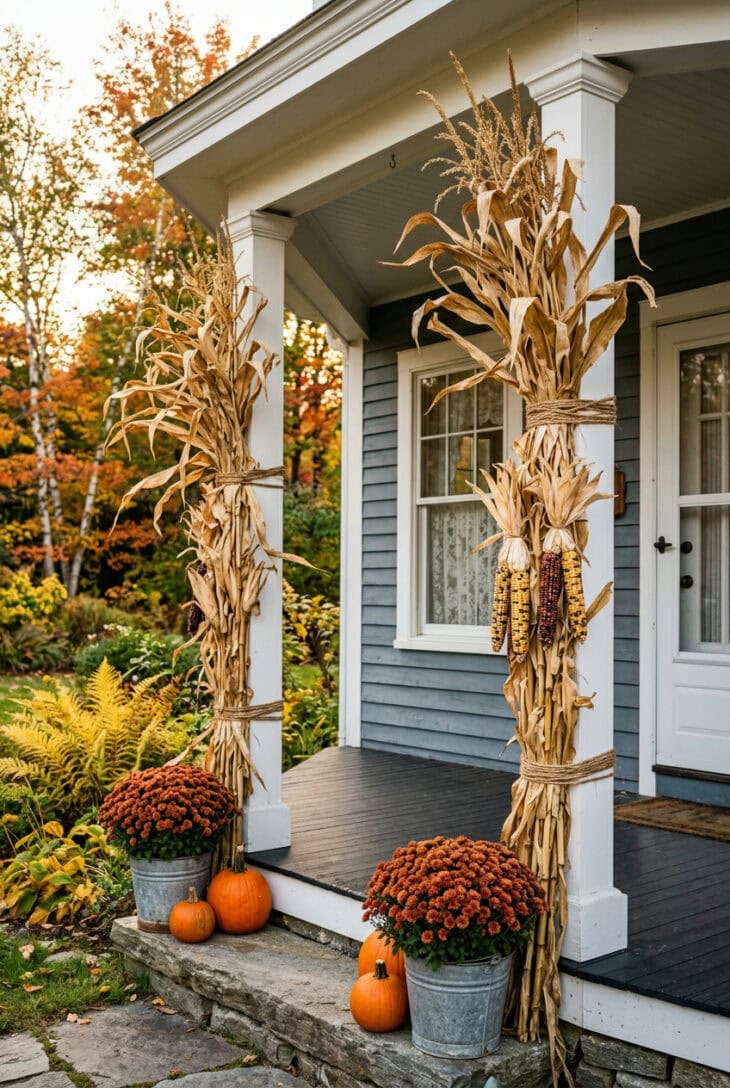
What you see Tall sheaves of dried corn stalks are lashed with jute to the white columns of a farmhouse porch, their tops flaring out in curls of papery leaf. A few ears of multicolored corn dangle from one bundle. Down at the base, rusty mums sit in galvanized buckets with a couple of pumpkins, all set against blue-gray siding.
Why it works Corn stalks are the cheapest way to add real height to a porch, reaching 6ft (1.8m) or more for a few dollars a bundle. They turn the porch posts into part of the display and draw the eye upward, which a row of floor-level pots cannot do. The pale gold also ties together every other harvest color on the porch.
How to get it Buy bundles from a farm stand or garden center, or grow your own from ornamental corn (Zea mays) such as ‘Earth Tones Dent’ or ‘Glass Gem’ and let the stalks dry in place. Use five to eight stalks per post and tie them in two places, near the bottom and about two-thirds of the way up, so the tops can fan. Stalks mold if they sit in the rain, so they last best on a covered porch. For a living version, grow ornamental millet (Pennisetum glaucum ‘Purple Majesty’) in large pots by the posts instead. Keep open flames well away, as dry corn leaves catch fast, and chop the stalks into the compost pile when the season is over.
08. Straw Bale Farmhouse Display
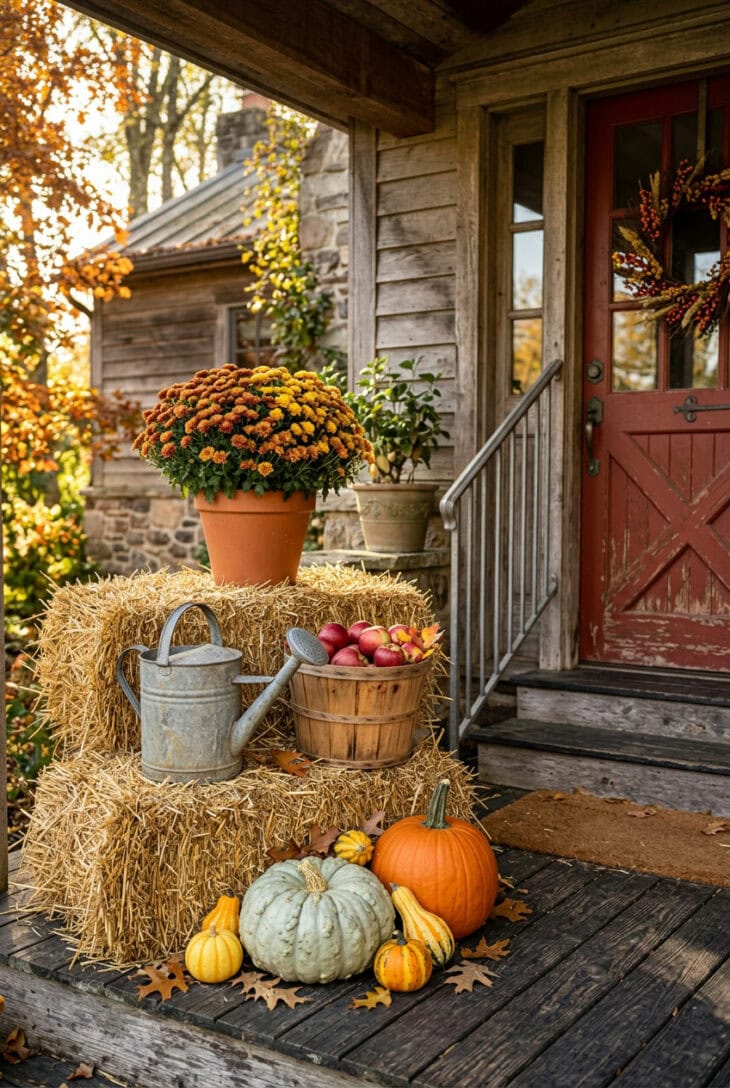
What you see Two golden straw bales stacked in a step beside the porch stairs, topped with fat bronze and yellow mums. A big orange pumpkin and a green warty one lean against the base with a scatter of gourds. An old galvanized watering can and a bushel basket of red apples sit on the lower bale, and a red door glows behind.
Why it works Bales work like instant shelving: they lift pots to different heights so nothing hides behind anything else. The straw texture and gold color say harvest without any effort, and the whole setup costs very little. Better still, the bales do not go to waste when the season is over.
How to get it Buy straw rather than hay: it is usually cheaper, it carries far fewer weed seeds, and it sheds less. Stand each bale on a sheet of heavy plastic or an old tarp trimmed to size, so moisture does not stain the porch floor. Stack them so they overlap by about half, and set potted mums in saucers on top. Mice love a bale, so give it a shake before you set it up and keep it off the porch once it is soggy. Afterward, break the straw up as mulch for bare beds, or condition the bales next spring and plant straight into them as an easy alternative to a raised bed garden.
09. Dried Hydrangea Door Wreath
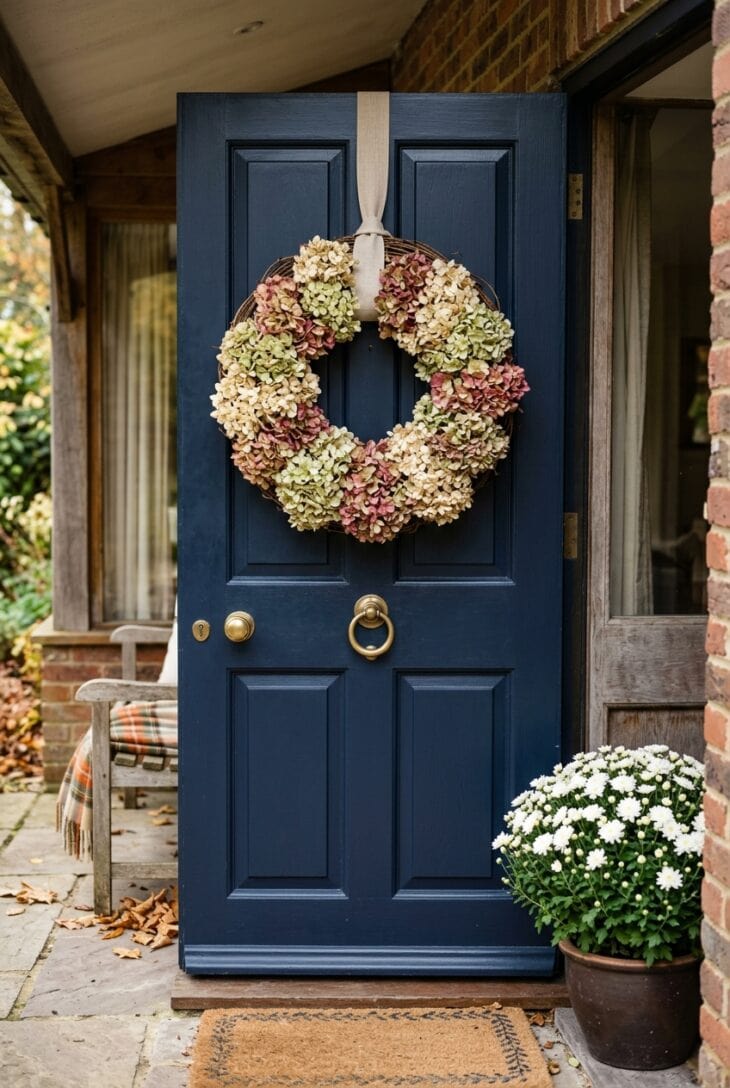
What you see A plump round wreath of dried hydrangea heads hangs on a navy door, its papery clusters in parchment cream, pale sage, dusty rose and soft burgundy. The flowers are packed so tightly that the grapevine base disappears. A wide linen ribbon at the top and a brass knocker below keep it simple and a little old-fashioned.
Why it works Hydrangeas age beautifully on the shrub, fading from white or green to antique tones that fit fall perfectly. Dried properly, the heads hold their color and shape for a year or more, so a wreath made in September lasts all season and costs nothing if the shrub is already in your yard. Its muted colors also balance the loud oranges of mums and pumpkins.
How to get it Cut heads from smooth hydrangea (Hydrangea arborescens ‘Annabelle’) and panicle hydrangea (Hydrangea paniculata ‘Limelight’) in late August or September, once the flowers feel papery rather than soft. Both bloom on new wood, so cutting now does not cost you next summer’s flowers. Stand the stems in a vase with about 2in (5cm) of water and let it evaporate; the heads dry slowly and keep their color better than when hung. Wire small clusters onto an 18in (45cm) grapevine wreath with floral picks, overlapping them so no base shows. Hang it only on a sheltered door, because rain turns dried hydrangeas brown within a day or two.
10. Chinese Lantern Door Swag
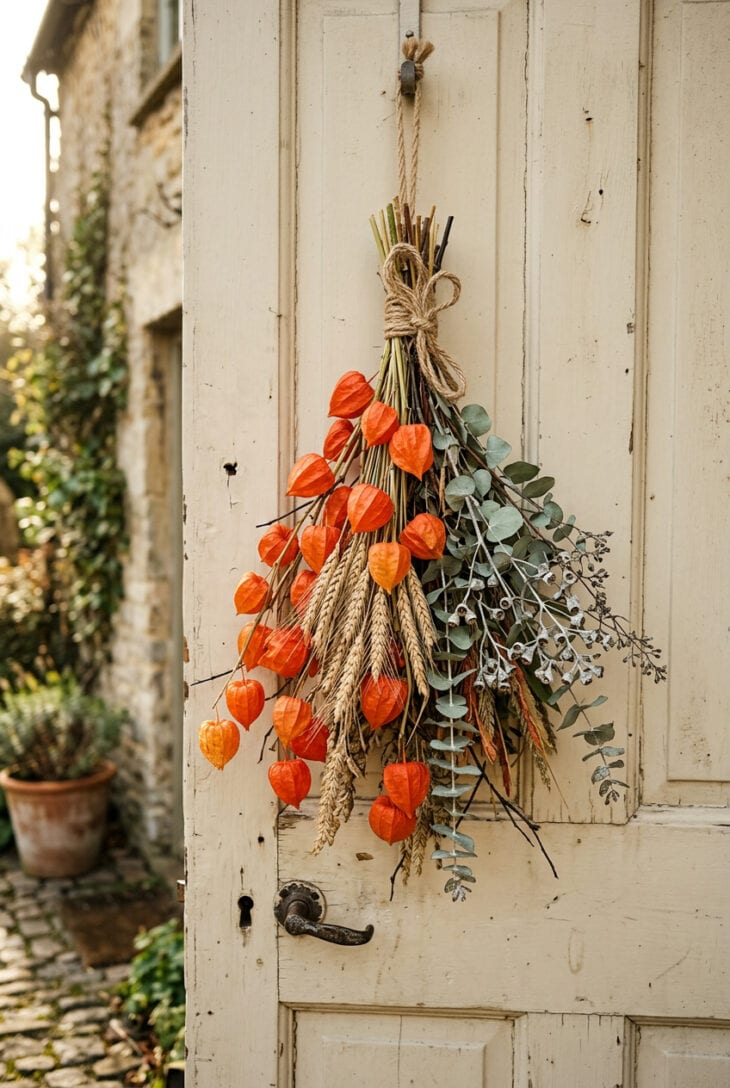
What you see A loose, hand-tied swag hangs upside down on a pale wooden door. Long stems strung with glowing orange lanterns, each one a papery husk shaped like a tiny paper lamp, mix with golden wheat and dusty silver eucalyptus. Rough jute gathers it all at the top, and the orange practically lights up the doorway.
Why it works A swag is easier than a wreath: no frame, no wiring, just a bundle tied at one end. Chinese lanterns bring the brightest orange of the season, and once dried they hold that color for years. It is also a safer choice than the popular bittersweet vine, because the invasive Oriental bittersweet (Celastrus orbiculatus) spreads when birds eat the berries off door decorations and drop the seeds in nearby woods.
How to get it Grow Chinese lantern (Physalis alkekengi) in a large pot or a bed with a buried barrier, because it spreads aggressively by underground runners in zones 3 to 9. Cut the stems once the husks have turned fully orange, strip off the leaves, and hang them upside down in a dry, dark place for two to three weeks. Bundle 10 to 15 stems with dried wheat (Triticum aestivum) and a few sprigs of eucalyptus, then tie tightly with jute and add a loop for hanging. The leaves and unripe fruit are toxic, so hang the swag where small children and pets cannot pull at it.
11. Evergreen Porch Pots That Last to Christmas
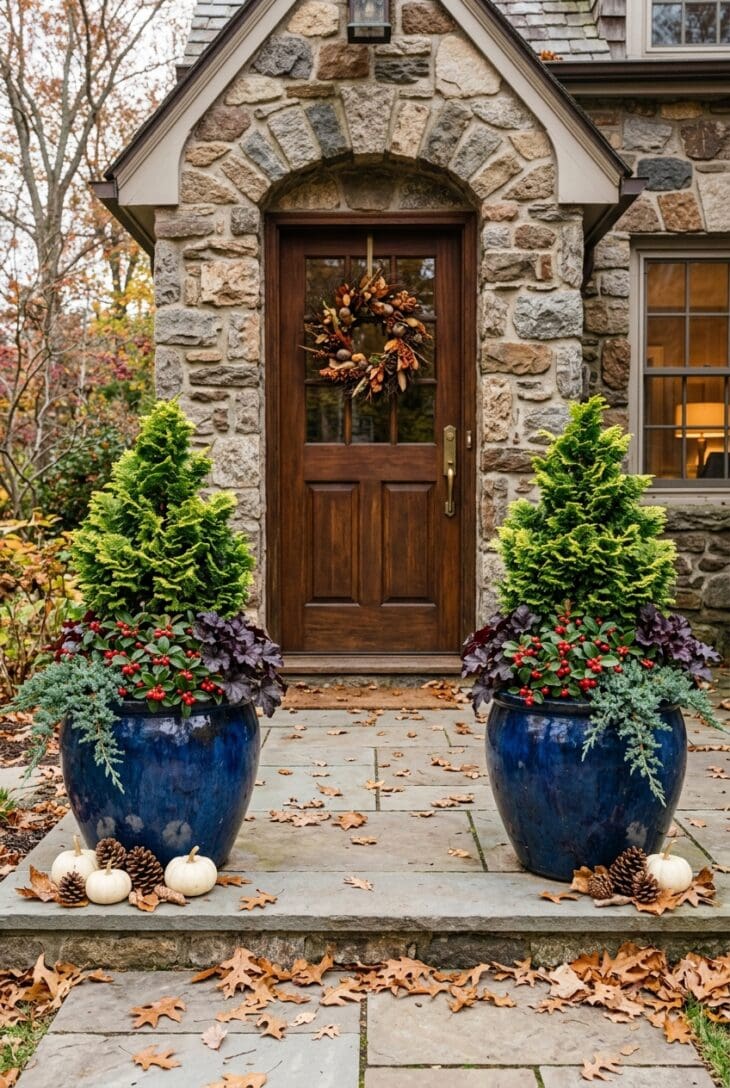
What you see Deep blue glazed pots flank a front door, each centered on a little golden cypress with layered, shell-like foliage. Around it, glossy wintergreen shows off bright red berries, a purple heuchera adds a dark note, and silvery-blue juniper trails over the rim. Pinecones and small white pumpkins sit at the base among fallen oak leaves.
Why it works Mums and annuals are done by November, but evergreens are just hitting their stride. A planter built around a slow-growing conifer bridges fall and winter without a replanting: swap the pumpkins for greenery and a bow at Thanksgiving and the same pot carries you to New Year. It is one of the most low-maintenance porch setups on this list.
How to get it Use frost-proof pots in fiberglass, concrete or high-fired glazed ceramic; ordinary terracotta cracks when wet soil freezes. Center each one on a golden dwarf Hinoki cypress (Chamaecyparis obtusa ‘Nana Lutea’), then add wintergreen (Gaultheria procumbens), which wants acidic mix and part shade, plus a heuchera such as ‘Obsidian’ and creeping juniper (Juniperus horizontalis ‘Blue Chip’) at the edge. Roots in a pot sit colder than roots in the ground, so choose plants rated at least two zones colder than yours if the pots stay out all winter. Water until the mix freezes, since evergreens lose moisture through their leaves even in January. In spring, plant the cypress in the garden and start again.
12. Bold Foliage Planters for a Shady Porch
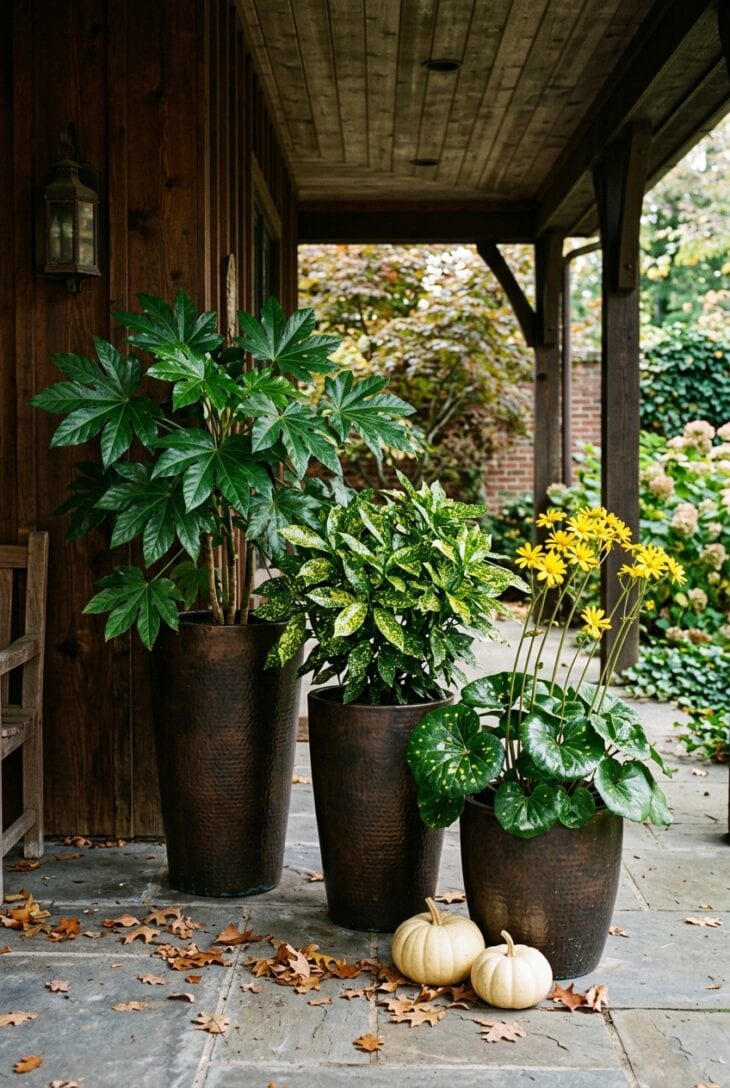
What you see A deep, shaded porch with three bronze planters grouped at different heights. The tallest bursts with huge glossy, hand-shaped leaves, the middle one glints with gold-speckled foliage, and the lowest holds round, gold-spotted leaves topped with sprays of bright yellow daisies. Two cream pumpkins at the front catch what little light there is.
Why it works Mums and most fall annuals sulk in shade, but glossy evergreen foliage thrives there and bounces light around a dark porch. Variegated and spotted leaves read as color from a distance, doing the job flowers would do in sun. The leopard plant brings the bonus: it waits until October to bloom, exactly when the porch needs it, and it borrows a trick from the best shade garden ideas by leaning on leaf texture first.
How to get it Plant a Japanese aralia (Fatsia japonica) in the largest pot, at least 18in (45cm) across; it is hardy outdoors to about zone 8, or zone 7 against a sheltered wall. Add a gold dust plant (Aucuba japonica ‘Variegata’) in the middle pot and a leopard plant (Farfugium japonicum ‘Aureomaculatum’) in the smallest. Group them in a tight triangle with the pots touching, which looks intentional where three pots in a row looks like a waiting line. In zones 6 and colder, move the planters into an unheated garage or bright shed before hard freezes. If you still want a mum, buy it in full bloom: it will hold its flowers in shade for a few weeks even though it will not set new buds.
13. Celosia and Coleus for a Warm Southern Fall
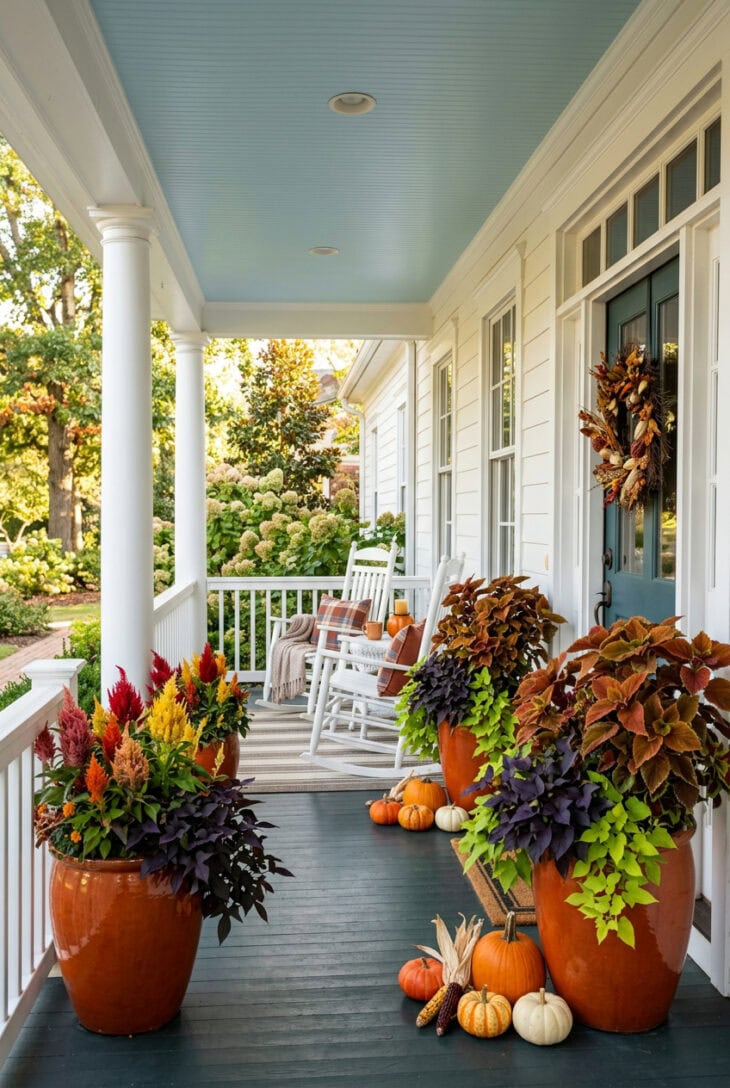
What you see A bright Southern porch with white rockers and a pale blue ceiling, where glazed orange pots brim with feathery celosia plumes in fire-engine red, orange and gold. Velvety rust and burgundy coleus stands behind them, and deep purple trails of purple heart pour down the sides. A few small pumpkins sit on the painted floor in strong, warm sun.
Why it works Across much of the South, September and October are still hot, and mums bought in early fall often fry before Halloween. Celosia and coleus relish the heat and wear the same harvest colors, so the porch reads as fall without a struggle. The purple heart spilling over the edge makes the oranges and reds look brighter still.
How to get it Choose plumed celosia (Celosia argentea var. plumosa) such as the Fresh Look series in red and gold, and a sun-tolerant coleus (Coleus scutellarioides) like ‘Redhead’ or ‘Henna’. Edge the pots with purple heart (Tradescantia pallida), which is perennial in about zones 8 to 11. Plant in pots at least 16in (40cm) across so they do not dry out by mid-afternoon, and pinch off coleus flower spikes to keep the leaves coming. This combination is at its best in zones 8 to 10. Farther north, it works in September but collapses at the first frost, so plan a second planting for later in the season.
14. A Modern Monochrome Porch
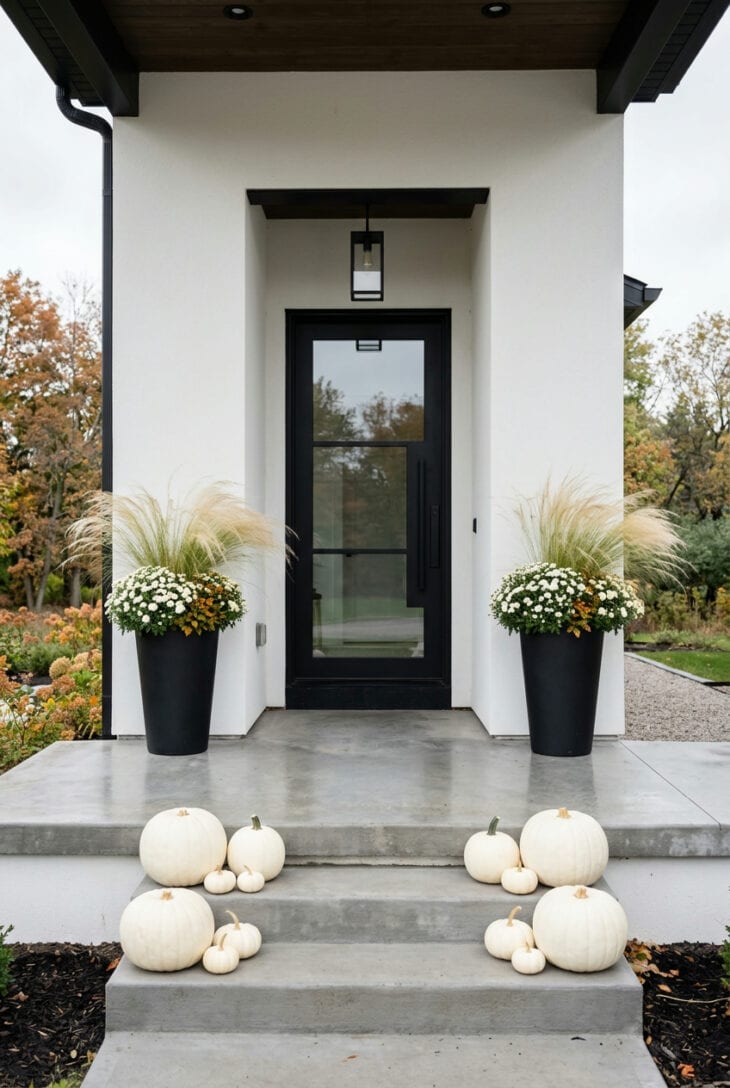
What you see A white stucco house with a black steel door, flanked by two tall matte black cylinders. Soft clouds of blond feather grass float above low mounds of white mums in each one. On the concrete steps, white pumpkins are grouped by size, from big ribbed ones to tiny minis, and there is nothing else to distract from the shapes.
Why it works Fall decorating does not have to be orange. Holding the palette to black, white and straw gives a contemporary house a seasonal feel without fighting its architecture. Symmetry and repetition do the work here, and the fine, moving grass softens all those hard edges, a balance that runs through most modern garden ideas.
How to get it Use a matched pair of lightweight fiberglass cylinders at least 24in (60cm) tall, and plant each with Mexican feather grass (Nassella tenuissima) over a ring of white garden mums. The grass self-seeds freely in warm, dry regions and is invasive in parts of California, so keep it in pots there and bag the seedheads rather than composting them. For the steps, mix large white ‘Lumina’ or ‘Casper’ pumpkins with ‘Baby Boo’ minis, grouped in odd numbers. Resist adding a colored mum or a gourd; the look falls apart with one stray color.
15. One Big Pot for a Small Stoop
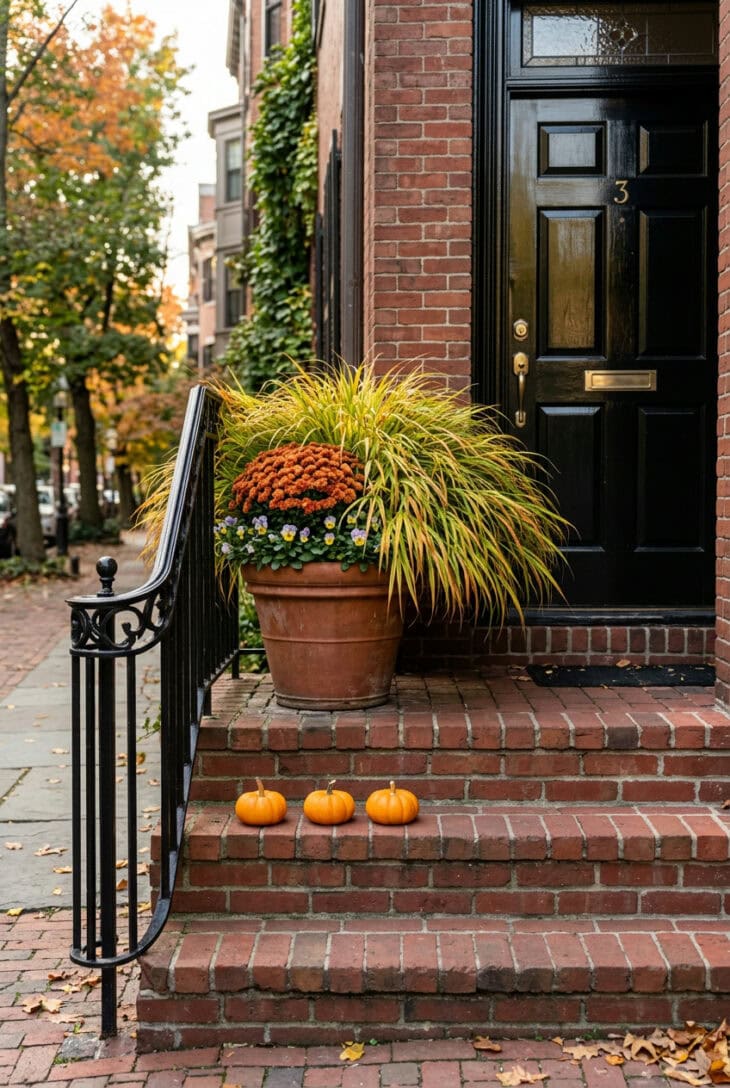
What you see A narrow brick stoop climbs to a glossy black townhouse door. On the landing sits one generous terracotta pot, spilling with golden Japanese forest grass whose arching blades are turning coppery at the tips. A burnt-orange mum nestles in the middle, and violas crowd the rim. Three mini pumpkins line up along one step, leaving plenty of room to walk.
Why it works On a small stoop, several little pots look like clutter and get kicked over. One big, well-filled pot has presence, stays wetter longer and makes the doorway look planned. The forest grass drapes like a waterfall and softens hard brick and iron, the same principle behind many small garden ideas: fewer, bigger moves.
How to get it Pick the largest pot the landing can take, ideally 16 to 18in (40 to 45cm) across. Plant Japanese forest grass (Hakonechloa macra ‘All Gold’) at the back so it falls forward, then a single mum and a ring of violas (Viola cornuta) at the edge. The grass tolerates the part shade many city stoops get, and it is hardy in zones 5 to 9, so it can move into a bed next spring. Keep at least 24in (60cm) of every step clear, especially on narrow city stairs. A cheap plastic liner inside a heavy terracotta pot makes it far easier to replant each season.
16. Tiered Wooden Crate Display
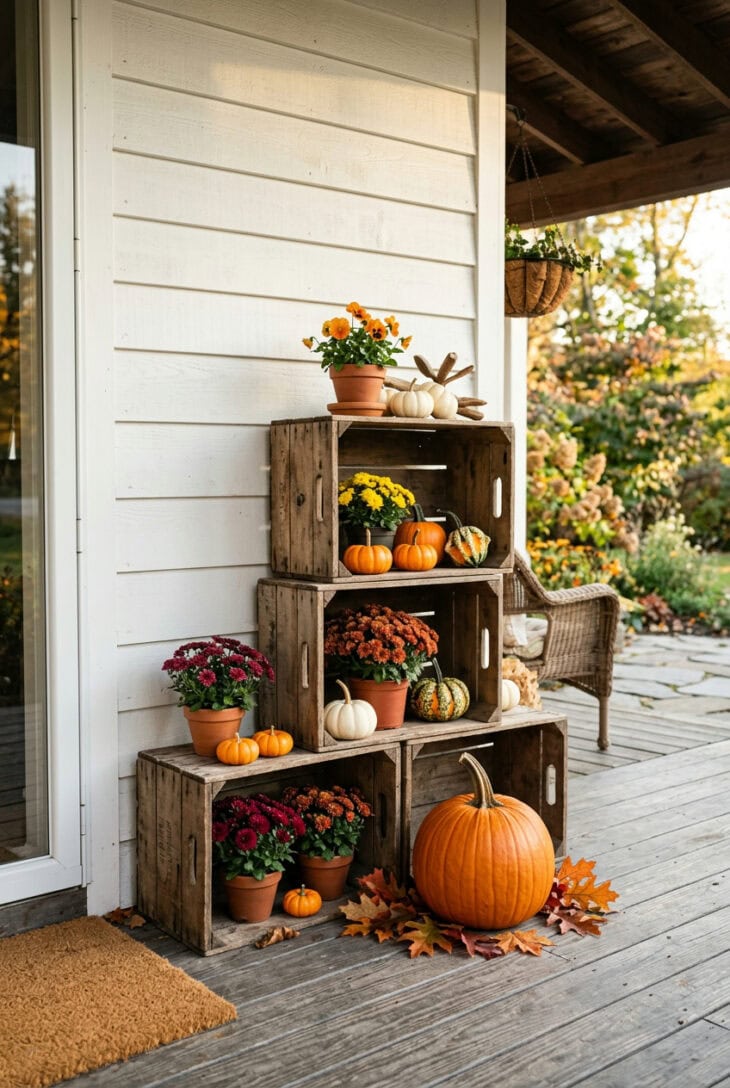
What you see Four weathered apple crates are stacked like a staircase against a white shiplap wall, their open sides turned out as shelves. Each ledge holds small pots of yellow, rust and burgundy mums, a scatter of orange and white mini pumpkins and speckled gourds. A pot of orange pansies peeks out of the lowest box, and a big pumpkin anchors the floor.
Why it works Crates turn a bare stretch of wall into a display that climbs, so a porch with little floor space still gets a lot of color. Small 6in (15cm) mums and minis are cheap, and staging them at different heights makes a handful of items look abundant. The weathered wood also holds up to the weather far better than a painted indoor shelf.
How to get it Craft stores and farm stands sell unfinished pine crates for a few dollars each; three or four is plenty. Stack them in an offset stair-step against a wall, with the heaviest crate at the bottom, and screw them together through the sides if children or dogs use the porch. Set each potted plant in a plastic saucer so water does not rot the wood. Fill the shelves with 6in (15cm) mums, ‘Jack Be Little’ and ‘Baby Boo’ mini pumpkins and a few gourds, leaving some gaps so each item reads. After fall, the same crates take poinsettias, then spring bulbs.
17. Porch Rail Planters with Ornamental Peppers
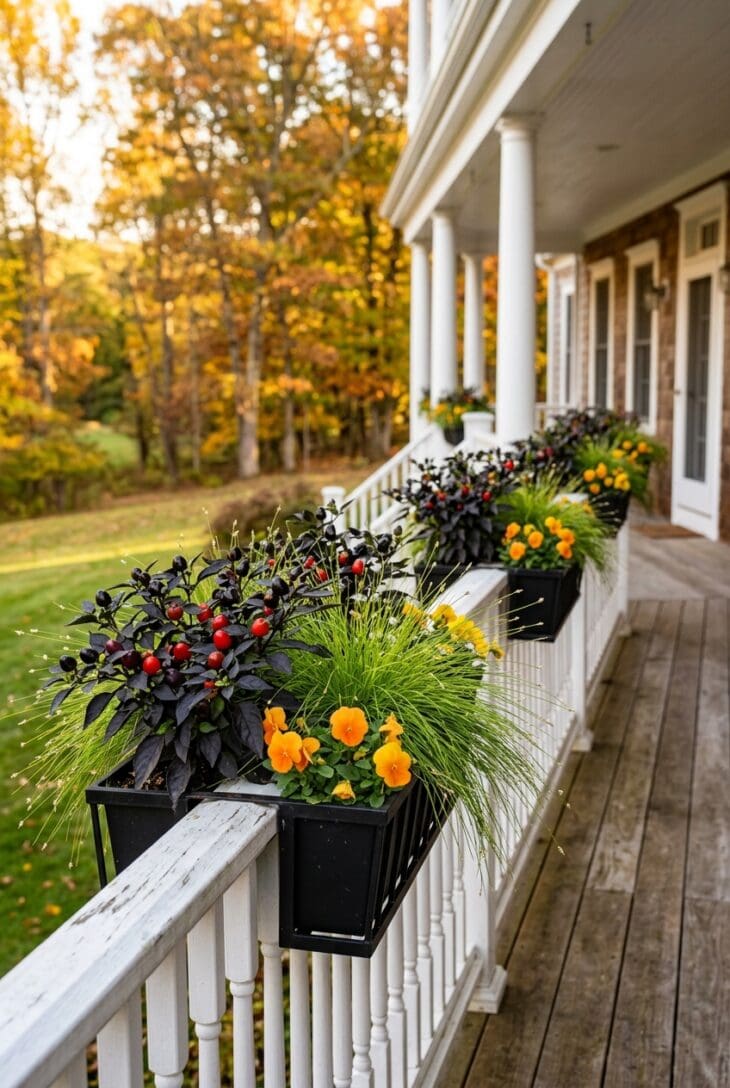
What you see Black rail planters sit along a white porch railing, packed with ornamental peppers whose purple-black leaves set off shiny round fruits in black, purple and fire-engine red. Fine green tufts of fiber optic grass spray up between them, each blade tipped with a tiny pale bead. Orange violas fill the gaps, and the yard glows gold beyond the rail.
Why it works A railing is a long, empty line that most people ignore, yet it sits right at eye level from a chair on the porch. Ornamental peppers peak in early fall, and their colors shift from black to red as the fruits ripen, so the planters change week by week. The same over-the-rail boxes are a staple of balcony garden ideas, and they suit a porch just as well.
How to get it Measure your rail before buying, since planters are made to straddle either a 2×4 or a 2×6. Plant ornamental pepper (Capsicum annuum) such as ‘Black Pearl’ or twisty-fruited ‘Medusa’ about 8in (20cm) apart, and add fiber optic grass (Isolepis cernua), which needs moist mix, and violas between them. Rail boxes dry quickly in wind and sun, so water daily and consider a mix with added moisture-retaining granules. The peppers are edible but very hot, so place them out of reach if young children visit. They are killed by frost, so plan to replace them with violas and small heucheras for the colder weeks.
18. Hyacinth Bean Vine Up the Porch Post
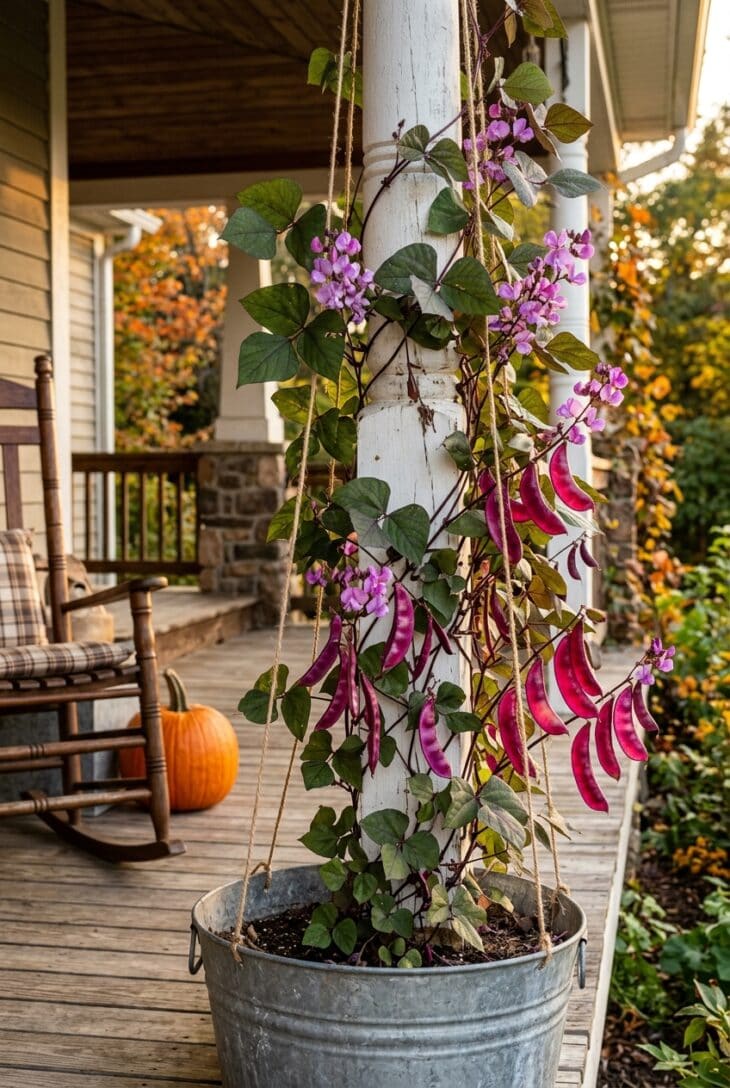
What you see A white porch post disappears under a twining vine with purple-veined, heart-shaped leaves. Sprays of lilac-pink pea flowers still bloom at the top, while lower down dozens of flat, glossy magenta pods dangle and glow in the backlight. The vine climbs jute strings out of a galvanized planter at the base, beside a rocking chair.
Why it works Most vines fade by fall, but hyacinth bean saves its best for last: the shiny purple pods appear in late summer and keep coming until frost. It gives height, shade and privacy on the side of a porch, all from a packet of seed. It is a plan-ahead idea, and a good example of growing up rather than out where floor space is tight.
How to get it Sow hyacinth bean (Lablab purpureus) seeds 1in (2.5cm) deep in late spring, once the soil is warm, either in the ground by the post or in a planter at least 18in (45cm) wide. Run three or four jute strings from the base to a hook under the porch roof, or wrap the post in wire mesh, and guide the young shoots onto them. The vine reaches 10 to 15ft (3 to 4.5m) in a single summer and wants full sun. The raw beans and seeds are toxic, so treat it as an ornamental only. Save a few dry pods at the end of the season and you will never need to buy seed again.
19. Potted Japanese Maples by the Door
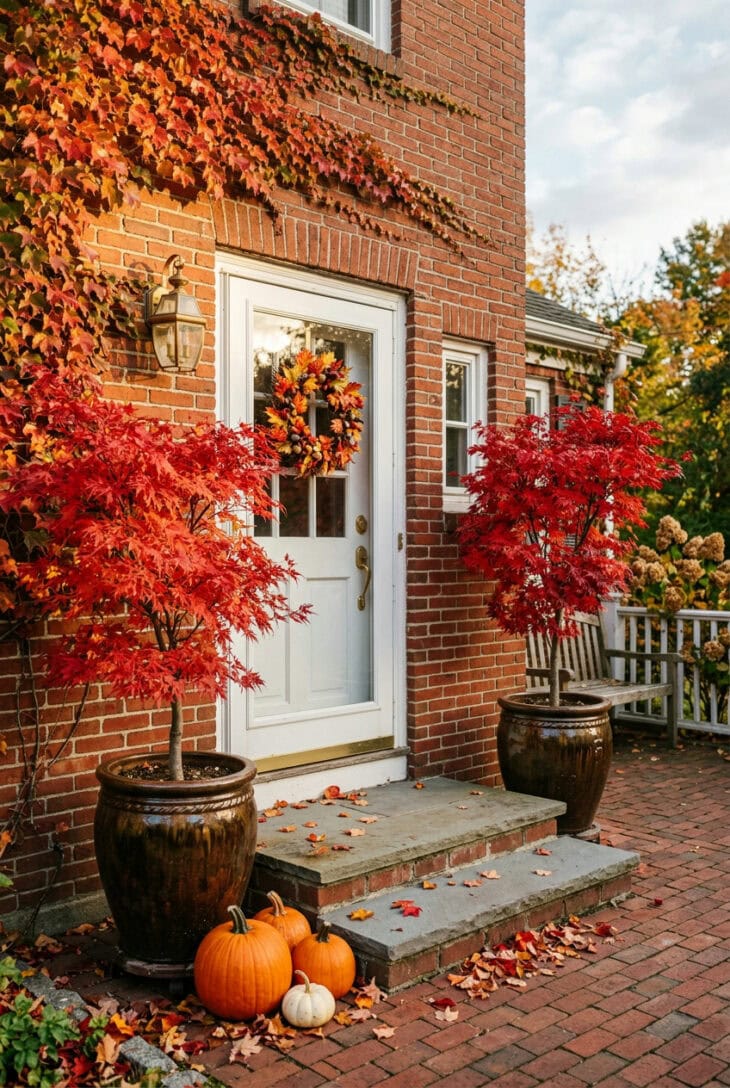
What you see Two small Japanese maples in bronze glazed pots stand either side of a white door, their lacy leaves lit up scarlet and crimson. Behind them, Boston ivy creeps over the brick in matching red. Fallen leaves are scattered on the stone steps, and a few orange pumpkins huddle at the foot of one pot.
Why it works A pair of potted trees gives a porch real architecture, and a Japanese maple in fall color outshines any cut arrangement. Unlike mums, they are a one-time purchase that returns every October and looks graceful the rest of the year too. Framing the front door with small trees makes a modest house look grander.
How to get it Choose a Japanese maple (Acer palmatum) known for fall color: ‘Osakazuki’ turns brilliant scarlet, ‘Bloodgood’ deepens to crimson, and ‘Sango-kaku’ goes gold with coral stems for winter. Plant in pots at least 18 to 24in (45 to 60cm) wide with a bark-rich, free-draining mix, and give them morning sun with afternoon shade to prevent leaf scorch. In zones 6 and colder, move the pots into an unheated garage once the leaves drop and water them about once a month. On a brick wall, Boston ivy (Parthenocissus tricuspidata) adds a crimson backdrop, but keep it off wood siding and painted trim, where its sticky pads leave marks.
20. Native Asters and Goldenrod Instead of Mums
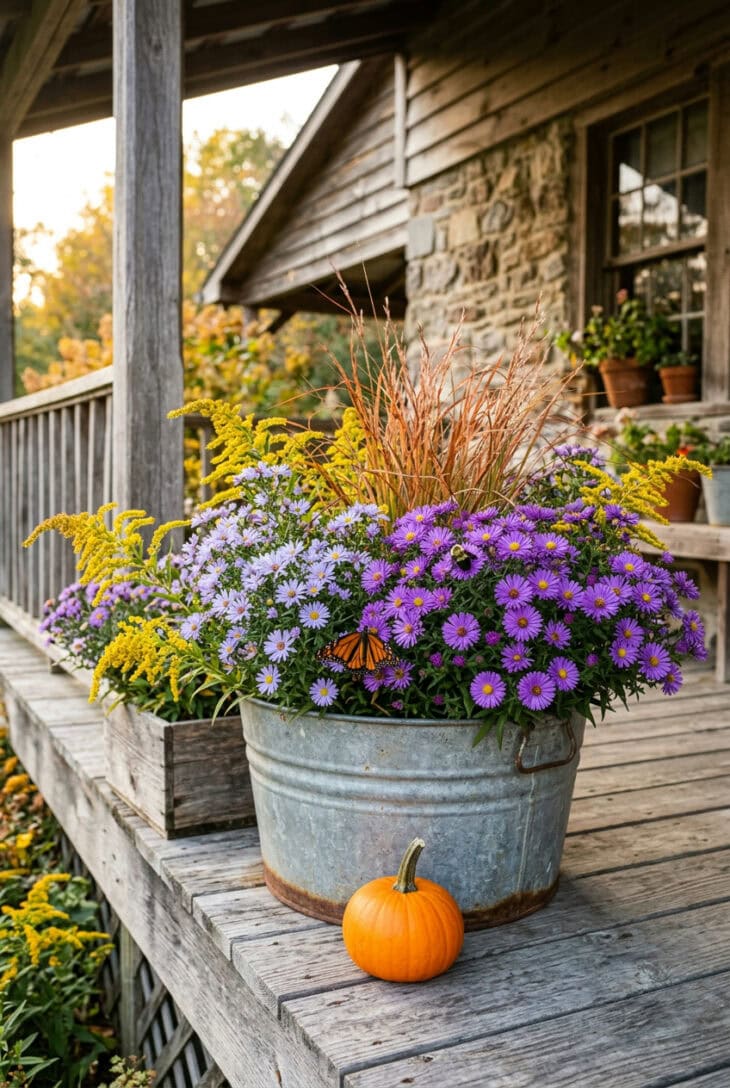
What you see A sunny porch lined with weathered planters and a galvanized tub, all filled with native fall flowers. Violet New England asters and paler lavender aromatic asters form soft mounds, golden goldenrod arches between them, and copper-red little bluestem adds a grassy spike. Bumblebees work the flowers and a monarch butterfly rests on the purple.
Why it works Most florist-style mums have tightly doubled flowers that offer bees very little. Asters and goldenrod are among the most important late-season food sources in North America, fueling bumblebee queens before winter and monarchs on their way south, which makes this a natural extension of any butterfly garden. The purple and gold also look richer than most mum mixes.
How to get it Look for compact cultivars that suit pots: New England aster (Symphyotrichum novae-angliae ‘Purple Dome’) at about 18in (45cm), aromatic aster (Symphyotrichum oblongifolium ‘October Skies’), and goldenrod (Solidago sphacelata ‘Golden Fleece’). Add little bluestem (Schizachyrium scoparium ‘Standing Ovation’) for its copper fall color. Goldenrod does not cause hay fever; that is ragweed, which blooms at the same time. These are hardy perennials, so plant them into the garden at least six weeks before the ground freezes and they will return as part of a pollinator garden next year.
21. Edible Planters of Chard, Kale and Herbs
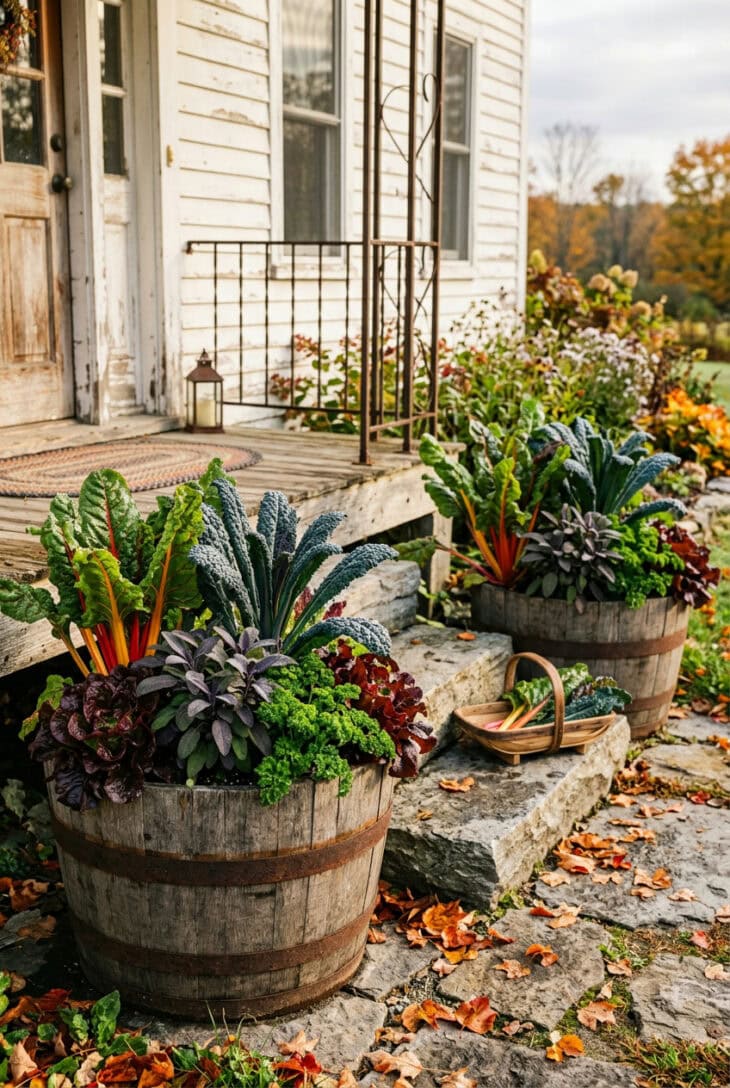
What you see Two wooden half barrels beside the porch step look ornamental at first glance. Then you notice the rainbow chard stems glowing red, orange and yellow, the crinkled purple kale, soft purple sage, bright curly parsley and burgundy lettuce ruffles at the front. A small harvest basket with a few picked leaves waits on the step in the morning dew.
Why it works Cool-season crops wear fall colors naturally, and they are happiest in exactly the weather when the porch needs refreshing. A container you can cook from earns its place twice over, and keeping it by the door means you actually pick it. It is a handy spillover for your herb garden, with the sage and parsley within reach of the kitchen.
How to get it Plant transplants in early September so they settle before the cold. Use ‘Bright Lights’ Swiss chard (Beta vulgaris) at the back, ‘Redbor’ kale (Brassica oleracea) in the middle, and purple sage (Salvia officinalis ‘Purpurascens’), curly parsley (Petroselinum crispum) and ‘Merlot’ lettuce (Lactuca sativa) toward the front. Space them a little closer than you would in the ground, about 8in (20cm) apart. Harvest the outer leaves only, so each plant keeps its shape. Kale turns sweeter after frost and chard handles light freezes, so the barrels often stay productive into December in zones 6 and warmer.
22. Lantern-Lit Steps at Dusk
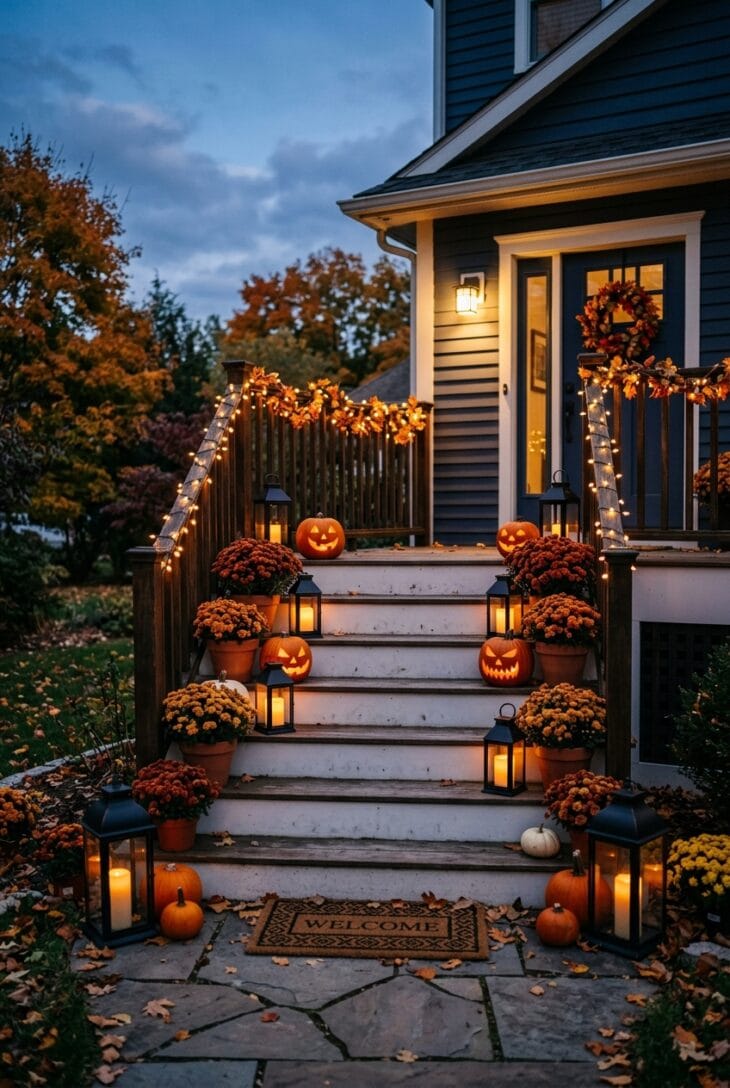
What you see Twilight has turned the sky deep blue, and the porch steps glow. Black lanterns with flickering candles alternate with carved jack-o’-lanterns lit from within and potted rust mums. String lights trace the railing overhead, and two more lanterns lead the way down to the flagstone walk.
Why it works In fall, most people see their porch after dark. Lighting turns the same mums and pumpkins into an evening scene, guides guests safely up the steps and makes the house feel lived in and welcoming. It fits naturally with Halloween garden ideas but works right through November, and the same principles apply to any set of garden lighting ideas.
How to get it Use battery LED candles with a built-in six-hour timer rather than real flames; a porch full of dry corn stalks, straw and dried flowers is no place for open fire. Put LED puck lights inside carved pumpkins too, since a candle cooks the flesh and speeds rot. Choose lanterns of two or three heights and place them on alternate sides of the steps, following the same zigzag as the mums. Drape warm white string lights (about 2700K) along the railing, never cool white, which looks harsh against orange. Carry a pair of lanterns down onto the garden path so the light meets visitors before they reach the steps.
23. A Harvest Still Life on an Old Bench
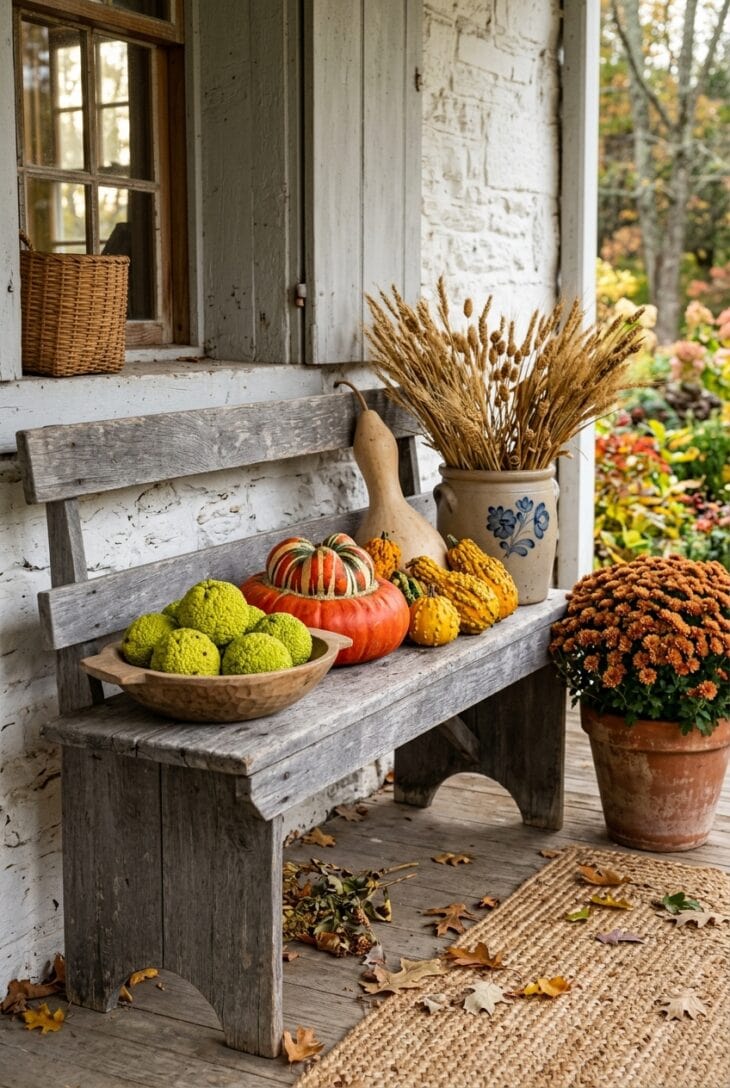
What you see An old gray bench against a whitewashed wall becomes a harvest table. A wooden bowl holds a pile of bumpy, brain-like chartreuse fruits, and beside it sits a red-orange Turk’s Turban squash with its striped cap. Warty gourds, a pale bottle gourd and a crock of golden wheat fill out the scene, with a bronze mum at the bench’s feet.
Why it works Grouping everything on one surface creates a focal point, like a painting hung on the porch wall. Odd shapes and unexpected greens keep the eye moving far longer than a row of identical orange pumpkins. It also needs no watering at all, which makes it a good fall setup for anyone who travels.
How to get it Gather osage orange (Maclura pomifera) fruits, sold as hedge apples at farm stands in the Midwest and South; they are inedible, and the milky sap can irritate skin, so wear gloves. They are often said to repel spiders, but there is no good evidence for it, and the harmless garden spiders on your porch are welcome pest control anyway. Add a Turk’s Turban squash (Cucurbita maxima), warty ornamental gourds (Cucurbita pepo) and a bottle gourd (Lagenaria siceraria). Build the arrangement around the tallest piece, then fill toward the ends with smaller items so it forms a loose triangle. Check weekly and remove anything that softens, before it leaks onto the wood.
24. A Cozy Seating Nook with Potted Grasses
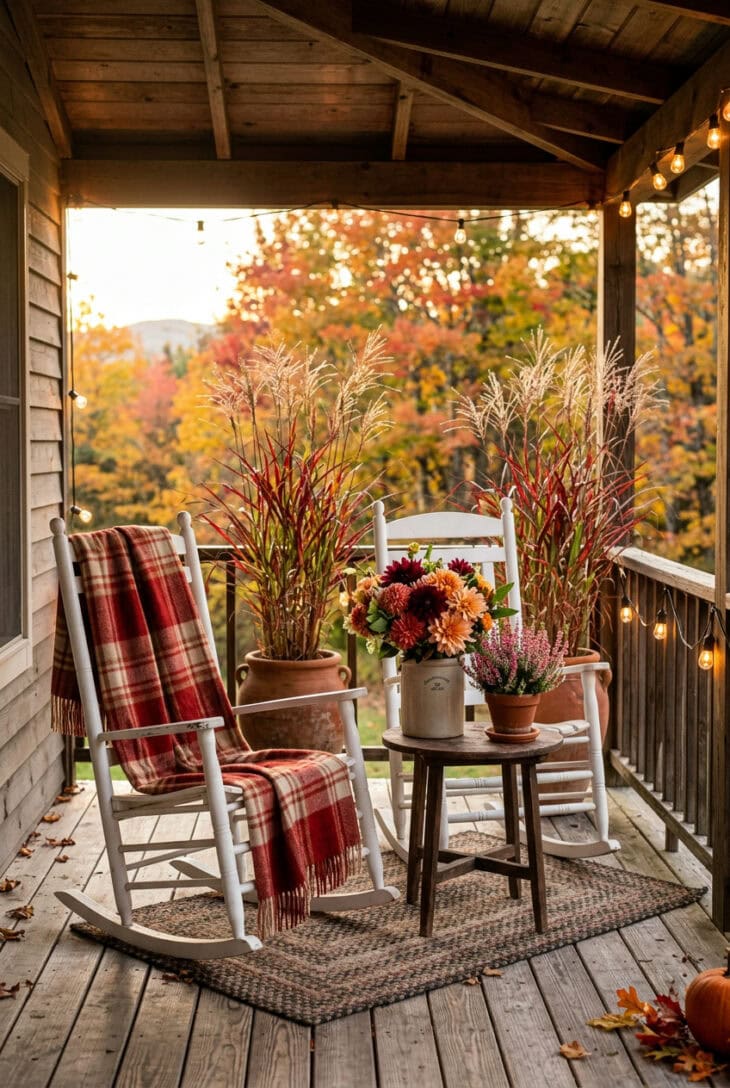
What you see Two white rockers angle toward each other in a corner of the porch, one draped with a red plaid throw. On the little table between them sits a crock of burgundy, peach and orange dahlias and a small pot of pink heather. Tall pots of switchgrass behind the chairs are turning wine-red at the tips, their airy seedheads catching the gold light.
Why it works A porch you actually sit on feels more inviting than one that is only decorated. The tall grasses create a sense of enclosure behind the chairs, like a low hedge, and they rustle in the breeze. Treating the porch as an outdoor room is the same thinking behind the best patio garden ideas, simply scaled to a corner.
How to get it Plant switchgrass (Panicum virgatum ‘Shenandoah’), which turns burgundy-red in fall, in pots at least 18in (45cm) across and place them behind or beside the seating. It is hardy in zones 4 to 9 and can stay in the pot or go into a border later. Set a small pot of heather (Calluna vulgaris) on the table; it needs acidic, sharply drained mix and should never dry out completely. Fill a crock with the last dahlias before frost blackens them, a small reward from a cut flower garden, and change the water every two days. Add a throw and a cushion in fall colors, and bring them in on damp nights.
25. A Late-Blooming Bed Along the Porch Front
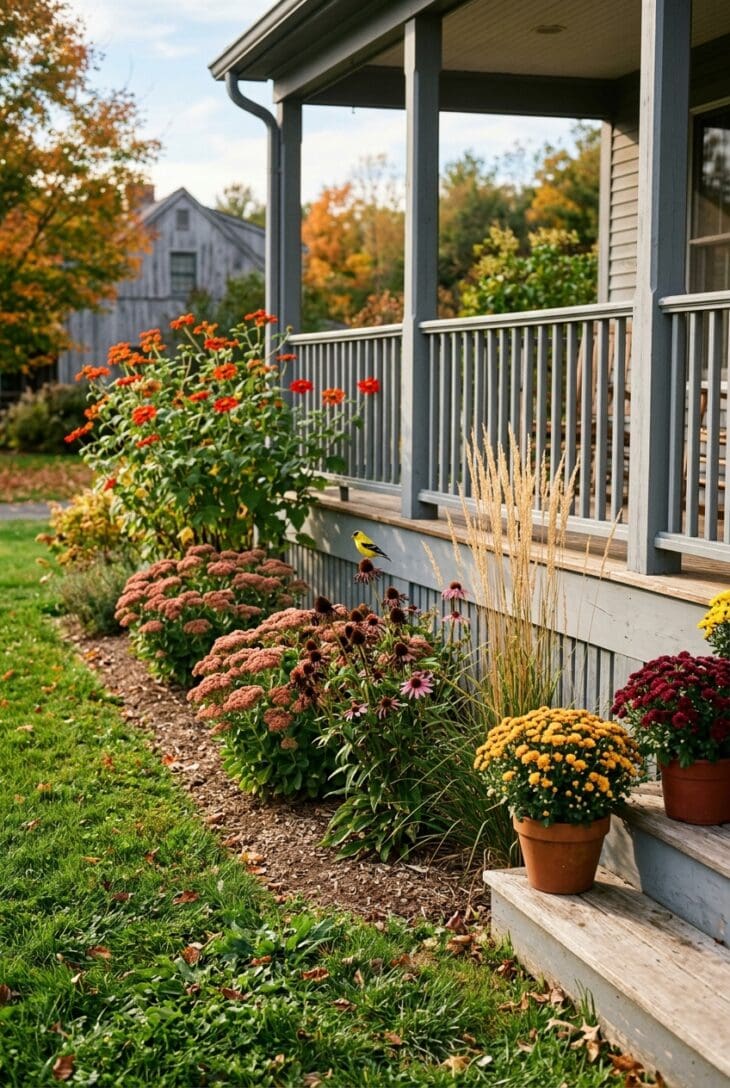
What you see A bed runs along the front of a gray porch, planted to peak in fall. Tall Mexican sunflowers blaze orange-red at the back, rosy-rust sedum heads fill the middle, and purple coneflowers stand with dark seedheads and a few late pink blooms. Upright straw-colored grass stitches it all together, and a goldfinch picks at a seedhead.
Why it works Pots are only half the story. A bed planted for late color means the porch sits in a frame of flowers every fall with no shopping trip at all. Mexican sunflowers bloom until frost, sedum shifts from pink to rust, and seedheads feed birds into winter, so the bed gets more interesting as the season goes on, just as a good flower bed should.
How to get it Sow Mexican sunflower (Tithonia rotundifolia ‘Torch’) directly in late spring after the last frost; it reaches 4 to 6ft (1.2 to 1.8m) in full sun and blooms from midsummer. In front, plant sedum (Hylotelephium ‘Herbstfreude’, sold as ‘Autumn Joy’) and purple coneflower (Echinacea purpurea) about 18in (45cm) apart, with feather reed grass (Calamagrostis × acutiflora ‘Karl Foerster’) repeated at intervals. Leave at least 3ft (90cm) of depth so the tall plants do not lean over the steps. Skip deadheading the coneflowers from September on, and leave the seedheads standing through winter for goldfinches.