Planting bulbs takes a small leap of faith. You bury dry, papery bulbs in cold soil in October, forget about them all winter, and then one gray morning in March the first crocus opens and the garden starts over. Few plants give back so much for a single afternoon’s work.
Contents
- 01. Layer a Bulb Lasagna Pot
- 02. Naturalize Daffodils in Rough Grass
- 03. Scatter Crocus Through the Lawn
- 04. Plant a Grape Hyacinth River
- 05. Float Allium Globes Over Catmint
- 06. Carpet a Woodland Floor With Snowdrops
- 07. Grow a Tulip Cutting Bed
- 08. Plant Tulips Through Forget-Me-Nots
- 09. Tuck Species Tulips Into a Rock Garden
- 10. Line the Front Walk With Hyacinths
- 11. Ring a Flowering Tree With Bulbs
- 12. Spread a Blue Carpet of Squill and Glory-of-the-Snow
- 13. Build an All-White Moonlit Bulb Border
- 14. Make a Statement With Crown Imperials
- 15. Plant Camassia and Snake’s Head Fritillary in Damp Ground
- 16. Plant a Deer-Resistant Bulb Border
- 17. Fill a Window Box With Miniature Bulbs
- 18. Try a Hot Orange and Purple Tulip Scheme
- 19. Let Tulips Rise Through Creeping Phlox
- 20. Pair Hellebores With Early Bulbs by the Back Door
- 21. Hide Fading Bulb Foliage Among Hostas and Ferns
- 22. Fill a Box Parterre With Tulips
- 23. Grow Anemones and Ranunculus in a Warm-Climate Bed
- 24. Plant Dwarf Iris in a Stone Trough
- 25. Plan a Succession Border From March to June
The 25 ideas below run from the first snowdrops of late winter to the alliums that close out spring in June. Some are big, like a meadow of naturalized daffodils or a formal tulip parterre, and others fit a window box or one pot by the door. There are ideas for sun and shade, wet ground and dry, deer country and mild Southern winters, and many of them cost little more than a bag of grape hyacinths.
Scroll through for inspiration, or jump to the ideas that suit your yard. Every one of them is planted now: most bulbs go in once the soil cools below 60°F (16°C), from late September in the North to November or December in the South. Order early, while the best varieties are still in stock.
01. Layer a Bulb Lasagna Pot
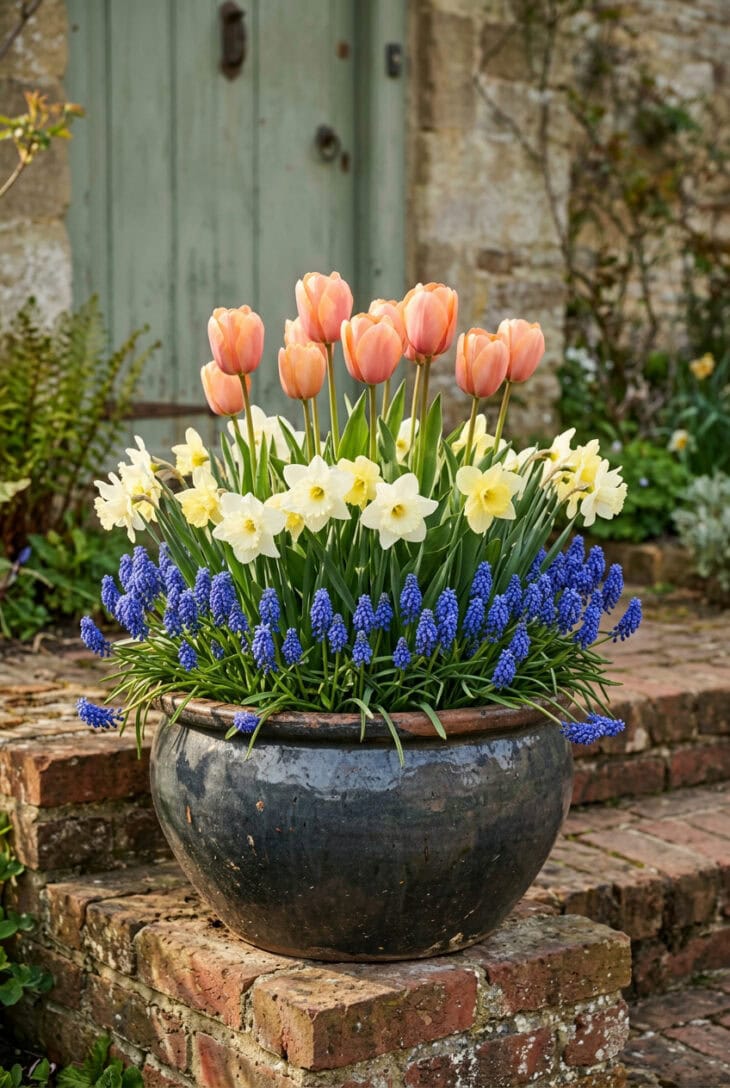
What you see A generous charcoal pot on a brick step overflows with three tiers of flowers: tall apricot tulips on top, creamy daffodils nodding below them, and a ring of blue grape hyacinths spilling over the rim. Everything is in bloom at once, so the pot looks full from every angle. Morning light catches the tulip petals against the weathered door behind.
Why it works A lasagna pot stacks bulbs by planting depth, so one container holds two or three times the flowers a single layer could. The lower bulbs push up past the ones above without any trouble, and because each layer blooms at a slightly different time, the display runs for five or six weeks. It is one of the simplest container garden ideas for a doorstep, since the whole thing is planted in one afternoon.
How to get it Use a pot at least 16in (40cm) wide and deep with a drainage hole, and fill the bottom third with gritty potting mix. Set tulips such as ‘Apricot Beauty’ almost touching at about 8in (20cm) below the rim, cover them with 2in (5cm) of mix, add a layer of daffodils such as ‘Ice Follies’, cover again, and finish with grape hyacinths (Muscari armeniacum) 3in (8cm) from the top. Water once after planting, then only when the mix is dry an inch down. In zone 6 or colder the soil in a pot freezes solid, so move it into an unheated garage or shed from December to early March. The usual mistake is a pot that is too small: bulbs need room to root before winter.
02. Naturalize Daffodils in Rough Grass
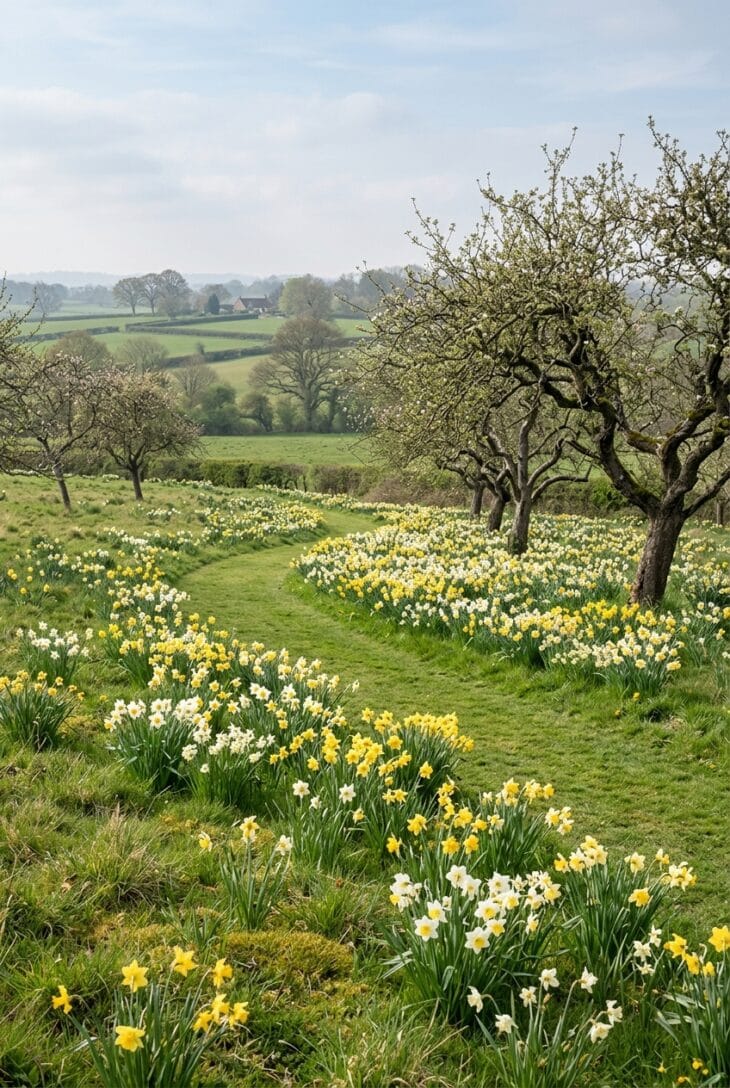
What you see Loose drifts of yellow and white daffodils spread through long grass beneath a few gnarled apple trees, thick in some places and thinning out at the edges as if they had seeded there on their own. A mown path cuts a clean curve through the flowers. The light is soft and hazy, and the grass is the fresh green of early April.
Why it works Daffodils are the most reliable perennial bulb there is: they come back and multiply for decades, and deer, voles and squirrels leave them alone because every part of the plant is toxic. Planted in grass, they need no bed, no weeding and no replanting, which makes them the easiest of all low-maintenance garden ideas. The mown path turns a patch of rough grass into something that looks deliberate.
How to get it Buy named varieties by the hundred rather than a cheap mixed bag: ‘February Gold’ for early yellow, ‘Ice Follies’ and ‘Carlton’ for mid-season, and poet’s narcissus (Narcissus poeticus ‘Actaea’) to finish in May. For a natural look, toss handfuls across the area and plant each bulb where it lands, about 6in (15cm) deep with the point up. A long-handled bulb planter saves your back in turf. Most daffodils are hardy in zones 3 to 8. The one rule that matters: do not mow the grass until the daffodil leaves have yellowed, about six weeks after flowering, or the bulbs will not build up enough energy to bloom next year.
03. Scatter Crocus Through the Lawn
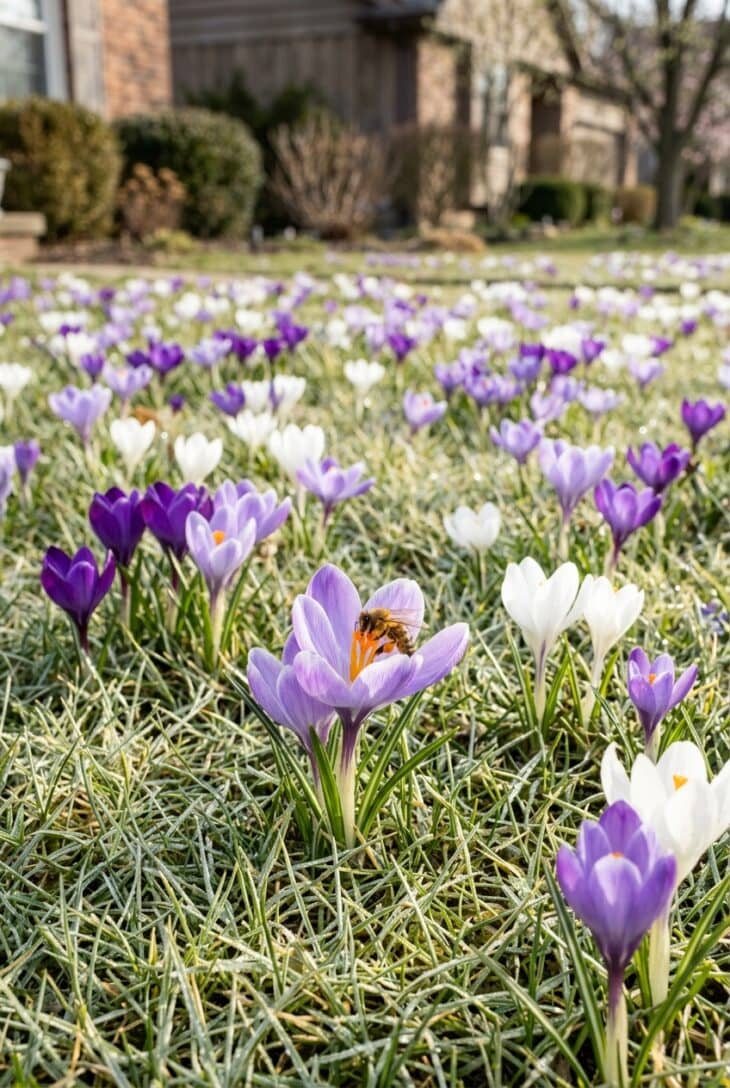
What you see A plain lawn in early March, still pale from winter, is spangled with hundreds of crocus flowers open flat in the sun. Lavender, violet and white goblets show off their orange stamens, and a honeybee has buried itself in one of them. Everything else in the garden is still asleep.
Why it works Crocus bloom and fade before the grass needs its first cut, so the lawn gets a whole extra season without losing any of its summer use. They are also one of the first pollen sources of the year for bees coming out of winter, which earns them a place among the best early pollinator garden ideas. Scattered at random rather than in rows, they look as if they arrived on their own.
How to get it Choose the early “tommy” crocus (Crocus tommasinianus ‘Ruby Giant’ or ‘Barr’s Purple’), hardy in zones 3 to 8, which spreads well in grass and is less appealing to squirrels than the large Dutch crocus. Plant in September or October, about 3in (8cm) deep and 10 to 15 corms per square foot. The quickest method is to cut an H in the turf with a spade, fold back the flaps, drop in a handful of corms and press the sod back down. Hold off on the first mow until the crocus leaves have yellowed, usually by early May. Avoid weed-and-feed products on that part of the lawn in spring.
04. Plant a Grape Hyacinth River
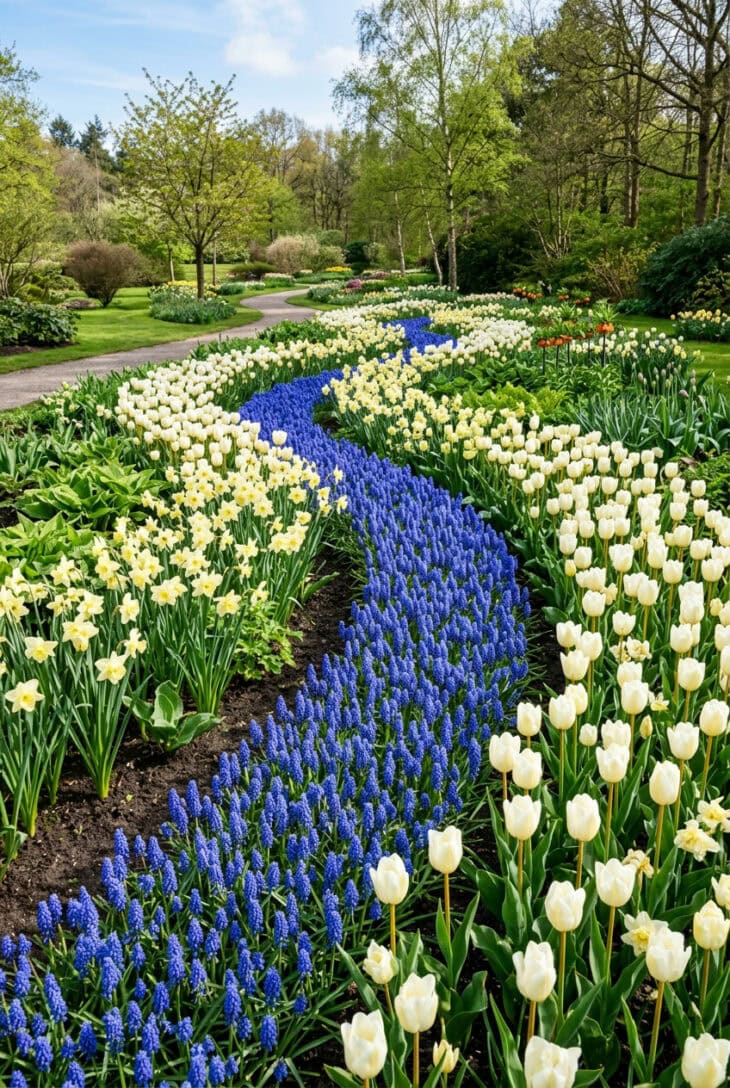
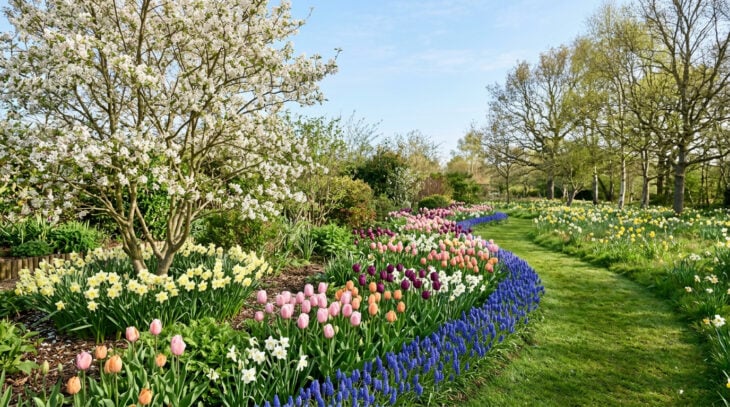
What you see A ribbon of deep blue grape hyacinths winds through a spring border like a stream, about two feet across and packed so tightly that no soil shows. Creamy white tulips and pale lemon daffodils stand on its banks. The curve pulls your eye from the front of the bed all the way to the back.
Why it works A single line of strong color gives a mixed planting a shape you can read from across the yard, the same trick the big Dutch bulb gardens use. Grape hyacinths are ideal for it: they are cheap by the hundred, short enough to stay tidy, and a true saturated blue that makes white and yellow look brighter. They also come back every year and slowly thicken the river.
How to get it Lay out the curve with a garden hose in fall, then dig a shallow trench 3in (8cm) deep and 12 to 24in (30 to 60cm) wide. Plant grape hyacinths (Muscari armeniacum), hardy in zones 4 to 8, about 2 to 3in (5 to 8cm) apart, which works out at roughly 20 bulbs per square foot: a river 2ft (60cm) wide and 10ft (3m) long takes about 400. Add a few pale ‘Valerie Finnis’ along the edges for a lighter shoreline. Grassy leaves appear in fall; that is normal and they will not be harmed by winter. Muscari seeds itself freely, so cut the spent flower spikes if you want the banks to stay crisp.
05. Float Allium Globes Over Catmint
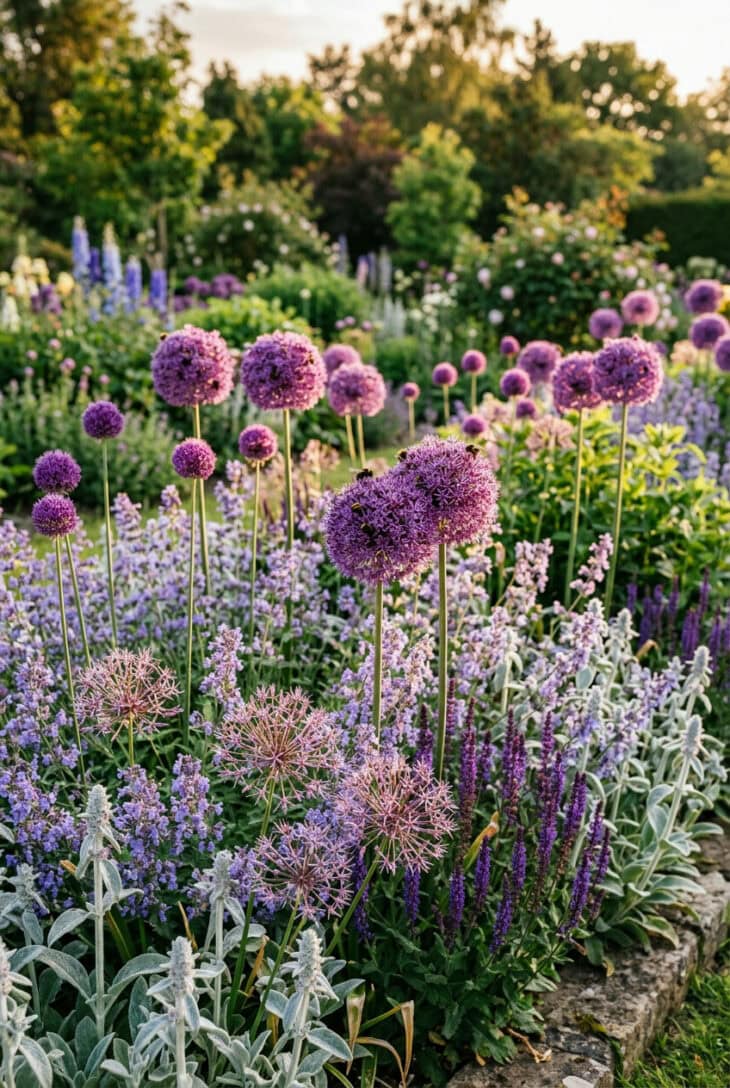
What you see Purple allium globes hang in the air above a cloud of lavender-blue catmint, some as big as a grapefruit, others small and starry. Their stems vanish into the foliage below, so the flowers seem to float. Bumblebees move from head to head in the warm evening light.
Why it works Allium leaves start to yellow and look tatty just as the flowers open, and catmint grows up at exactly the right moment to hide them. The pairing bridges the gap between tulips and summer perennials, and the dried seedheads stay handsome into July. It is a staple of perennial garden designs because both plants come back every year with no fuss, and deer and rodents avoid both.
How to get it Mix three alliums for a longer show: ‘Purple Sensation’ (Allium hollandicum), about 30in (75cm) and affordable, for mid-May; ‘Globemaster’, with heads up to 8in (20cm) across on 3ft (90cm) stems, for late May; and star of Persia (Allium cristophii), 18in (45cm) with metallic starry heads, for the front. Plant them 6 to 8in (15 to 20cm) deep and 8in (20cm) apart in full sun and well-drained soil, zones 4 to 8. Set catmint (Nepeta ‘Walker’s Low’) 24in (60cm) apart among them in fall or spring. Leave the seedheads standing after bloom rather than cutting them.
06. Carpet a Woodland Floor With Snowdrops

What you see Under bare gray trees, the ground is white with nodding snowdrops and splashed with the buttercup yellow of winter aconites, each flower sitting on its own green ruff. They push up through last year’s brown leaves and around mossy roots. Pale sun slants between the trunks as the frost melts.
Why it works These bulbs flower, set seed and die back before the trees overhead leaf out, so they use the light that reaches the woodland floor in February and are gone by the time it turns shady and dry. Given a few years undisturbed, they seed and spread into the kind of carpet you see in old gardens. Nothing else will give you flowers this early for so little effort.
How to get it Plant common snowdrops (Galanthus nivalis), hardy in zones 3 to 7, or the larger giant snowdrop (Galanthus elwesii), which copes better with heat into zone 8, with winter aconite (Eranthis hyemalis), zones 3 to 7. Both dry out quickly as dormant bulbs, so order early and plant the day they arrive in September, about 3in (8cm) deep and 3in (8cm) apart in humus-rich soil under deciduous trees or shrubs; soak the aconite tubers overnight first. Better still, split a friend’s clump right after it flowers and replant it “in the green”. Leave the fallen leaves in place as mulch. For a yellow echo overhead, plant a Cornelian cherry dogwood (Cornus mas), which blooms at the same time.
07. Grow a Tulip Cutting Bed
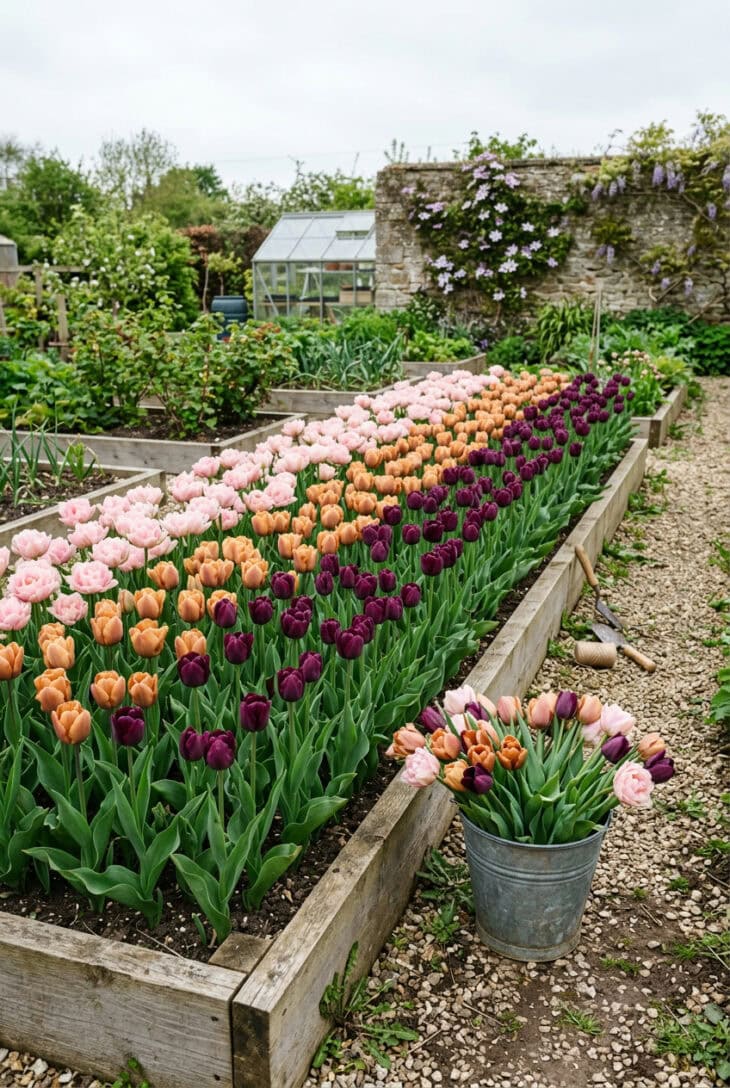
What you see A raised cedar bed is packed wall to wall with tulips in neat rows: blush-pink doubles as full as peonies, apricot and copper singles, and a deep purple one to set them off. They stand shoulder to shoulder at the same height. A galvanized bucket on the path already holds a fresh-cut armful.
Why it works Cutting tulips from a flower border leaves holes in it, so growers keep a separate bed that exists only to be harvested. A raised bed drains fast and warms early, which tulips love, and at waist height the harvest is easy. It is one of the most rewarding cut flower garden ideas because a bed the size of a door can fill vases for a month.
How to get it Treat the tulips as annuals and plant them almost touching, about 1in (2.5cm) apart and 6in (15cm) deep, in late October or November once the soil drops below 60°F (16°C). Good cutting varieties include ‘Angélique’ (a late pink double), ‘Menton’ (tall apricot-pink), ‘Brown Sugar’ (copper-orange and scented) and ‘Negrita’ (purple). Cut when the bud is colored but still closed; tulips keep growing 1 to 2in (2.5 to 5cm) in the vase. For the longest stems, pull the whole plant and snip off the bulb. Replant with fresh bulbs each fall, and use the empty bed for summer crops in the meantime, as in many raised bed layouts.
08. Plant Tulips Through Forget-Me-Nots
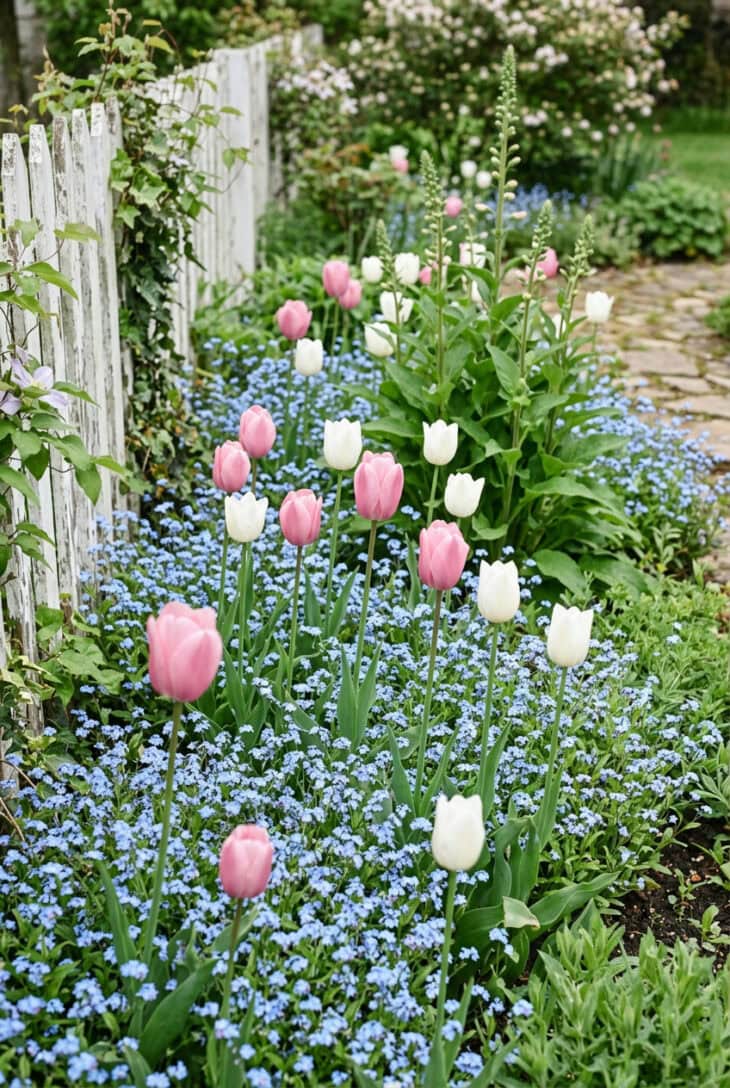
What you see Soft pink and white tulips rise on slender stems from a haze of tiny sky-blue forget-me-nots. The blue flowers fill every gap at their feet, so the tulips seem to stand in water. A weathered picket fence runs behind, with fresh foxglove leaves waiting for their turn.
Why it works Tulips on bare soil look stiff and lonely; forget-me-nots cover the ground, hide the tulip leaves and soften the whole bed. That clear pale blue flatters every tulip color, from white to deep plum. The pairing is a classic of cottage garden planting, and because forget-me-nots seed themselves, it renews itself from one year to the next.
How to get it Plant tulips first, in October or November, 6in (15cm) deep and 5in (13cm) apart. ‘Pink Impression’, a Darwin hybrid, is one of the tulips most likely to return for a few years; add white ‘Purissima’ for contrast. Then set out forget-me-not plants (Myosotis sylvatica), hardy in zones 3 to 8, about 8in (20cm) apart over the top, or sow seed the previous August so plants are ready. In June, when the forget-me-nots turn gray and mildewed, pull them up and shake them over the bed to drop their seed. Thin the seedlings in fall so they do not smother the tulips.
09. Tuck Species Tulips Into a Rock Garden
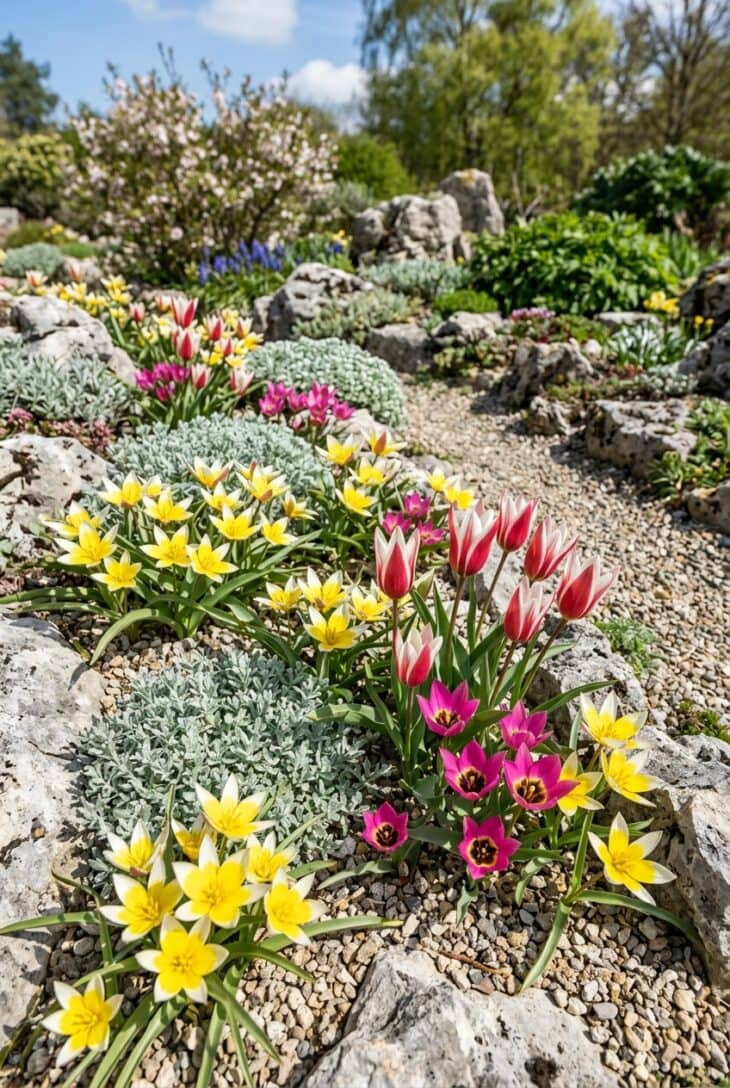
What you see Small wild tulips open flat as stars among pale limestone and gravel: clusters of yellow and white, slender red-and-white candy stripes, and a few magenta cups with dark eyes. None of them is taller than a hand. They glitter in the midday sun between low silver cushions.
Why it works Species tulips are close to the wild plants of Central Asian hillsides, and unlike big hybrid tulips they come back and multiply for years if they get the hot, dry summer rest they are used to. A rock garden gives them exactly that. Their small scale matches the rocks and alpines, which is why they belong in almost any list of rock garden ideas.
How to get it Try late tulip (Tulipa tarda), yellow and white and just 4 to 6in (10 to 15cm) tall, zones 4 to 8; lady tulip (Tulipa clusiana ‘Cynthia’ or ‘Lady Jane’), one of the few tulips that also returns in zone 8 and parts of zone 9; and Tulipa humilis ‘Persian Pearl’ for magenta. Plant them 4 to 5in (10 to 13cm) deep and 3in (8cm) apart in groups of ten or more, with a handful of grit under each group. Choose the sunniest, best-drained pocket you have, and do not water them in summer. The flowers close on cloudy days and open wide in sun, so site them where the sun reaches them from midmorning.
10. Line the Front Walk With Hyacinths
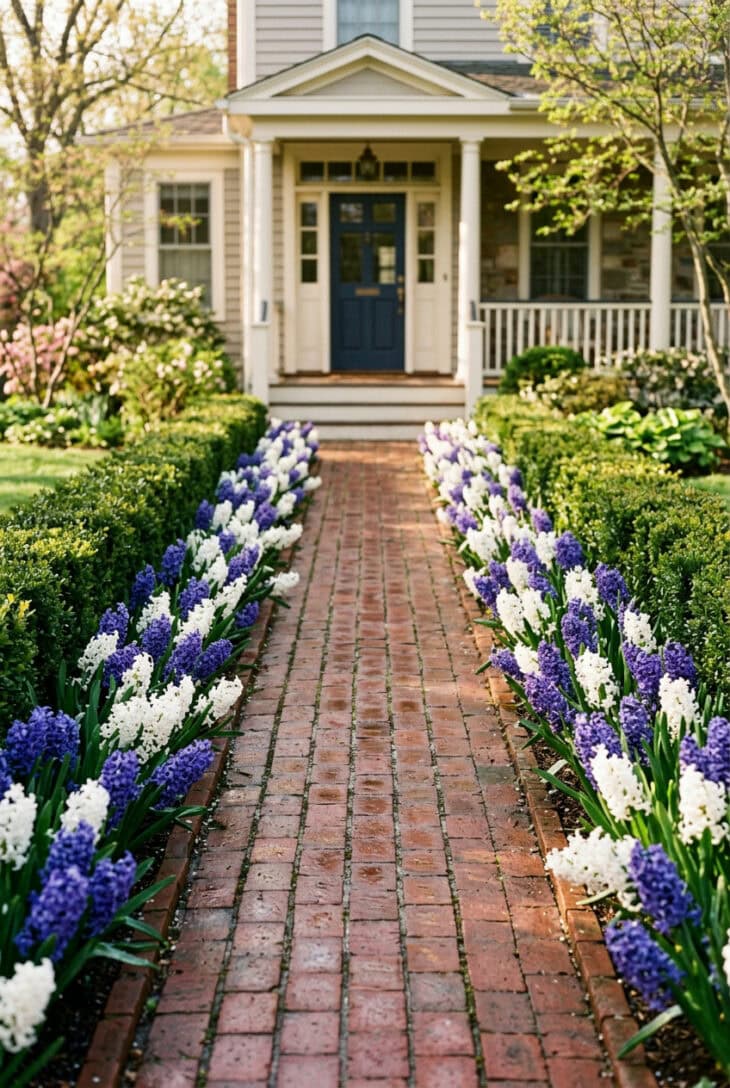
What you see A brick walk leads straight to the front porch between two bands of fat hyacinths in deep violet-blue and white, backed by a low boxwood edge. Dew still glistens on the bricks. You can almost smell it: the scent reaches you before you reach the door.
Why it works Hyacinths have one of the strongest scents of any spring flower, so putting them along the path means you walk through the fragrance every time you come home. Their stiff, compact spikes stand up to spring rain and do not flop onto the walk. A repeated two-color band is a quick way to add curb appeal, and it suits the formal lines of most front garden designs.
How to get it Plant ‘Delft Blue’ and white ‘Carnegie’ hyacinths (Hyacinthus orientalis), hardy in zones 4 to 8, in October, about 6in (15cm) deep and 6in (15cm) apart, set back 8in (20cm) from the edge of the walk. Alternate the colors or plant them in blocks of five. Wear gloves, because the bulbs can make your skin itch. The first year’s spikes are dense and formal; in later years they become looser and more natural, and many gardeners top up the line every few years. Deer and squirrels usually pass them by.
11. Ring a Flowering Tree With Bulbs
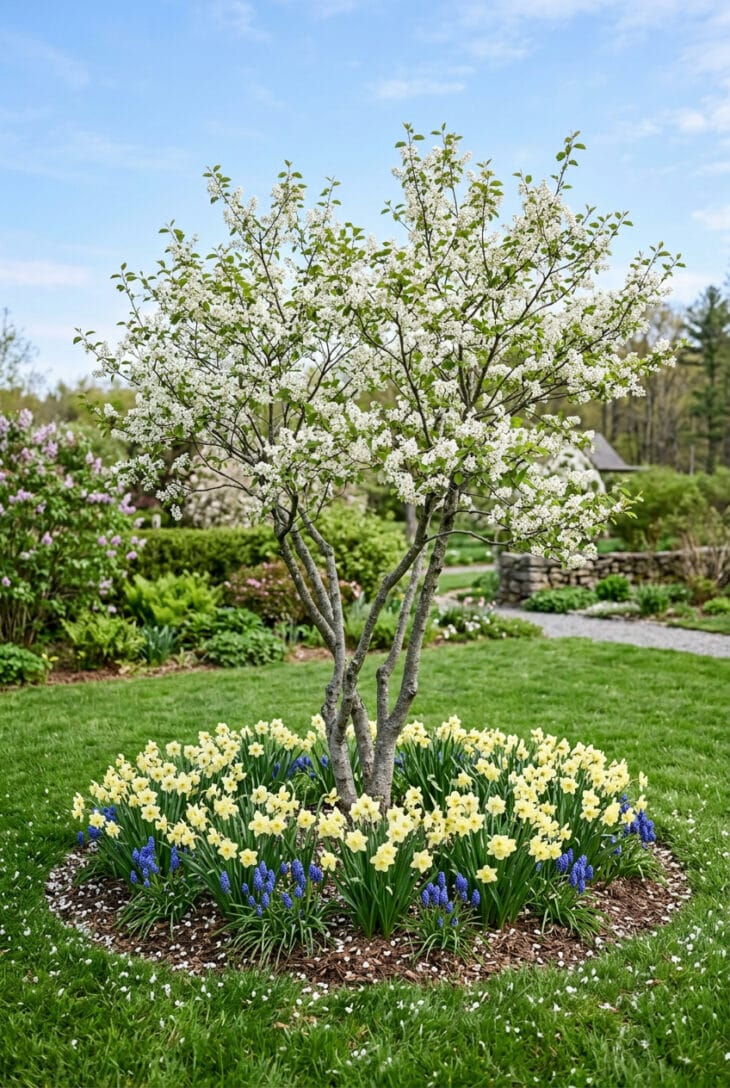
What you see A small serviceberry stands in the lawn in a haze of white blossom, and around its feet a wide ring of pale lemon daffodils and blue grape hyacinths blooms at the same time. Fallen petals drift down onto the flowers below. The tree and the bulbs look like one planting, flowering from the ground to the treetop.
Why it works Bulbs finish their growth before a tree’s canopy fills in, so they happily share the root zone that would starve summer perennials. The ring doubles the tree’s moment of glory and ends the awkward job of mowing tight around a trunk. Any of the spring flowering trees can be dressed this way.
How to get it Allegheny serviceberry (Amelanchier laevis), hardy in zones 4 to 8, grows 15 to 25ft (4.5 to 7.5m) and blooms in April alongside small daffodils. Mark a ring 3 to 5ft (90 to 150cm) wide around the trunk and use bulbs that need shallow holes, so you do not sever roots: grape hyacinths, Grecian windflower (Anemone blanda) and small daffodils such as ‘Hawera’. Plant with a narrow trowel between the roots rather than digging the area over, and never pile extra soil against the trunk. Let the foliage yellow before you mow the ring, and top-dress with compost each fall.
12. Spread a Blue Carpet of Squill and Glory-of-the-Snow

What you see Beneath bare shrubs, the ground has turned an electric blue. Tiny nodding bells and upturned white-eyed stars crowd together so densely that they flow around the mossy stepping stones like water. It is late March, and nothing else in the garden is this color.
Why it works These are among the smallest and cheapest bulbs you can buy, yet over a few years they seed into sheets of color. Their foliage is gone by late spring, so they share space with shrubs and perennials without competing. True blue is rare so early in the year, which makes a blue carpet more striking than any drift of yellow.
How to get it Plant glory-of-the-snow (Scilla forbesii, still sold as Chionodoxa forbesii ‘Blue Giant’), hardy in zones 3 to 8, about 3in (8cm) deep and 2 to 3in (5 to 8cm) apart in September or October. Siberian squill (Scilla siberica) is even tougher, but it has escaped into woodlands in parts of the Midwest and Northeast, so check your state’s invasive plant list before using it, and keep it well away from natural areas. If your garden backs onto woods, use Grecian windflower (Anemone blanda ‘Blue Shades’) instead. Buy at least 100 bulbs to start a carpet, and leave the seedheads to ripen.
13. Build an All-White Moonlit Bulb Border
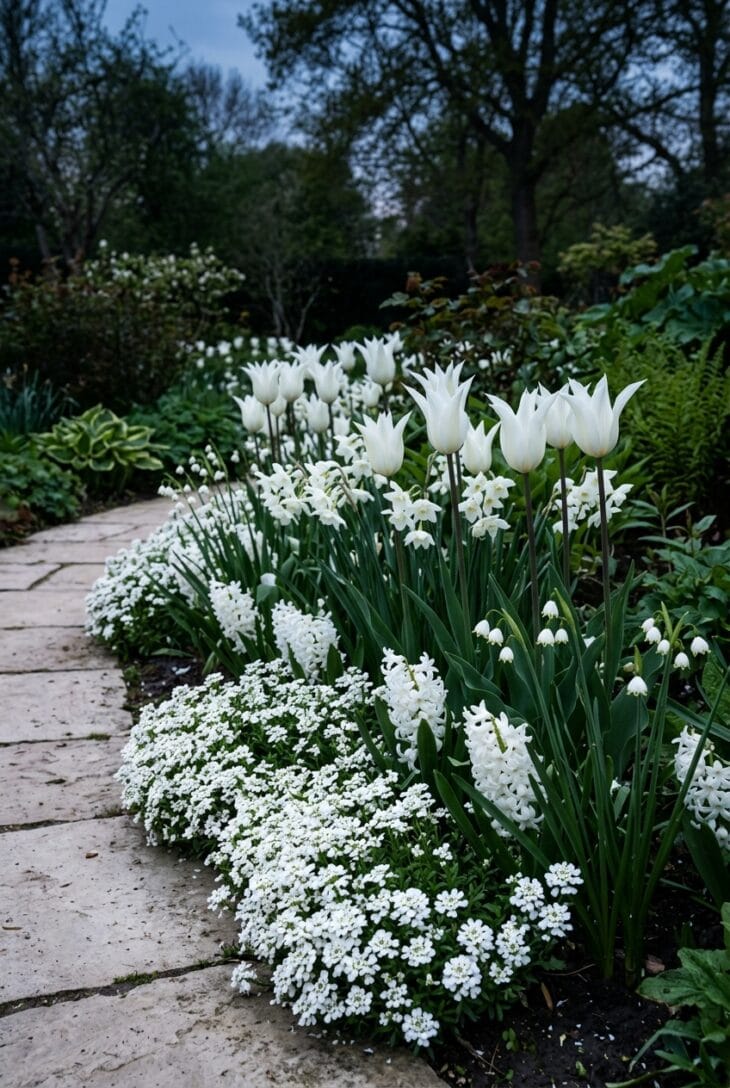
What you see At dusk, when every other color has gone gray, this border still glows. Tall white tulips with pointed petals stand over nodding clusters of white narcissus, green-tipped snowflake bells and white hyacinths. A froth of white candytuft spills onto the pale stone path in front.
Why it works White reflects what little light there is, so a white planting is the one you actually see on spring evenings after work. Sticking to one color also makes planning easy, since every bulb you add is bound to match. It is the spring chapter of a moon garden, and it looks just as crisp in daylight.
How to get it Combine ‘White Triumphator’ tulips, about 24in (60cm) tall, with fragrant narcissus ‘Thalia’, white hyacinth ‘Carnegie’ and summer snowflake (Leucojum aestivum ‘Gravetye Giant’), which is hardy in zones 4 to 8 and ignored by deer. Plant each in groups of 7 to 15 rather than single lines, tulips and hyacinths 6in (15cm) deep and snowflakes 4in (10cm) deep. Edge the border with candytuft (Iberis sempervirens), an evergreen that grows 8 to 12in (20 to 30cm) tall in zones 3 to 9, set 12in (30cm) apart. Avoid cream and ivory varieties, which look dingy next to pure white.
14. Make a Statement With Crown Imperials
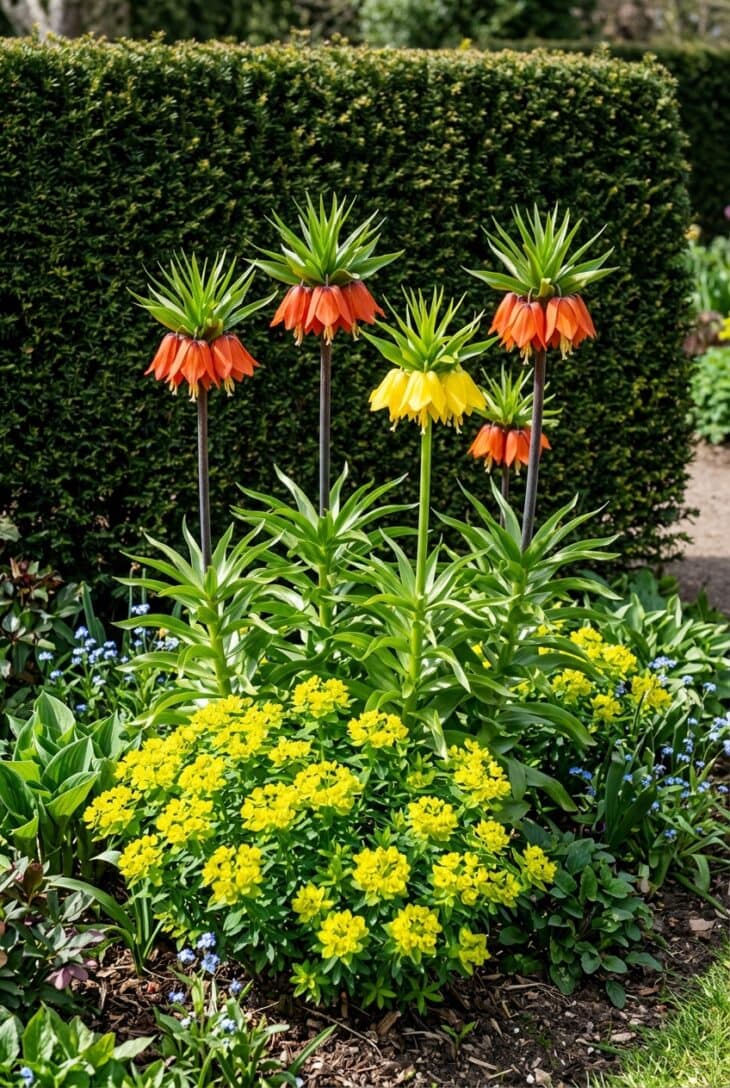
What you see Three crown imperials stand waist high against a dark yew hedge, each thick stem ending in a ring of hanging orange bells crowned by a tuft of green leaves. One carries yellow bells instead. Lime-yellow cushion spurge glows at their feet in the April sun.
Why it works Most spring bulbs are knee high or lower, so one tall, strongly shaped flower gives a spring bed the vertical accent it usually lacks. A dark hedge behind makes the orange glow. Crown imperials also have a musky smell that deer and most rodents avoid, which makes them one of the safer showpieces for suburban yards.
How to get it Choose crown imperial (Fritillaria imperialis) ‘Rubra Maxima’ for orange-red or ‘Lutea’ for yellow; they grow 3 to 4ft (90 to 120cm) tall in zones 5 to 8. The bulbs dry out fast, so plant them as soon as they arrive in September, about 8in (20cm) deep, tilted on their side so water does not sit in the hollow top, with a handful of grit underneath. Give them full sun and sharp drainage, and plant them away from seating, because the smell is noticeable up close. They are one of the pricier bulbs, so buy three large ones rather than ten small ones. In spring, check the leaves for bright red lily leaf beetles and pick them off.
15. Plant Camassia and Snake’s Head Fritillary in Damp Ground
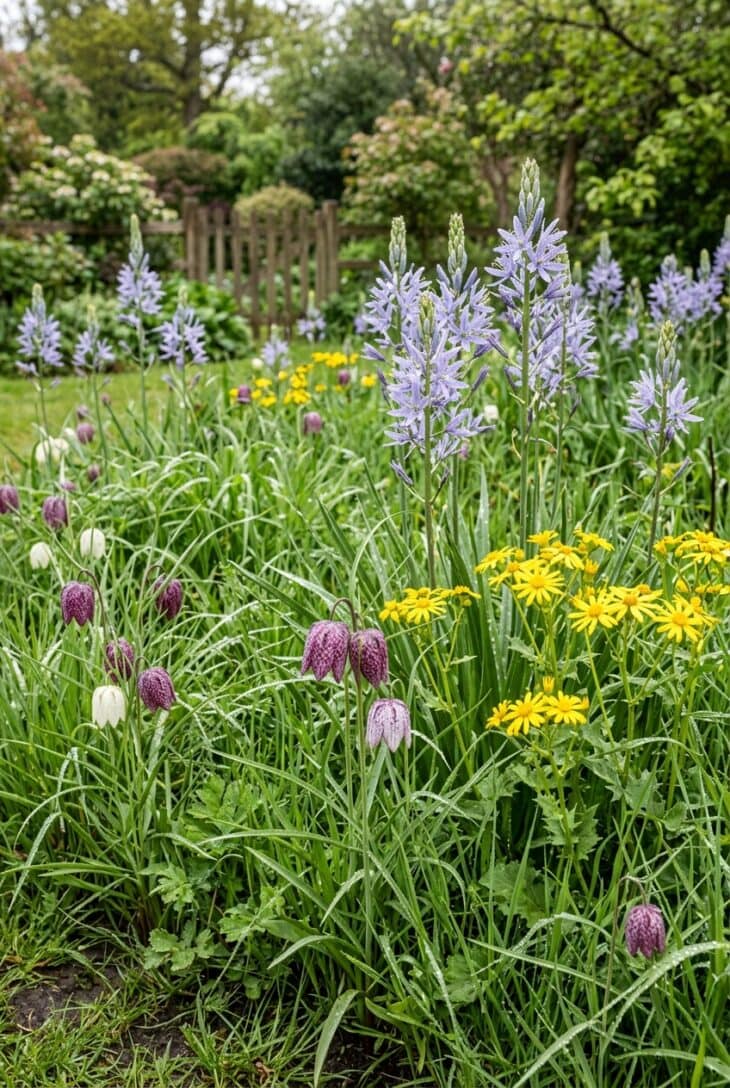
What you see Spires of starry lavender-blue camassia rise above lush grass that is still wet from rain. In front, checkered purple and white bells of snake’s head fritillary nod on thin stems, and clumps of yellow golden ragwort brighten the edges. The whole scene looks like a wild meadow that happened to grow at the end of the yard.
Why it works Most bulbs rot in soggy soil, but these two grow wild in wet meadows and actually want spring moisture. That turns a low, soggy corner from a problem into the best spot in the yard. Camassia is a North American native, and it fits naturally into rain garden plantings that are wet in spring and drier by summer.
How to get it Plant Camassia leichtlinii ‘Caerulea’, 24 to 36in (60 to 90cm) tall and hardy in zones 4 to 8, about 4 to 6in (10 to 15cm) deep and 6in (15cm) apart in fall; in the East, the native wild hyacinth (Camassia scilloides) is an alternative. Add snake’s head fritillary (Fritillaria meleagris), zones 3 to 8, at 3 to 4in (8 to 10cm) deep. Fill gaps with golden ragwort (Packera aurea), a native groundcover that thrives in wet soil and flowers yellow at the same time. Aim for ground that is moist in spring but not under standing water all year. Delay mowing until July so the bulbs can ripen and drop their seed.
16. Plant a Deer-Resistant Bulb Border
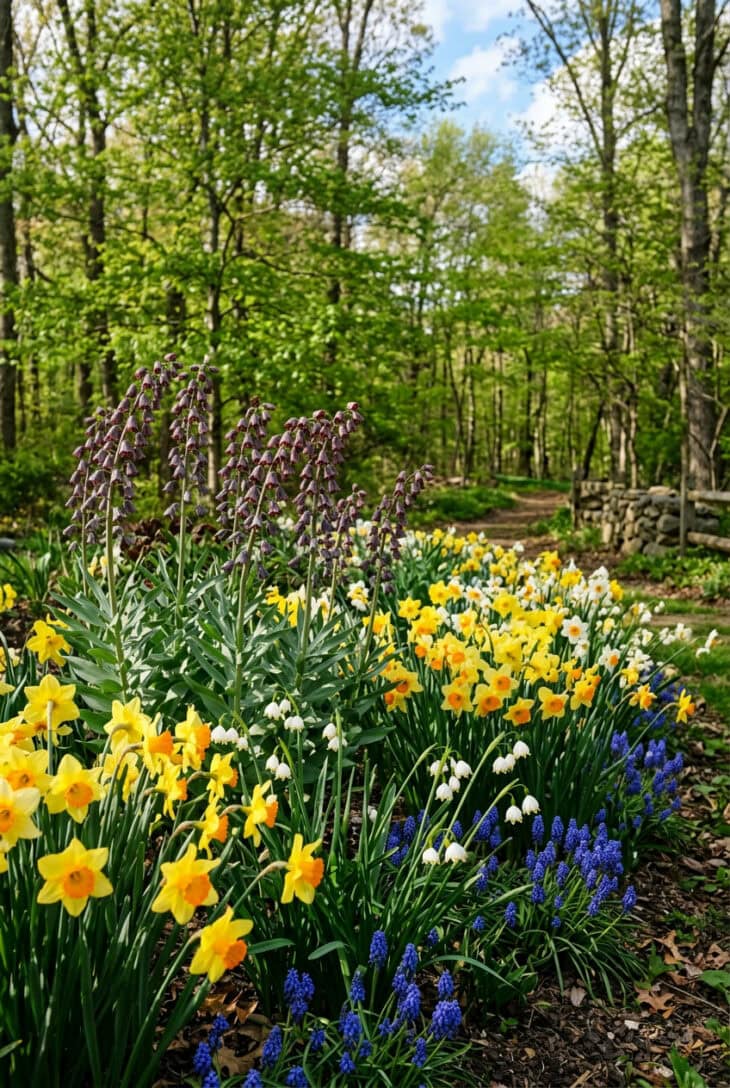
What you see Where the lawn meets the woods, a sunny border is full of yellow and orange-cupped daffodils, white snowflakes and blue grape hyacinths. Tall Persian fritillaries rise among them with spikes of dusky plum bells. The trees behind are just breaking into leaf.
Why it works Tulips and large crocus are deer candy, and in many yards they get eaten the night before they open. Daffodils are poisonous, alliums taste of onion, and fritillaries smell skunky, so deer, voles and chipmunks pass all of them by. Built entirely from these, a border next to the woods blooms every spring, and it gives the rest of your garden borders a template for deer country.
How to get it Build the border from daffodils (try ‘Jetfire’ and ‘Pipit’), summer snowflake (Leucojum aestivum), grape hyacinths, alliums, camassia and Persian fritillary (Fritillaria persica ‘Adiyaman’), which grows 30 to 36in (75 to 90cm) tall in zones 5 to 8. Plant in October at three times the bulb’s height in depth. Skip tulips, Dutch crocus and lilies entirely along a wooded edge. If you must have tulips, grow them in pots on a deck close to the house, where deer rarely venture. Group the bulbs in drifts of 10 to 25 so the border reads from the house.
17. Fill a Window Box With Miniature Bulbs
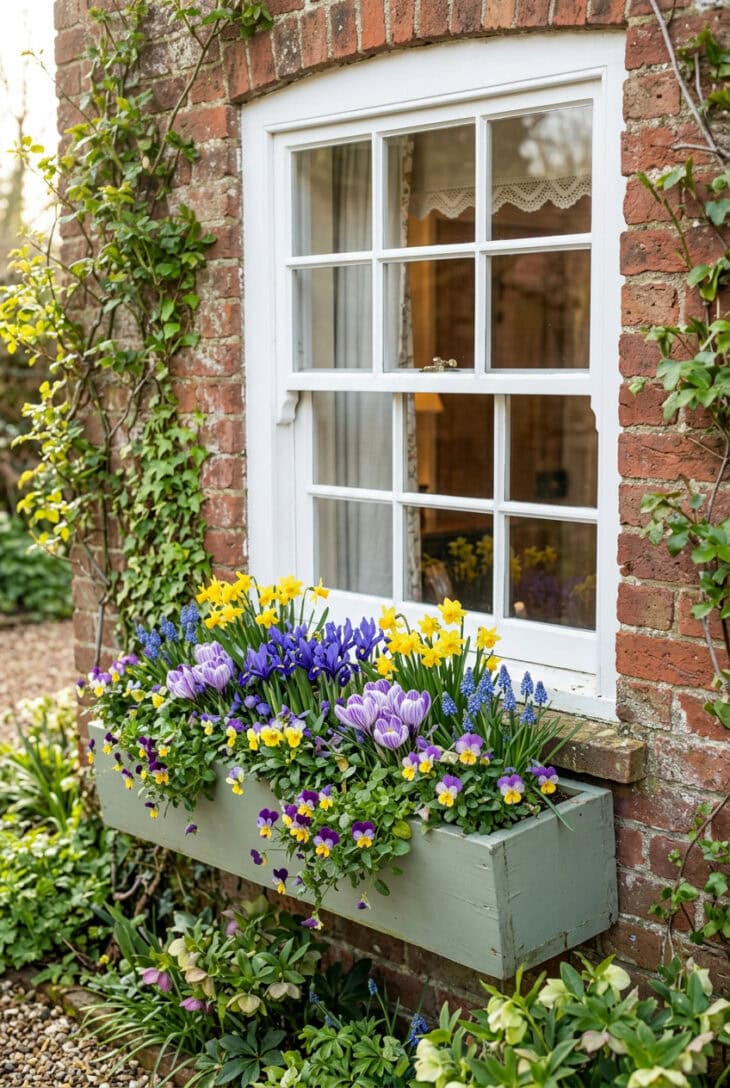
What you see A sage-green window box under a white sash window is crammed with tiny spring flowers: golden miniature daffodils, violet dwarf irises, striped crocus and blue grape hyacinths. Purple and yellow violas tumble over the front edge. Against the red brick, it looks like a bouquet left on the sill.
Why it works Full-size tulips and daffodils look top-heavy in a narrow box and snap in the wind, but miniature bulbs stay in proportion and stand up to weather. You see them from inside the house too, on days too cold to go out. For renters and apartment dwellers it is one of the easiest balcony garden ideas, since the whole box lifts off at the end of the season.
How to get it Choose a box at least 8in (20cm) deep and plant in two layers: miniature daffodil ‘Tête-à-tête’ about 5in (13cm) down, then dwarf iris (Iris reticulata ‘Harmony’), crocus ‘Pickwick’ and grape hyacinths about 3in (8cm) down, all nearly touching. Top with violas for color through fall and early spring. A window box freezes solid fast, so in zone 6 and colder use a removable liner and keep it in an unheated garage or shed from December until late February, watering lightly once a month. In zone 7 and warmer, it can stay on the sill all winter.
18. Try a Hot Orange and Purple Tulip Scheme
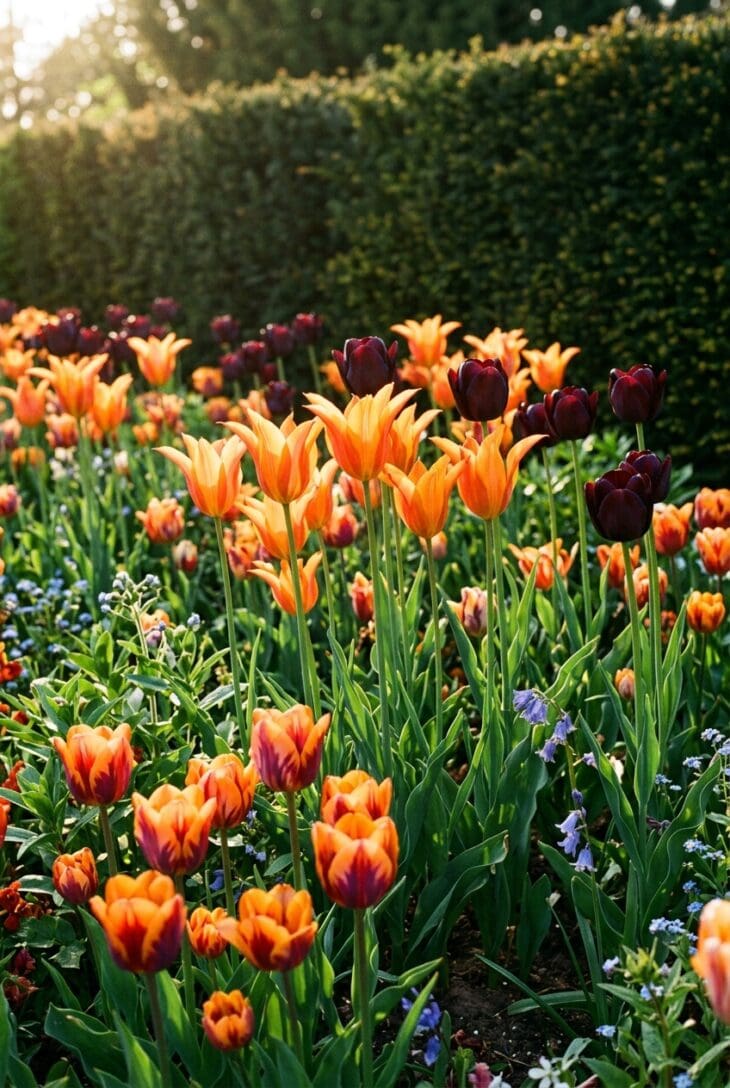
What you see Tangerine tulips with pointed petals glow like lanterns in the late sun, mixed through with glossy tulips so dark they look almost black. Shorter orange tulips, flamed with purple, fill the front. The colors are hot, loose and a little theatrical.
Why it works Dark flowers make bright ones look brighter, and nearly black maroon is the perfect foil for orange. Mixing the bulbs together rather than planting them in blocks gives a painterly, relaxed look instead of a municipal one. If most spring beds you see are pastel, this is the idea for anyone who wants flower bed ideas with a bit more heat.
How to get it Combine ‘Ballerina’, a scented orange lily-flowered tulip about 22in (55cm) tall, with ‘Queen of Night’, a deep maroon single late tulip of about 24in (60cm); both bloom in May. Plant about two ‘Ballerina’ for every ‘Queen of Night’, because dark tulips disappear at a distance. Add ‘Princess Irene’, 12 to 14in (30 to 35cm) and orange flamed with purple, at the front for earlier color. Tip the bulbs into a bucket, mix them by hand, and plant them 6in (15cm) deep and 4 to 5in (10 to 13cm) apart in full sun. Treat them as annuals and replant each fall for the same density.
19. Let Tulips Rise Through Creeping Phlox
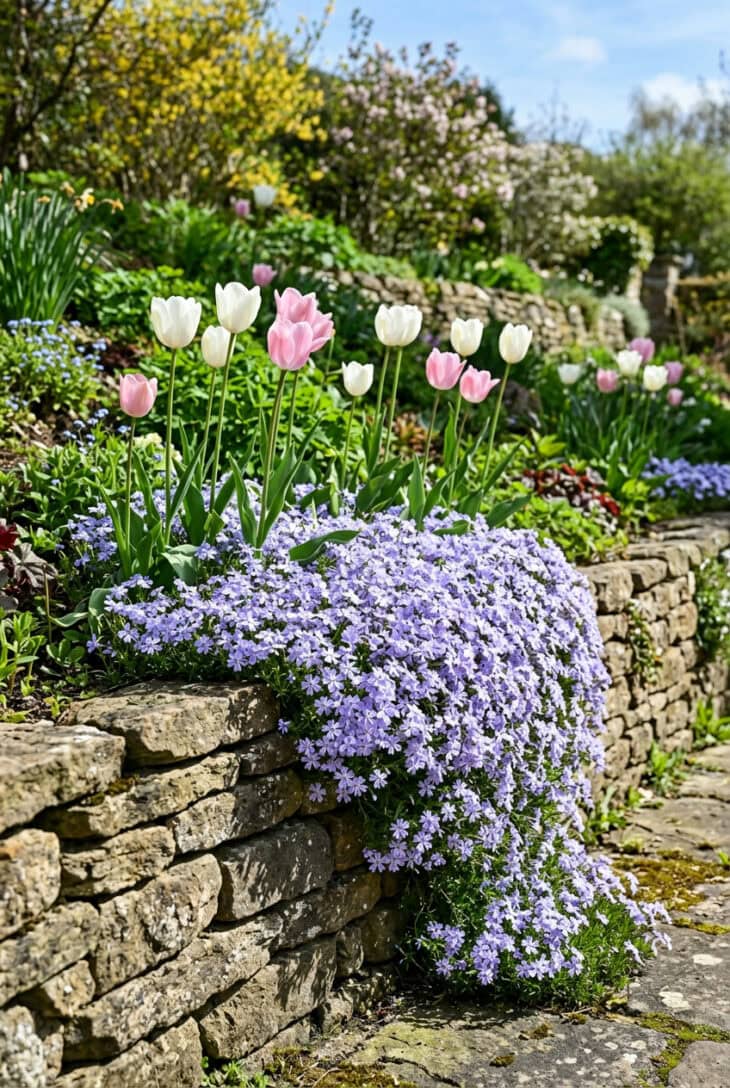
What you see A mat of lavender-blue creeping phlox pours over a low stone wall, so thick with flowers that the leaves disappear. White and soft pink tulips stand up through it on slender stems. Sunlight picks out every stone in the wall below.
Why it works Creeping phlox and mid-spring tulips flower at the same moment, so the tulips get a colored carpet instead of bare soil. The evergreen phlox mat covers the ground all year, keeps weeds down and hides the tulip leaves as they fade. It is a natural fit for a dry, sunny bank, one of the more rewarding sloped garden ideas, where mowing is awkward anyway.
How to get it Plant creeping phlox (Phlox subulata ‘Emerald Blue’), hardy in zones 3 to 9, 18in (45cm) apart in full sun and lean, well-drained soil; it grows about 6in (15cm) tall and 2ft (60cm) wide. In fall, part the mat with your fingers and plant tulips 6in (15cm) deep with a narrow trowel. White ‘Purissima’, about 16in (40cm) and one of the more reliable returning tulips, blooms right alongside the phlox. After flowering, shear the phlox lightly to keep it dense, taking care not to cut the tulip leaves.
20. Pair Hellebores With Early Bulbs by the Back Door
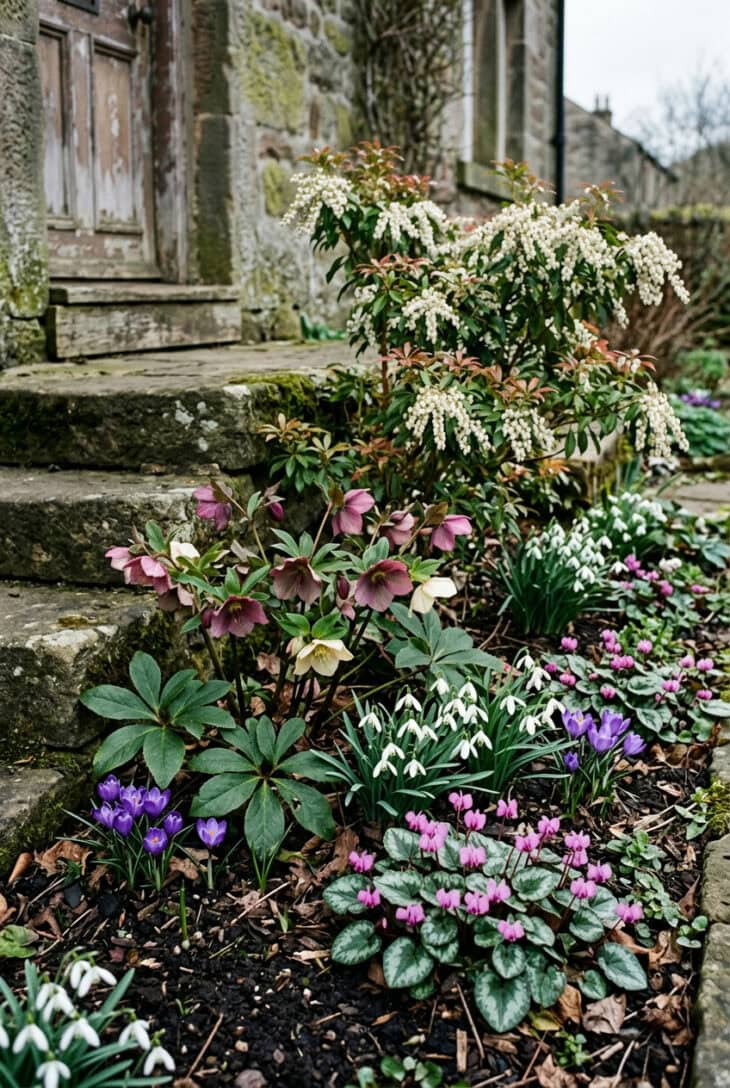
What you see Beside a worn stone step, hellebores hang their plum, pink and cream flowers above dark leathery leaves. Around them, snowdrops, violet crocus and tiny magenta cyclamen with silver-marbled leaves crowd into the gaps. A pieris behind drips with tassels of white bells.
Why it works In February and March you only see the parts of the garden you pass on the way to the car or the trash cans, so that is where the earliest flowers belong. Hellebores bloom for two months and stay evergreen, giving the small bulbs a solid backdrop. Everything here likes the part shade that most back-door beds get.
How to get it Plant Lenten rose (Helleborus × hybridus), hardy in zones 4 to 9, 18in (45cm) apart, and cut off last year’s tattered leaves in late winter so the new flowers show. Tuck in snowdrops and tommy crocus 3in (8cm) deep, and hardy cyclamen (Cyclamen coum), zones 5 to 9, with the tubers only just covered. A Japanese pieris (Pieris japonica), zones 5 to 8, makes an evergreen backdrop that flowers at the same time if your soil is acidic. Plant everything in fall, and mulch with leaf mold rather than bark so the small bulbs can push through.
21. Hide Fading Bulb Foliage Among Hostas and Ferns
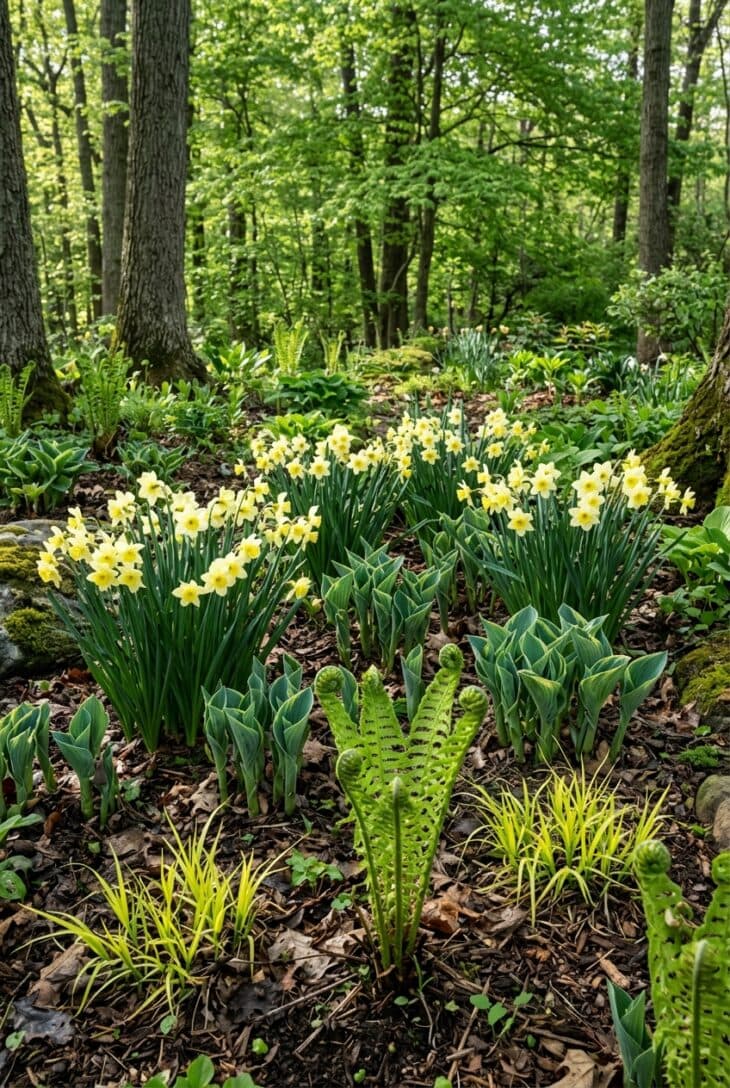
What you see In dappled shade, clumps of pale lemon daffodils bloom among hosta shoots just beginning to unroll their blue-green and gold-edged leaves. Ostrich fern fiddleheads uncurl beside them, and golden grass is only starting to show. In a few weeks, the leaves will close over the spot where the daffodils stand.
Why it works Hostas and ferns are late to wake up, which leaves a shade bed as bare soil through April. Daffodils fill that gap, and when their leaves start to yellow, the hostas and ferns expand and hide them completely. It is the smartest way to get two seasons out of the same ground, and it works in most of the shade garden ideas built around foliage.
How to get it This works in deciduous shade, where the spring sun reaches the ground before the trees leaf out. Plant daffodils 6in (15cm) deep in the gaps between hosta clumps, about 8 to 12in (20 to 30cm) from the crowns, in groups of five to seven. Shade-tolerant, late varieties such as ‘Pipit’ and ‘Jack Snipe’ do well. Add ostrich fern (Matteuccia struthiopteris), zones 3 to 7, and Japanese forest grass (Hakonechloa macra ‘Aureola’), which also emerges late. Never cut, braid or knot the daffodil leaves; just let the hostas cover them.
22. Fill a Box Parterre With Tulips

What you see Low clipped boxwood hedges trace squares and triangles around a stone urn, and every bed is filled with scarlet tulips all opening on the same day. Pale gravel paths separate the beds. Seen from above, it looks like a carpet laid out in the sun.
Why it works The hedges give the garden a green pattern all year, and each spring the tulips fill it with a single burst of color. One variety in every bed is what makes it look grand rather than busy. It is a small-scale version of the great historic gardens and sits well with many English garden ideas.
How to get it Plant boxwood (Buxus ‘Green Velvet’ or ‘Green Mountain’), zones 5 to 8, 10 to 12in (25 to 30cm) apart for a hedge about 12in (30cm) high. Where boxwood blight is a problem, use inkberry (Ilex glabra ‘Gem Box’), zones 5 to 9, instead. Fill the beds with a Darwin hybrid tulip such as red ‘Apeldoorn’, about 22in (55cm) tall, planted 6in (15cm) deep and 4 to 5in (10 to 13cm) apart, keeping 6in (15cm) back from the hedge roots. After flowering, lift the tulips and replace them with summer annuals, then plant fresh bulbs each fall.
23. Grow Anemones and Ranunculus in a Warm-Climate Bed
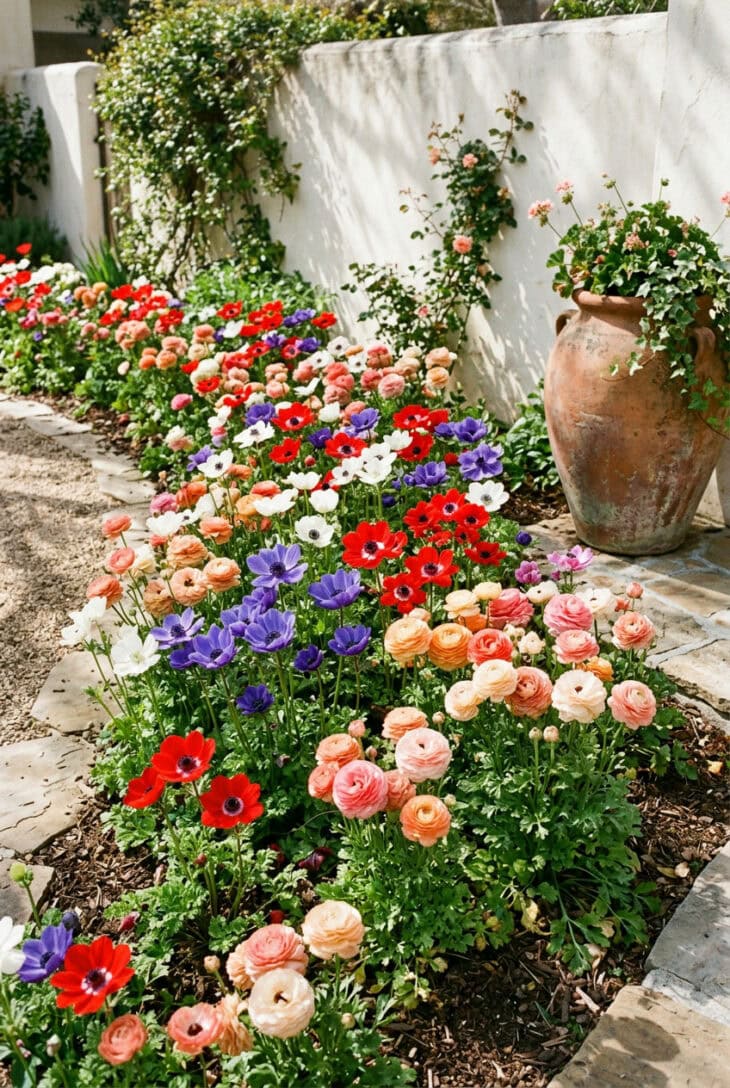
What you see Against a sun-warmed white stucco wall, a bed is packed with poppy anemones in scarlet, violet and white, each with a dark eye, and ranunculus in apricot, coral and pink, their petals layered like tissue paper. A terracotta pot anchors the end of the bed. It is March, and the colors are as bright as midsummer.
Why it works Where winters are mild, tulips and hyacinths do not get enough cold to bloom well, but anemones and ranunculus come from the Mediterranean and grow happily through cool, wet winters. Planted in fall, they flower in late winter and early spring, weeks before gardens in the North. They pair naturally with Mediterranean garden ideas for hot, dry summers.
How to get it In zones 8 to 10, plant in October or November. Soak ranunculus (Ranunculus asiaticus) and poppy anemone (Anemone coronaria ‘De Caen’) corms for 3 to 4 hours, then plant them 2in (5cm) deep and 6in (15cm) apart; ranunculus go in with their claws pointing down. Cover them with frost cloth on nights forecast below 25°F (-4°C). In colder zones, start them in pots indoors in late winter and plant out after the last frost. If you want tulips in the South, chill the bulbs in the refrigerator for 10 to 12 weeks, away from fruit, and plant in late December or January.
24. Plant Dwarf Iris in a Stone Trough
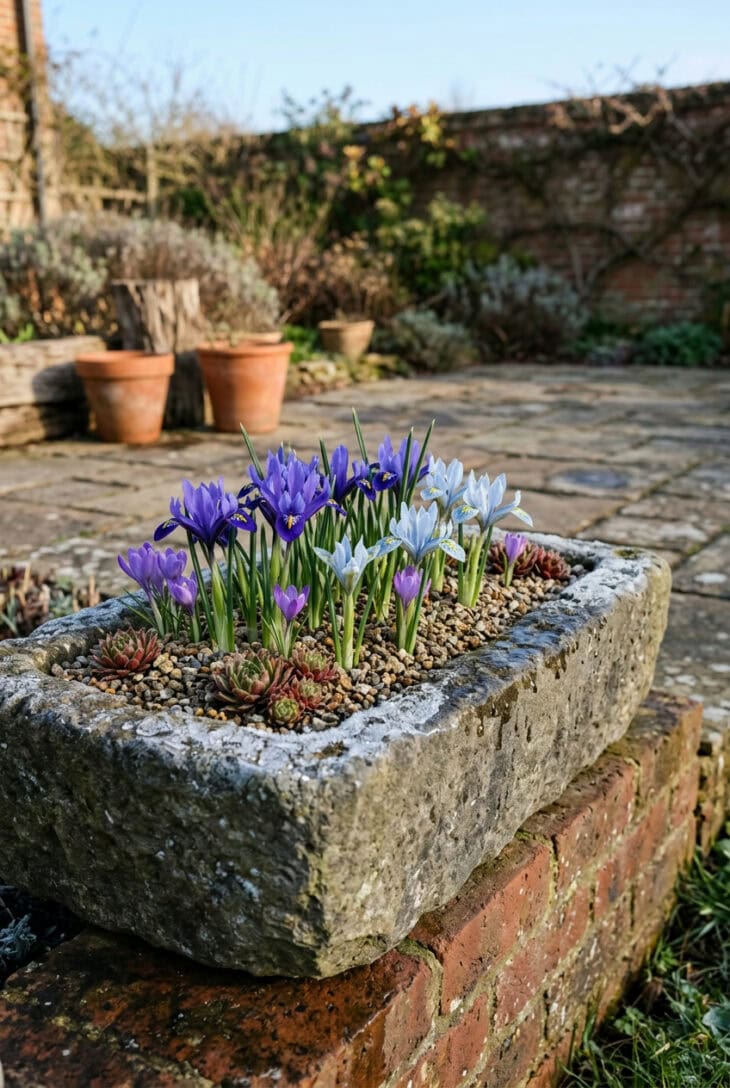
What you see A weathered stone trough sits at knee height by the patio, its gravel surface studded with small irises in deep violet and pale ice blue, each petal marked with a flash of yellow. A few violet crocus and houseleek rosettes keep them company. Frost is still melting on the rim.
Why it works Dwarf irises are only 4 to 6in (10 to 15cm) tall and get lost in a border, but raised in a trough you can see every marking and catch their faint violet scent. The trough gives them the sharp drainage they need. For a patio or tiny yard it is one of the most charming small garden ideas, since the whole display fits into a few square feet.
How to get it Use a trough at least 8in (20cm) deep with drainage holes, filled with half potting mix and half grit or fine gravel. Plant dwarf iris (Iris reticulata ‘Harmony’ for deep blue, Iris ‘Katharine Hodgkin’ for pale blue), hardy in zones 5 to 9, about 4in (10cm) deep and 2in (5cm) apart, and top-dress with gravel. They often split into tiny bulblets that skip a year of flowering; deep planting and a feed of tomato fertilizer after flowering help, and topping up each fall keeps the display full. Add houseleeks (Sempervivum) for year-round interest. In zone 6 and warmer the trough can stay outside all winter.
25. Plan a Succession Border From March to June
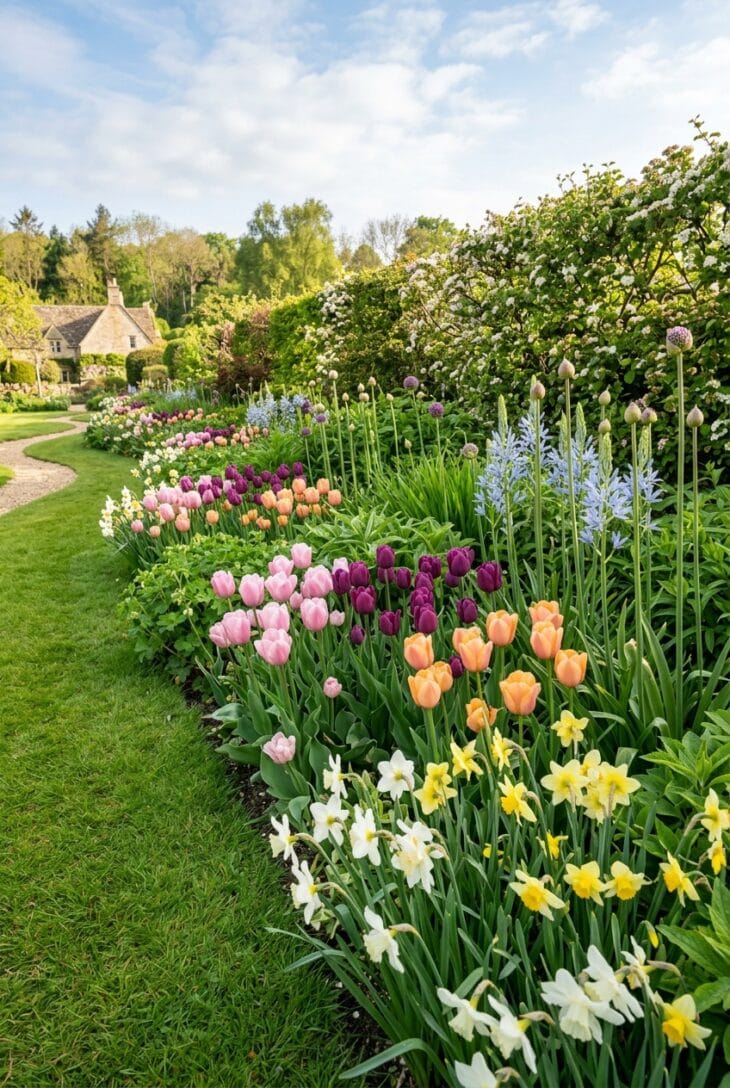
What you see A long border shows several waves of spring at once: daffodils just past their best at the front, tulips in pink, purple and apricot at full bloom through the middle, and camassia spires and allium buds opening at the back. Fresh perennial foliage fills in around them all. Soft morning light runs the length of the bed.
Why it works Most gardens get one big bulb moment in April and then nothing. Planning in three waves (early, mid and late) stretches the show from March into June, and as each wave fades the next one grows up to hide it. It is the idea that ties the rest together, and it scales from a single bed to a whole backyard garden.
How to get it For March, plant crocus, snowdrops and dwarf iris; for April, daffodils, hyacinths, grape hyacinths and early tulips; for May into June, late tulips, camassia and alliums such as ‘Globemaster’. Put the late, tall bulbs at the back and the early, small ones at the front, where their leaves will be covered by perennials. Make your list in August and order before the best varieties sell out, then plant in October or November. Each spring, take photos of the border every week and push a stick into any gap, so you know exactly where to add bulbs next fall.