There is something about a cottage garden that makes you slow down. Roses tumble over the doorway, bees work the foxgloves, and a narrow path disappears into a happy tangle of color. It feels less like a garden you built and more like one that grew up around you.
Contents
- 01. Classic English Mixed Cottage Border
- 02. Climbing Roses Over the Front Door
- 03. Picket Fence with Flowers Spilling Through
- 04. A Patch of Wildflower Meadow
- 05. Foxgloves and Hollyhocks for Height
- 06. A Lavender-Lined Path
- 07. Self-Seeding Annuals for a Carefree Look
- 08. Vintage Containers and Reclaimed Finds
- 09. A Rambling Rose Arch or Pergola
- 10. A Mixed Herb and Flower Potager
- 11. A Sweet Pea Wigwam
- 12. A Small Cottage Garden Pond
- 13. A Stone Path with Creeping Thyme
- 14. A Soft Pastel Color Scheme
- 15. Hot Colors with Dahlias and Crocosmia
- 16. A Rustic Bench Tucked Among the Flowers
- 17. Hardy Geraniums to Fill Every Gap
- 18. Delphiniums and Lupins for Vertical Spires
- 19. A Welcoming Cottage Garden Gate
- 20. Peonies and Roses for Pure Romance
- 21. A Clematis-Clad Wall or Trellis
- 22. Catmint and Salvia for Easy Drifts of Blue
- 23. Old-Fashioned Scented Flowers
- 24. A Cottage Garden Buzzing for Pollinators
- 25. Spring Bulbs Underplanting the Border
- 26. Overflowing Window Boxes
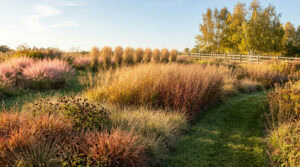
- 27. Trained Apples and Espaliered Fruit
- 28. A Relaxed Gravel Cottage Garden
- 29. A Cottage Garden for a Tiny Space
- 30. A Shady Cottage Corner
The beautiful thing is that the look works almost anywhere. The 30 ideas below run from a single rose-clad arch to a full wildflower border, from pastel romance to hot dahlia drama, and from a tiny courtyard to a shady corner most people would give up on. Beginner or seasoned grower, sun or shade, big plot or balcony — there is a version here for your space.
Read straight through for the full picture, or scroll and pick the ideas that fit your patch. Each one explains what you are looking at, why it works, and exactly how to recreate it — so you can borrow a single detail or steal the whole scene.
01. Classic English Mixed Cottage Border
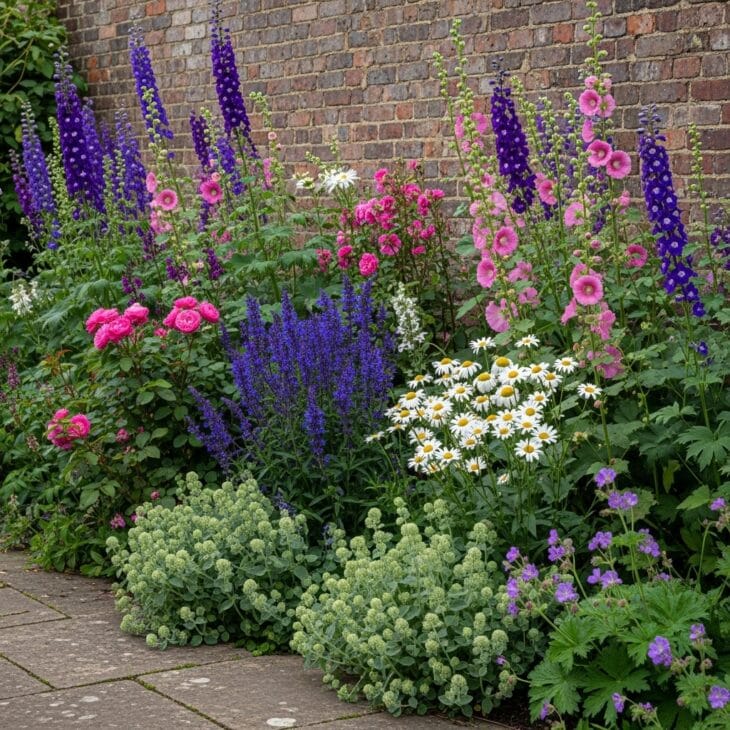
What you see This is the cottage garden of the imagination: a deep border packed wall to wall, with no bare soil in sight. Spires of purple delphinium (Delphinium ‘Black Knight’) and pink hollyhock (Alcea rosea) rise at the back, pink roses and blue salvia fill the middle, and soft mounds of lady’s mantle (Alchemilla mollis) froth over the edge of the path. Every layer leans gently into the next.
Why it works It works because it is built in tiers — tall at the back, low at the front — so nothing is hidden and the whole border reads as one generous wave of color. Mixing spires, daisies and rounded mounds gives you contrasting shapes, which is what stops an abundant planting from looking like a mess. The slight informality is the point, not a flaw.
How to get it Give yourself a bed at least 4ft (120cm) deep so you have room for three height layers. Plant in groups of three or five of each variety rather than dotting singles about, and set plants 12 to 18in (30 to 45cm) apart so they knit together by midsummer. Stake delphiniums and hollyhocks early, before they flop. Feed with a balanced fertilizer in spring and deadhead through summer to keep the show going into fall.
02. Climbing Roses Over the Front Door
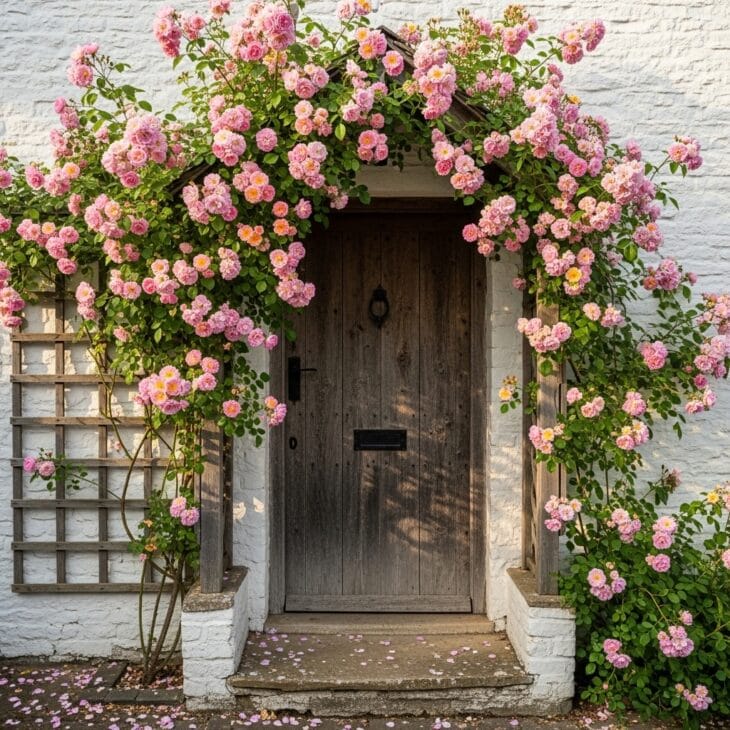
What you see Nothing says cottage garden faster than a climbing rose framing the front door. Here a soft pink climber arches over the entrance, its canes trained around a simple trellis so the blooms gather thickest where you pass beneath them. A few petals on the step finish the picture.
Why it works It works because it draws the eye straight to the entrance and softens the hard line where house meets garden. A doorway is also a spot you see and smell every day, so a scented climber here earns its keep more than almost anywhere else in the garden. Vertical space is free real estate, and a rose uses it generously.
How to get it Choose a repeat-flowering climber such as ‘New Dawn’ (pale pink, tough and reliable) or fragrant ‘Gertrude Jekyll’. Fix horizontal wires or a trellis to the wall first, holding it 2in (5cm) off the brick for airflow. Train the main canes as horizontally as you can — bending them sideways triggers far more flowering side shoots than letting them shoot straight up. Tie in with soft twine, prune lightly after the first flush, and feed with rose fertilizer in spring and midsummer.
03. Picket Fence with Flowers Spilling Through
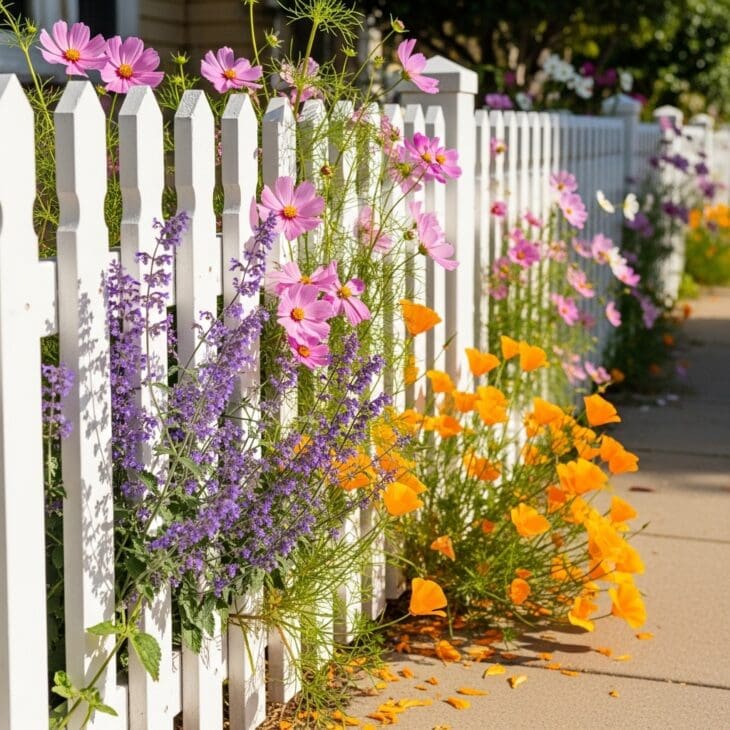
What you see A white picket fence with flowers pushing through the gaps is cottage gardening at its most charming. Cosmos, catmint and California poppies lean out over the sidewalk, blurring the boundary between garden and street so the planting seems to spill into the world beyond.
Why it works The crisp white pickets do something clever: they give a loose, romantic planting a tidy frame, so the overflow reads as generous rather than neglected. That contrast between structure and abandon is the heart of cottage style. It is also the friendliest possible face to present to passers-by.
How to get it Plant a relaxed, free-flowering mix right up against the inside of the fence — catmint (Nepeta ‘Walker’s Low’), cosmos (Cosmos bipinnatus) and California poppy (Eschscholzia californica) all lean and self-seed beautifully. Set them 9 to 12in (23 to 30cm) from the pickets so they grow into the gaps. Repaint or oil the fence every couple of years before the planting fills in, because you will not be able to reach it once the flowers take over. Shear catmint back hard after its first flush for a fresh second wave.
04. A Patch of Wildflower Meadow
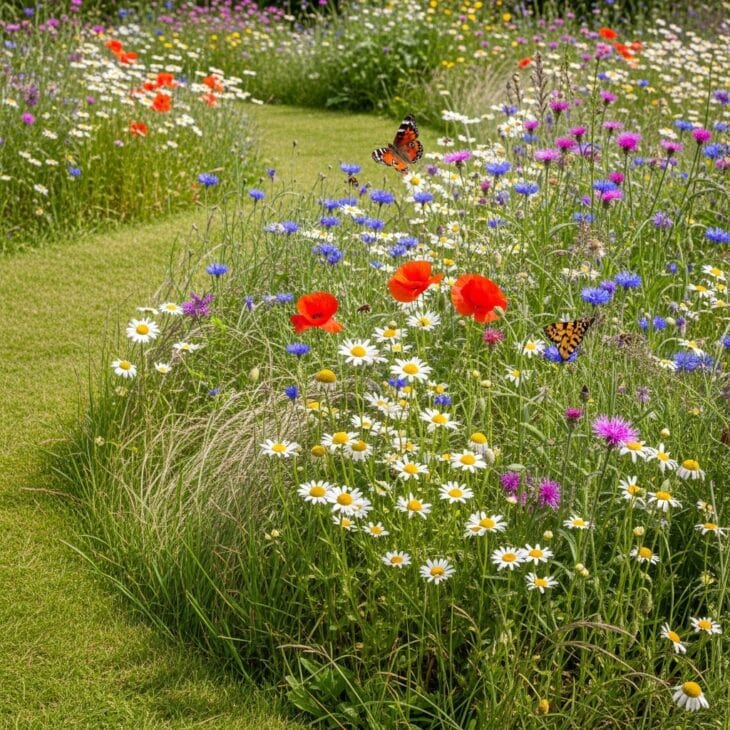
What you see Let a patch of lawn grow long and seed it with wildflowers, and you get a pocket meadow alive with ox-eye daisies, red poppies and blue cornflowers. A single mown path curving through it turns a “messy” corner into a clear design choice and invites you to walk in among the flowers.
Why it works A meadow patch is the most relaxed and wildlife-friendly idea on this list — it hums with bees and butterflies and asks almost nothing of you once established. The mown edge or path is the trick that makes it look intentional; without that frame, long grass just looks unmown. Cottage gardens have always blurred the line between garden and countryside, and this leans right into it.
How to get it Sow a meadow mix suited to your soil in spring or fall — yellow rattle (Rhinanthus minor) is worth adding, as it weakens vigorous grass and lets flowers compete. Poor soil gives better results than rich, so do not feed it. Mow paths and edges regularly to keep the shape sharp, but leave the meadow itself until late summer, then cut it down and rake off the clippings. This annual “cut and rake” gradually lowers fertility and improves the display year on year.
05. Foxgloves and Hollyhocks for Height
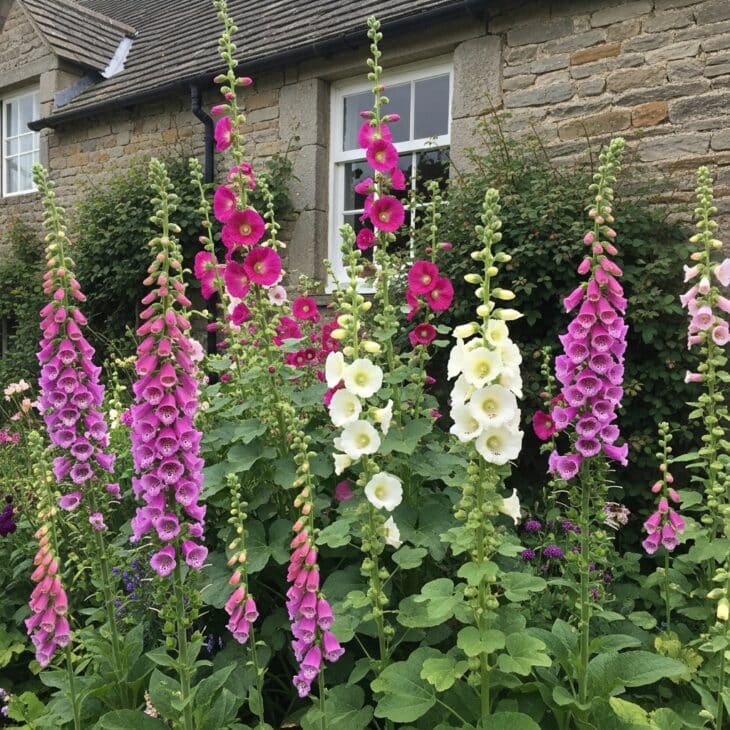
What you see For instant cottage drama, nothing beats the tall spires of foxgloves (Digitalis purpurea) and hollyhocks (Alcea rosea) standing against a wall. Their flower-studded columns rise well above head height, drawing the eye up and giving the garden a sense of enclosure and old-fashioned romance.
Why it works Vertical accents are what separate a flat planting from a memorable one. These two also do the cottage thing of seeding themselves around, so over a couple of years they pop up in unplanned spots and stitch the border together. Bees adore the foxglove bells, working their way up each spire.
How to get it Both are easy from seed, but remember foxgloves are biennial — sow them in early summer to flower the following year, and let some set seed so you always have a new generation coming. Plant against a sunny or lightly shaded wall that shelters the tall stems from wind. Hollyhocks can suffer rust; space them for good airflow and clear away affected leaves. Note that foxgloves are toxic if eaten, so site them thoughtfully where small children play.
06. A Lavender-Lined Path
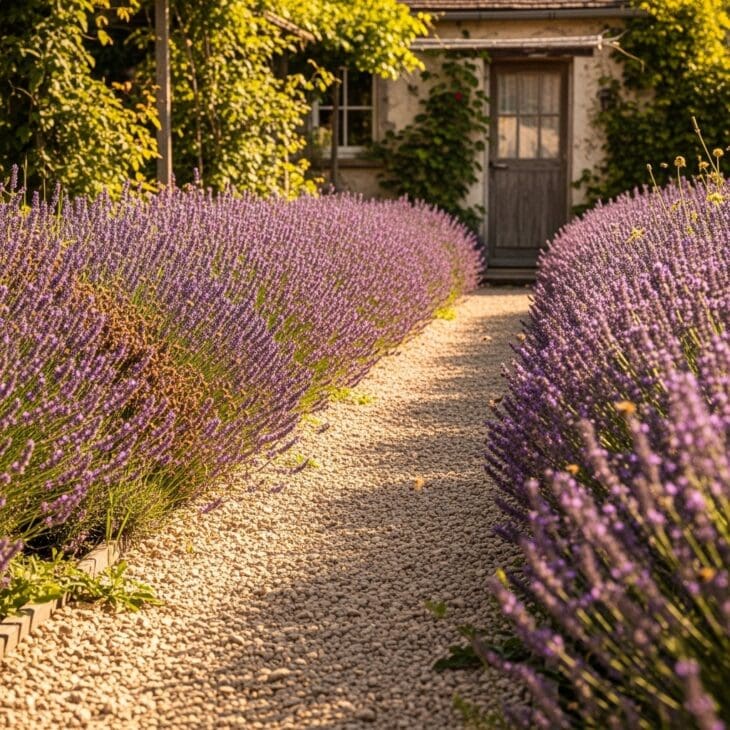
What you see A path edged on both sides with lavender (Lavandula angustifolia) is a feast for the senses. The low purple hedges hum with bees, release their scent every time you brush past, and frame the walk with soft, silvery mounds that look good even out of flower.
Why it works Lining a path with a single repeated plant brings rhythm and calm to the cottage garden’s general exuberance — a moment of order amid the abundance. Lavender is perfect for the job because it is evergreen, drought-tolerant and pollinator-friendly, and its scent is at its strongest exactly where you walk. The effect is both formal and deeply relaxing.
How to get it Choose a compact, reliable variety like ‘Hidcote’ (deep purple) or ‘Munstead’, and plant 12 to 18in (30 to 45cm) apart for a continuous hedge. Lavender demands full sun and sharp drainage — improve heavy soil with grit, or it will rot in winter. Prune every year in late summer after flowering, cutting back into the green but never into bare old wood, which rarely re-shoots. Replace plants every 8 to 10 years as they grow woody and open at the base.
07. Self-Seeding Annuals for a Carefree Look
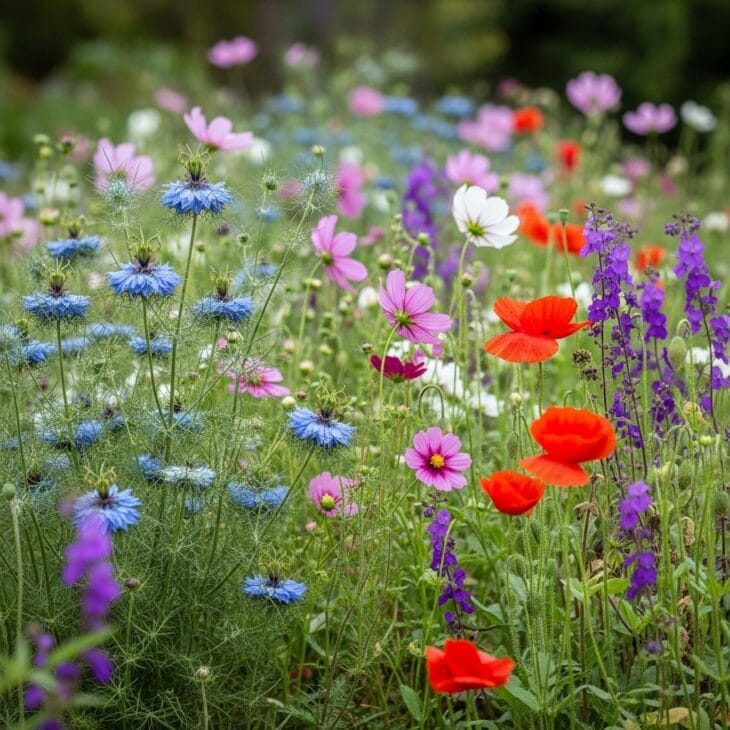
What you see The most carefree cottage gardens lean on annuals that sow themselves: love-in-a-mist (Nigella damascena), cosmos, field poppies and honesty (Lunaria annua) drifting through the border in combinations you could never quite plan. Each year they reappear in slightly different places, so the garden reinvents itself for free.
Why it works This is cottage gardening in its original, thrifty spirit — flowers raised from a pinch of saved seed rather than a trolley of pots. The happy accidents that self-seeders create, weaving one plant through another, are exactly the natural look designers work hard to fake. And the price could not be better.
How to get it Sow your chosen annuals once, directly where you want them in spring, then let a few flowers go to seed at the end of the season instead of deadheading everything. Learn to recognize the seedlings so you do not weed them out the following spring. Thin or transplant the self-sown crowds while small, and pull out any that land somewhere awkward. Nigella, poppies, cosmos, calendula and Verbena bonariensis are all generous, well-behaved self-seeders to start with.
08. Vintage Containers and Reclaimed Finds
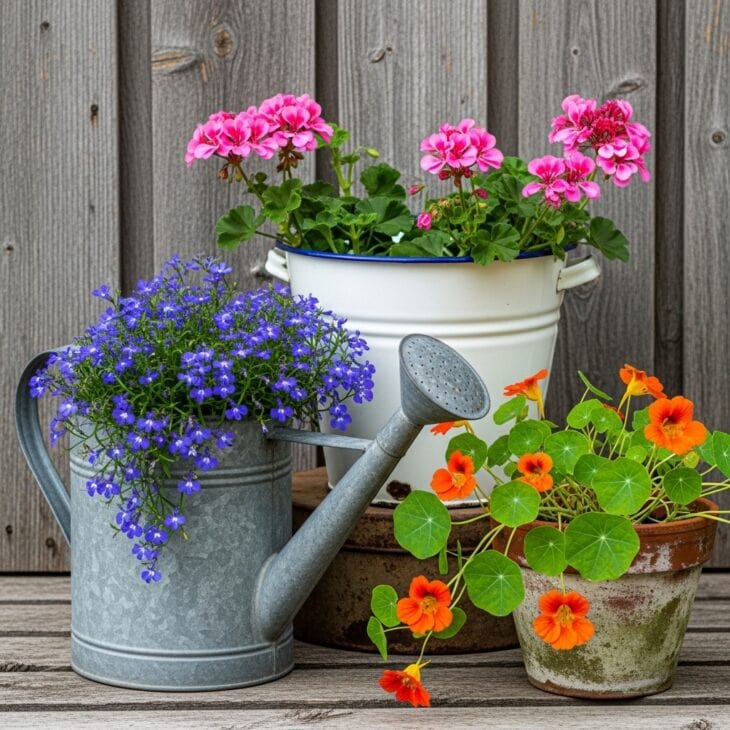
What you see Old galvanized buckets, chipped enamel pails and a weathered watering can, grouped together and overflowing with flowers, give a cottage garden instant character. Trailing lobelia, pink geraniums and peppery nasturtiums tumble over their rims, turning junk-shop finds into the prettiest planters you own.
Why it works Reclaimed containers suit cottage style because they look lived-in and unpretentious — a little rust and patina is a feature, not a fault. They also let you garden on paving, steps or a doorstep where there is no soil at all. Grouping several together at different heights makes far more impact than the same pots dotted around separately.
How to get it Drill drainage holes in the base of any metal container — without them, roots drown. Add a layer of crocks, use a peat-free multipurpose compost, and remember that small metal pots heat up and dry out fast, so check them daily in summer. Plant a “thriller, filler, spiller” mix: something upright like a geranium, something bushy, and a trailer like nasturtium or lobelia to soften the edges. Feed weekly through summer, as container plants quickly exhaust their compost.
09. A Rambling Rose Arch or Pergola
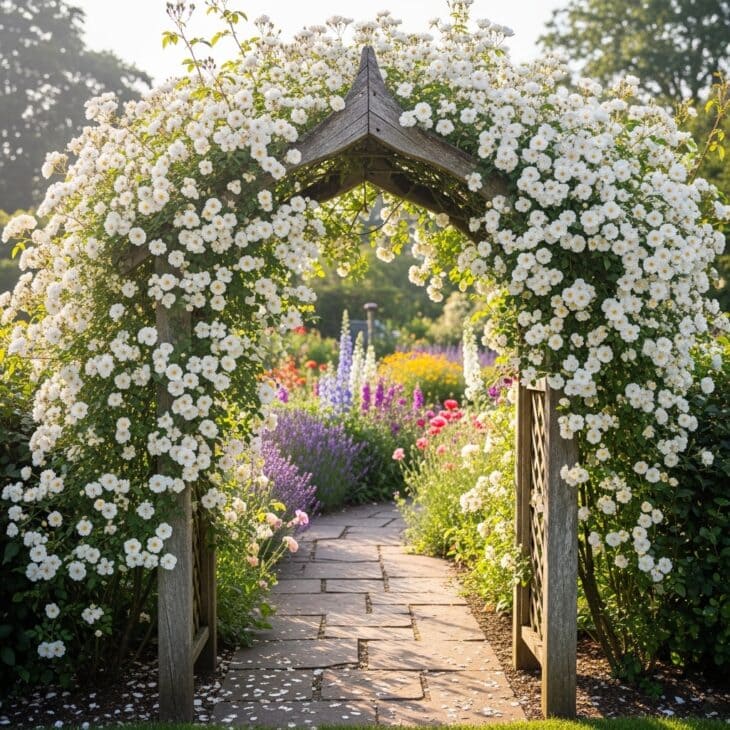
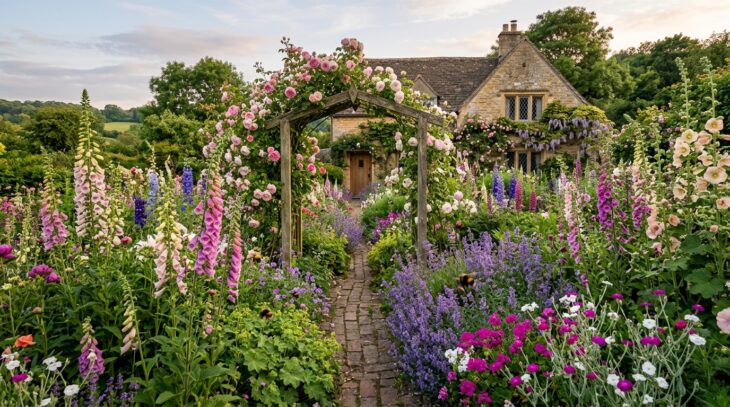
What you see A simple wooden arch smothered in a rambling rose is one of the most romantic things you can build in a garden. Here a white rambler cascades overhead in a single midsummer flush, hundreds of small blooms forming a fragrant tunnel you walk beneath to reach the garden beyond.
Why it works An arch does two jobs at once: it adds height and structure, and it frames a view, making the garden feel like it has rooms and journeys rather than one flat space. Ramblers are far more vigorous than climbers, so a single plant can clothe a whole arch quickly. Positioned over a path, it turns simply moving through the garden into an event.
How to get it Pick a once-flowering rambler like the classic white ‘Rambling Rector’ or pink ‘Albertine’ — they put on a spectacular early-summer show but be aware most flower just once. Set the arch on firm footings, because a mature rambler is heavy and catches the wind. Plant the rose 12 to 18in (30 to 45cm) out from the leg and lead the canes in, tying them as horizontally as the frame allows for maximum bloom. Prune after flowering, removing a few of the oldest stems to keep it from becoming a tangled monster.
10. A Mixed Herb and Flower Potager
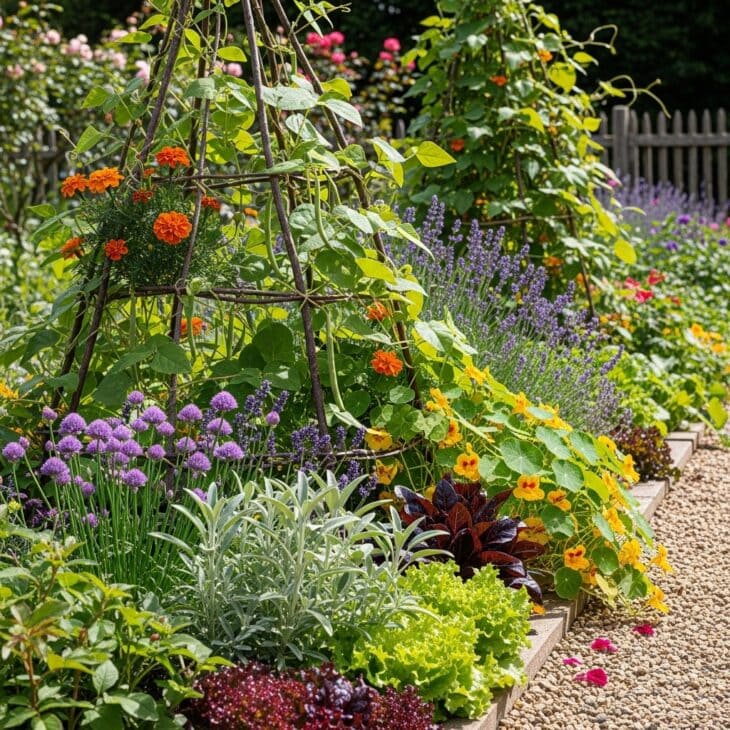
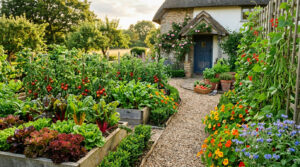
What you see The classic cottage garden never separated the pretty from the useful, and a potager brings that tradition back: herbs, vegetables and flowers all growing in the same bed. Purple chive flowers, silver sage and frilly lettuces mingle with marigolds and climbing beans, so the bed feeds you and delights you at once.
Why it works Mixing flowers in among the crops is not just charming — it is practical. Flowers like marigolds and nasturtiums draw in pollinators and predatory insects that protect your vegetables, while herbs confuse pests with their scent. The result is a productive bed that looks like a flower border, which is exactly the cottage ideal.
How to get it Start with easy, good-looking edibles: chard, lettuce, climbing beans, chives, sage and thyme, woven through with calendula and nasturtiums. Give it a sunny, sheltered spot and rich, well-dug soil, since the vegetables are hungry. Plant in informal drifts rather than rigid rows to keep the cottage feel, and use a wigwam of beans or sweet peas to add height in the center. Sow little and often so there is always something to pick and something coming into flower.
11. A Sweet Pea Wigwam
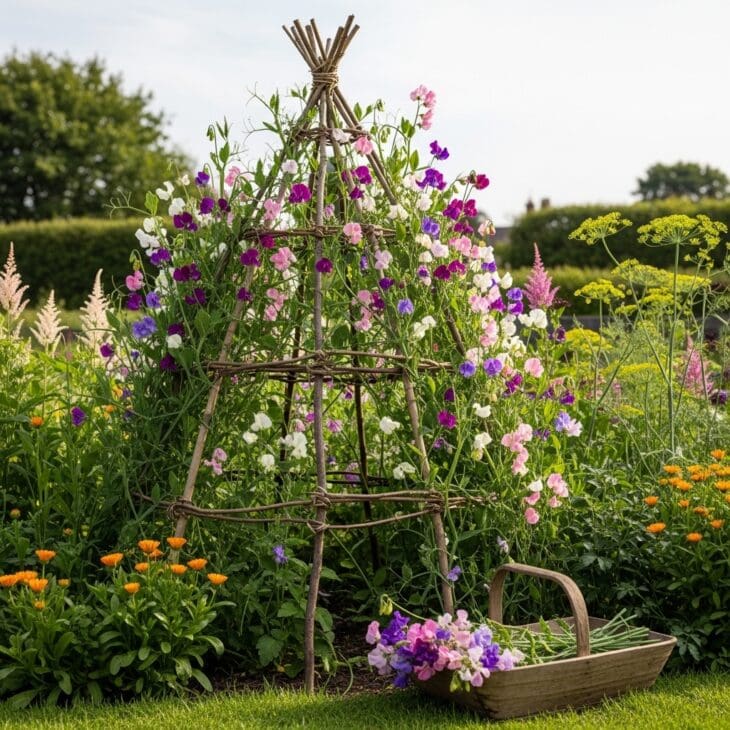
What you see A wigwam of hazel or bamboo canes wreathed in sweet peas (Lathyrus odoratus) is a cottage garden in miniature — height, scent and cut flowers from a structure you can build in ten minutes. The ruffled blooms in pink, purple and white scramble all the way to the top, perfuming the whole corner.
Why it works Sweet peas are the ultimate cut-and-come-again cottage flower: the more you pick, the more they produce, so a single wigwam can supply posies for the kitchen table all summer. A wigwam also adds vertical interest exactly where a border needs a lift, and packs a lot of flower into a small footprint. Their old-fashioned scent is unbeatable.
How to get it Sow seeds in fall or early spring in deep pots, and pinch out the tips when seedlings reach 4in (10cm) to encourage bushy growth. Build the wigwam from five or six 7ft (210cm) canes and plant two seedlings at the base of each. They are hungry and thirsty — enrich the soil with compost before planting and never let them dry out. Pick flowers every few days and remove any seed pods immediately, because once a plant sets seed it stops flowering.
12. A Small Cottage Garden Pond
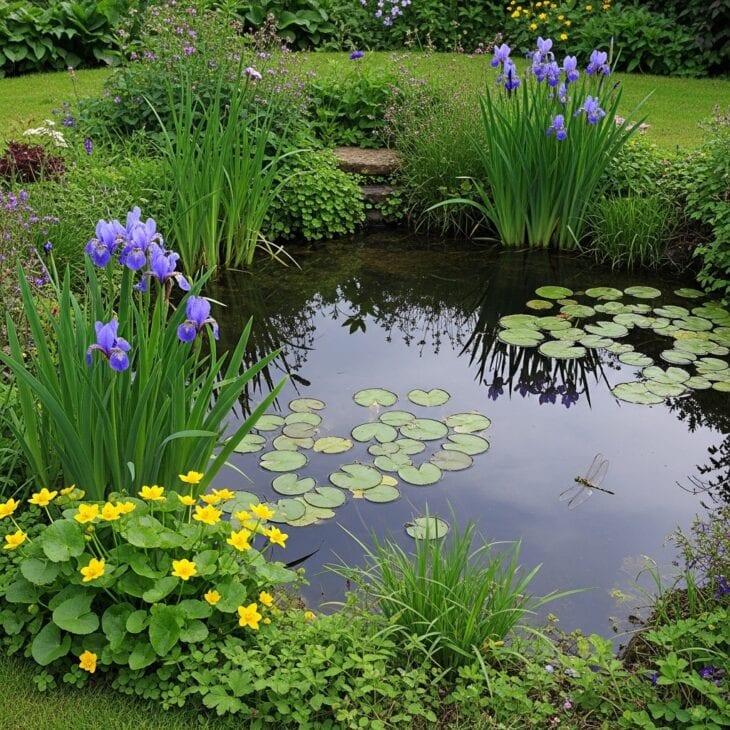
What you see A small pond, edged with flag iris and marsh marigold and reflecting the sky, brings a cottage garden to life. Planting tumbles right to the water, lily pads float on the surface, and dragonflies patrol the margins — a whole new layer of wildlife arrives within weeks of filling it.
Why it works Water is the single best thing you can add for wildlife, and it brings movement, reflection and sound to a planting that is otherwise all about flowers. An informal, planted edge keeps it firmly in cottage territory rather than looking like a formal water feature. Even a half-barrel pond will draw in frogs, birds and beneficial insects.
How to get it Dig the pond with at least one gently sloping side or add a ramp of stones, so creatures can climb in and out and hedgehogs do not drown. Include a shelf around 9in (23cm) deep for marginal plants like flag iris (Iris pseudacorus) and marsh marigold (Caltha palustris). Use rainwater rather than tap water where possible, and avoid fish if wildlife is your goal, as they eat tadpoles and insect larvae. Site it in sun but away from overhanging trees to limit leaf fall, and let it settle naturally rather than reaching for chemicals when it goes green in its first spring.
13. A Stone Path with Creeping Thyme
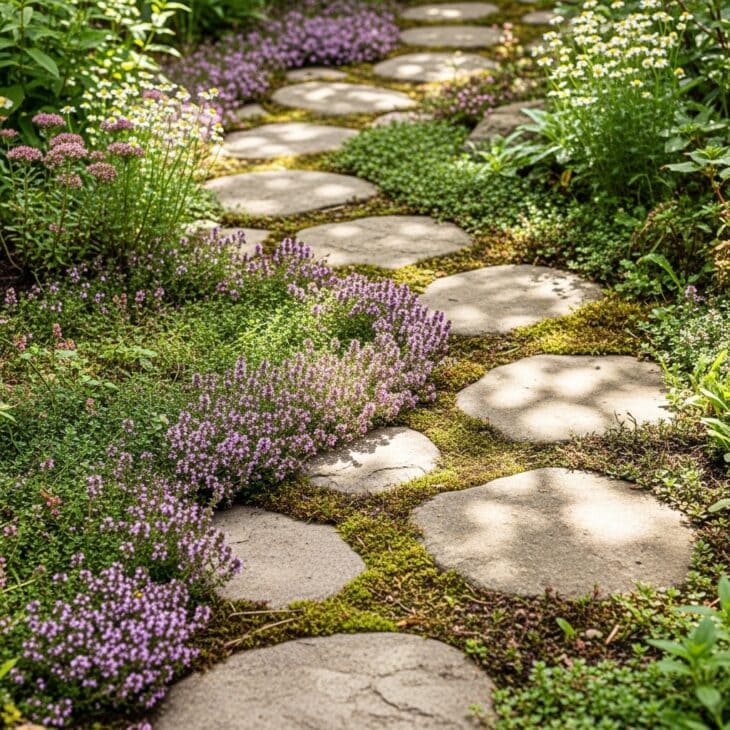
What you see An informal stone path with creeping thyme spilling from the gaps is a quietly magical cottage detail. The low mats of foliage soften every hard edge, flower purple and pink in summer, and release a wave of herby scent each time you tread on them.
Why it works Planting in the cracks of paving is the perfect way to take the newness off hard landscaping and make a path look as though it has been there for decades. Low, tough, aromatic plants thrive in the sharp drainage between stones where little else will grow. It is also a clever way to green up a surface without losing somewhere firm to walk.
How to get it Lay stepping stones or crazy paving on a free-draining base with soil-filled gaps of an inch or two between them. Plant small plugs of creeping thyme (Thymus serpyllum), or other tough crevice plants like chamomile and Erigeron, firming them into the gaps and watering until established. Choose a sunny path, as thyme sulks in shade and wet. Tread lightly at first while plants root in, then enjoy releasing the scent underfoot once they have spread to fill the joints.
14. A Soft Pastel Color Scheme
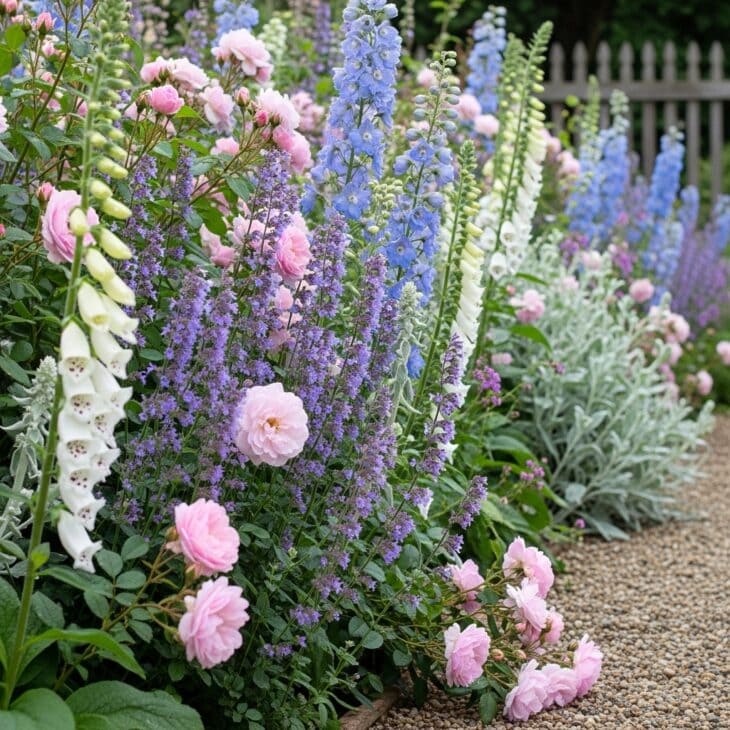
What you see Limit a cottage border to soft pinks, lilacs, powder blues and white, thread silver foliage through it, and you get the dreamiest version of the style. Pale roses, catmint, delphiniums and white foxgloves blend into one another in a gentle, romantic haze rather than competing for attention.
Why it works A restricted palette is the simplest way to bring harmony to a planting as busy as a cottage garden — when the colors agree, the eye relaxes even though there is a lot going on. Pastels are especially lovely in the soft light of morning and evening, when they seem to glow. Silver and grey foliage acts as the peacemaker, separating and uniting the flower colors at once.
How to get it Pick a tight color story and stick to it when buying plants — pale pink, lilac, blue and white, plus silver leaves. Reliable performers include ‘Gertrude Jekyll’ rose, catmint, lavender, white foxgloves and silvery artemisia or lamb’s ears (Stachys byzantina). Repeat two or three key plants down the border to tie the scheme together. White flowers also extend the display into dusk, so weight them toward seating areas you use in the evening.
15. Hot Colors with Dahlias and Crocosmia
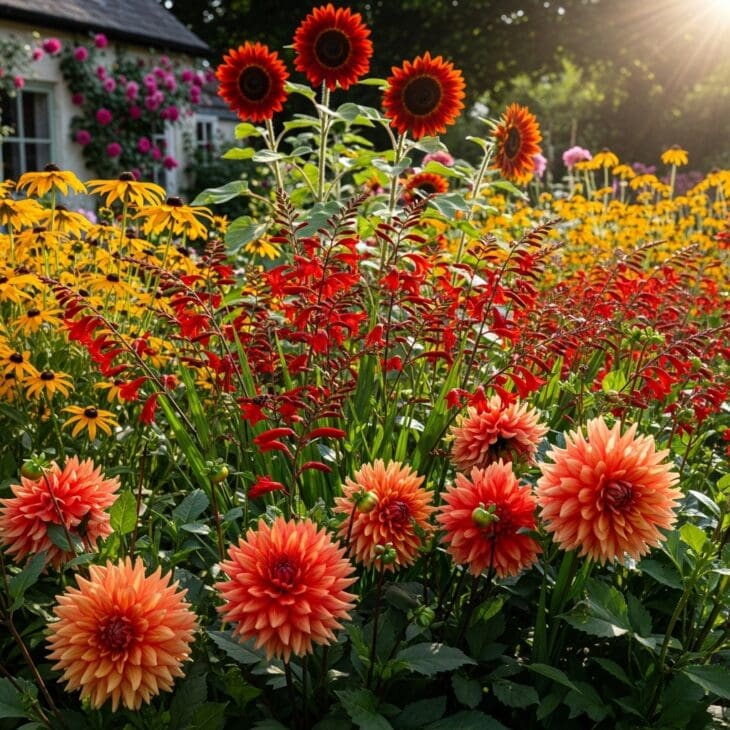
What you see Not every cottage garden has to be soft and romantic. Pack a border with scarlet dahlias, fiery crocosmia ‘Lucifer’, golden rudbeckia and deep red sunflowers and you get a hot, joyful display that peaks in late summer when many gardens are flagging.
Why it works Hot colors bring energy and carry across the garden, reading clearly from a distance where pastels can fade away. Crucially, this palette comes into its own in August and September, extending the cottage season well past the early-summer rose-and-delphinium peak. It is the perfect tonic for that late-summer lull.
How to get it Build the scheme around dahlias (start tubers off in pots in spring, plant out after frost, and stake the taller ones). Add crocosmia ‘Lucifer’, Rudbeckia fulgida, Helenium and a few annual sunflowers for instant height. Deadhead dahlias relentlessly to keep them blooming until the first frost, then lift the tubers in colder regions or mulch heavily where winters are mild. Site hot borders in full sun, which makes the colors sing rather than muddy.
16. A Rustic Bench Tucked Among the Flowers
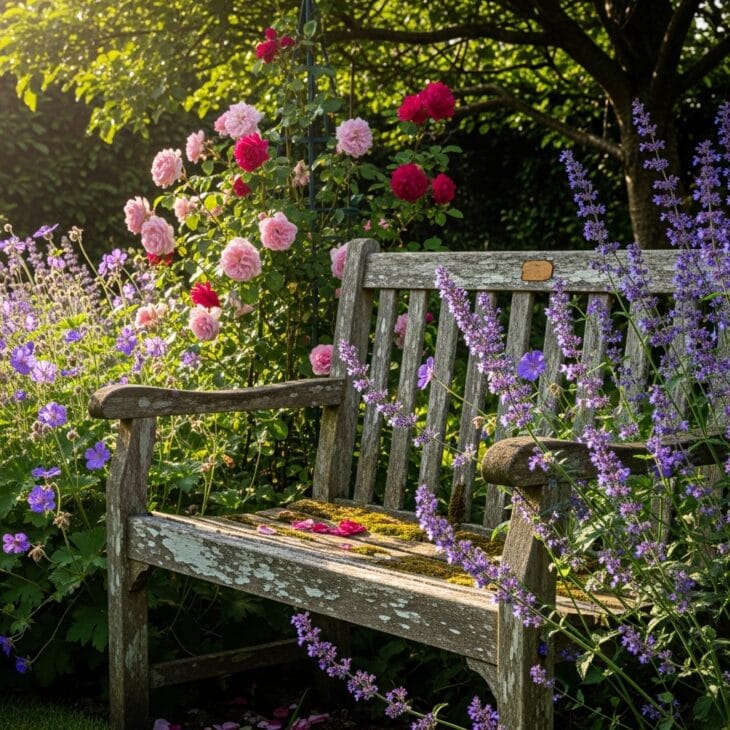
What you see A weathered wooden bench half-swallowed by the planting turns a border into a place to be, not just to look at. Roses and hardy geraniums lean in around it, catmint brushes your ankles, and the seat feels like a secret spot the garden grew around.
Why it works Every garden needs a destination, somewhere the path leads and you can sit and take it in. Surrounding the seat with planting, rather than setting it on bare paving, is what makes it feel intimate and cottagey instead of exposed. Place it where you catch the scent of nearby roses or lavender and you give yourself a reason to linger.
How to get it Choose a simple, weathered-looking bench in wood or metal that will age gracefully rather than something glossy and new. Position it to catch a particular moment — morning sun with a coffee, or evening light at the end of the day — and to look back over the best view of the garden. Plant fragrant, slightly arching plants around it but keep a clear pocket so you can actually sit down. A self-seeder or two creeping up to the legs will quickly make it feel established.
17. Hardy Geraniums to Fill Every Gap
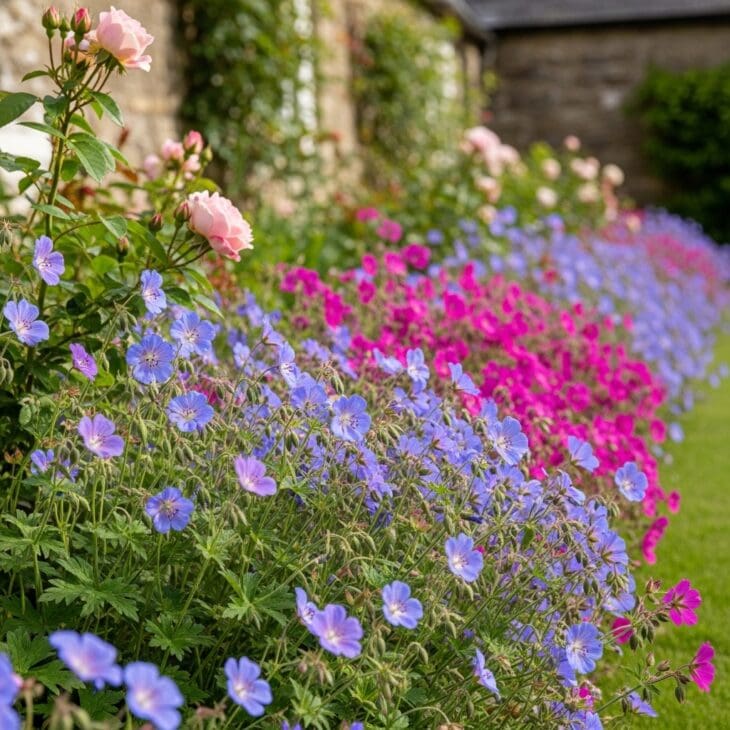
What you see Hardy geraniums, or cranesbills, are the unsung heroes of the cottage border — the plants that fill the gaps and tie everything together. Drifts of blue, magenta and pink flowers weave between rose stems and tumble over path edges, covering the bare soil and bare ankles of leggier plants.
Why it works A cottage garden lives or dies by how well its plants knit together, and few plants do that as generously or as easily as hardy geraniums. They are tough, long-flowering, shade-tolerant and almost impossible to kill, which makes them the ideal backbone for a beginner. Used in repeated drifts, they bring unity to an otherwise busy planting.
How to get it For reliable workhorses, plant Geranium ‘Rozanne’ (violet-blue, flowers for months), G. ‘Ann Folkard’ (magenta, scrambling) or the classic G. macrorrhizum for dry shade. Space them 18in (45cm) apart at the front and middle of the border and let them spread. After the first flush fades, shear the whole plant back hard to a few inches — it looks brutal, but fresh foliage and a second flush of flowers follow within weeks. Lift and divide congested clumps every few years in spring or fall.
18. Delphiniums and Lupins for Vertical Spires
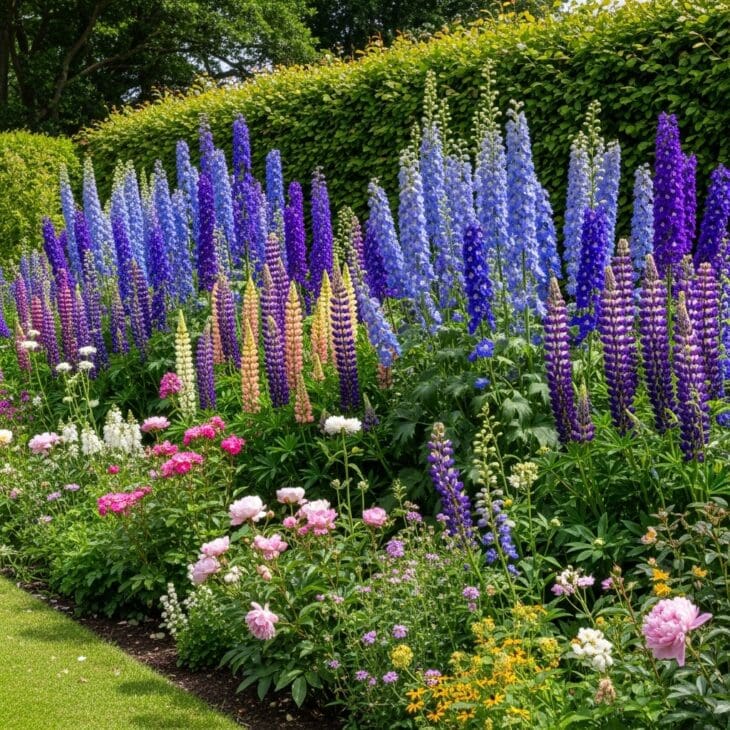
What you see The blue spires of delphiniums and the candy-colored cones of lupins (Lupinus) are the aristocrats of the early-summer cottage border. Rising in vertical columns above the froth of geraniums and catmint, they give the planting its grandest, most painterly moment.
Why it works True blue is rare in the garden, and delphiniums supply it in spectacular quantity, while lupins add the warm pinks, yellows and bicolors that set the blue off. Their strong vertical lines contrast with the rounded, spreading shapes around them, creating the structure that makes a cottage border feel composed rather than chaotic. Bees work their way up every spire.
How to get it Both enjoy rich soil and full sun. Stake delphiniums individually and early — their hollow stems snap in summer storms once the heavy flower heads form. Slugs adore the emerging shoots of both, so protect new growth in spring. Cut delphiniums right down after flowering and feed them, and you will often get a smaller second flush in fall. Lupins are short-lived, so let a few set seed or take basal cuttings to keep a supply coming.
19. A Welcoming Cottage Garden Gate
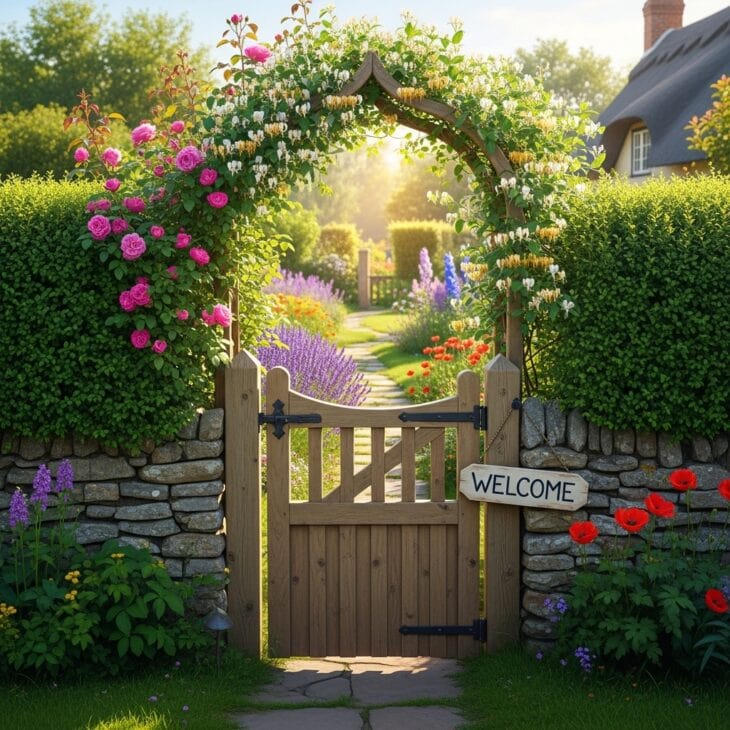
What you see A simple wooden gate, set in a hedge with roses or honeysuckle scrambling over the arch above it, is an invitation. It frames a glimpse of the flower-filled garden beyond and marks the threshold between the outside world and your own private patch of romance.
Why it works A gate creates a sense of arrival and anticipation — you cannot see the whole garden at once, so stepping through it becomes a small event. Clothing the arch above with a fragrant climber means you are greeted by scent as well as a view. It is the detail that makes a garden feel cared for from the very first step.
How to get it Choose a gate that suits the house — a low picket for a pretty cottage, a sturdier plank gate for something more rustic — and let it weather naturally or paint it a soft sage or grey-green. Add an arch over the top and train a honeysuckle (Lonicera periclymenum) or a compact climbing rose up each side, tying the stems in to meet overhead. Keep the planting either side lower than the gate so the eye is drawn through the opening. A well-oiled latch and hinges make all the difference to the everyday pleasure of using it.
20. Peonies and Roses for Pure Romance
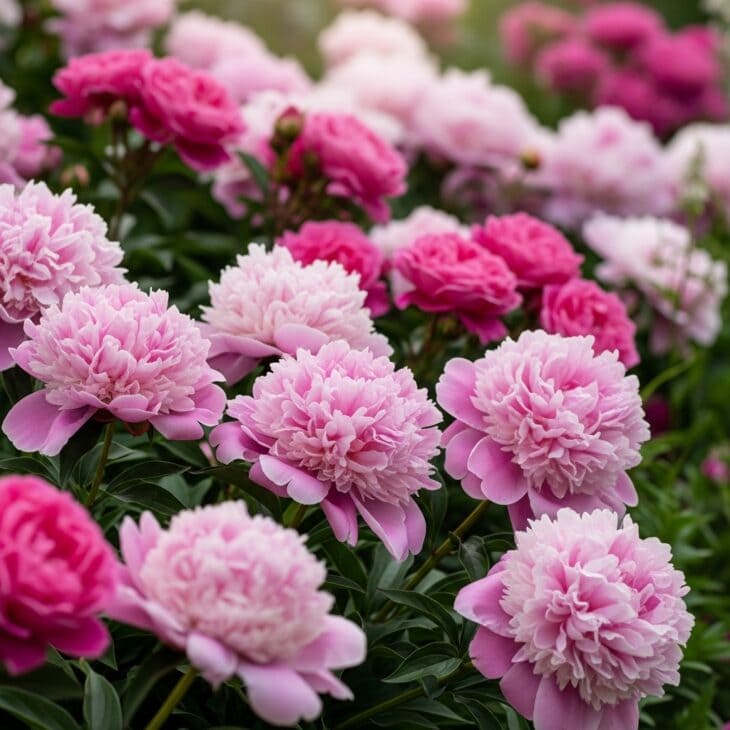
What you see For sheer romance, nothing tops the pairing of blowsy peonies (Paeonia) and old-fashioned roses. Their full, ruffled blooms in blush and rose open together in early summer for a few intoxicating weeks, filling the border with petals and perfume in the most extravagant way.
Why it works Peonies and roses share the same generous, many-petalled flower shape and the same nostalgic mood, so they amplify each other beautifully. Both are long-lived — a peony can outlast the gardener who planted it — making them an investment in romance that deepens every year. The combination is the very picture most people have in mind when they think of a cottage garden.
How to get it Plant peonies in fall in a sunny spot, and plant them shallow — bury the buds (eyes) more than 2in (5cm) deep and they may never flower, the single most common peony mistake. They resent being moved, so choose the spot carefully and be patient, as they often sulk for a year or two before settling. Support the heavy blooms with a ring stake before they open, since one downpour can flatten them. Pair with a repeat-flowering rose so the border keeps blooming after the peonies’ brief, glorious season ends.
21. A Clematis-Clad Wall or Trellis
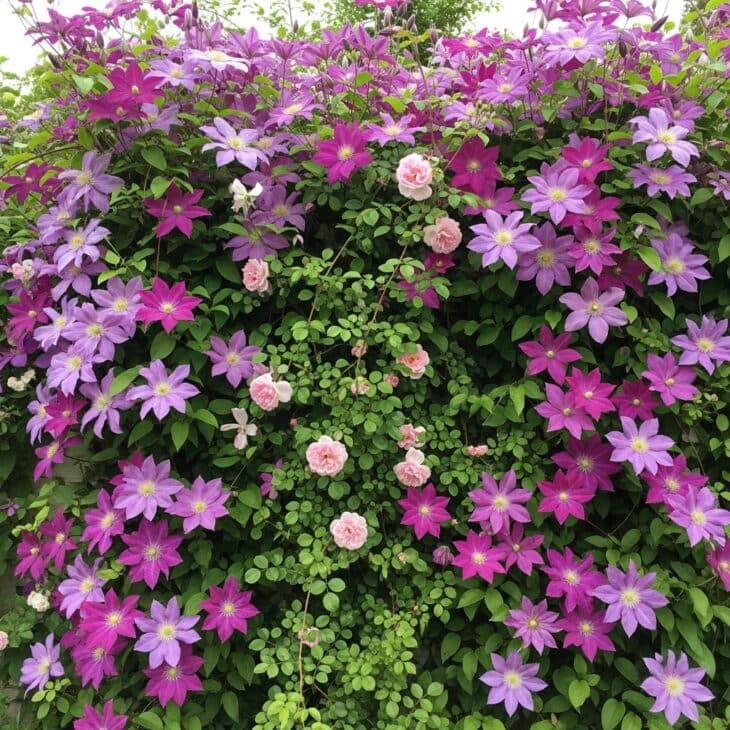
What you see A clematis scrambling over a wall or trellis turns a flat vertical surface into a sheet of star-shaped flowers. Whether grown alone or threaded through a climbing rose, it covers fences, sheds and bare walls with purple, pink or white blooms and takes up almost no ground space.
Why it works Vertical surfaces are often the most wasted space in a garden, and clematis is the perfect way to use them. With careful choice of varieties you can have clematis in flower from spring right through to fall, and growing one up through a rose gives you two flushes of color from a single patch of soil. It is a small-space gardener’s best friend.
How to get it The golden rule is “feet in the shade, head in the sun” — shade the roots with a slab or low planting while the top climbs into the light. Provide wires or a trellis for the leaf stalks to grip. The one thing you must know is the pruning group: group 1 (early, like montana) needs almost no pruning, group 2 (large-flowered) is lightly tidied in early spring, and group 3 (late, like viticella) is cut hard back to 12in (30cm) each spring. Check the label and prune accordingly, and a clematis will reward you for decades.
22. Catmint and Salvia for Easy Drifts of Blue
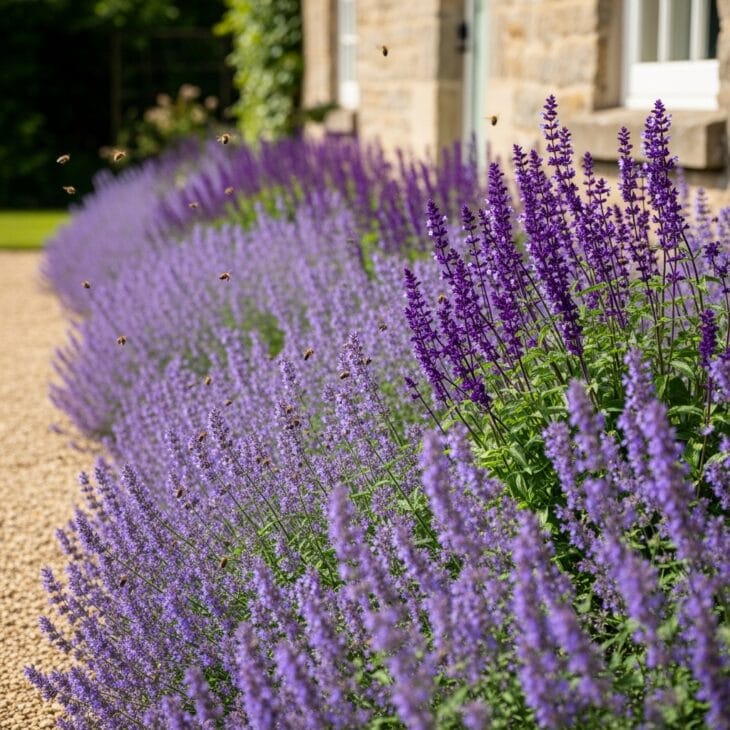
What you see Long, hazy drifts of catmint (Nepeta) and upright salvia bring a river of blue-purple to the front of a cottage border. Both are wreathed in bees from late spring onward, both spill happily onto paths, and neither asks much of you in return — making them the easiest way to get that relaxed, full cottage look.
Why it works Drifting one or two reliable plants in quantity, rather than collecting lots of singles, is the secret to a cottage garden that looks lush instead of bitty. Catmint and salvia flower for months, shrug off drought, and are catnip — literally and figuratively — for pollinators. Their soft, smoky color also flatters almost every other flower in the border.
How to get it Plant catmint ‘Walker’s Low’ and a hardy salvia like ‘Caradonna’ in groups of three or five, 18in (45cm) apart, in full sun and well-drained soil. After the first flush fades, shear catmint back by half to a third for a fresh mound and a second wave of flower. Salvias respond to the same Chelsea-chop treatment. Both are easy to divide in spring, so a few starter plants soon become enough to drift right along the border.
23. Old-Fashioned Scented Flowers
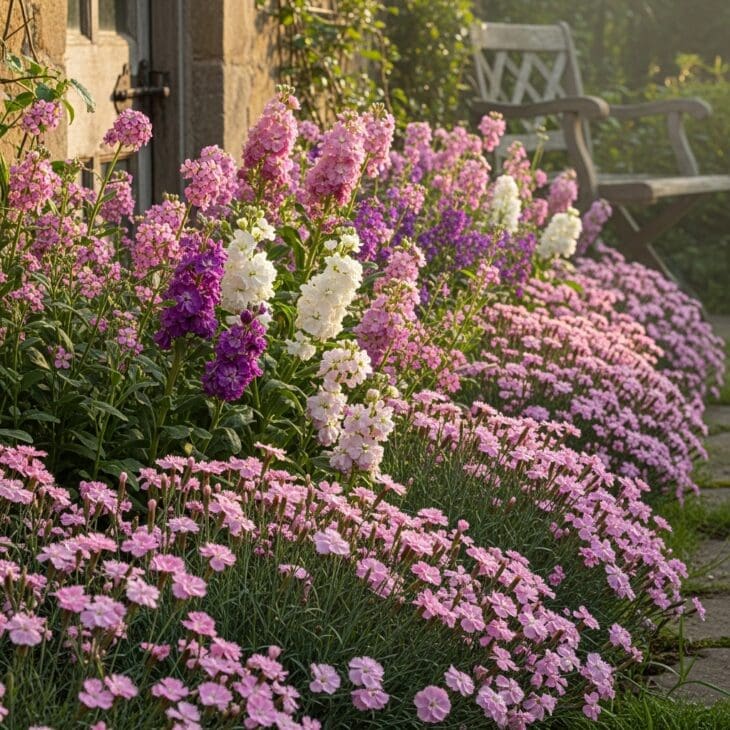
What you see A cottage garden should be as much about scent as sight. Clove-scented pinks (Dianthus), tall stocks (Matthiola), sweet rocket (Hesperis matronalis) and night-scented stock fill the air with old-fashioned perfume, especially in the evening when the garden quietens and the fragrance seems to rise.
Why it works Scent is the most evocative and nostalgic part of a garden, and it is exactly the quality modern bred-for-looks flowers so often lack. Planting deliberately for fragrance brings a whole extra dimension to the cottage experience and rewards you most in the cool of the evening. Many of these flowers also happen to be magnets for moths and other night pollinators.
How to get it Concentrate scented plants where you will appreciate them — beside a path, a doorway or a favorite seat — rather than scattering them far away. Choose old varieties specifically, as breeding for size and color has stripped the perfume from many modern strains. Pinks need sharp drainage and full sun; sweet rocket and stocks are happy in ordinary soil. Mix in some night-scented stock (Matthiola longipetala), which is plain by day but astonishingly fragrant after dark, sown straight into gaps each spring.
24. A Cottage Garden Buzzing for Pollinators
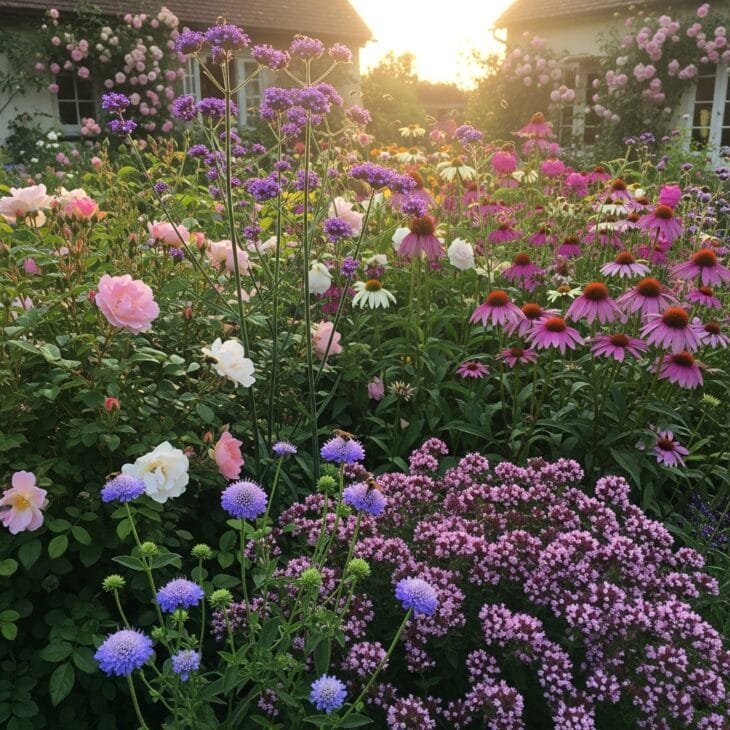
What you see A cottage garden planted for pollinators is a garden in motion — bees, butterflies and hoverflies working open-faced roses, tall Verbena bonariensis, coneflowers (Echinacea) and scabious from morning to dusk. The hum is as much a part of the scene as the flowers themselves.
Why it works Cottage gardens are naturally good for wildlife, but a few deliberate choices make them exceptional. Single, open flowers let insects reach the nectar that fancy double blooms hide away, and a long succession of flowering keeps food on the table from spring to fall. A buzzing garden is not only the right thing to do — it is more alive, and more fun to be in.
How to get it Favor single-flowered varieties over heavily doubled ones, and aim for something in bloom in every month from March to October. Plant in generous drifts so insects can forage efficiently, and include herbs like oregano, thyme and chives, which bees adore once they flower. Leave seedheads standing over winter for birds and overwintering insects, and resist tidying everything away in fall. Avoid pesticides altogether — a healthy cottage garden builds its own balance of predators and prey.
25. Spring Bulbs Underplanting the Border
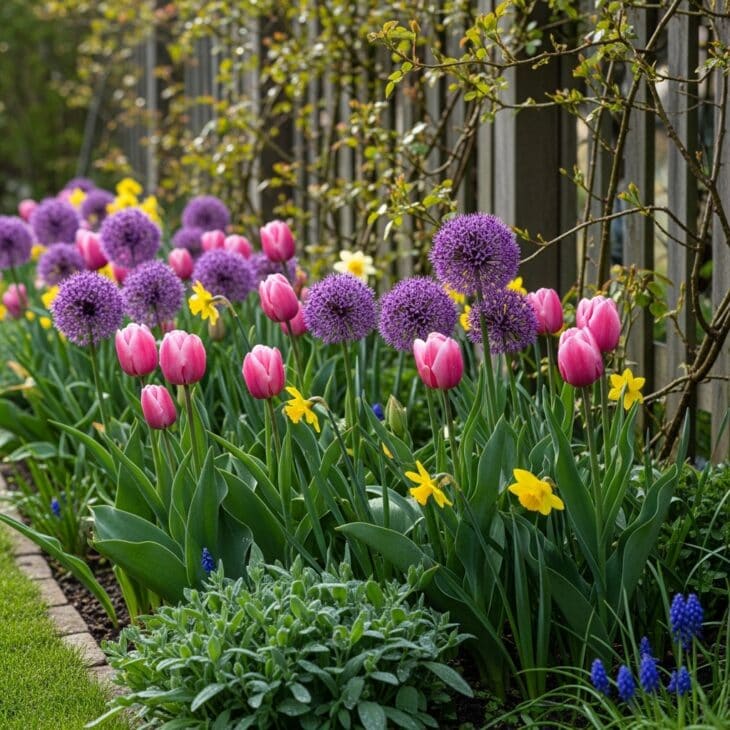
What you see Underplant the border with bulbs and you give the cottage garden a whole extra season. Daffodils, tulips and globe-headed alliums rise through the emerging foliage of the summer perennials in spring, carrying color in the weeks before the roses and delphiniums get going.
Why it works Bulbs are the most efficient plants you can grow — tucked beneath later-flowering perennials, they occupy the same ground twice, flowering and dying back just as their neighbors fill out to hide their fading leaves. This layering is how experienced gardeners keep a border interesting for ten months of the year rather than three. Alliums in particular bridge the gap perfectly, their purple drumsticks overlapping the first early-summer flowers.
How to get it Plant bulbs in fall, in groups rather than rows, at roughly three times their own depth. Choose alliums (such as ‘Purple Sensation’), tulips and daffodils, and tuck them between perennials whose foliage will rise to disguise the dying bulb leaves. Resist cutting that foliage down until it yellows, as the leaves feed next year’s flower. Tulips are best treated as short-lived in heavy soil — many gardeners replant fresh bulbs each fall — while daffodils and alliums settle in and multiply.
26. Overflowing Window Boxes
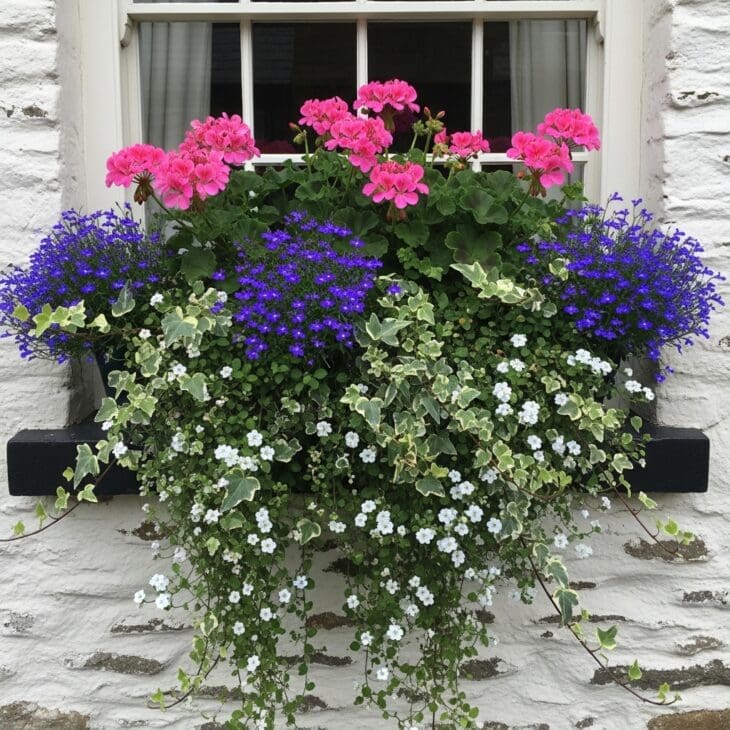
What you see A window box overflowing with trailing geraniums, lobelia and ivy brings the cottage garden right up to the house and into view from indoors. Spilling down the wall beneath the glass, it frames the window with flowers and makes even a bare facade look loved.
Why it works Window boxes are the perfect way to garden when you have no ground at all, and they put color exactly where you and passers-by see it most. They also extend the cottage look up the walls, helping the house and garden feel like one connected, flower-wrapped whole. Few things give so much charm for so little space.
How to get it Fix boxes securely with proper brackets — a planted box full of wet compost is surprisingly heavy. Use a peat-free compost with added water-retaining material, since boxes dry out fast in sun and wind. Plant the classic trio of an upright (geranium), a filler (such as petunia or bacopa) and trailers (trailing lobelia, ivy) packed in tightly for instant fullness. Water daily in summer, sometimes twice in a heatwave, and feed weekly to keep the display going right through to the first frost.
27. Trained Apples and Espaliered Fruit
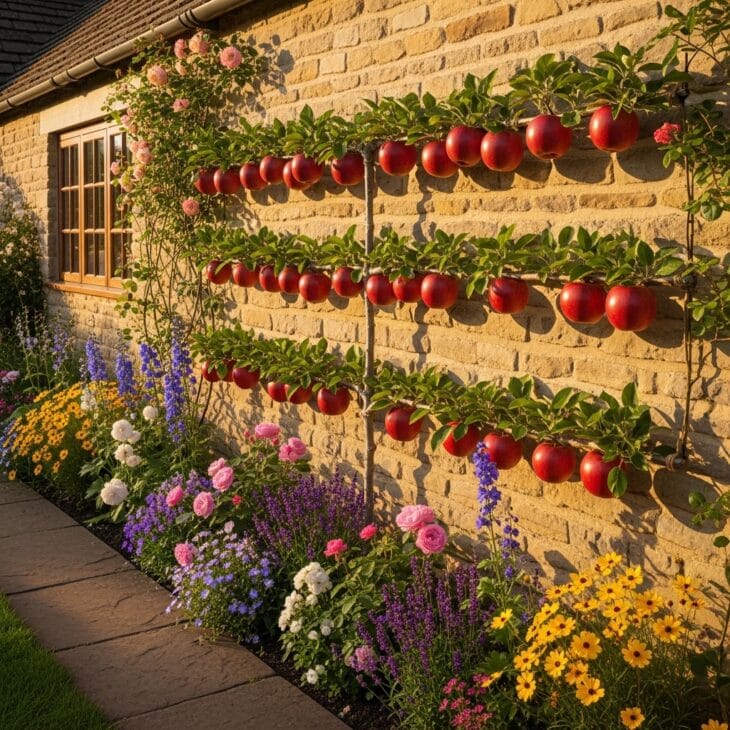
What you see An apple tree trained flat against a wall in neat horizontal tiers is the cottage garden at its most quietly clever. The espalier carries blossom in spring and fruit in fall, all on a plant barely a foot deep, with cottage flowers crowding happily at its feet.
Why it works Trained fruit is the original cottage marriage of beauty and productivity, letting you grow apples, pears or plums where a full tree would never fit. Flattened against a warm wall, the fruit ripens better and the tree becomes a living piece of architecture that gives the garden structure all winter. It is proof that even the smallest plot can be both pretty and productive.
How to get it Buy a ready-started espalier or train a young, whippy tree yourself against horizontal wires spaced about 18in (45cm) apart on a sunny wall or fence. Choose a variety on a dwarfing rootstock such as M26 to keep it manageable, and check whether it needs a pollination partner nearby. Tie in the horizontal arms as they grow and prune in summer to build the tiered shape and encourage fruiting spurs. It takes a few years of patient training, but the result lasts a lifetime.
28. A Relaxed Gravel Cottage Garden
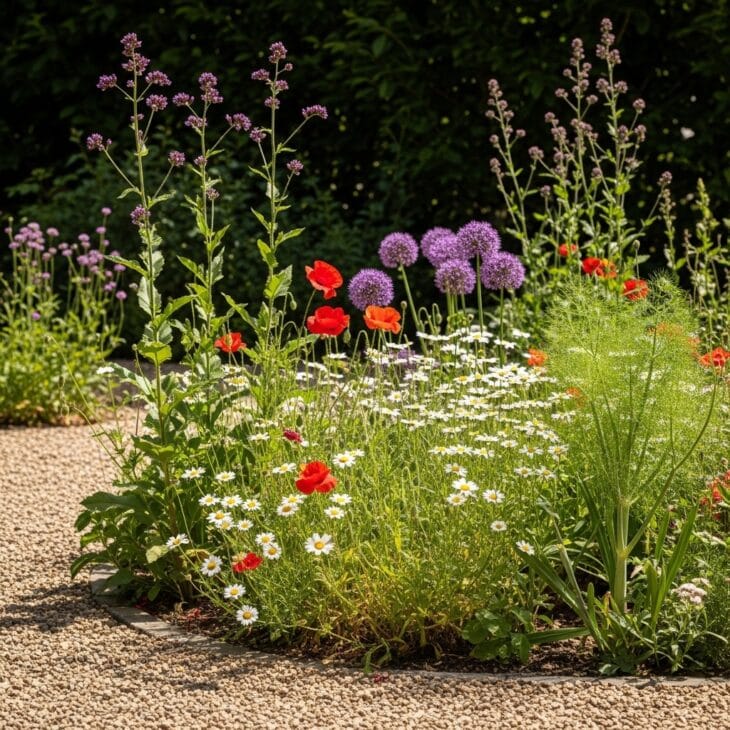
What you see In a gravel garden, the plants grow straight out of the stone, self-seeding where they please. Spires of mullein (Verbascum), poppies, alliums and feathery fennel rise from a pale gravel surface with no hard edges between path and planting — a looser, sun-baked take on the cottage look.
Why it works Gravel suits the modern cottage gardener perfectly: it is drought-tolerant, low-maintenance and lets plants seed around to create that natural, self-made effect. The stone acts as a mulch that locks in moisture and suppresses weeds, so once established the garden largely looks after itself. It is the ideal answer for a hot, dry, free-draining spot where a traditional border would struggle.
How to get it Lay a deep gravel mulch of 2 to 3in (5 to 8cm) over well-drained soil — skip the weed membrane if you want plants to self-seed into the stone. Choose sun-lovers that thrive on poor soil and relish the conditions: lavender, Verbascum, Erigeron, alliums, fennel and grasses. Plant them straight into the soil beneath the gravel and water only until established, after which they should cope alone. Let the self-seeders do their thing, simply editing out anything that lands where you do not want it.
29. A Cottage Garden for a Tiny Space
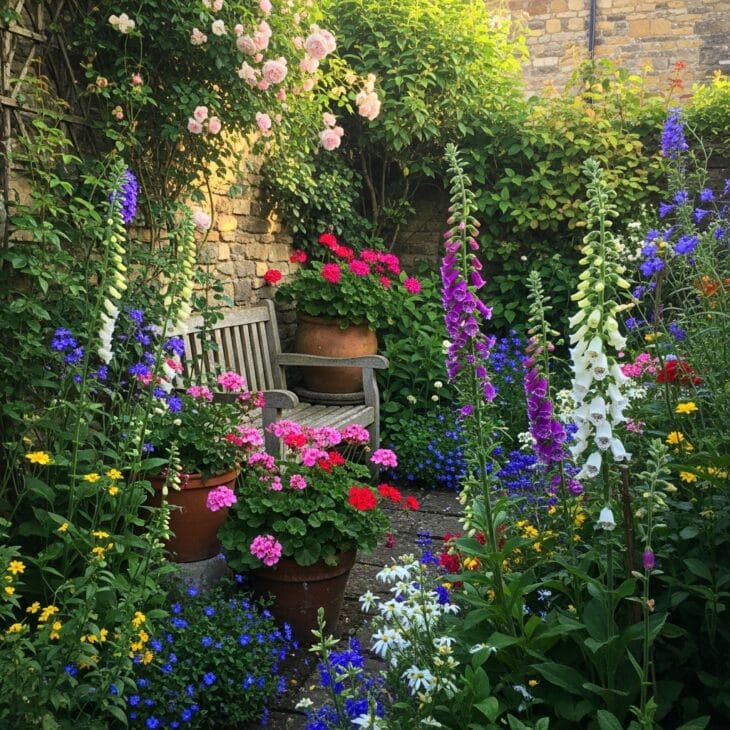
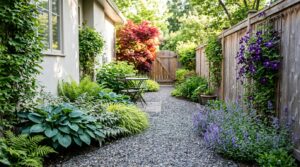
What you see You do not need a country plot to have a cottage garden. A tiny courtyard or front yard, packed with a climbing rose on the wall, pots of foxgloves and geraniums and a single small bench, can deliver every bit of the romance in a fraction of the space.
Why it works Cottage style is actually well suited to small gardens, because abundance and a little controlled chaos disguise a lack of square footage. The trick is to go up as well as out, using walls, fences and arches for climbers so the planting wraps around you. Packing the space full, rather than leaving polite gaps, is exactly what makes a small cottage garden feel lush rather than cramped — see our other small garden ideas for more on this.
How to get it Use every vertical surface for climbing roses, clematis or sweet peas, and choose compact or repeat-flowering varieties that earn their place over a long season. Grow upright plants like foxgloves and cosmos in pots to add height without taking ground space. Keep to a tighter color palette than you would in a big garden, as too many colors in a small space can feel restless. Above all, do not be afraid to over-plant — in a small cottage garden, more really is more.
30. A Shady Cottage Corner
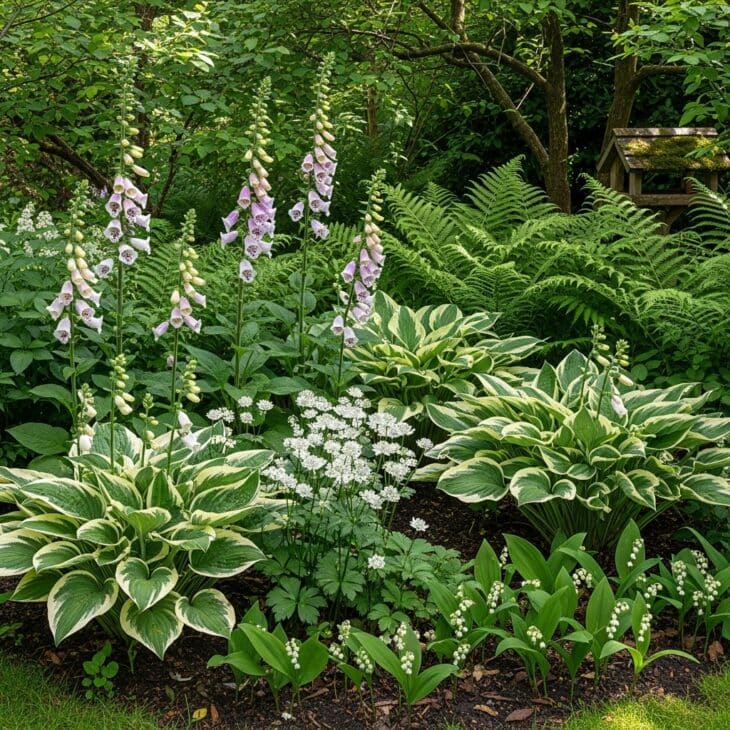
What you see The shady corner everyone struggles with can become one of the loveliest parts of a cottage garden. Foxgloves, ferns, white astrantia, hostas and lily of the valley glow in the cool dappled light, bringing a fresh, luminous calm in greens and whites where bright flowers would only sulk.
Why it works Shade is not a problem to be solved but a different mood to be embraced — restful, green and sophisticated, a soothing counterpoint to the sunny exuberance elsewhere. Pale flowers and variegated foliage seem to light up dim spots, drawing the eye into the corner rather than away from it. Many woodland-edge cottage plants positively prefer these conditions, so you are working with the site, not against it.
How to get it Improve the soil first with plenty of leaf mould or compost, since dry shade under trees is the real challenge, not shade itself. Choose proven shade-lovers: foxgloves, astrantia, hardy geraniums, hostas, ferns, and lily of the valley (Convallaria majalis) for ground cover and scent. Lean on white and pale flowers plus bold or variegated foliage to lift the gloom, and use plant shapes and leaf textures rather than color alone to create interest. Mulch every spring to keep moisture in, and the corner will repay you with one of the most tranquil scenes in the garden — see our wider shade garden ideas for more inspiration.