A wildlife garden is the rare kind of gardening where doing less often achieves more. The messy corner you have been meaning to clear is already a beetle nursery, and the seedheads you were about to cut back are a winter grocery store for finches. Once you start seeing your yard the way a bee or a wren sees it, the whole job changes.
Contents
- 01. A Wildlife Pond With a Sloping Beach Edge
- 02. A Mini Wildflower Meadow in the Lawn
- 03. A Native Hedgerow Instead of a Fence
- 04. A Log Pile in the Shady Corner
- 05. A Long-Season Nectar Border
- 06. Caterpillar Host Plants, Not Just Nectar
- 07. Berry Shrubs for Winter Birds
- 08. A Bird Feeding Station With Cover Close By
- 09. Nest Boxes at Different Heights
- 10. Seedheads Left Standing Through Winter
- 11. A Bee Hotel on a Warm South Wall
- 12. A Bare Earth Patch for Ground-Nesting Bees
- 13. A Compost Heap That Doubles as Habitat
- 14. A Shallow Pebble Dish for Thirsty Insects
- 15. A Night-Scented Border for Moths
- 16. A No-Mow Zone Under the Trees
- 17. A Climber-Clad Wall for Shelter and Late Nectar
- 18. Leaf Litter Left Where It Falls
- 19. One Native Tree as the Centerpiece
- 20. A Hummingbird Corner in Red and Orange
- 21. A Dry Stone Wall or Rock Pile
- 22. A Clover Lawn Instead of Perfect Turf
- 23. A Rain Garden in the Soggy Spot
- 24. A Green Roof on the Shed
- 25. The Wild Corner You Never Tidy
The ideas below run from a five-minute change to a full weekend project. Some cost nothing at all, like leaving the leaves where they fall or raising the mower blade. Others, such as digging a small pond or planting a native hedgerow, ask for real effort but pay you back with frogs, birds and butterflies for decades.
You do not need acreage or a rewilding manifesto to make a difference, and you do not have to give up a beautiful garden to get a living one. Scroll through, pick the two or three ideas that suit your space and your soil, and let the rest wait. Wildlife responds fast, usually within a single season.
01. A Wildlife Pond With a Sloping Beach Edge
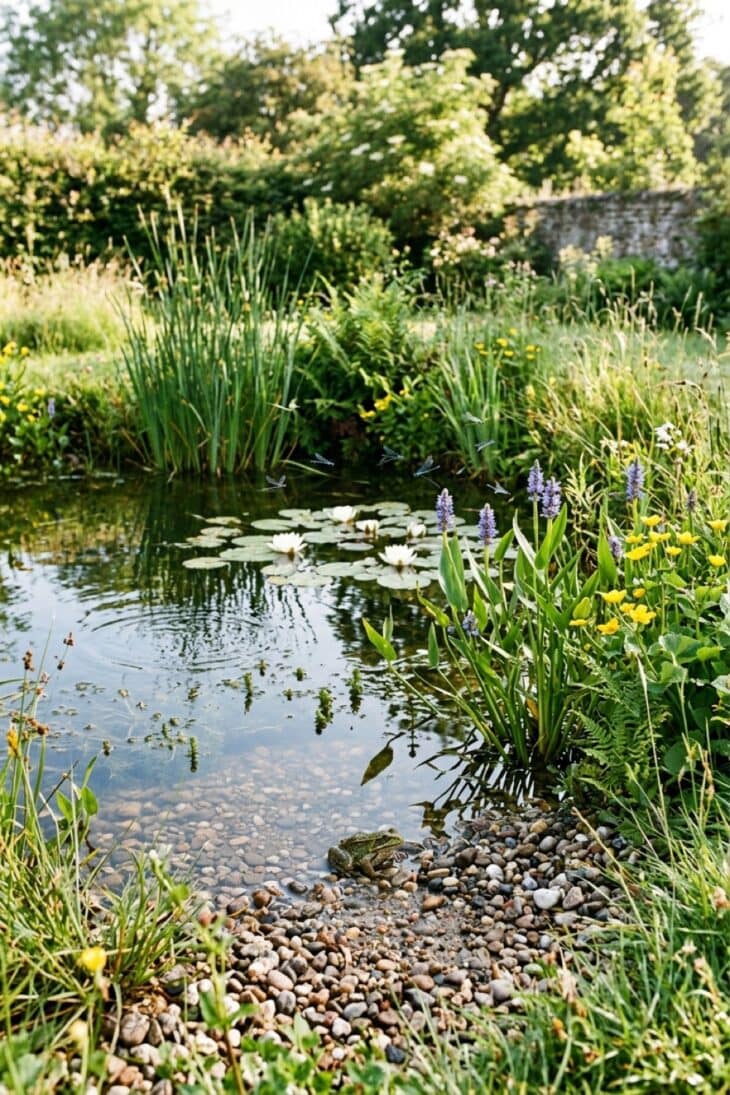
What you see A pool of open water no bigger than a dining table, ringed with rushes and pickerelweed, with one side shelving gently down into a beach of rounded pebbles. Damselflies stitch back and forth over the surface. A frog sits half-submerged at the shallow end, and the whole thing looks less like a feature and more like something that was always there.
Why it works Water is the single biggest thing you can add for wildlife, and it works faster than anything else in this article. Within weeks you get insects, within months amphibians, and birds will use it year round. The sloping edge is the part people skip and the part that matters most: without it, hedgehogs, young frogs and fledglings that fall in cannot climb out again.
How to get it Dig a shallow bowl at least 3ft (90cm) across, with a deeper zone of 24in (60cm) in the middle and one bank sloping at no more than 20 degrees. Line with butyl over old carpet or sand, then cover the liner with a layer of washed gravel. Fill with rainwater if you possibly can, since tap water is rich in nutrients and will green the pond up. Plant marginals such as marsh marigold (Caltha palustris) and pickerelweed (Pontederia cordata) in aquatic baskets, add one oxygenator like hornwort, and then leave it alone. Do not add fish, which eat the tadpoles and invertebrates you are trying to attract, and never move spawn in from another pond.
02. A Mini Wildflower Meadow in the Lawn
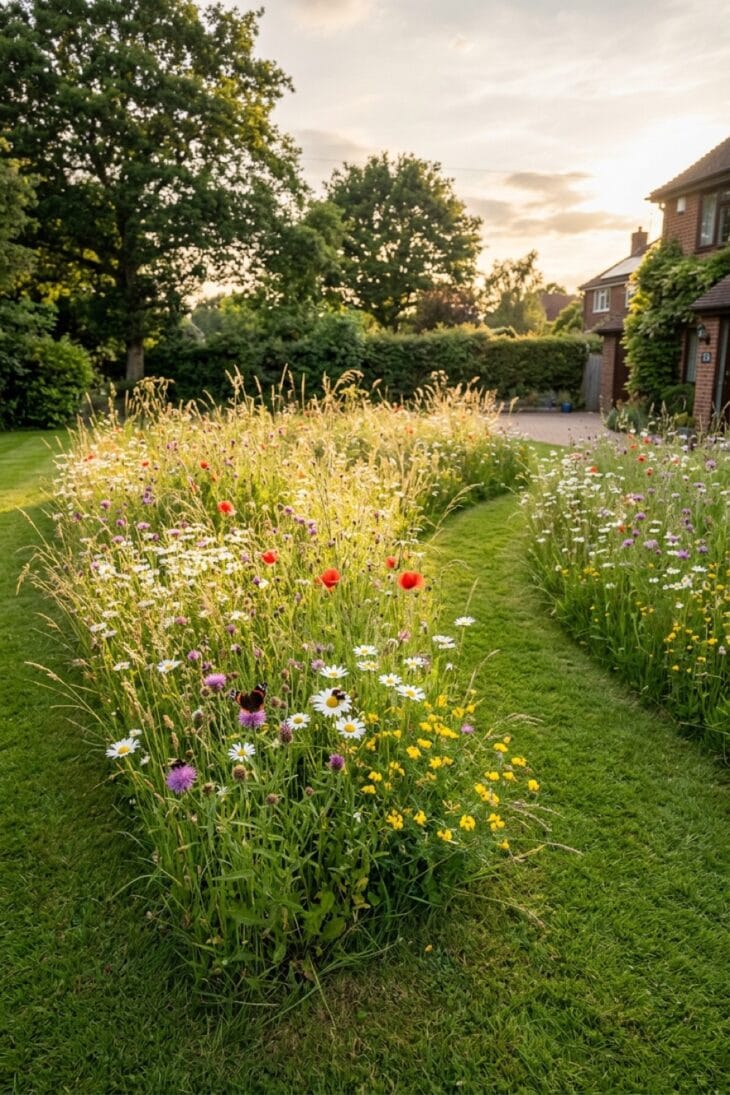
What you see Waist-high grasses gone to seed, threaded with oxeye daisies, poppies and purple knapweed, all glowing where the low evening sun catches them from behind. A mown path curves straight through the middle. The contrast between the sharp green edge and the loose meadow inside it is what makes the eye read it as a design rather than neglect.
Why it works Lawn is close to a desert for insects, and converting even a fraction of it multiplies the life your yard supports. The mown frame is the trick that makes it acceptable to neighbors and to your own eye: a crisp edge signals intent, and once people read the meadow as deliberate they stop seeing it as a mess.
How to get it Wildflowers want poor soil, so never feed the area and, if your lawn is lush, strip the top 2in (5cm) of turf and topsoil first. Sow a regional native mix in fall at about 1 to 2 grams per square foot, raked into bare soil and firmed down. Add yellow rattle (Rhinanthus minor) to the mix, since it parasitizes grasses and weakens them enough for flowers to compete. Cut the whole thing once in late summer after seeds have dropped, then rake off and remove the clippings so the soil stays hungry. The first year often looks thin, and that is normal, so do not panic and reseed.
03. A Native Hedgerow Instead of a Fence
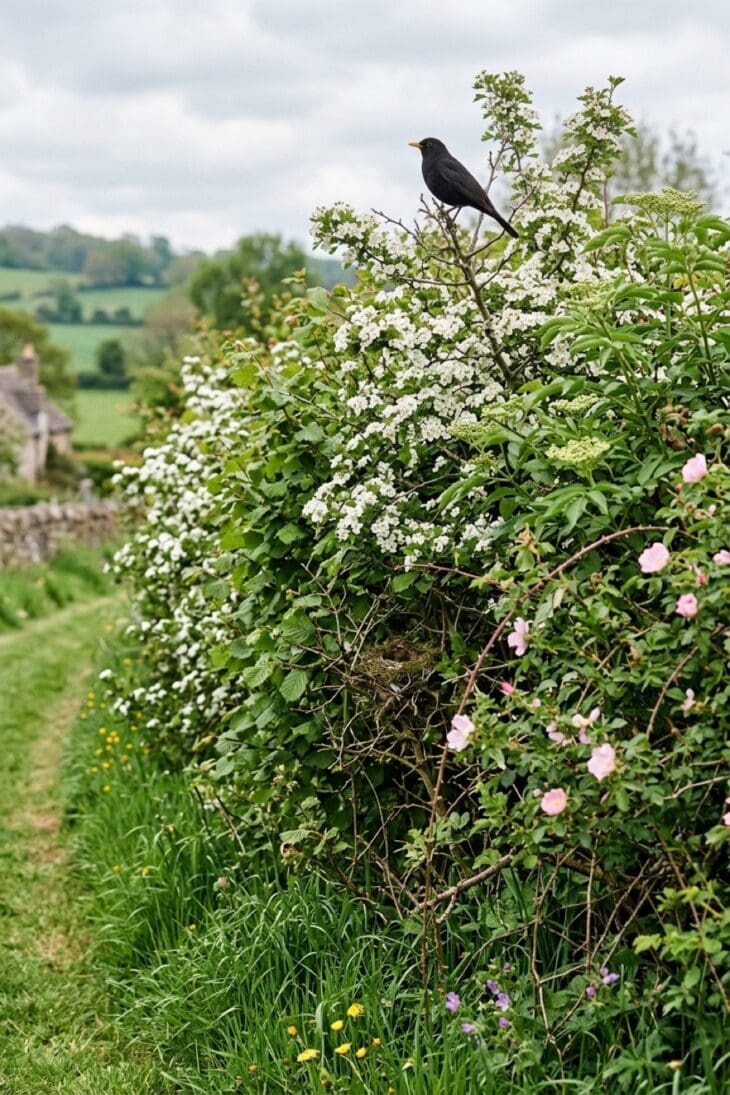
What you see A loose, thorny wall of green marking the boundary, foaming with hawthorn blossom in May and shot through with the pink of dog rose. It is 6ft (180cm) high and nothing about it is clipped. A blackbird sits on top singing, and you can hear more birds moving deep inside where you cannot see them.
Why it works A fence is a barrier; a hedge is a habitat, a highway and a larder all at once. Thorny species give nesting birds protection from cats, the flowers feed pollinators in spring, and the berries feed thrushes and waxwings well into winter. It also outlives any fence panel you will ever buy, and unlike a row of evergreen conifers it supports hundreds of insect species rather than almost none.
How to get it Plant bare-root whips in late fall or winter, five to six per yard (metre) in a double staggered row, and mix at least five species so something is flowering or fruiting in every season. Hawthorn (Crataegus spp.) is the backbone, joined by hazel (Corylus avellana), elderberry (Sambucus nigra), dog rose (Rosa canina) and a native viburnum. Cut back hard by half in the first winter, which feels brutal but is what makes the base thicken instead of going bare and leggy. Trim only every second or third year, and only in late winter, so you never destroy nests or the coming berry crop. If you need something denser and more formal, the tighter evergreen hedge shrubs are worth comparing before you commit.
04. A Log Pile in the Shady Corner
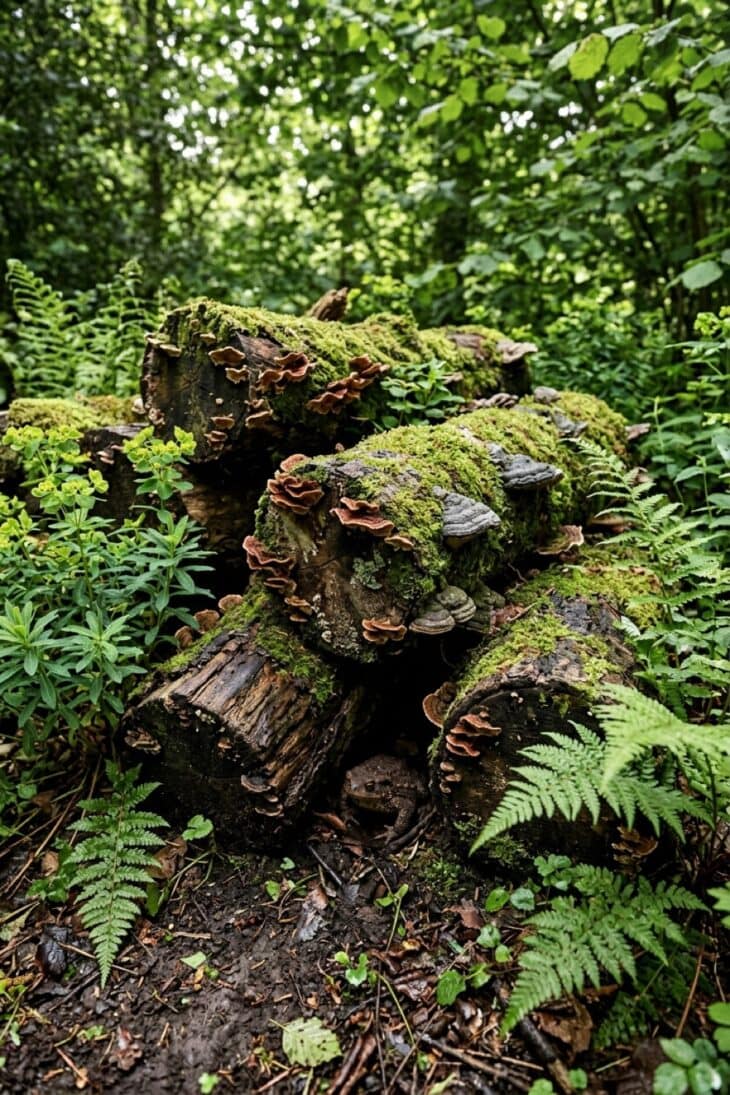
What you see A rough stack of hardwood logs, half sunk into the earth in the dampest corner of the garden, furred over with moss and edged with bracket fungi. Ferns push up between them. Lift one and you find woodlice, centipedes, beetle larvae and, if you are lucky, a toad sitting in the cool dark.
Why it works Rotting wood is one of the scarcest habitats in a tidy world, and a startling number of species depend on it: saproxylic beetles, fungi, and everything further up the chain that eats them. This is the single laziest high-value thing in this article, since it costs nothing, needs no maintenance, and is best when you forget about it entirely. It belongs on any list of low-maintenance garden ideas.
How to get it Use native hardwood such as oak, beech or fruitwood, in chunky pieces at least 4in (10cm) thick, since thin sticks dry out and rot too fast to be useful. Choose the shadiest, dampest spot you have and part-bury the bottom logs so they stay in contact with the soil moisture. Do not treat, seal or strip the bark, and do not use softwood pallets or anything pressure-treated. Then leave it: no rearranging, no tidying, no checking underneath every week. Top it up with a fresh log every few years as the old ones vanish into the soil.
05. A Long-Season Nectar Border
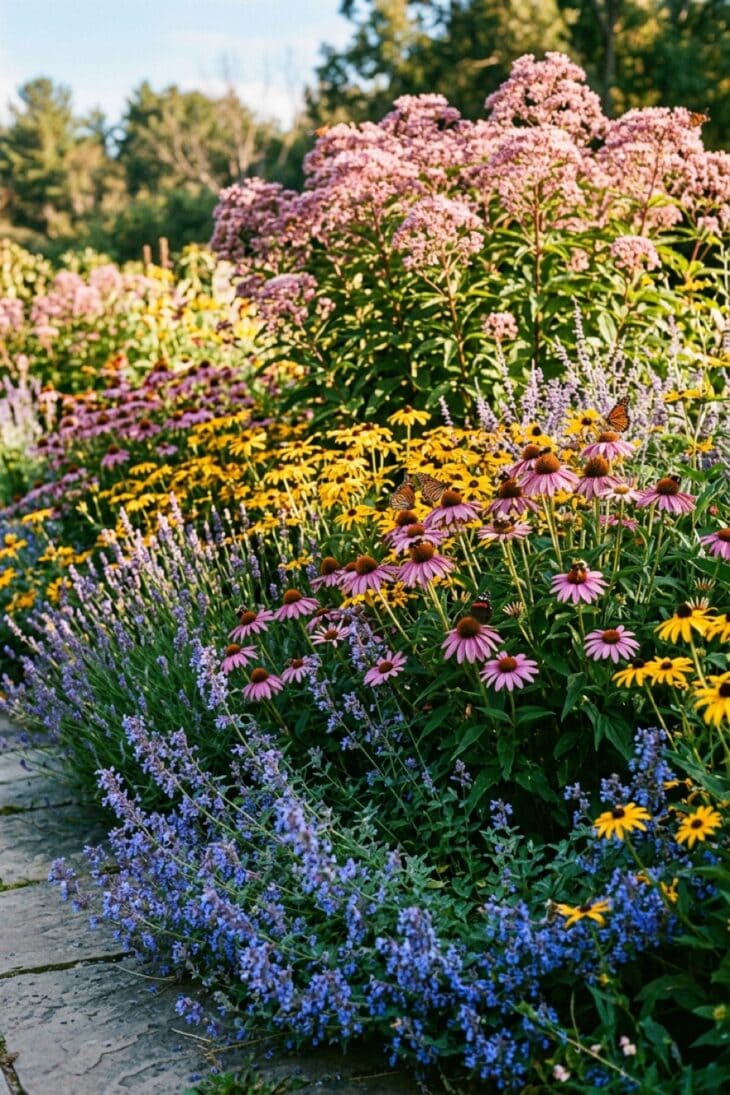
What you see A deep border so full that no soil shows, with blue catmint (Nepeta mussinii) foaming over the front edge, purple coneflowers and black-eyed Susan (Rudbeckia hirta) through the middle, and tall Joe Pye weed at the back. The whole thing hums audibly. Stand near it on a warm afternoon and you can count a dozen bee species without moving your feet.
Why it works Most gardens have a nectar glut in June and a famine either side of it. Pollinators need food from the first warm day of spring to the last of fall, so a border planned across the whole season keeps queens alive when they emerge and lets late bumblebees fatten up before winter. The loose, generous cottage garden style is not just charming here, it is functional, since dense planting shelters insects from wind.
How to get it Plant in drifts of three, five or seven of the same plant rather than singles, because bees forage far more efficiently when they can work one flower type at a time. Cover the calendar deliberately: pussy willow and crocus for March, lavender (Lavandula angustifolia ‘Hidcote’) and salvia for midsummer, then asters, sedum and goldenrod carrying you into October. Choose single, open flowers over double-flowered cultivars, which are often bred to the point of having no accessible pollen at all. Give the bed at least 4ft (120cm) of depth and full sun, and skip the fertilizer, which produces soft leafy growth and fewer flowers.
06. Caterpillar Host Plants, Not Just Nectar
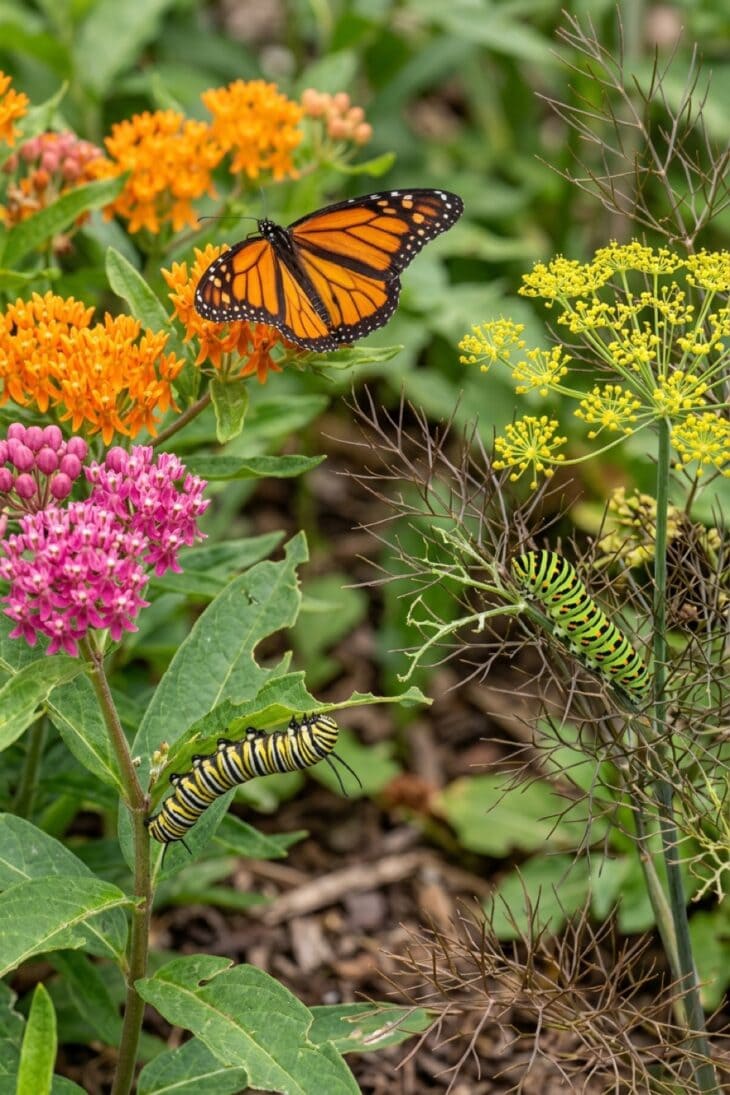
What you see A patch of orange butterfly weed (Asclepias tuberosa) and pink swamp milkweed with a fat striped monarch caterpillar working along a leaf. Nearby, bronze fennel and dill carry the black and green banded caterpillars of the swallowtail. Leaves are visibly chewed, and that is exactly the point.
Why it works Nectar feeds adult butterflies for a few weeks; host plants are where the next generation actually comes from, and without them your garden is a restaurant with no maternity ward. Most butterflies are extremely fussy, and monarchs will lay on nothing but milkweed. Accepting a bit of leaf damage is the price of admission, and it is the difference between visiting butterflies and breeding ones.
How to get it Plant milkweed for monarchs, choosing a species native to your region: swamp milkweed (Asclepias incarnata) for damp soil, butterfly weed for dry. Add fennel (Foeniculum vulgare), dill and parsley for black swallowtails, and simply plant enough that you can share. Put host plants somewhere slightly out of the main sightline, since they will look ragged by August. Never spray anything, including organic Bt or insecticidal soap, on or near them. If you want the full picture of which flowers pull the adults in, see our guide to the best plants to attract butterflies.
07. Berry Shrubs for Winter Birds
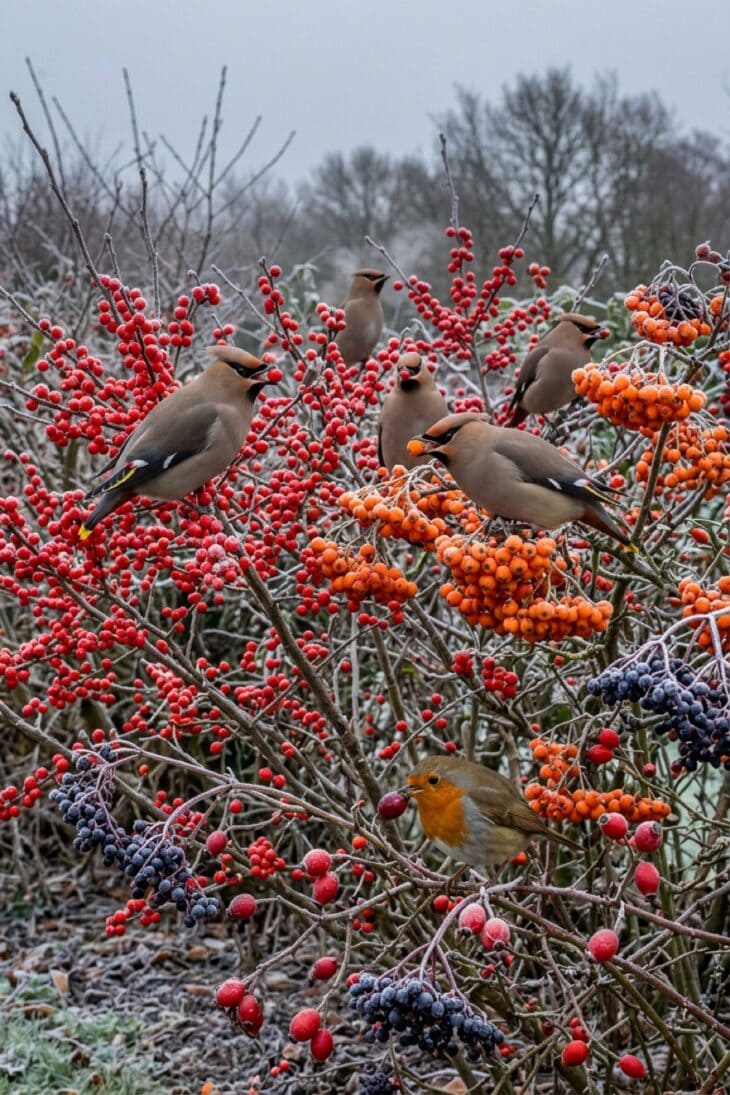
What you see Bare winter branches hung with scarlet, orange and purple fruit, frost silvering the edges, and a flock of waxwings stripping them methodically. On a grey January afternoon the berries are the only strong color in the garden. Within a week of the birds arriving, the shrubs are picked clean.
Why it works Winter, not summer, is when birds actually starve, and fruit is high-energy fuel exactly when insects have vanished. Berry shrubs also do a job feeders cannot: they spread the food through cover, so small birds can eat without sitting exposed to hawks and cats. And they earn their space twice, since the spring blossom feeds pollinators before the fruit feeds birds.
How to get it Pick a succession so the larder is not emptied in October: serviceberry (Amelanchier arborea) fruits in June, elderberry (Sambucus nigra) in late summer, and winterberry holly (Ilex verticillata) holds its fruit into February. Note that winterberry needs one male plant for every five females or you get no berries at all, which is the mistake almost everyone makes. Plant in a group rather than dotted about, so birds find them and feel safe using them. Resist deadheading and pruning in fall, since every cut is fruit you are throwing away.
08. A Bird Feeding Station With Cover Close By
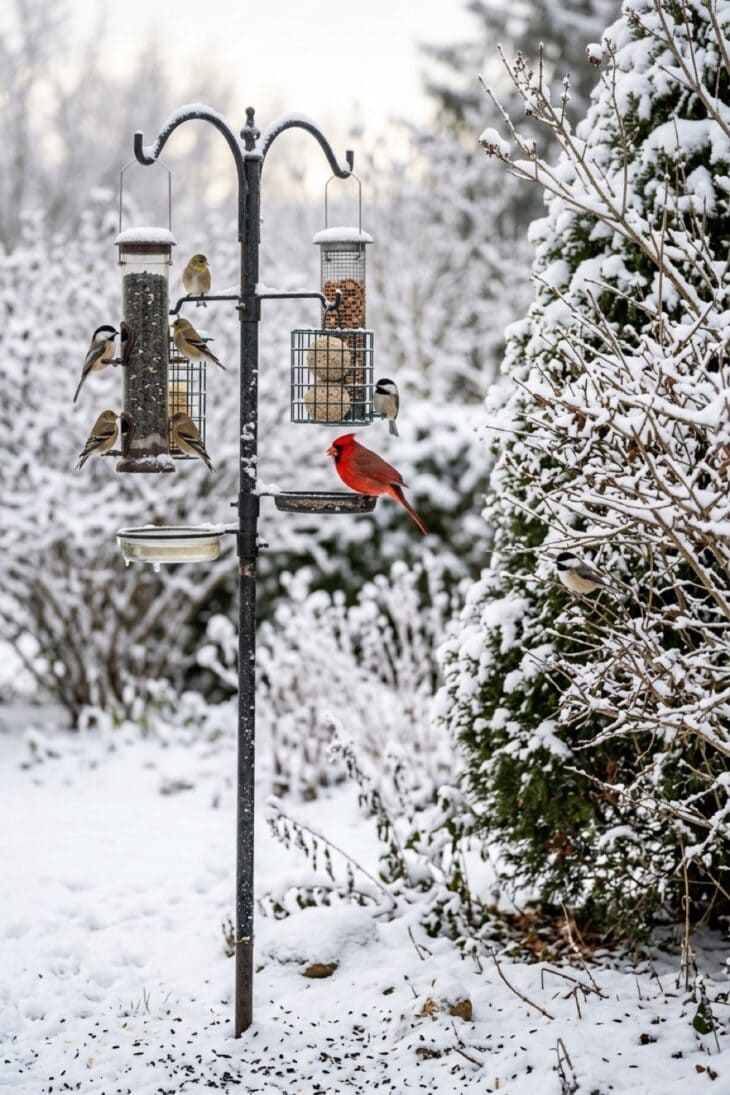
What you see A pole hung with four feeders, black sunflower seed and peanuts and suet, ringed with chickadees and goldfinches while a cardinal waits its turn. Six feet away a dense shrub holds a queue of birds, each dropping in, grabbing a seed and bouncing straight back to cover.
Why it works The feeder is the easy part; the cover next to it is what decides whether birds actually use it. Small birds will not feed in the open if there is nowhere to bolt to, but a shrub too close (under 5ft or 150cm) gives cats a launching pad. Getting that distance right, roughly 6 to 10ft (180 to 300cm), matters more than what you put in the feeders.
How to get it Offer black oil sunflower seed as your staple, which suits the widest range of species, plus a suet feeder from October to March when birds need fat. Clean feeders every two weeks in hot soapy water, since dirty feeders spread trichomonosis and salmonella and can do more harm than the food does good. Site the station where you can see it from a window, but keep it either within 3ft (90cm) of the glass or more than 30ft (900cm) away, because the deadly zone for window strikes is in between. Add a water dish, and keep feeding once you start, since birds come to depend on a reliable source.
09. Nest Boxes at Different Heights
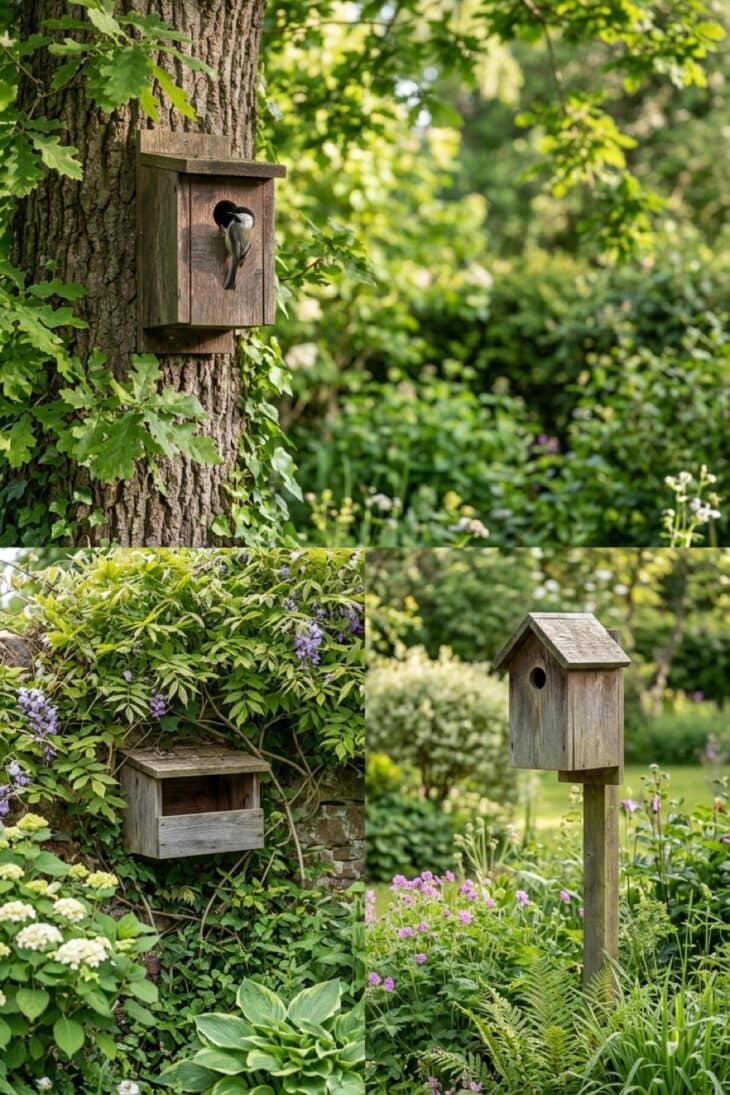
What you see Weathered untreated wood boxes at three different heights: a small hole-fronted one high on a trunk with a chickadee peering out, an open-fronted box hidden low in a wall climber, and a bigger box on a post. None of them face into the afternoon sun. They look like they have been there for years.
Why it works Different birds nest at completely different heights and in completely different box shapes, so one box in one spot serves one species at best. Old trees with natural cavities are increasingly rare in suburban yards, and boxes are a straight substitute for them. Spreading boxes apart also stops territorial fights, since two pairs of the same species will not tolerate neighbors.
How to get it Match the hole size to the bird: 1 1/8in (28mm) for chickadees and wrens, 1 1/2in (38mm) for bluebirds, and use open-fronted boxes for robins and phoebes, tucked into cover. Mount them facing between north and east so the entrance is shaded from midday sun and driving rain. Use untreated wood at least 3/4in (18mm) thick, never plastic, and skip the decorative perch below the hole, which only helps predators. Put them up by late winter so birds can find them before the breeding season, and clean them out once, in fall, after the last brood has fledged.
10. Seedheads Left Standing Through Winter
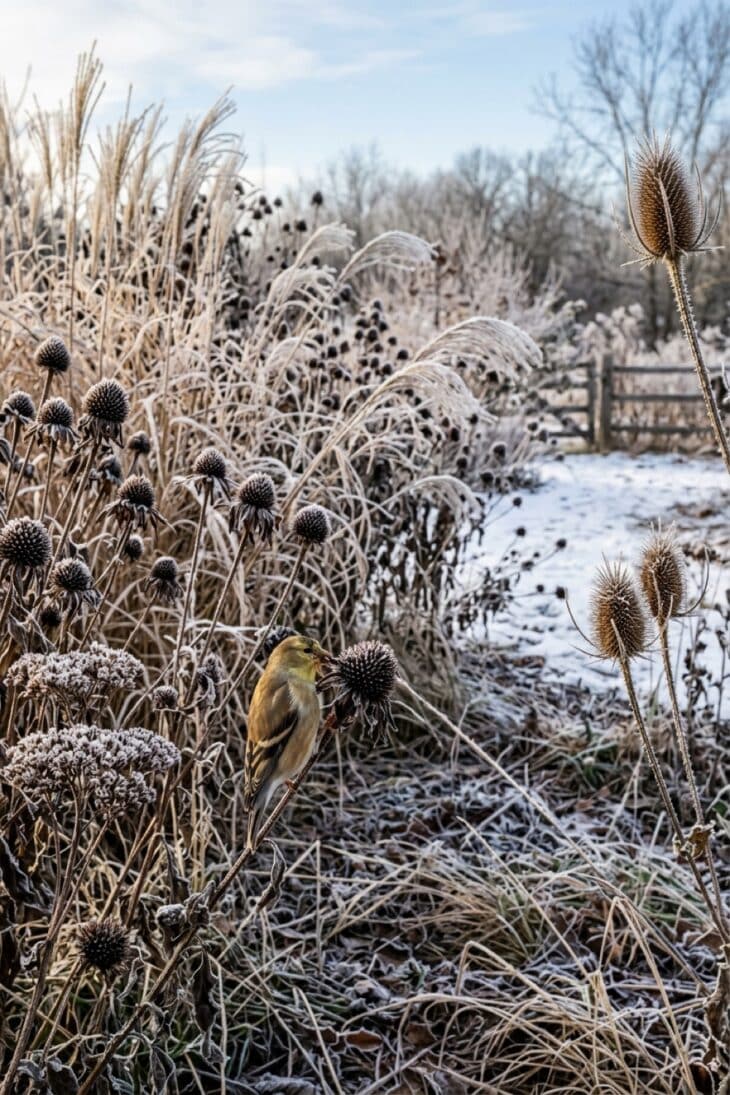
What you see The border in January, uncut: black coneflower cones, flat sedum plates, and bleached grasses standing stiff under a coat of hoar frost. A goldfinch hangs sideways off a seedhead, working the seeds out. Everything is brown and buff and silver, and it looks intentional rather than abandoned.
Why it works The fall cutback is a habit, not a horticultural necessity, and it removes food and shelter at the exact moment both become scarce. Hollow stems hold overwintering solitary bees and ladybugs; seedheads feed finches; the standing structure catches frost and gives the winter garden something to look at. You are gaining wildlife and losing nothing but a chore.
How to get it Grow plants that die well: coneflower, black-eyed Susan (Rudbeckia hirta), sedum ‘Autumn Joy’, teasel, and grasses such as little bluestem (Schizachyrium scoparium) that hold their shape. Cut back in late March or April instead of October, and when you do, stack the cut stems in a corner for a few weeks so anything still sleeping inside can crawl out. Cut a few hollow stems to 12in (30cm) and leave them standing as bee nest sites. Do clear anything that has gone slimy or is smothering a neighbor, since this is about structure, not blanket neglect.
11. A Bee Hotel on a Warm South Wall
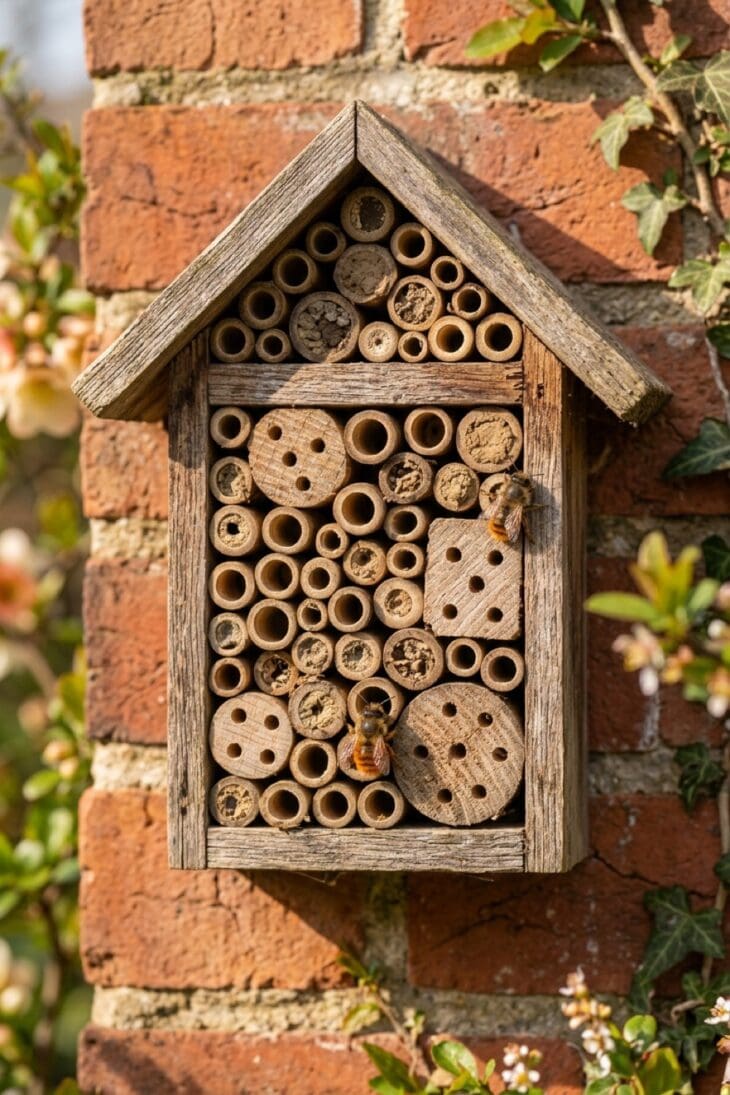
What you see A plain wooden box on a sunlit brick wall, packed with bamboo canes and drilled hardwood blocks. A third of the tubes are sealed with neat mud plugs, each one a sealed nursery. A red mason bee lands, pauses, and reverses in.
Why it works Most bees are not honeybees. The great majority are solitary, they do not sting in any meaningful sense, and they are far better pollinators per insect than a honeybee is. They nest in cavities, cavities are scarce in modern gardens, and a bee hotel supplies them directly. If you are unsure who is actually visiting, our guide to the different types of bees sorts out who is who.
How to get it Mount it on a south or southeast-facing wall at about 3 to 5ft (90 to 150cm), fixed rigidly so it cannot swing, with a roof overhang keeping rain off the tube openings. Use tubes between 1/8 and 3/8in (4 to 10mm) in diameter, cut cleanly, closed at the back and around 6in (15cm) deep. Skip the pretty painted hotels with pine cones and giant holes, which are decor, not habitat. The one real duty: replace or clean the tubes every year or two, because unmaintained hotels build up parasitic mites and fungal disease and eventually do more harm than good.
12. A Bare Earth Patch for Ground-Nesting Bees
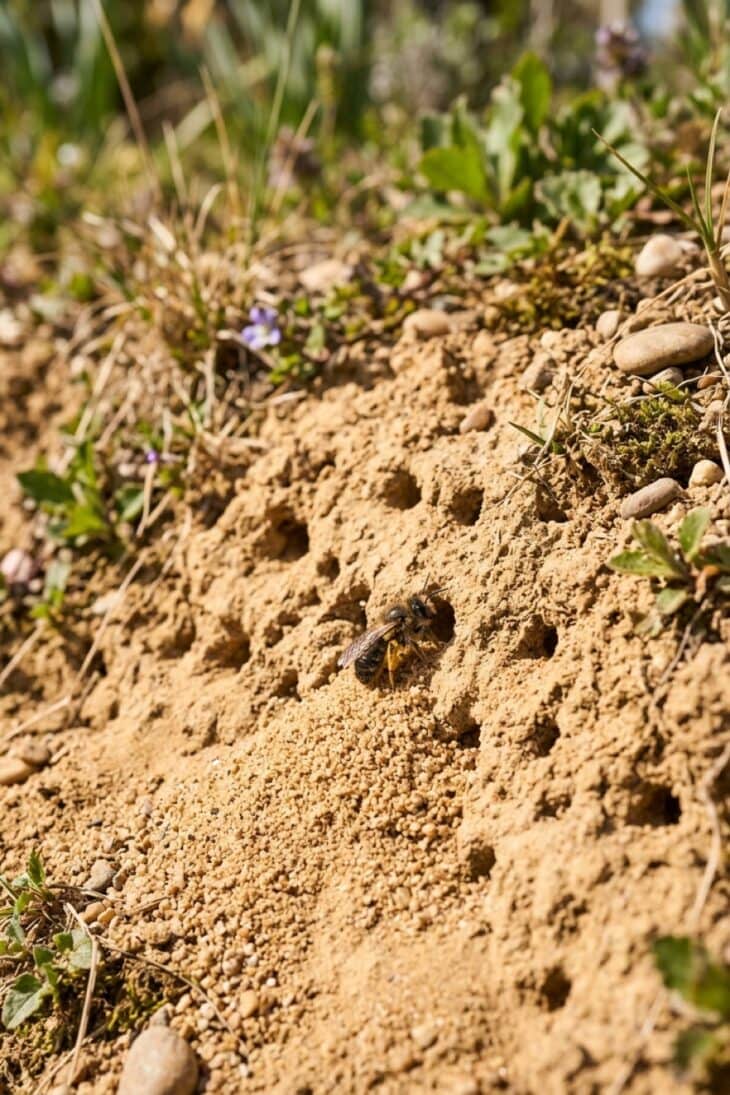
What you see A south-facing slope of bare, sandy, sun-baked soil, pocked with small round holes each ringed by a tiny volcano of excavated sand. A mining bee backs out of one, pauses in the sun, and flies. It looks, to a tidy gardener, like a patch that has been forgotten.
Why it works Around seventy percent of native bees nest in the ground, not in bee hotels, and every square yard we mulch, pave or plant up is a nest site removed. They need warm, bare, undisturbed soil in full sun, which is precisely the thing modern gardening advice tells us to eliminate. Leaving some is the cheapest wildlife intervention there is, and the free-draining conditions in a gravel garden suit these bees perfectly.
How to get it Choose a sunny, south-facing spot with well-drained soil, ideally on a slight slope or bank, and simply keep it clear: no mulch, no landscape fabric, no planting. A patch 3ft by 3ft (90 by 90cm) is plenty. If your soil is heavy clay, dig out 12in (30cm) and backfill with a sand and loam mix, roughly 70 percent sharp sand. Then do not dig, walk on, or water it, and do not be alarmed by the holes, since mining bees are solitary and essentially harmless.
13. A Compost Heap That Doubles as Habitat
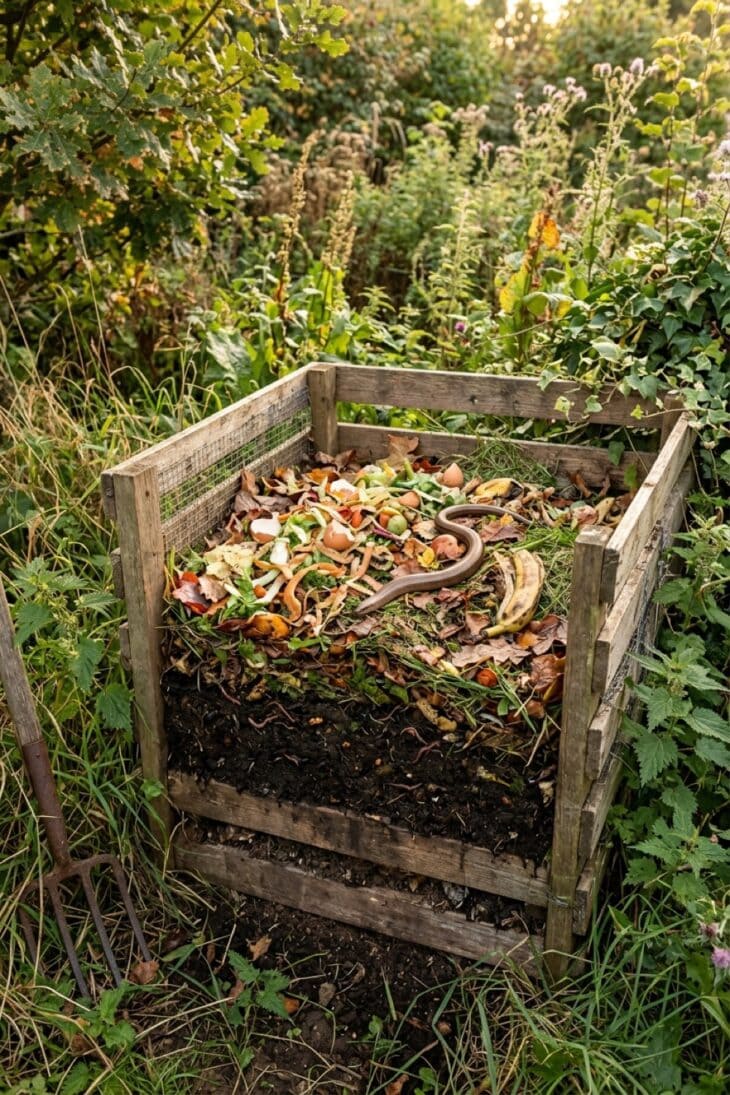
What you see An open slatted wooden bay, layered with leaves and kitchen scraps, dark crumbly compost at the bottom. Push a hand in and it is warm. Worms and beetles work through the rich material, and something long and glossy slides away from the sunny top layer as you approach.
Why it works A compost heap is a food web in a box, generating both warmth and endless invertebrates. That heat makes it a magnet for reptiles, and the invertebrates draw in birds and small mammals. Meanwhile it closes the loop on your garden waste and produces the mulch that feeds everything else, which is why it belongs in every vegetable garden.
How to get it Build an open-bottomed bay directly on soil, about 3ft by 3ft (90 by 90cm), so worms and beetles can move in and out freely. Layer roughly half green material (grass clippings, kitchen scraps) with half brown (dead leaves, cardboard, woody prunings). Turn it in spring or fall if you want fast compost, but turn it slowly and check as you go, since heaps are prime nesting sites and a fork through a nest is a grim way to learn this. Keep one heap permanently unturned as a dedicated habitat pile if you have room for two.
14. A Shallow Pebble Dish for Thirsty Insects
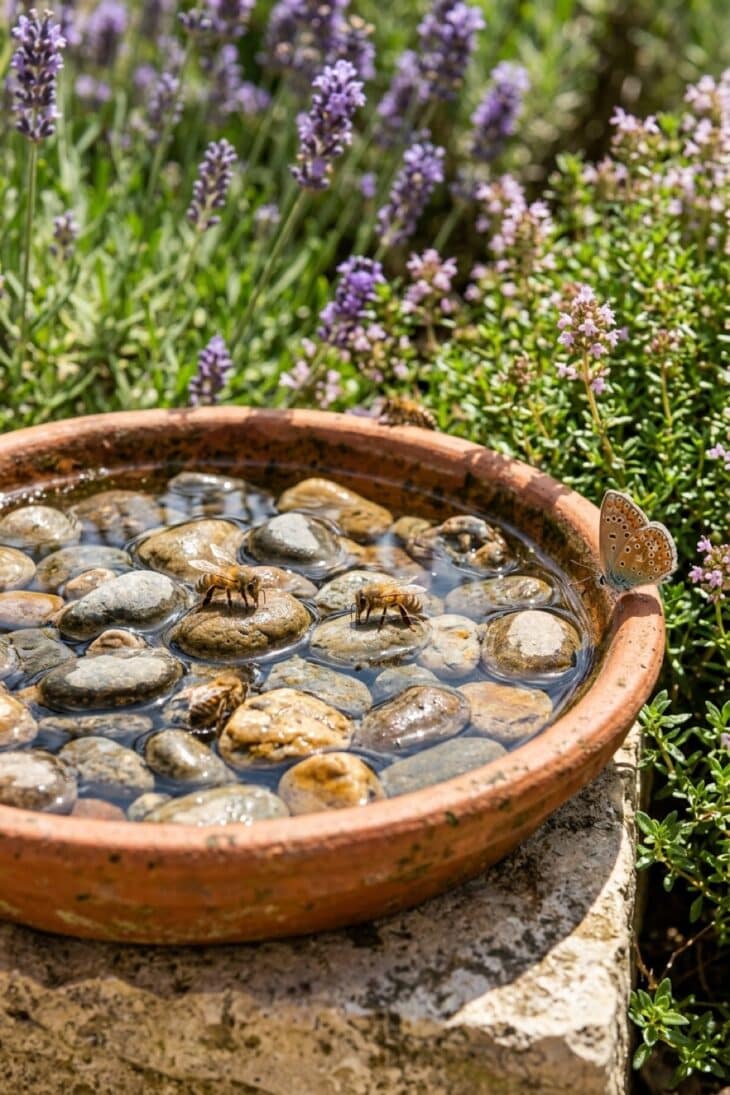
What you see A terracotta saucer of water set on a stone among lavender and thyme, filled with rounded pebbles that break the surface like stepping stones. Bees stand on the wet stones and drink. A butterfly rests on the rim with its wings half open, and the water throws light back up into the foliage.
Why it works Bees need water as much as nectar, especially in heat, but they drown easily in anything with a steep side or an open surface. The pebbles turn a dish into a safe landing raft. It costs almost nothing, takes two minutes, and fits a balcony or a doorstep, which makes it the ideal starting point if you are working with small garden ideas and no room to dig a pond.
How to get it Use a wide, shallow saucer no more than 2in (5cm) deep, and fill it with pebbles or marbles so that plenty of dry surface sits proud of the waterline. Place it in a sheltered spot near flowers, ideally in morning sun, and raise it slightly off the ground and away from dense cover so cats cannot ambush visitors. Top it up every day or two in summer, since a dish that runs dry is worse than useless once insects have learned to rely on it. Rinse and refill weekly rather than letting it stagnate, and skip the sugar water, which does more harm than good.
15. A Night-Scented Border for Moths
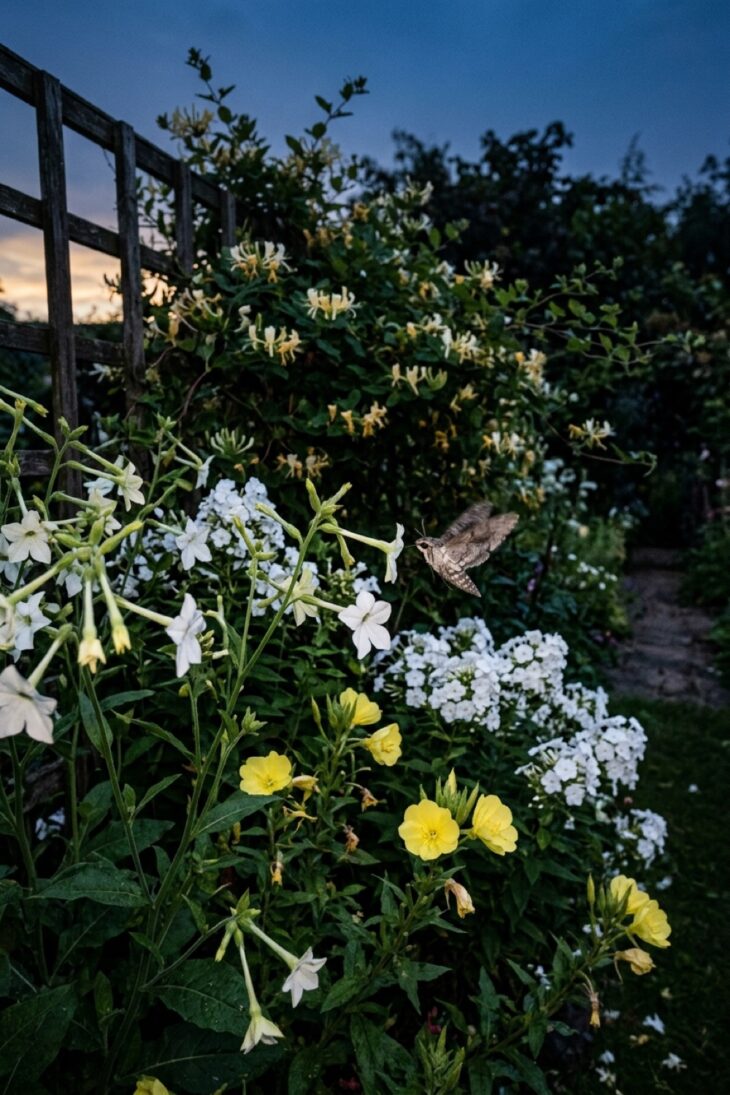
What you see Pale flowers glowing at dusk while the rest of the garden falls away into blue: white flowering tobacco, evening primrose opening its yellow cups, honeysuckle scrambling behind. The scent arrives before you reach it. A hawkmoth hovers at a tubular flower, wings a blur, and holds there like a hummingbird.
Why it works Moths outnumber butterflies many times over, pollinate a huge share of night-flowering plants, and are the main food source for bats and for most nestling songbirds. Yet almost nobody plants for them. Night-scented flowers are pale for a reason, since white shows up in low light, and heavy evening perfume is how these plants advertise across the dark.
How to get it Plant flowering tobacco (Nicotiana alata), evening primrose (Oenothera biennis), night-scented stock (Matthiola longipetala) and honeysuckle (Lonicera periclymenum) near a seating area or an open window, where you will actually enjoy the payoff. Group them rather than scattering, since scent needs concentration to carry. Crucially, turn the outside lights off or fit warm amber, downward-facing bulbs on a timer, because bright white lighting disorients moths, pulls them out of the garden and exhausts them. Leave the seedheads and let some self-seed, and never spray the caterpillars, which are the whole point.
16. A No-Mow Zone Under the Trees
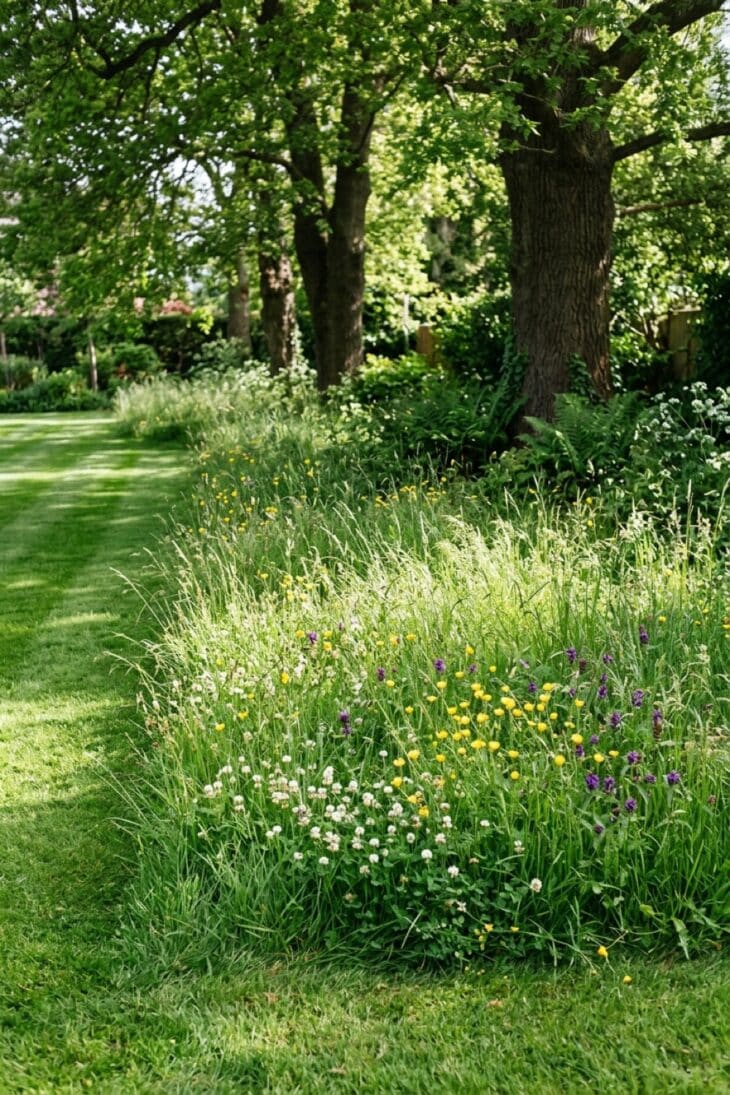
What you see Long soft grass under the trees, threaded with clover, buttercups and purple self-heal, moving in the wind while the rest of the lawn stays sharply cut around it. Dappled light falls through the canopy. It reads as a soft green room rather than a patch someone forgot.
Why it works Simply mowing less is the highest-return, lowest-effort thing in this entire article: studies consistently find that cutting every four weeks instead of weekly can multiply the nectar a lawn produces several times over. Long grass shelters beetles, grasshoppers, caterpillars and the small mammals that hunt them. Under trees, where grass sulks and thins anyway, you are giving up nothing.
How to get it Mark out the zone and simply stop cutting it from April to August, then mow it once at the end of summer with the blade high, and rake the clippings off. Keep mowing a clean edge or path around it, since the contrast is what makes it legible as a choice. Raise the blade on the rest of the lawn to 3in (8cm) too, which alone lets clover and self-heal flower. Do not feed or weedkill the area, and expect the first year to look scruffy before the flowers establish.
17. A Climber-Clad Wall for Shelter and Late Nectar
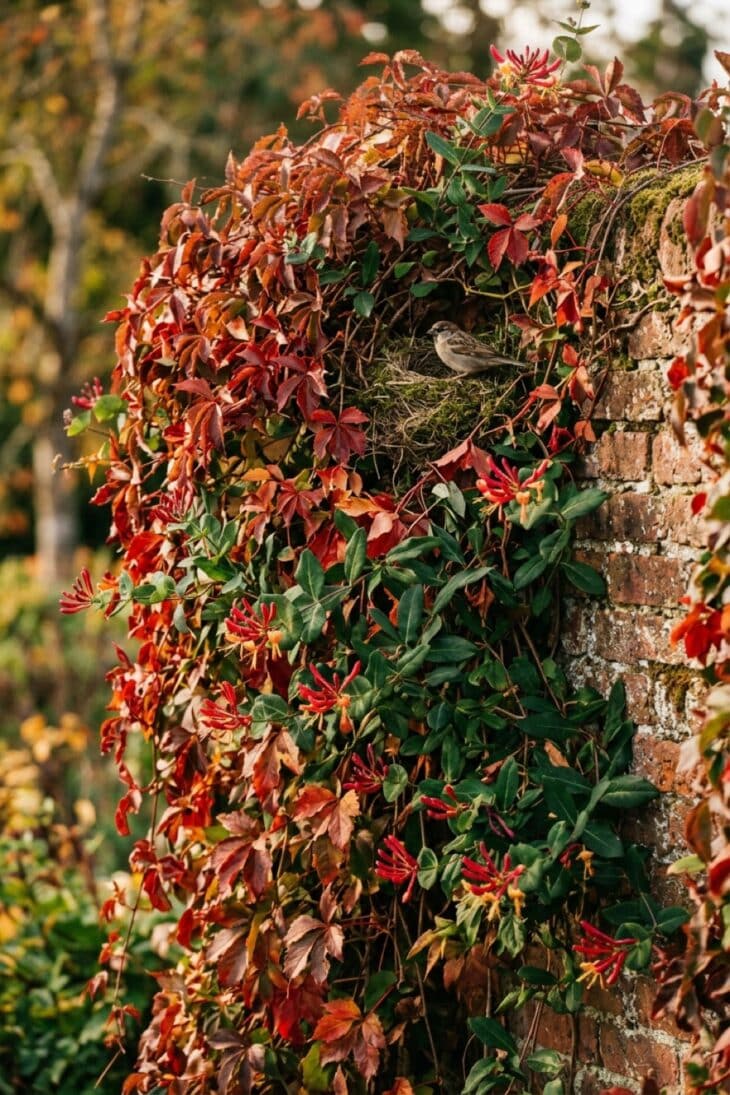
What you see An old brick wall vanished under a curtain of foliage, Virginia creeper turning crimson in October with trumpet honeysuckle threaded through it. Push the leaves aside and there is a nest deep in the structure. Sparrows argue inside it all day, invisible from the yard.
Why it works A bare fence or wall is dead space, and cladding it converts a flat surface into a vertical habitat with almost no footprint. Dense climbers give nesting sites, roosting cover and a deep, insulated layer that shelters insects through winter. They also flower and fruit late in the year, filling the exact gap when little else is left.
How to get it In the US, favor natives: Virginia creeper (Parthenocissus quinquefolia) for cover and fall berries, trumpet honeysuckle (Lonicera sempervirens) for hummingbirds, and a native clematis for late nectar. Think twice about English ivy (Hedera helix), which is superb for wildlife in its native Europe but invasive across much of North America, so check your state’s list before planting it. Fix horizontal wires 18in (45cm) apart for twiners, and give self-clinging climbers sound mortar, since they will find and worsen any weak joint. Clip only in late winter, never in nesting season, and keep growth clear of gutters and roof tiles.
18. Leaf Litter Left Where It Falls
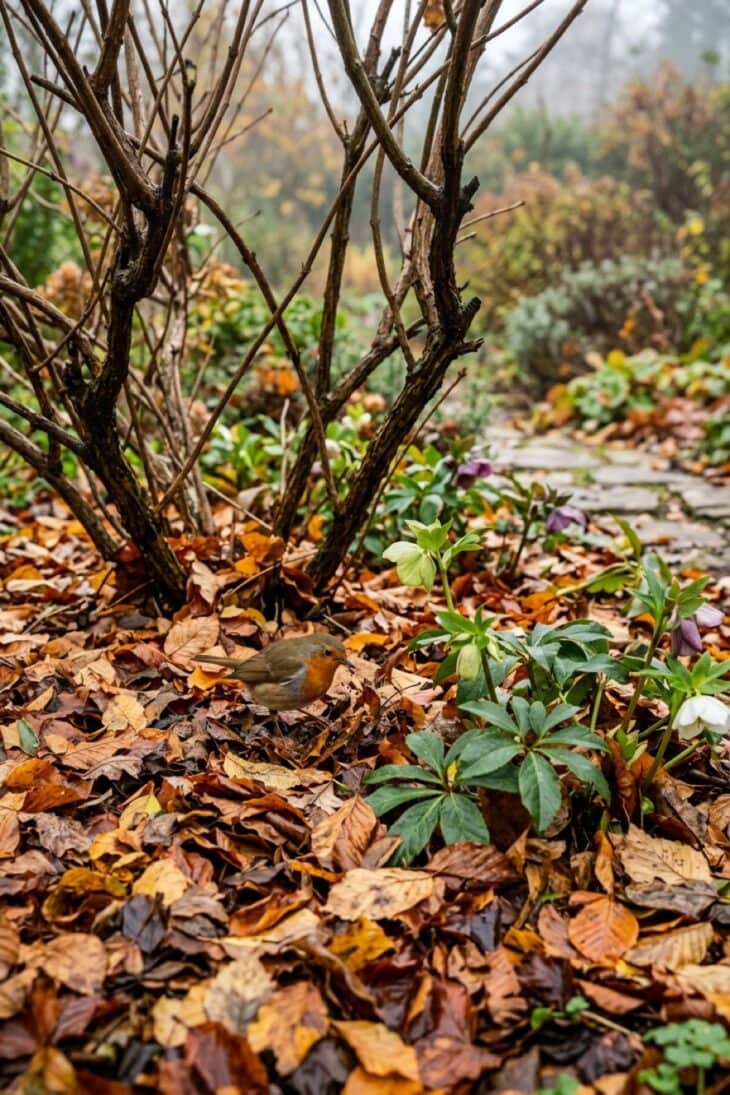
What you see A deep amber and russet drift of fallen leaves under the shrubs, undisturbed, with hellebores pushing up through it. A robin works the edge, flicking leaves aside for the insects underneath. On a misty November morning it smells like a woodland floor.
Why it works Leaf litter is where an enormous share of garden wildlife overwinters: moth and butterfly pupae, queen bumblebees, beetles, spiders and the amphibians that hunt them. Raking it all up and bagging it removes next year’s insects, and with them the food supply for nestling birds in spring. It is also free mulch that suppresses weeds and feeds the soil, which makes it a natural fit for a shade garden under trees.
How to get it Rake leaves off the lawn and hard paths, where they will smother grass and turn slippery, but sweep them straight onto the borders rather than into a bag. Aim for a layer 2 to 4in (5 to 10cm) deep under shrubs and hedges, pulled back a few inches from the crowns of plants that rot easily. Pile any surplus into a wire cage or a bin bag with holes punched in it, and in a year you have leaf mold worth more than anything you can buy. Wait until late spring before disturbing any of it, and do not shred leaves you plan to leave, since shredding kills the very things sheltering inside them.
19. One Native Tree as the Centerpiece
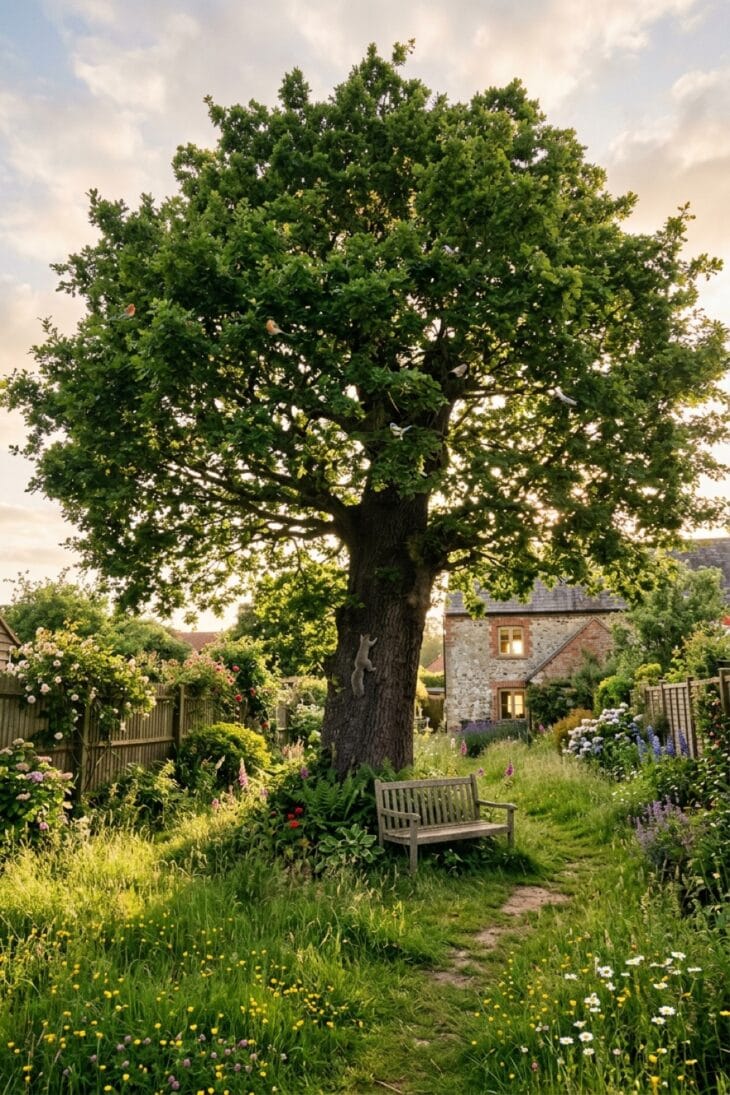
What you see One good tree with a broad canopy holding the whole yard together, throwing dappled shade across long grass, with a bench beneath it and birds working the branches. The garden arranges itself around it. Everything else in the yard suddenly looks like it belongs.
Why it works No other single planting comes close. A native oak supports hundreds of species of caterpillar, and caterpillars are what nearly all songbirds feed their young, which means one tree can underwrite the birdlife of an entire street. Non-native ornamentals typically support a tiny fraction of that. If you are rethinking the whole plot, our backyard garden ideas are a good place to start.
How to get it Choose a species native to your region and honest about your space: white oak (Quercus alba) if you have the room, or crabapple (Malus spp.) and serviceberry for a small yard. Plant bare-root in late fall or winter, with the root flare level with the soil, in a hole twice as wide as the roots but no deeper. Do not stake unless the site is windy, since a little movement builds a stronger trunk. Water deeply once a week through the first two summers, mulch a 3ft (90cm) circle but keep it off the bark, and resist planting it too close to the house, since you are siting this for a fifty-year canopy rather than the sapling in your hand.
20. A Hummingbird Corner in Red and Orange
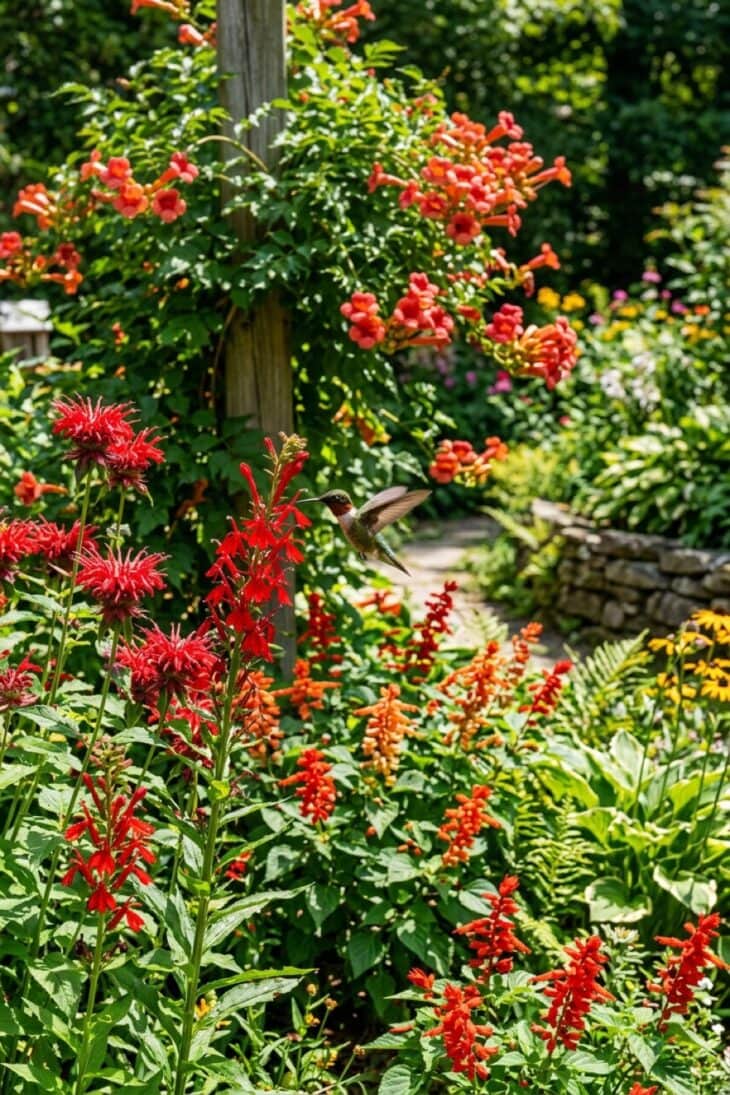
What you see A hot corner burning with red and orange: scarlet cardinal flower, red bee balm, and a trumpet vine climbing a post. A ruby-throated hummingbird hangs in the air at a flower, wings invisible, then vanishes sideways faster than you can follow. The reds are almost violent against the green.
Why it works Hummingbirds see red exceptionally well and feed from long tubular flowers that most insects cannot reach, so the color and the flower shape are doing the advertising. Planting for them costs you nothing extra, since these same flowers are excellent for long-tongued bees and hawkmoths. Live nectar also beats a feeder, because it never ferments, never needs cleaning, and never runs dry in a heatwave.
How to get it Plant cardinal flower (Lobelia cardinalis) in damp soil, bee balm (Monarda didyma) in sun, and trumpet honeysuckle or trumpet vine (Campsis radicans) on a support, warning that the latter is vigorous enough to need annual cutting back. Group them in a sheltered, sunny corner where the birds can perch nearby between feeds, since they spend most of the day sitting rather than flying. Aim for something in flower from May right through to September, because migrating birds need fuel late in the season. If you do run a feeder, use four parts water to one part white sugar, never honey or red dye, and clean it every two or three days in hot weather.
21. A Dry Stone Wall or Rock Pile
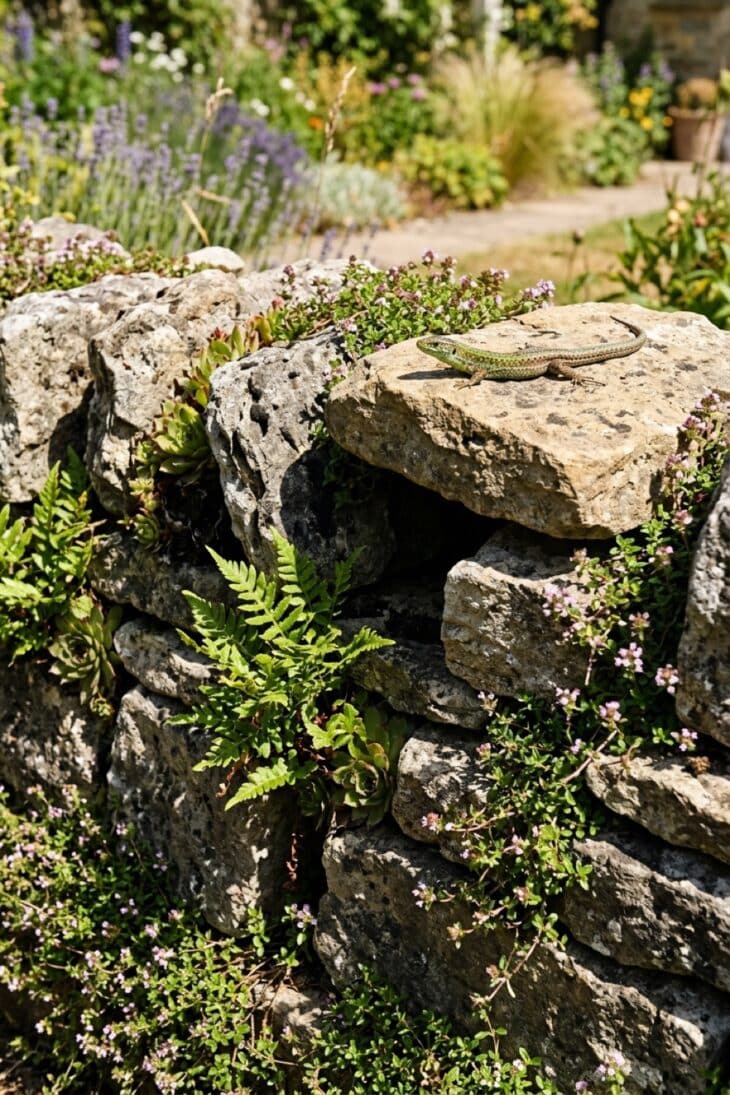
What you see A low wall of stacked stone with no mortar, its face full of dark crevices, houseleeks and creeping thyme rooting straight out of the joints. A lizard lies flat on a sun-warmed capstone. The stone holds the heat and you can feel it radiating when you put a hand on it.
Why it works The gaps are the habitat. Unmortared stone gives cool damp refuges deep inside and hot basking surfaces on top, which is exactly the range reptiles, amphibians and overwintering insects need in one structure. It also does real work as a retaining edge or a boundary, so unlike most wildlife features it is earning its keep structurally, and it suits a sunny garden border perfectly.
How to get it Build with local stone laid on a gravel base, battered slightly inwards for stability, and deliberately leave gaps rather than packing every void with soil. Even a simple pile of rocks in a sunny corner, with a few larger flat stones on top, delivers most of the benefit for none of the skill. Site it in full sun with cover nearby so basking animals have somewhere to bolt. Plant the crevices with houseleeks (Sempervivum) and creeping thyme, and then leave the structure undisturbed, since every time you rebuild it you evict everything living in it.
22. A Clover Lawn Instead of Perfect Turf
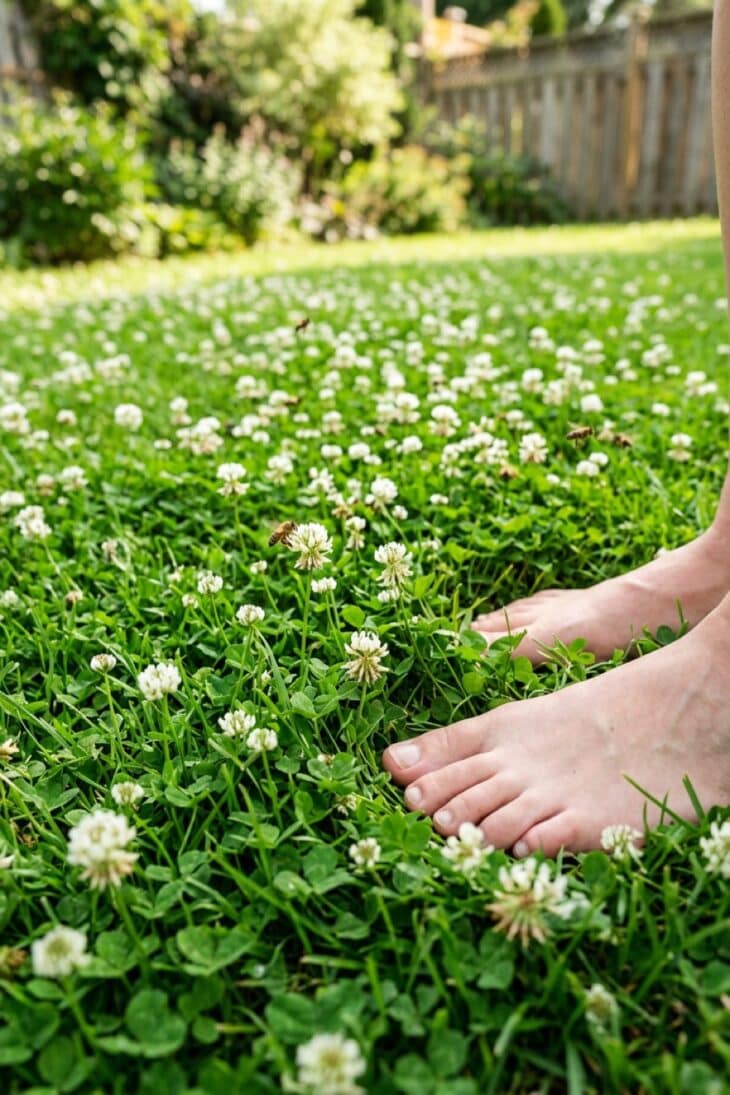
What you see A soft, dense lawn dotted all over with small white clover flowers, each one carrying a bee. It stays green in August when the neighbors’ turf has gone straw-colored. It is barefoot soft, and it is quietly full of insects the whole time you are standing on it.
Why it works Clover fixes its own nitrogen, so a clover lawn feeds itself and needs no fertilizer. Its deep roots keep it green through drought when grass browns off. And it flowers, which a monoculture lawn never does, turning a dead green carpet into one of the most productive nectar sources in the average yard. The only thing you give up is the idea that a lawn should be nothing but grass.
How to get it Overseed an existing lawn with micro-clover or white clover (Trifolium repens) at about 2 ounces per 100 square feet, scattered in spring or early fall onto scarified, lightly raked turf, then watered in. Stop using weed and feed entirely, since the herbicide in it is designed to kill exactly what you are trying to grow. Mow high, at 3in (8cm), and let it flower for a few weeks between cuts. If you are barefoot-nervous about bees, mow a clover-free strip where children play and leave the rest to flower.
23. A Rain Garden in the Soggy Spot
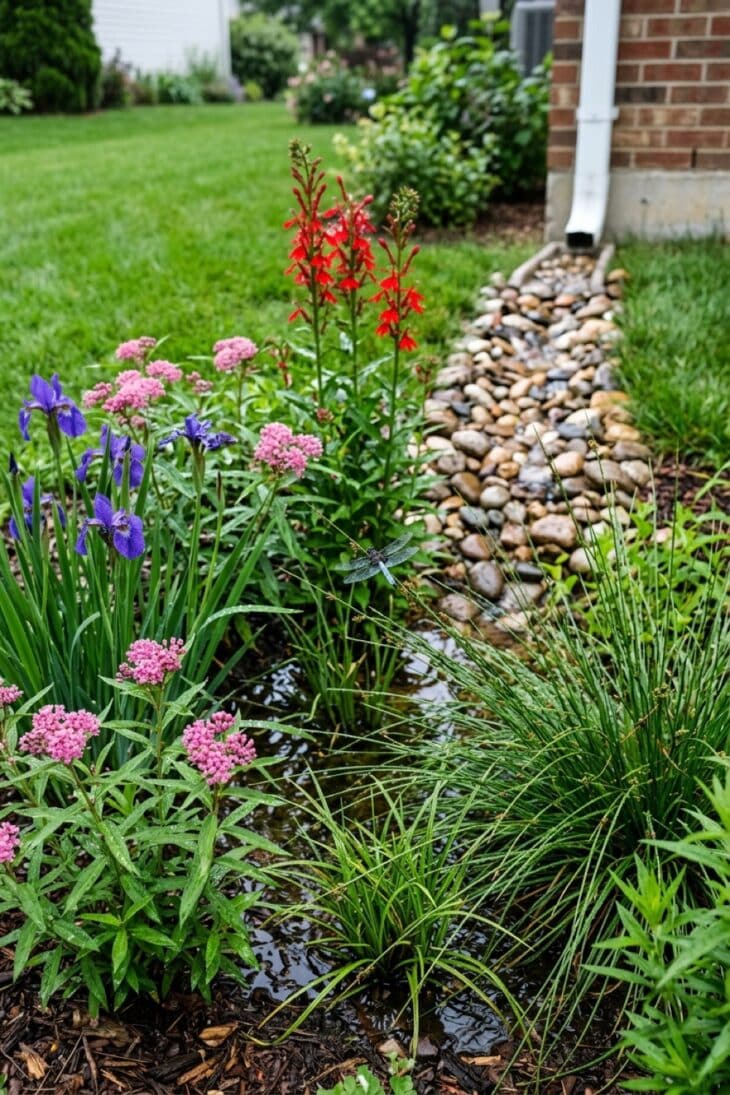
What you see A shallow saucer in the lawn where water used to sit and sulk, now planted with blue flag iris, rushes and red cardinal flower, fed by a channel of river stone running from the downspout. After rain it holds an inch of water for a few hours. A dragonfly rests on a stem, and the whole depression looks lush rather than boggy.
Why it works This turns your worst problem into your best habitat. A rain garden intercepts roof runoff that would otherwise scour the lawn or overload the storm drain, lets it soak away slowly, and grows a rich damp-soil plant community in the process. Damp ground supports amphibians, dragonflies and a whole set of insects that dry gardens simply cannot.
How to get it Dig a shallow basin 6 to 8in (15 to 20cm) deep, sized at roughly a fifth of the roof area draining into it, and site it at least 10ft (300cm) from the house foundation. Check drainage first by filling a test hole with water: if it has not drained within 24 hours, amend the base with compost and sand or pick another spot, because a rain garden must empty within a day or it becomes a mosquito farm. Plant swamp milkweed, blue flag iris (Iris versicolor) and sedges, putting the thirstiest species in the wettest center and drought-tolerant ones on the rim. Mulch with shredded hardwood, not bark chips, which float away on the first big storm.
24. A Green Roof on the Shed
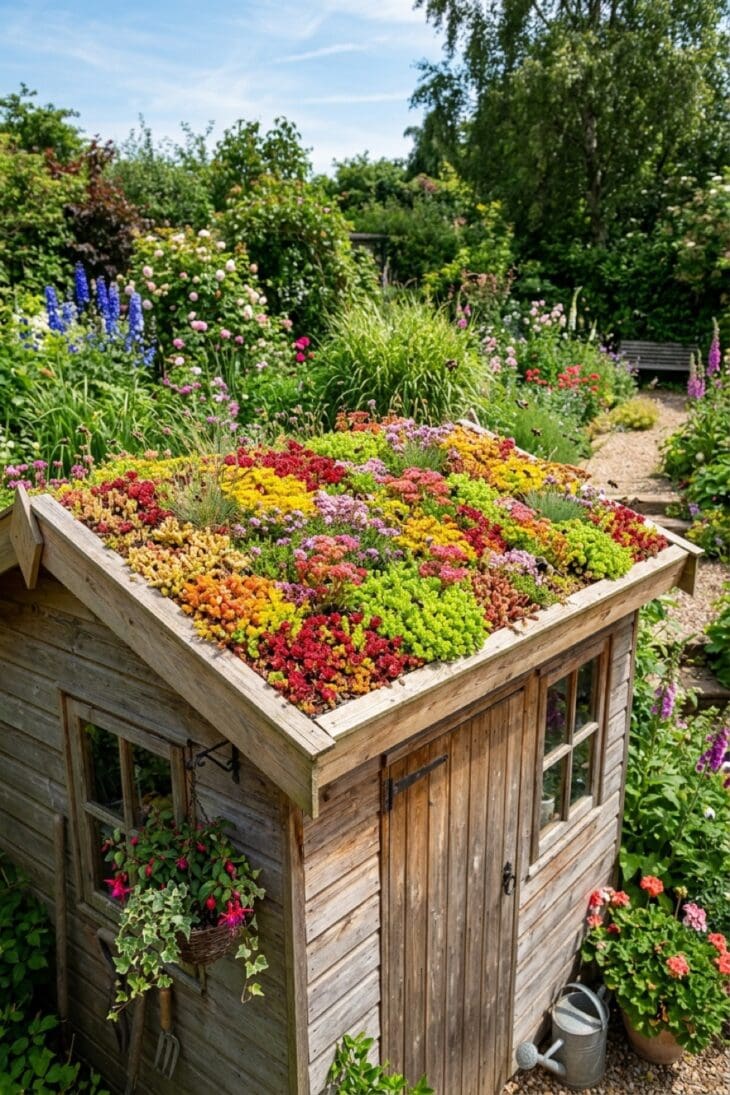
What you see The shed roof carpeted in sedum rosettes, red and gold and green, flowering in a haze of bees, with grasses and wildflowers threaded through. From the upstairs window it is the best view in the garden. The plainest structure you own has become the most alive thing in the yard.
Why it works A shed roof is dead square footage, and a green roof turns it into hot, dry, free-draining habitat, which is scarce and valuable for solitary bees and beetles. It also insulates the shed, slows rainwater runoff and shades the roof membrane so it lasts longer. In a tight yard it is the cleverest way to add habitat without giving up an inch of ground, and it works beautifully alongside container garden ideas.
How to get it Check the structure first, because a saturated green roof weighs 60 to 90 pounds per square yard and most standard sheds need the rafters doubled or extra posts added. Build up in layers: waterproof membrane, root barrier, drainage layer, then 3 to 4in (8 to 10cm) of a lightweight substrate, ideally crushed brick or expanded clay rather than garden soil, which is far too heavy and too rich. Plant sedum plugs or lay a sedum mat, then add a few drought-tolerant wildflowers for variety. Keep the pitch under 20 degrees, frame the edges to hold the substrate in, and water it through the first summer only, after which it should look after itself.
25. The Wild Corner You Never Tidy
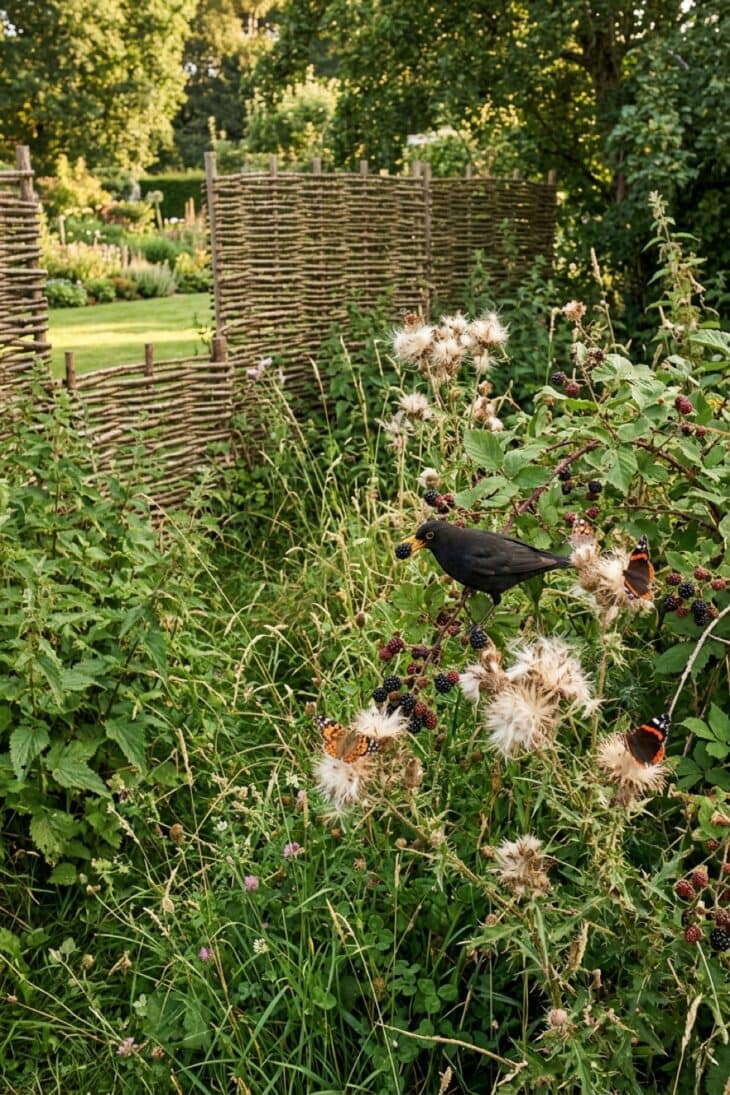
What you see The far corner, screened off behind a low hazel hurdle: nettles, brambles heavy with blackberries, tangled grass, thistles going to seed. A blackbird is deep in the fruit and butterflies are working the thistle heads. It is the messiest square yard you own and the busiest.
Why it works Nettles are the sole caterpillar food plant for several of the most familiar butterflies, and brambles feed pollinators in summer and birds and mammals in fall. These are the plants a tidy garden removes first and the ones wildlife misses most. The screen matters as much as the patch, because it lets you keep a beautiful garden and a genuinely wild one at the same time.
How to get it Pick the least useful corner you have, ideally in sun and out of the main view, and give it at least 3ft by 3ft (90 by 90cm). Let nettles and brambles run, but sink a physical root barrier 12in (30cm) deep around the patch, or plant into a bottomless container sunk in the ground, since both spread aggressively and you want a wild corner rather than a wild garden. Cut roughly half the nettles back in June, which forces fresh young growth just as the second brood of caterpillars is hatching. Screen it with a hazel hurdle or a shrub, and then, genuinely, do nothing: no cutting, no clearing, no weeding, forever.