Few things make a garden feel alive like a butterfly settling on a flower you planted. A butterfly garden is part flower bed and part nursery: it feeds the adults you see and gives the next generation somewhere to grow. Once you start noticing who visits, it becomes very hard to stop.
Contents
- 01. A Monarch Waystation Bed
- 02. A Pocket Prairie in Drifts
- 03. A Swallowtail Herb Patch
- 04. Hot-Color Landing Pads: Zinnias and Mexican Sunflowers
- 05. A Sheltered Suntrap With Puddle and Basking Stones
- 06. Maypop on the Fence for Gulf Fritillaries
- 07. A Pipevine Arbor for Pipevine Swallowtails
- 08. Early Nectar for the First Butterflies of Spring
- 09. Garden Phlox and Tall Verbena in a Cottage Border
- 10. A Butterfly Container Garden for the Patio
- 11. Spicebush at the Woodland Edge
- 12. Violets Welcome in the Lawn
- 13. Tall Back-Row Magnets: Joe Pye Weed and Ironweed
- 14. A Front-Yard Butterfly Strip
- 15. A Seedless Butterfly Bush, or a Native Stand-In
- 16. Buttonbush in the Damp Corner
- 17. A Kids’ Caterpillar Nursery
- 18. Small Host Trees: Wild Plum and Pussy Willow
- 19. A Desert Butterfly Garden
- 20. A Fruit Feeding Station for Admirals and Commas
- 21. A Sunny Bank of Little Bluestem and Butterfly Weed
- 22. A Subtropical Butterfly Garden for the Deep South
- 23. A Pawpaw Patch for Zebra Swallowtails
- 24. A California Native Butterfly Garden
- 25. A Late-Season Aster Border for Migrants
The ideas below cover sunny prairie beds, shady woodland edges, soggy corners and patio pots, with regional plans for the desert Southwest, California and the Gulf Coast. Some cost little more than a few seed packets, or simply putting down the weed-and-feed, while others are long-term plantings of host trees and shrubs. There are projects for children, for tiny spaces and for gardeners who want to raise one particular butterfly.
Scroll through for inspiration, or pick the ideas that match your region, light and space. Each one explains why it draws butterflies and gives you the plants, spacing and timing to make it work.
01. A Monarch Waystation Bed
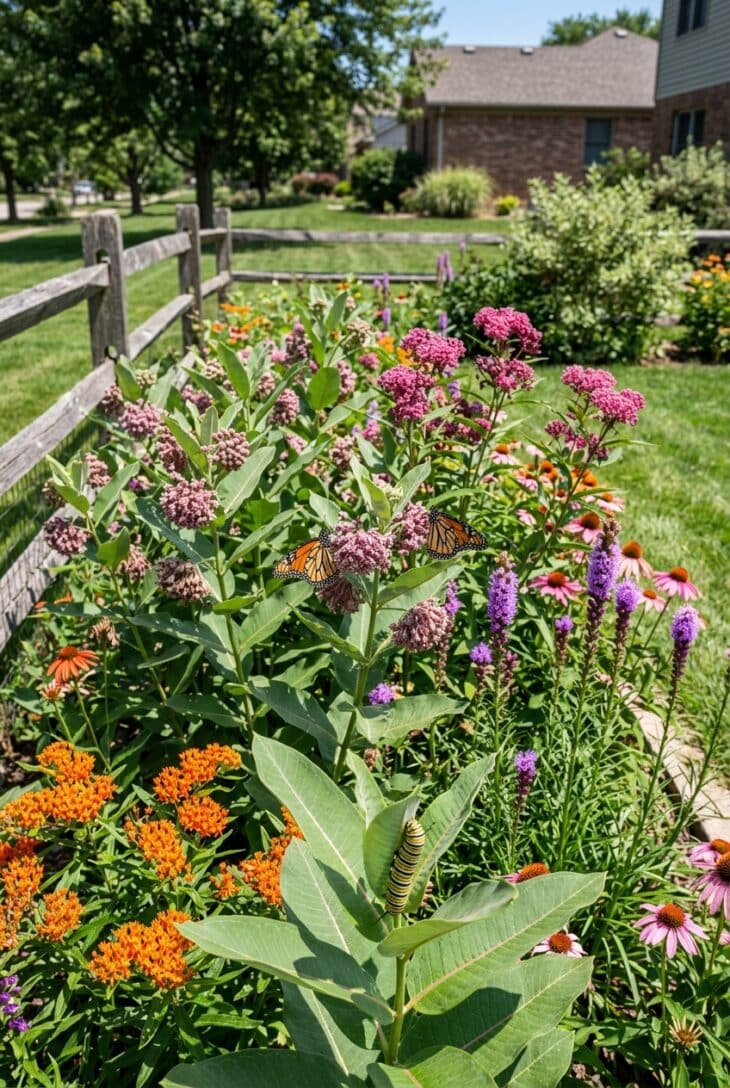
What you see Three milkweeds share one sunny bed: tall common milkweed with its dusky pink balls of flower, rosy swamp milkweed, and a front row of blazing orange butterfly weed. Monarchs drift between the blooms, and if you look closely at the broad leaves you will find their caterpillars, striped yellow, black and white and eating steadily. Purple blazing star and pink coneflowers fill the gaps.
Why it works Monarch caterpillars eat nothing but milkweed, so a bed built around it does more than feed passing adults: it lets them breed. Growing several species stretches the season, because each blooms and puts out fresh leaves at a slightly different time, and the nectar plants mean egg-laying females can refuel on the spot. It is the single most useful butterfly planting you can make, and a natural next step if you already grow a general pollinator garden.
How to get it Choose a spot with at least six hours of sun and plan for about 100 sq ft (9 sq m), the area Monarch Watch recommends for a registered Waystation, with at least 10 milkweeds of two or more species. Swamp milkweed (Asclepias incarnata) and butterfly weed (Asclepias tuberosa) stay in tidy clumps, while common milkweed (Asclepias syriaca) spreads by its roots, so give it a corner where it can roam. Buy plants for a first-year result, or sow seed outdoors in fall so winter supplies the cold it needs to germinate. If you grow tropical milkweed such as Silky Gold milkweed (Asclepias curassavica), cut it to the ground each fall in mild-winter areas, because year-round foliage can build up a parasite that weakens monarchs. Never spray the bed, even for the orange aphids milkweed attracts; squash them or hose them off instead.
02. A Pocket Prairie in Drifts
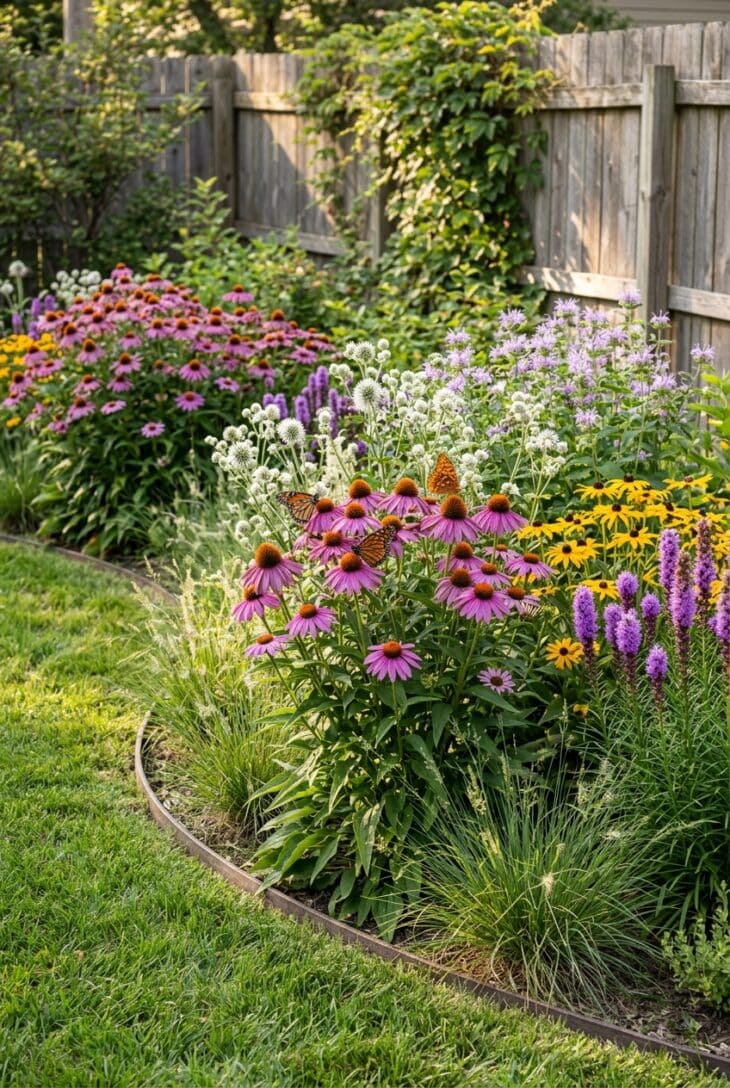
What you see A curve of the lawn has become a slice of tallgrass prairie: pink-purple coneflowers, lilac wild bergamot, spiky white globes of rattlesnake master and gold black-eyed Susans, all in generous drifts. Purple blazing star pokes up through the middle, and a front edge of fine prairie dropseed softens the line where the planting meets the grass. An orange fritillary works the coneflowers while a monarch waits its turn.
Why it works Prairie plants evolved alongside the butterflies of the central states, and their flowers suit them perfectly: open daisies to land on, and dense heads of small tubular florets full of nectar. Grouping each species in a drift gives a butterfly a large target to spot and lets it feed for longer without flying. Once established, the deep roots shrug off drought, which makes this one of the easiest perennial plantings to keep.
How to get it Plant plugs or quart pots in spring or early fall, 12 to 18in (30 to 45cm) apart, in groups of five to nine of each kind. Good starters are purple coneflower (Echinacea purpurea), wild bergamot (Monarda fistulosa), rough blazing star (Liatris aspera), rattlesnake master (Eryngium yuccifolium), black-eyed Susan (Rudbeckia hirta) and prairie dropseed (Sporobolus heterolepis). Skip the compost: most prairie plants flop in rich soil. Weed carefully for the first two years, when the planting is most vulnerable. Leave the stems standing over winter and cut them down in early spring.
03. A Swallowtail Herb Patch
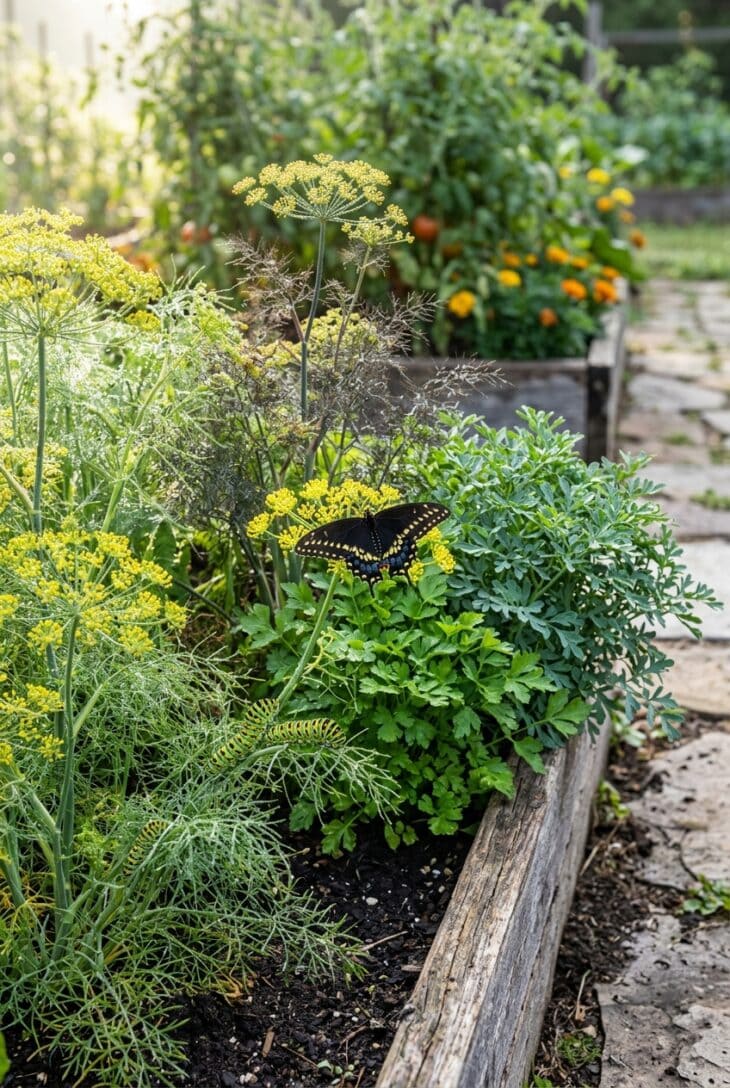
What you see Feathery dill in yellow flower, a haze of bronze fennel, a mound of parsley and some blue-green rue fill a sunny bed by the kitchen door. Look along the dill and you will spot plump caterpillars banded in green, black and yellow, while a black swallowtail with rows of yellow spots rests on a flower head above them.
Why it works Black swallowtails lay their eggs on the carrot family, which includes many of the herbs we already grow. Planting extra means you can share: the caterpillars take their fill and you still have plenty for the kitchen. It is a friendly way into butterfly gardening for anyone who already enjoys growing herbs, and the butterflies it raises stay around to feed on the rest of the garden.
How to get it Sow dill (Anethum graveolens) directly every three to four weeks from spring to midsummer so there is always fresh foliage; it resents transplanting. Add flat-leaf parsley (Petroselinum crispum), bronze fennel (Foeniculum vulgare ‘Purpureum’) and, if you like its flavor, anise (Pimpinella anisum). Rue (Ruta graveolens) is a caterpillar favorite, but wear gloves when handling it, as the sap can blister skin in sunlight. Keep fennel well away from dill, since the two cross-pollinate and the seedlings come up muddled. Plant roughly twice what you expect to eat, and if caterpillars strip one plant, move them by hand onto another.
04. Hot-Color Landing Pads: Zinnias and Mexican Sunflowers
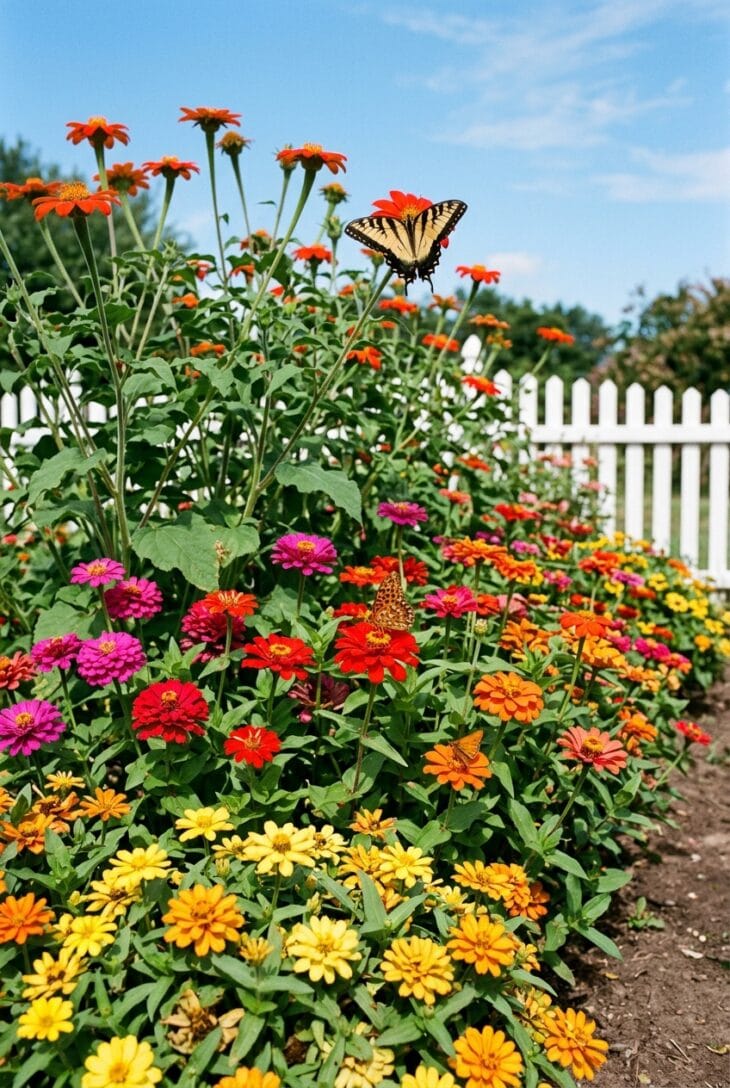
What you see Orange Mexican sunflowers tower over a bed of zinnias in scarlet, magenta and tangerine, the whole planting glowing in the late-summer sun. Butterflies are everywhere: a tiger swallowtail on the tallest bloom, fritillaries on the zinnias and small skippers darting between them.
Why it works Many butterflies are drawn to warm reds, oranges, pinks and purples, and they need somewhere flat to stand while they drink. Zinnias and Mexican sunflowers offer both: broad, sturdy flowers ringed around a center of tiny tubular florets, each one holding nectar. They are also cheap, fast from seed and in flower nonstop until frost, which makes this a quick first-year win while slower perennials settle in, and a lively addition to any summer flower bed.
How to get it Sow both directly after your last frost, once the soil feels warm, in the sunniest spot you have. Space Mexican sunflowers (Tithonia rotundifolia) 2ft (60cm) apart: ‘Torch’ reaches 4 to 6ft (1.2 to 1.8m) and may need a stake, while ‘Fiesta del Sol’ stays at 2 to 3ft (60 to 90cm). Pick zinnias (Zinnia elegans) with single or semi-double flowers so butterflies can reach the florets; ‘State Fair’ and ‘Zowie! Yellow Flame’ are reliable. Thin zinnias to 9 to 12in (23 to 30cm) apart and water at the base to keep powdery mildew down. Deadhead or cut faded blooms every week and they will keep coming until frost.
05. A Sheltered Suntrap With Puddle and Basking Stones
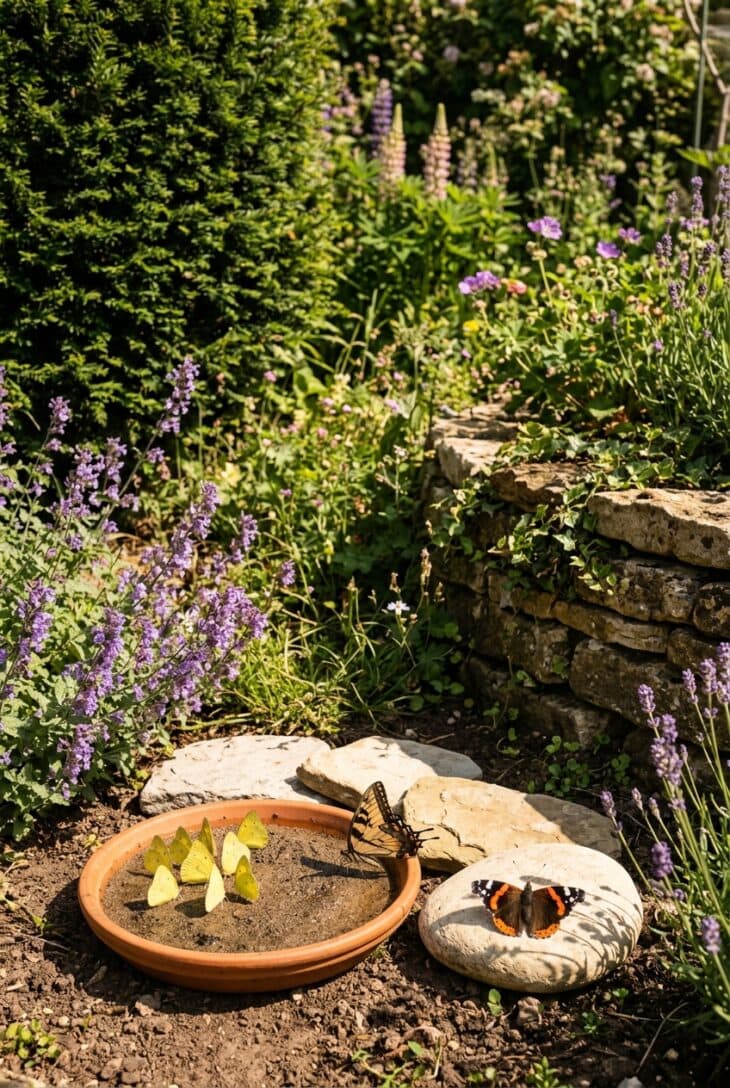
What you see A hedge blocks the wind and a low stone wall soaks up the morning sun, making this corner noticeably warmer than the rest of the garden. On the ground, a shallow saucer of wet sand draws a cluster of yellow sulphurs and a tiger swallowtail, all with their tongues down, while a red admiral lies on a pale stone with its wings spread wide.
Why it works Butterflies cannot fly until their flight muscles are warm, so on cool mornings they bask, and they pick sheltered spots where the wind will not strip the heat away. Damp sand or mud supplies something nectar lacks, salts and minerals, which males in particular gather and pass to females when they mate. Put the two together out of the wind and you create the place where butterflies start every day, which also makes it the best spot in the garden to watch them.
How to get it Look for a corner that gets morning sun and has shelter on the north and west, where cold and prevailing winds usually come from; if you have none, plant a hedge or a row of tall grasses to make one. Set a few flat stones at ground level in full sun. Fill a shallow saucer with coarse sand, mix in a pinch of sea salt and a handful of compost, and keep it wet but not flooded, topping it up every day or two in summer. A patch of bare soil kept damp by a dripping hose works just as well. Keep the corner away from bird feeders, where predators already gather.
06. Maypop on the Fence for Gulf Fritillaries
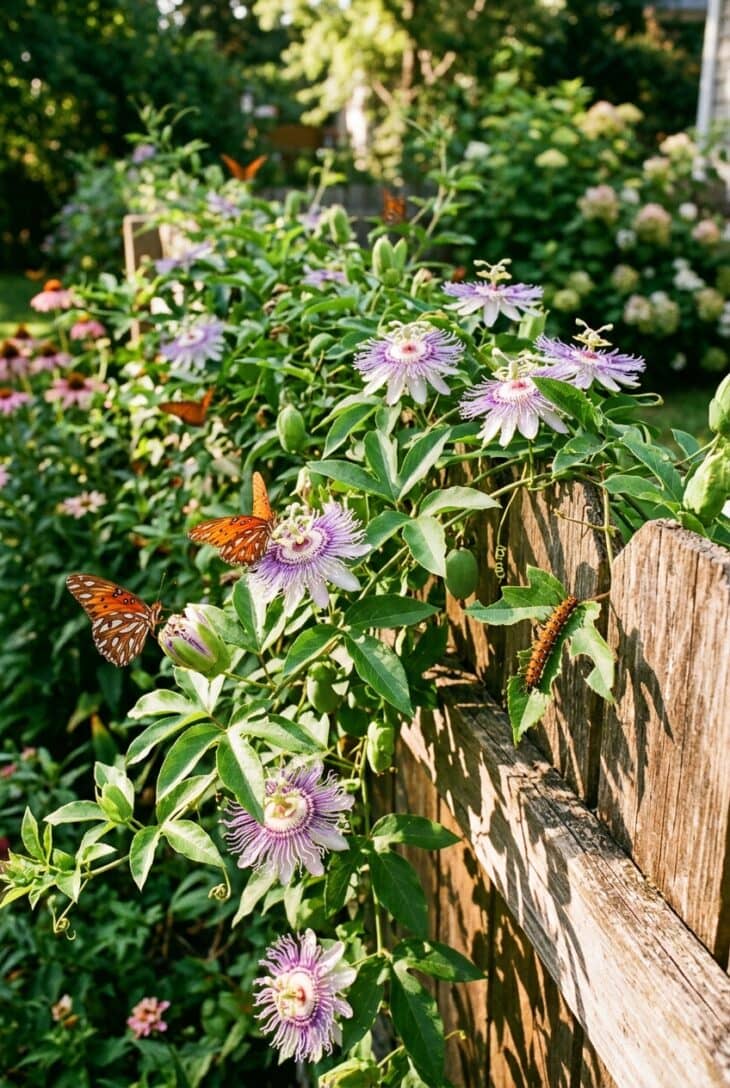
What you see A plain board fence has disappeared under a tangle of maypop, its extraordinary fringed flowers in lavender and white opening among three-lobed leaves. Bright orange gulf fritillaries flicker along the vine, flashing silver spots when they close their wings, and spiny orange caterpillars work through the foliage lower down.
Why it works Maypop is a native host plant for the gulf fritillary across the South, as well as the variegated fritillary and, in Florida and Texas, the zebra longwing. It turns a boundary you need anyway into a breeding ground, and it adds nectar for bees, a flower that stops visitors in their tracks and edible fruit in fall. If you are looking for ways to dress a fence, few vines do as much.
How to get it Plant maypop (Passiflora incarnata) in full sun against a fence or trellis fitted with wires or mesh for its tendrils; it is hardy in zones 6 to 10 and in sheltered zone 5 gardens. In cold areas it dies to the ground each winter and reappears late, often not until June, so mark the spot. It spreads by underground runners, so plant it where suckers can be mowed or pulled, or sink a root barrier 12in (30cm) deep. Expect the caterpillars to strip whole sections by late summer; the vine regrows quickly, and the damage is the point. Pick the fruit when it yellows and wrinkles slightly.
07. A Pipevine Arbor for Pipevine Swallowtails
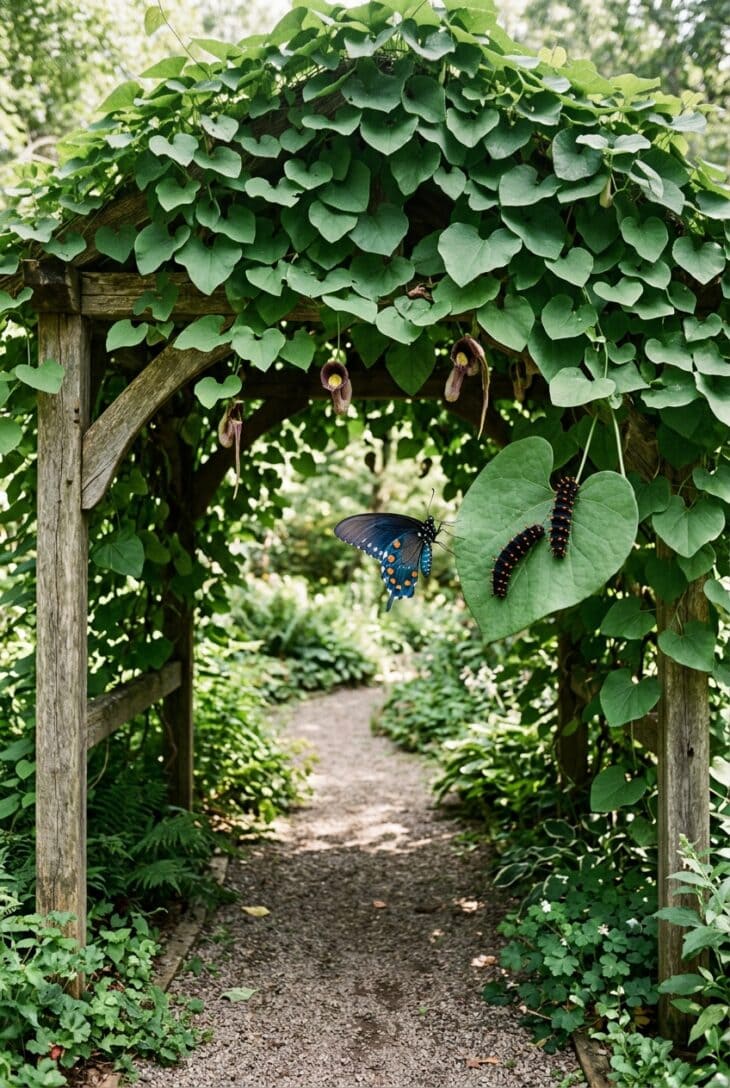
What you see Heart-shaped leaves as big as dinner plates overlap across a wooden arbor, turning the path beneath into a cool green tunnel. Odd curved flowers shaped like old tobacco pipes hang half-hidden under the foliage, and an iridescent blue-black swallowtail patrols the entrance. Turn a leaf over and you may find its caterpillars, dark and velvety with rows of orange knobs.
Why it works The pipevine swallowtail lays its eggs only on pipevines, and its caterpillars absorb the plant’s toxins, which makes both them and the adults distasteful to birds. That protection works so well that several other butterflies mimic its blue-black coloring. Without the vine you will rarely see this butterfly in a garden; with it, you may host a resident colony and gain a shaded walkway into the bargain.
How to get it In the East, grow Dutchman’s pipe (Aristolochia macrophylla), a vigorous twining vine for zones 4 to 8 that reaches 20 to 30ft (6 to 9m), or woolly pipevine (Aristolochia tomentosa) for zones 5 to 8. In California, use California pipevine (Aristolochia californica). Give it a sturdy arbor or pergola in sun to part shade, with moist, rich soil. Avoid the tropical calico flower (Aristolochia littoralis, often sold as A. elegans), which is toxic to the caterpillars that eat it. Caterpillars can strip a young vine, so plant two or three and move caterpillars between them if one runs bare.
08. Early Nectar for the First Butterflies of Spring
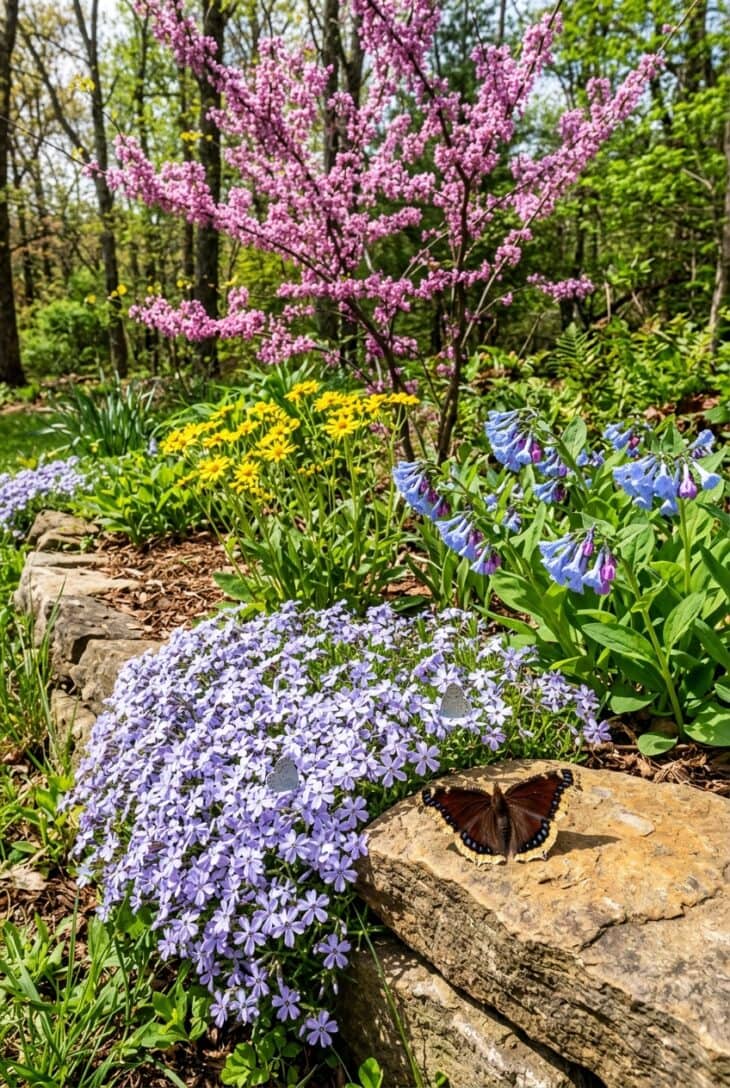
What you see A carpet of lavender creeping phlox tumbles over a stone edge, backed by bright yellow golden ragwort, nodding Virginia bluebells and a redbud glowing pink overhead. On a warm April morning a mourning cloak, dark chocolate edged in cream, suns itself on the stones, while a tiny pale blue spring azure moves among the phlox.
Why it works Most butterfly gardens peak in summer, but the first butterflies are on the wing weeks earlier. Mourning cloaks and commas spend winter as adults tucked into bark and woodpiles and emerge hungry on the first warm days, with spring azures and early swallowtails hatching soon after. Early flowers bridge the gap when little else is in bloom and persuade those first arrivals to stay.
How to get it Plant creeping phlox (Phlox subulata) along a sunny edge, 12 to 18in (30 to 45cm) apart, and add woodland phlox (Phlox divaricata) where there is part shade. Golden ragwort (Packera aurea) thrives in damp, part-shaded soil and spreads into a weed-smothering groundcover. Tuck in Virginia bluebells (Mertensia virginica), which vanish by early summer, so mark them and plant later perennials between. An eastern redbud (Cercis canadensis) or a pair of highbush blueberries (Vaccinium corymbosum) adds early nectar at head height. Put the planting where you can see it from the house, since cool spring days are when you will be watching from indoors.
09. Garden Phlox and Tall Verbena in a Cottage Border
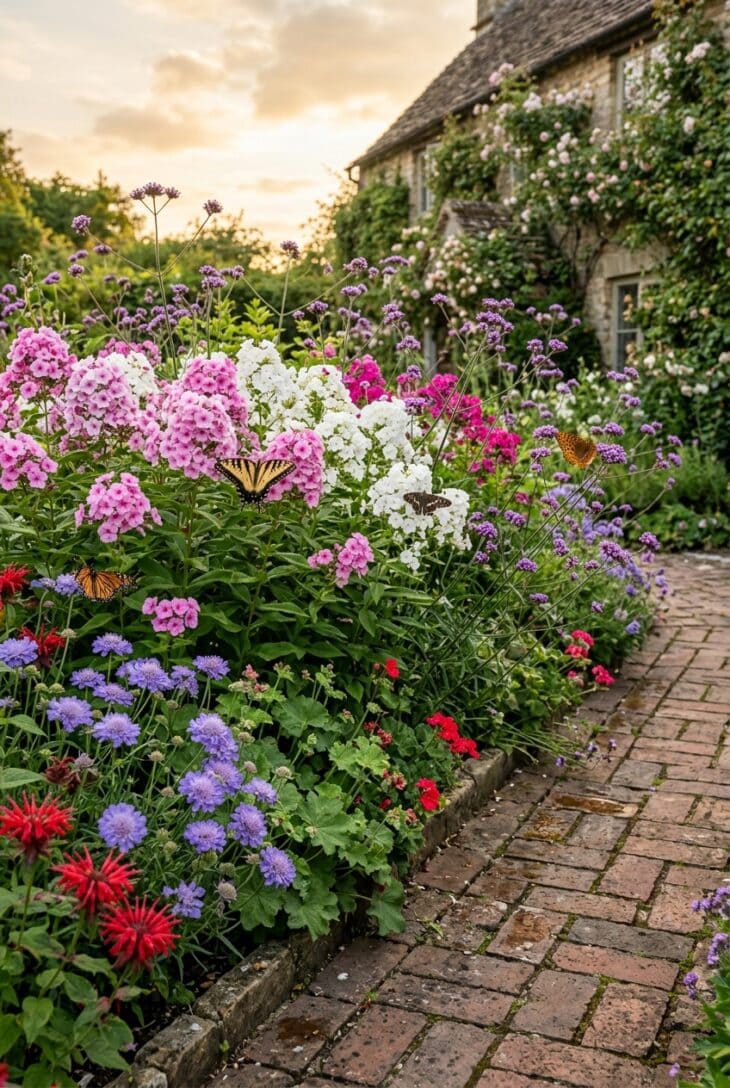
What you see Fragrant domes of pink and white garden phlox fill the middle of a crowded cottage border, with the purple clusters of tall verbena floating above on stems so thin they almost disappear. Pincushion flowers and red bee balm crowd the front edge. A tiger swallowtail hangs from one phlox head and a fritillary works another; stand still for a minute and you will count half a dozen species.
Why it works Phlox and verbena both hide their nectar at the bottom of narrow tubes that many bees struggle to reach but butterfly tongues are built for. The phlox gives weeks of bloom and a sweet evening scent, while the verbena weaves through everything without shading it. It proves a butterfly garden does not have to look wild: this is a classic, generous cottage garden border that happens to be full of wings.
How to get it Choose mildew-resistant garden phlox (Phlox paniculata) such as ‘Jeana’, which drew more butterflies than any other phlox in trials at Mt. Cuba Center, or the white ‘David’. Plant them 18 to 24in (45 to 60cm) apart so air can move, and thin out weak stems in spring. Scatter tall verbena (Verbena bonariensis) between them; it is perennial in zones 7 to 11 and self-seeds elsewhere, so pull surplus seedlings in spring. Add pincushion flower (Scabiosa columbaria ‘Butterfly Blue’) and bee balm (Monarda didyma ‘Jacob Cline’) along the front. Water at the base in dry spells to keep the phlox leaves clean.
10. A Butterfly Container Garden for the Patio
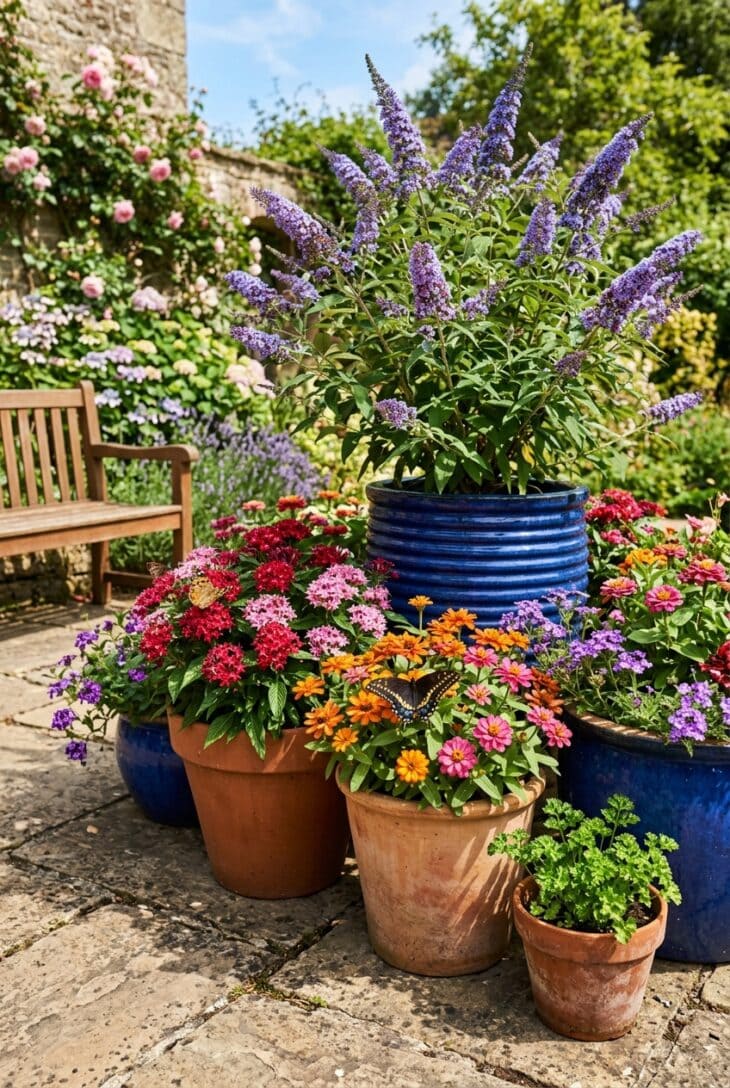
What you see A cluster of glazed pots turns a bare patio corner into a butterfly stop. Red and pink pentas, compact orange zinnias and a spill of purple verbena fill the smaller pots, a blue butterfly bush rises from the tallest, and a pot of curly parsley sits at the edge. A painted lady feeds on the pentas while a swallowtail visits the zinnias.
Why it works Butterflies find flowers by color and scent, not by whether they grow in the ground, so a well-stocked group of pots works on a patio, a deck or a balcony several floors up. Grouping the containers makes one bold patch of color that is easier to spot than scattered single pots, and the parsley gives a passing swallowtail somewhere to lay eggs. It is the easiest butterfly garden here to start, and a good fit for container gardening in rented or tiny spaces.
How to get it Use pots at least 14in (35cm) across, since bigger volumes of soil dry out more slowly, and fill them with potting mix blended with slow-release fertilizer. Pentas (Pentas lanceolata) are the stars, blooming all summer in heat; pair them with compact zinnias such as ‘Profusion’ and trailing verbena (Glandularia ‘Homestead Purple’). The blue butterfly bush (Clerodendrum ugandense) needs a tall pot and a frost-free spot indoors over winter. Water daily in hot weather and deadhead weekly. Keep one pot of parsley or dill purely for caterpillars.
11. Spicebush at the Woodland Edge
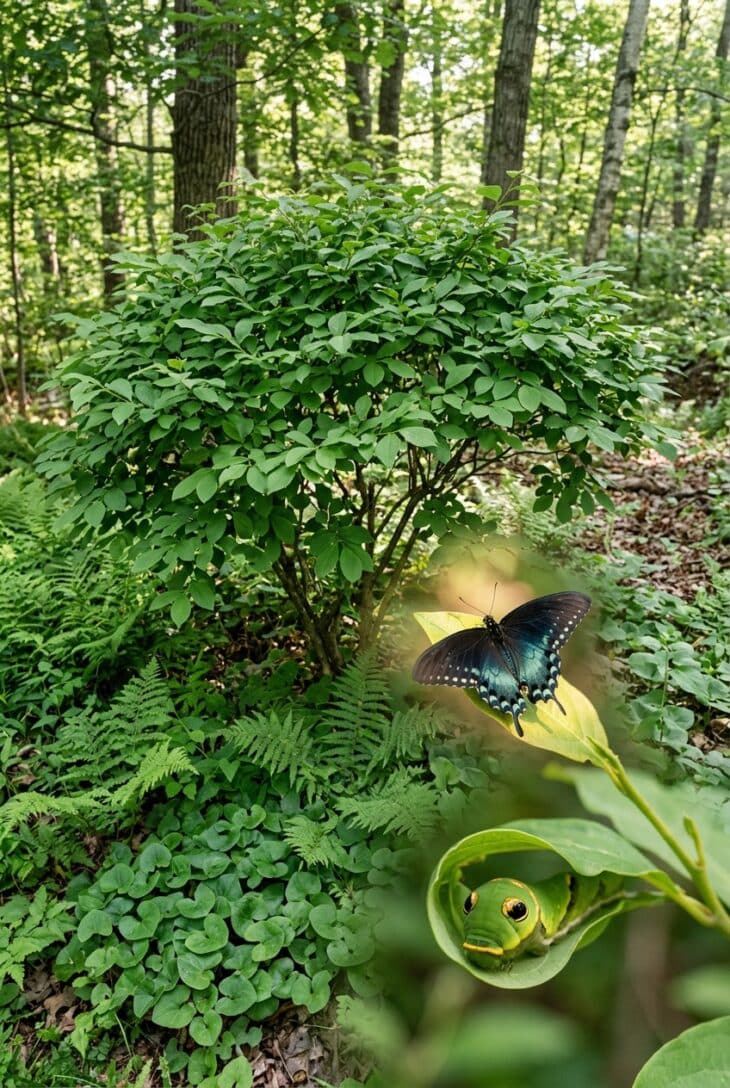
What you see Where the lawn meets the trees, a broad spicebush stands in dappled shade with ferns and wild ginger at its feet. A dark swallowtail with blue-green patches on its hindwings drifts through a shaft of light, and on one leaf, folded over like a sleeping bag, rests a green caterpillar with huge false eyes that make it look like a small snake.
Why it works Most butterfly advice assumes full sun, but the spicebush swallowtail is a creature of woodland edges, and its caterpillars feed on spicebush and sassafras. Planting the host in a shady corner brings a butterfly to a place you would not expect one, and the shrub earns its keep regardless, with yellow flowers in early spring, red berries for birds and clear yellow fall color. It is one of the best native shrubs for shade gardens.
How to get it Plant spicebush (Lindera benzoin) in part shade and moist, humus-rich soil in zones 4 to 9; it grows 6 to 12ft (1.8 to 3.6m) tall and wide. Plants are either male or female and only females bear berries, so buy three or more if you want fruit. Sassafras (Sassafras albidum) is the other main host, but it suckers into a thicket, so save it for a wilder corner. Leave fallen leaves under the shrub in autumn, because the chrysalises spend winter on stems and in the litter below. Add a few shade-tolerant nectar plants nearby, such as woodland phlox (Phlox divaricata) and great blue lobelia (Lobelia siphilitica), for the adults.
12. Violets Welcome in the Lawn
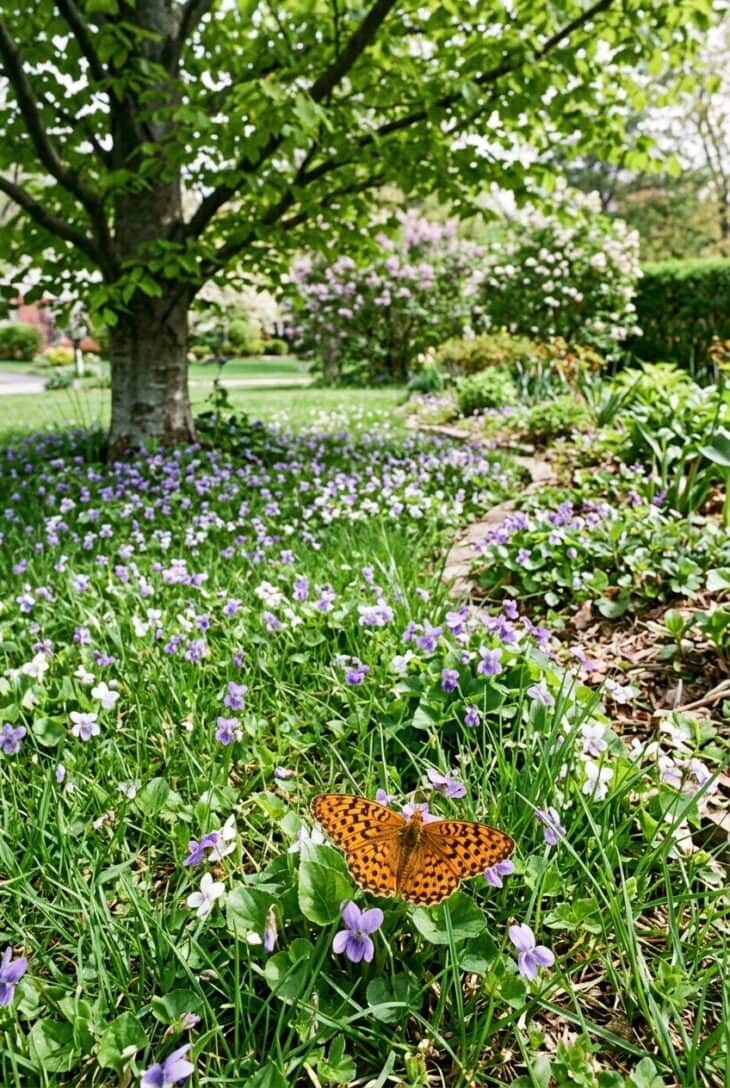
What you see The spring lawn is freckled with violets, purple and white, thickest where the grass thins under the trees and running on into the border. A small orange fritillary, checkered with black, basks among them, and later in summer its larger cousin, the great spangled fritillary, will come here to lay its eggs.
Why it works Violets are the only food of fritillary caterpillars, and fritillaries are among the biggest and brightest butterflies in North American gardens. Many gardeners spend years killing violets with weed-and-feed; simply stopping is one of the cheapest butterfly projects there is. A lawn that tolerates a few “weeds” is also far easier to look after, a real bonus if low-maintenance gardening is the goal.
How to get it Stop using broadleaf herbicides and weed-and-feed products on the lawn, and mow no lower than 3in (8cm) so violets and grass can share the space. Native common blue violet (Viola sororia) usually turns up on its own; if not, plug a few along shady edges and under shrubs, 12in (30cm) apart, and let them seed. Birdsfoot violet (Viola pedata) suits dry, sunny, sandy ground. Great spangled fritillaries lay eggs near violets in late summer and the tiny caterpillars spend winter unfed in the leaf litter, so leave fallen leaves in the border next to the lawn. If you must clear leaves off the grass, push them into the beds rather than bagging them.
13. Tall Back-Row Magnets: Joe Pye Weed and Ironweed
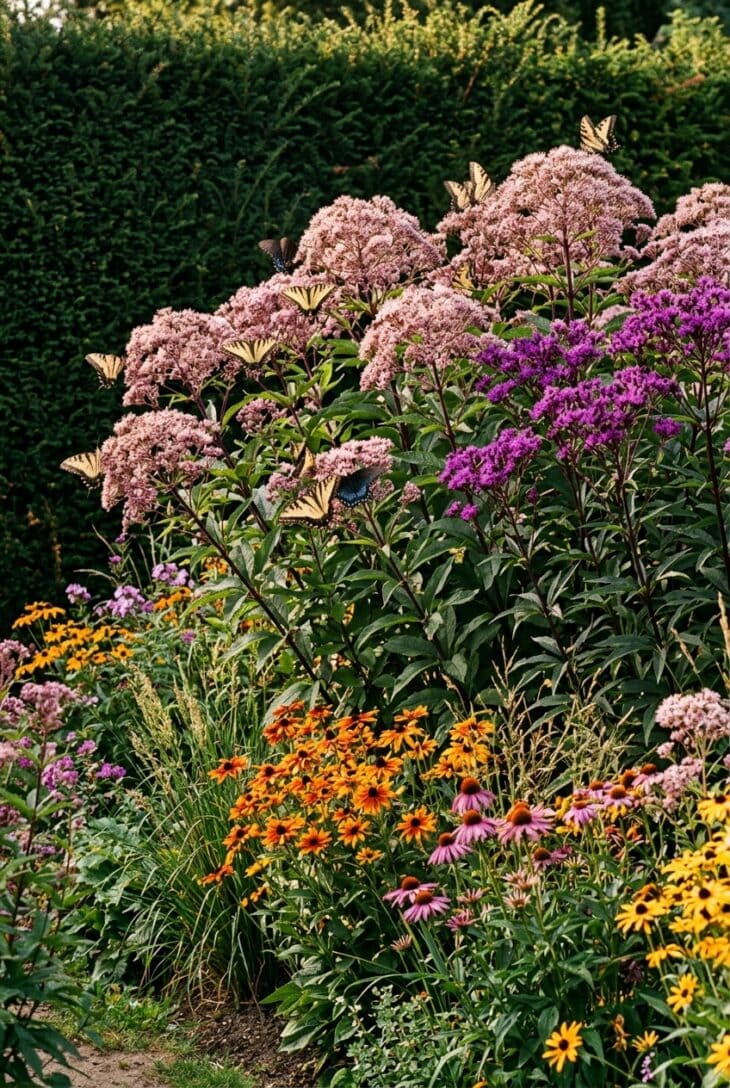
What you see At the back of the border, Joe Pye weed lifts dusty-pink flower heads the size of dinner plates on purple stems, with New York ironweed beside it in vivid royal purple. Both stand head-high by August, and the Joe Pye weed can carry half a dozen tiger swallowtails at once, their yellow and black wings slowly opening and closing as they feed.
Why it works Big butterflies like swallowtails and monarchs look for big targets, and these two are among the strongest butterfly magnets in eastern North America. Their height lets them act as a flowering screen in late summer, just as many beds start to fade, and they give depth to the back row of a mixed border. Their seedheads feed goldfinches in fall.
How to get it Plant Joe Pye weed (Eutrochium maculatum ‘Gateway’, 5 to 6ft or 1.5 to 1.8m) and New York ironweed (Vernonia noveboracensis, 5 to 7ft or 1.5 to 2.1m) about 3ft (90cm) apart at the back of a sunny bed with moist soil. For smaller spaces, choose Joe Pye weed ‘Little Joe’ (Eutrochium dubium, 3 to 4ft or 90 to 120cm) and ‘Iron Butterfly’ ironweed (Vernonia lettermannii, 2 to 3ft or 60 to 90cm). To keep tall plants shorter and sturdier, cut the stems back by a third in late May or early June. Water deeply in dry spells, as both wilt in drought. Cut them down in late winter rather than fall.
14. A Front-Yard Butterfly Strip
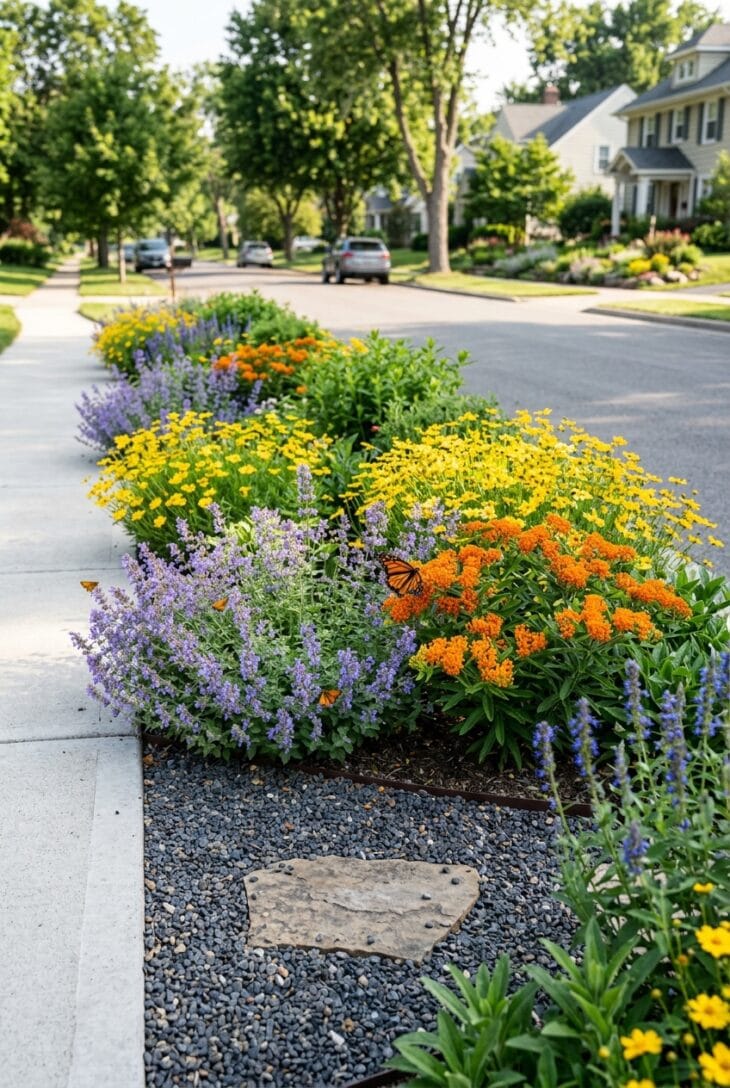
What you see The strip of grass between sidewalk and street has become a low, bright ribbon of flowers: soft blue catmint, sunny yellow coreopsis, clumps of orange butterfly weed and blue spikes of anise hyssop. Everything stays below knee height, the edges are crisp, and a monarch and a few orange skippers feed as people walk by.
Why it works Front yards and curbside strips are often the sunniest, hottest ground on a lot, exactly what butterflies want, and they are wasted on lawn that needs mowing and watering. Planting here also turns your garden into a stepping stone that links up with others along the street. Kept low and neat, it adds curb appeal and shows the planting is deliberate, which helps with neighbors and homeowners’ associations.
How to get it Check local rules before replacing a curbside strip, and keep plants under about 30in (75cm) near driveways and corners so drivers can see. Tough, compact choices include catmint (Nepeta ‘Cat’s Pajamas’), threadleaf tickseed (Coreopsis verticillata ‘Zagreb’), butterfly weed (Asclepias tuberosa) and anise hyssop (Agastache ‘Blue Boa’). Plant in groups of three to five, 12 to 18in (30 to 45cm) apart, and mulch with gravel or shredded bark. Set a flat stepping stone every 10ft (3m) so people can get out of parked cars without trampling plants. Water weekly through the first summer, then only in drought.
15. A Seedless Butterfly Bush, or a Native Stand-In
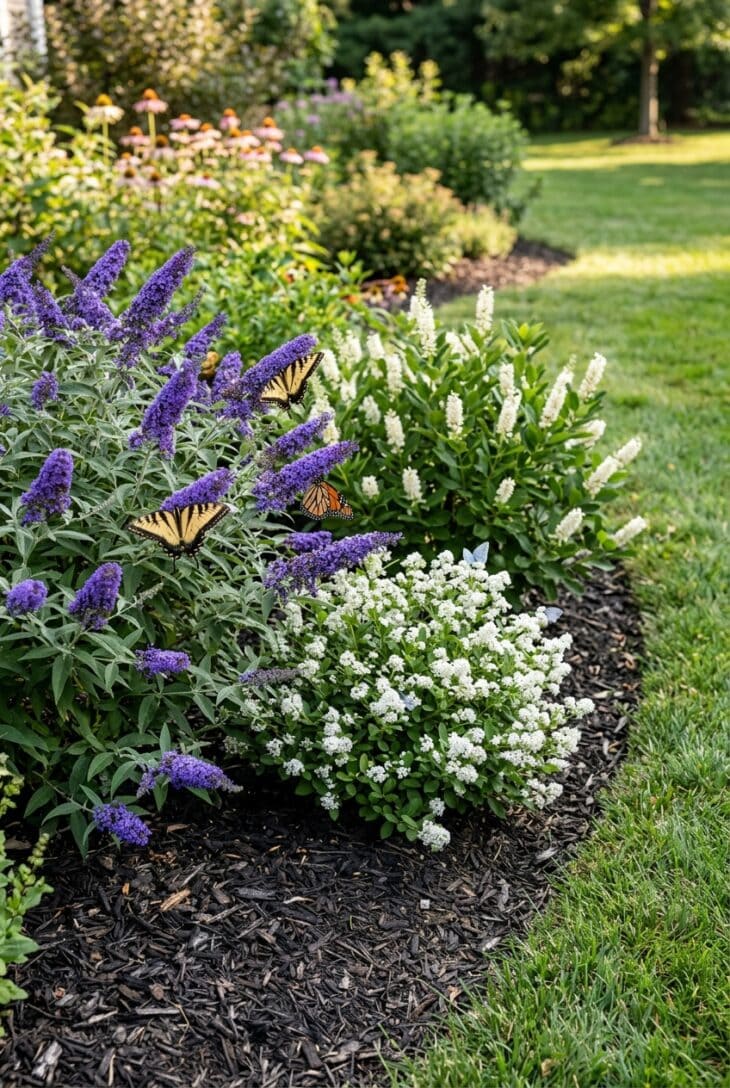
What you see A compact butterfly bush covered in violet spikes shares a sunny shrub bed with two natives: New Jersey tea, frothy with tiny white flowers, and summersweet with fragrant white bottlebrushes. Tiger swallowtails crowd the butterfly bush, and a tiny summer azure flits over the white blooms beside it.
Why it works Butterfly bush earns its name as a nectar source, but it has two drawbacks. The species spreads by seed and is listed as invasive in parts of the country, especially the Pacific Northwest, and no North American caterpillar feeds on it, so it fuels adults without helping them breed. A seedless cultivar solves the first problem, and planting natives alongside it solves the second.
How to get it If you grow butterfly bush (Buddleja davidii), check your state’s invasive plant list first, then buy a cultivar sold as seedless or nearly so, such as ‘Blue Chip’ from the Lo & Behold series. Better still, grow New Jersey tea (Ceanothus americanus), a tough 3ft (90cm) shrub for dry, sunny spots that hosts the spring and summer azures and the mottled duskywing. Summersweet (Clethra alnifolia ‘Hummingbird’ or ‘Sixteen Candles’) flowers in July and August in sun or part shade and moist soil. Plant shrubs 3 to 5ft (90 to 150cm) apart. Cut butterfly bush back hard to 12in (30cm) in early spring; the natives need little more than dead wood removed.
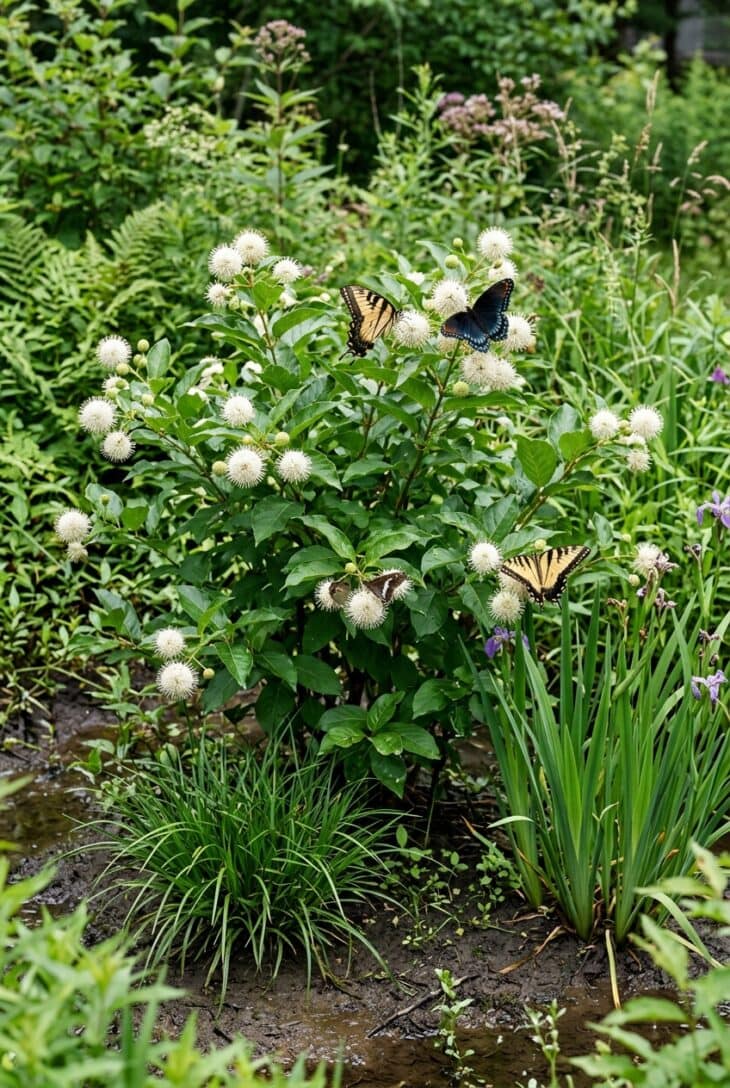
What you see In the low corner where water collects after rain, a buttonbush has filled out into a rounded shrub studded with white flowers shaped like pincushions or tiny planets. Tiger swallowtails, a skipper and a red-spotted purple jostle for space on them, while sedges and blue flag iris grow in the wet ground below.
Why it works Every garden has a spot where most plants sulk: soggy, slow-draining, sometimes standing in water after storms. Buttonbush loves it. It flowers in midsummer, when butterfly numbers peak, and each ball is made of hundreds of tiny tubular florets packed with nectar. Its leaves feed the caterpillars of several sphinx moths and ducks eat the seeds, making it a valuable shrub in any wildlife garden.
How to get it Plant buttonbush (Cephalanthus occidentalis) in full sun to part shade in wet or consistently moist soil, in zones 5 to 9. The species reaches 6 to 12ft (1.8 to 3.6m), while ‘Sugar Shack’ stays around 3 to 4ft (90 to 120cm) and suits small spaces. It leafs out late in spring, so do not assume it has died. Underplant with sedges (Carex) and blue flag iris (Iris versicolor) to finish the wet corner. Prune in late winter, taking out a few of the oldest stems if it gets leggy.
17. A Kids’ Caterpillar Nursery
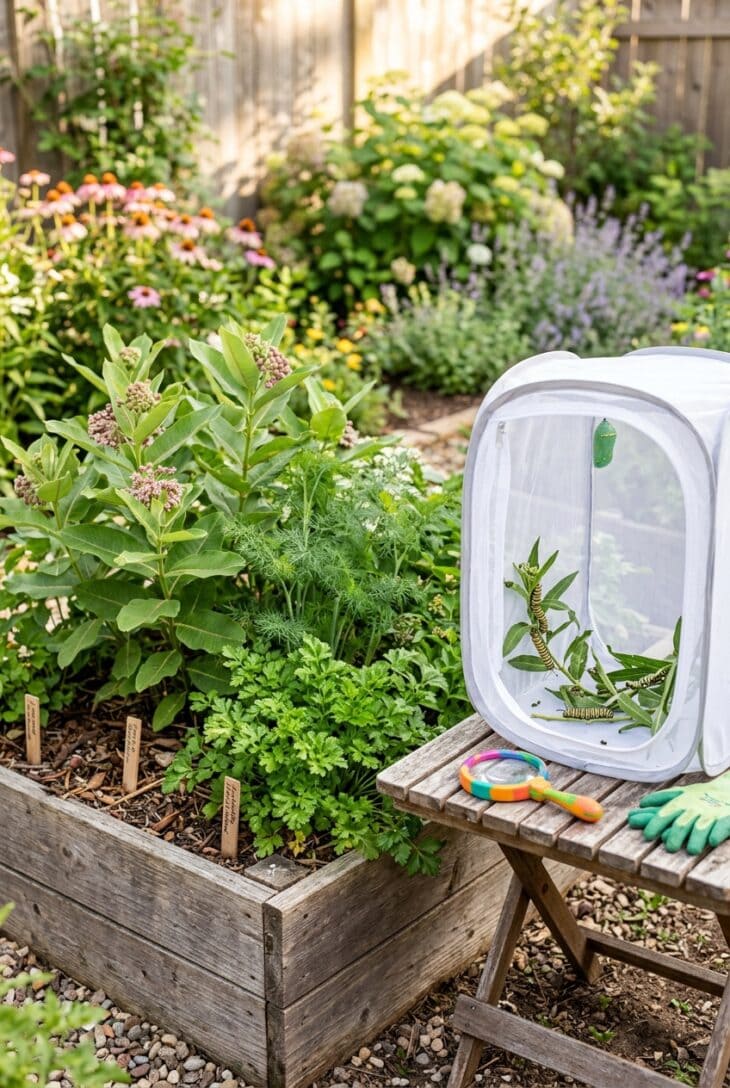
What you see A low raised bed of milkweed, dill and parsley sits at child height, and on a small table beside it stands a white mesh cage. Inside, striped caterpillars munch through fresh milkweed leaves, and a jade-green chrysalis with gold dots hangs from the roof. A magnifying glass waits on the table for the daily check.
Why it works Watching a caterpillar become a butterfly is the moment that turns many children into lifelong gardeners, and a small host-plant bed puts it on your doorstep. The plants bring the caterpillars to you naturally, and raising a few in a cage protects them from wasps and birds while children see every stage up close. Building the bed at their height makes it their project, one of the best raised bed ideas for families.
How to get it Build or buy a raised bed about 18in (45cm) high and plant it with swamp milkweed, butterfly weed, dill and parsley. From early summer, check the undersides of leaves for eggs and small caterpillars, and bring in no more than a handful at a time. Keep them in a mesh pop-up cage out of direct sun, add fresh leaves every day and clean out the droppings to prevent disease. When a butterfly emerges, let its wings dry for a few hours, then release it where the caterpillar was found. Raise local wild caterpillars rather than buying mail-order kits, which conservation groups discourage because releases can spread disease and muddle wild populations.
18. Small Host Trees: Wild Plum and Pussy Willow
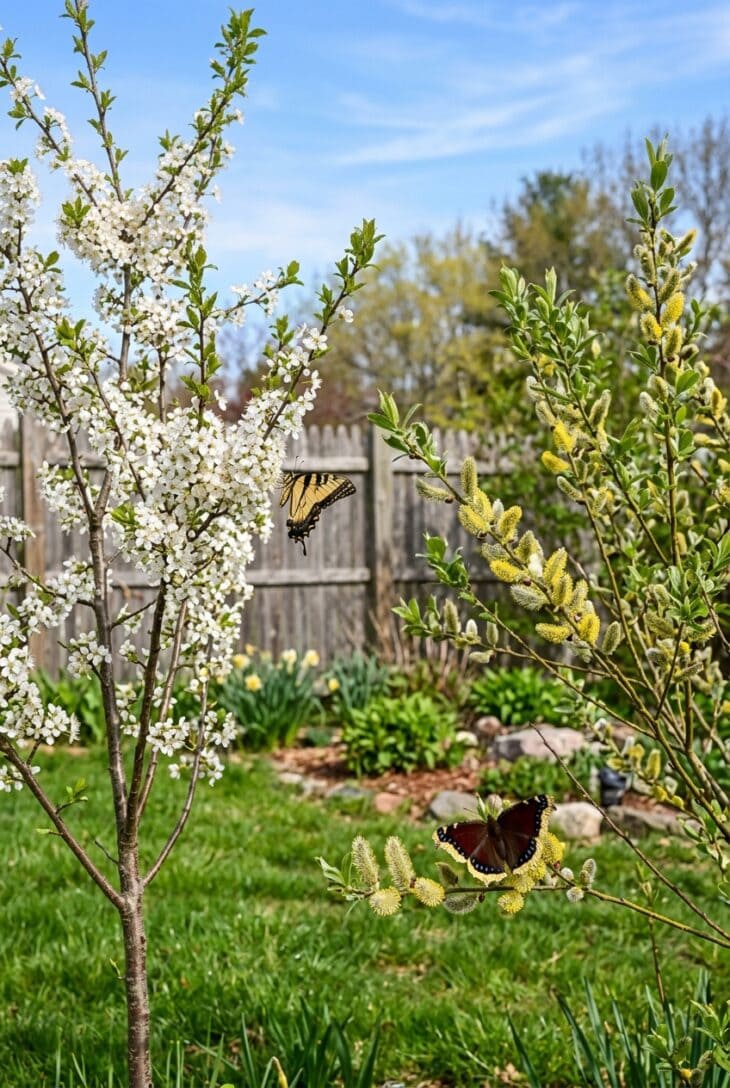
What you see At the edge of the yard, a wild plum is a cloud of white blossom, and a pussy willow beside it glows with fuzzy catkins turning gold with pollen. A mourning cloak rests on a willow twig, and an eastern tiger swallowtail sails in to the plum flowers.
Why it works Flowers feed butterflies, but trees and shrubs raise them. Native plums, cherries and willows each support hundreds of species of butterflies and moths, according to research by entomologist Doug Tallamy, far more than most garden perennials. The plum hosts tiger swallowtails, red-spotted purples and coral hairstreaks, while the willow feeds mourning cloaks and viceroys. Both fit a suburban lot and bloom early, when food is scarce.
How to get it Plant American plum (Prunus americana) in full sun, where it reaches 15 to 20ft (4.5 to 6m) and suckers into a thicket if you let it; mow around it to keep a single clump. Pussy willow (Salix discolor) grows 10 to 15ft (3 to 4.5m) in moist soil and can be cut back hard every few years to keep it shrubby. Keep any willow at least 50ft (15m) from drains and foundations, as the roots seek out water. Plant in fall or early spring from bare-root or container stock. Accept chewed leaves in summer: they are a sign the tree is doing its job.
19. A Desert Butterfly Garden
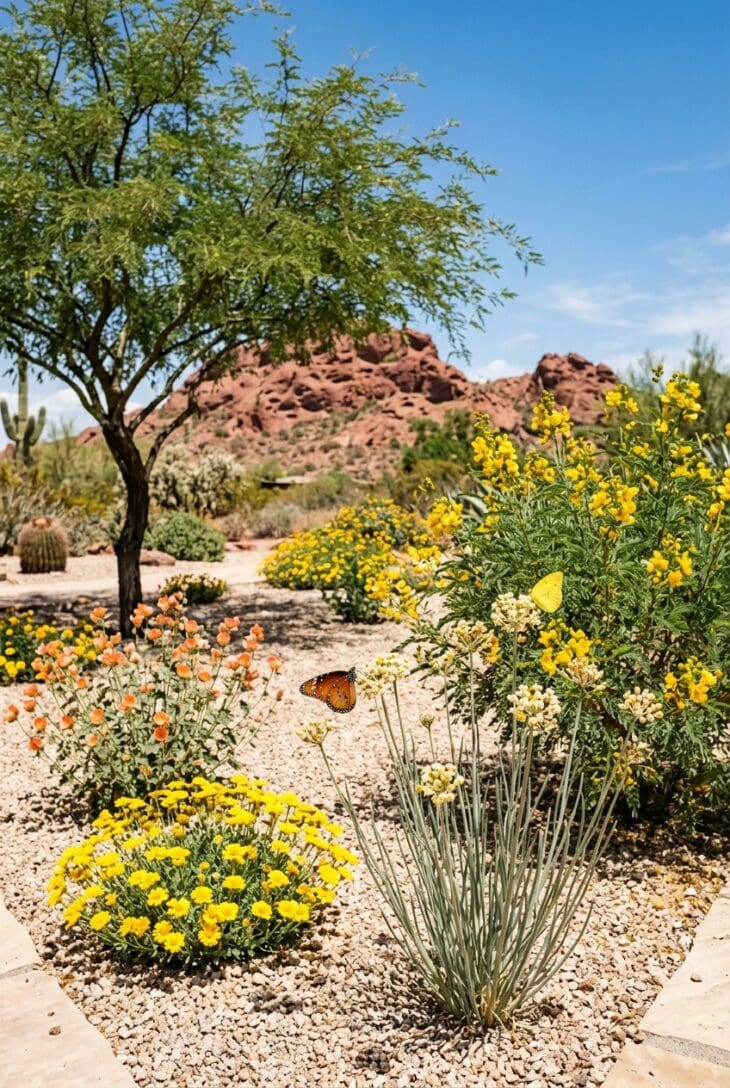
What you see Under the lacy shade of a velvet mesquite, clumps of apricot globe mallow, bright yellow desert marigold and the gray, reed-like stems of desert milkweed stand out against pale gravel. An orange-brown queen butterfly feeds on the milkweed’s cream flowers and a sulphur flashes yellow over a feathery senna.
Why it works Deserts are rich in butterflies, but they rely on plants adapted to heat and scarce water, not the thirsty bedding flowers sold everywhere else. A native desert palette feeds adults through the long season and hosts caterpillars too: milkweeds feed monarchs and queens, sennas feed sulphurs, and mesquite hosts several small blues. It sits naturally alongside other drought-tolerant garden ideas and uses a fraction of the water of a lawn.
How to get it Plant in fall so roots establish through the cooler months. Start with a velvet mesquite (Prosopis velutina) for shade, then add desert globe mallow (Sphaeralcea ambigua), desert marigold (Baileya multiradiata), desert milkweed (Asclepias subulata) and a native senna such as desert senna (Senna covesii). Space perennials 2 to 3ft (60 to 90cm) apart and mulch with gravel rather than bark. Water deeply every week or two on drip through the first summer, then taper to occasional deep soaks in the hottest months. Add a shallow damp puddling spot, which draws butterflies strongly in dry climates.
20. A Fruit Feeding Station for Admirals and Commas
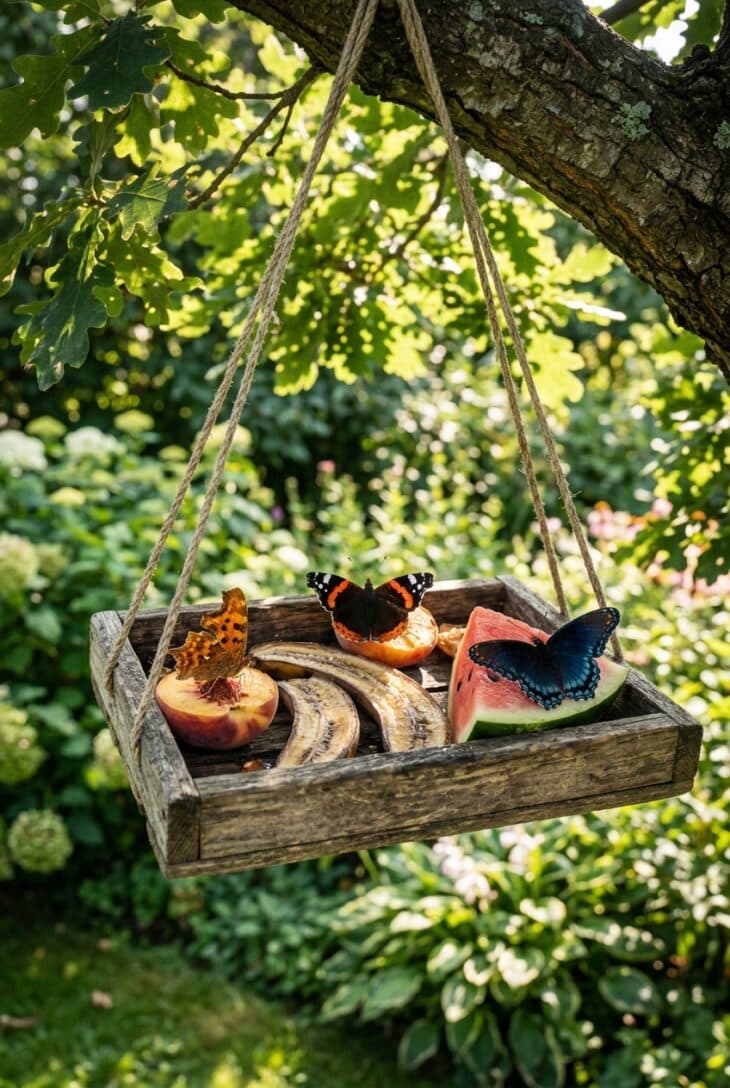
What you see A small wooden tray hangs from a branch at the garden’s edge, loaded with slices of overripe banana, soft peach halves and a wedge of watermelon. A red admiral, a ragged-edged question mark and a velvety red-spotted purple share the fruit, their wings opening slowly as they drink.
Why it works Not every butterfly visits flowers. Admirals, commas, question marks, mourning cloaks and emperors prefer the sugars in rotting fruit and tree sap, so they often ignore even the best-planted border. A fruit tray brings these handsome woodland-edge species into view, and they are rewarding to watch: they settle and feed for long spells, so you can get close with a camera.
How to get it Hang a shallow tray or plate 4 to 5ft (1.2 to 1.5m) up in part shade, near shrubs or trees. Fill it with overripe or bruised fruit: bananas, peaches, plums, melons or soft apples. A splash of fruit juice or a pinch of brown sugar speeds up fermentation, which is what draws them. Replace the fruit every two or three days before it turns moldy, and rinse the tray. Keep it well away from doors and seating, since wasps love it too.
21. A Sunny Bank of Little Bluestem and Butterfly Weed
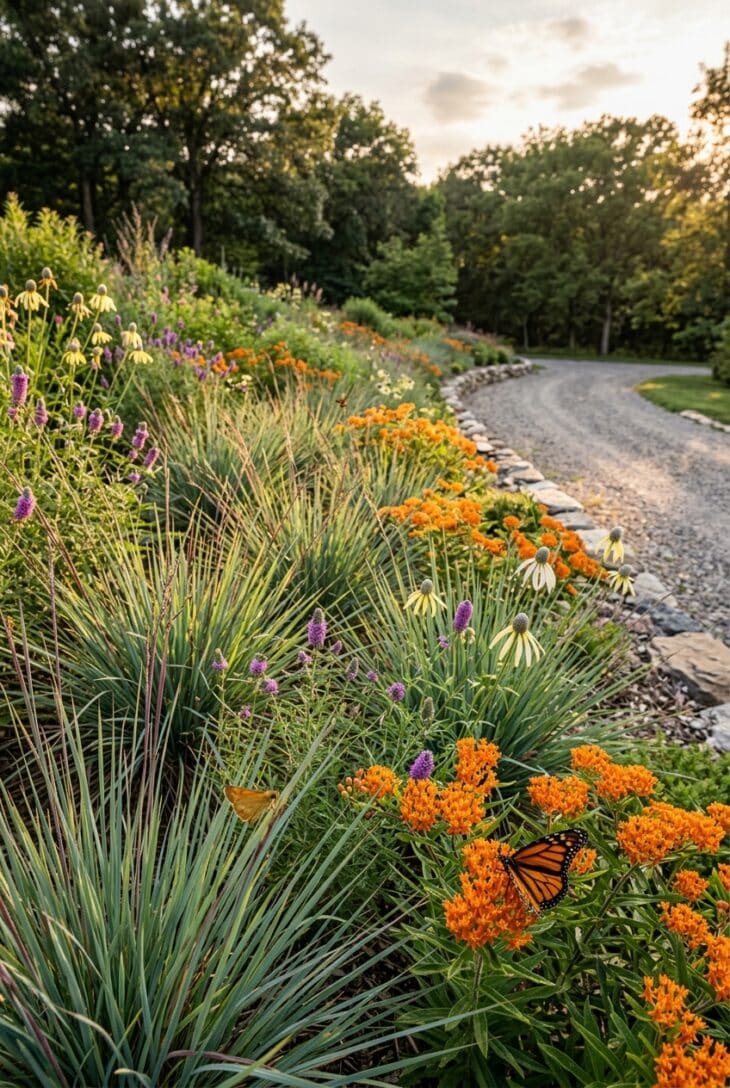
What you see A bank too steep to mow has been planted with clumps of blue-green little bluestem and blazing orange butterfly weed, with purple prairie clover and pale yellow coneflowers woven between. Small tawny skippers perch on the grass blades like tiny fighter jets, and a monarch feeds on the orange flowers.
Why it works Native grasses are an overlooked part of butterfly gardening: little bluestem is the host plant for several skippers, the small, quick butterflies that are often the most common visitors in summer. Mixed with deep-rooted wildflowers it holds the soil, needs no mowing and turns copper in fall. It is one of the simplest ideas for a sloped garden that is hard to maintain.
How to get it In spring or early fall, plant plugs of little bluestem (Schizachyrium scoparium ‘Standing Ovation’ or ‘The Blues’) 18 to 24in (45 to 60cm) apart, with butterfly weed (Asclepias tuberosa), purple prairie clover (Dalea purpurea) and gray-headed coneflower (Ratibida pinnata) between them. On steep ground, lay a biodegradable jute erosion blanket first and plant through slits cut in it. Butterfly weed has a deep taproot, so plant small pots and never move them. Water through the first summer only. Leave the grass standing all winter, since some skipper caterpillars overwinter in shelters among the blades, and cut it back to 4 to 6in (10 to 15cm) in late winter.
22. A Subtropical Butterfly Garden for the Deep South
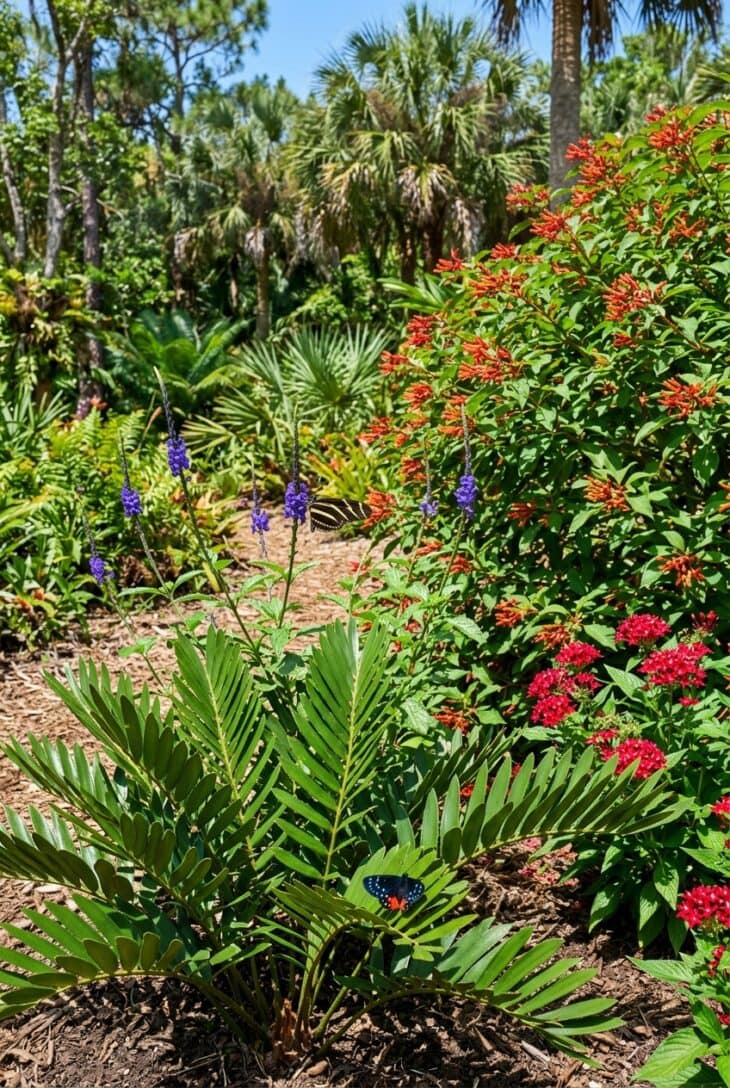
What you see Firebush glows with tubular red-orange flowers above spikes of purple porterweed and clusters of red pentas, while a glossy clump of coontie grows at their feet. A striped zebra longwing, Florida’s state butterfly, floats onto the porterweed, and on the coontie sits the tiny atala, velvety black with metallic blue spots and a bright red body.
Why it works In frost-free and nearly frost-free climates, butterflies fly almost all year, so the garden needs to bloom almost all year too, and native subtropical shrubs do exactly that. This mix covers hosts as well: in South Florida, coontie is the native host of the atala, a butterfly once feared lost from the state that has returned largely thanks to people planting coontie in their yards. It has all the lush, bold foliage of a tropical garden, with far more wildlife.
How to get it For zones 9b to 11, plant native firebush (Hamelia patens var. patens) rather than the non-native look-alike sold as African or dwarf firebush, and native porterweed (Stachytarpheta jamaicensis) rather than the invasive nettleleaf porterweed (Stachytarpheta cayennensis). Add coontie (Zamia integrifolia) in sun or shade, and grow corkystem passionflower (Passiflora suberosa) on a fence as a host for zebra longwings and gulf fritillaries. Pentas (Pentas lanceolata) fill the gaps with nonstop bloom. Space shrubs 4 to 6ft (1.2 to 1.8m) apart, and cut firebush back by a third in late winter to keep it dense.
23. A Pawpaw Patch for Zebra Swallowtails
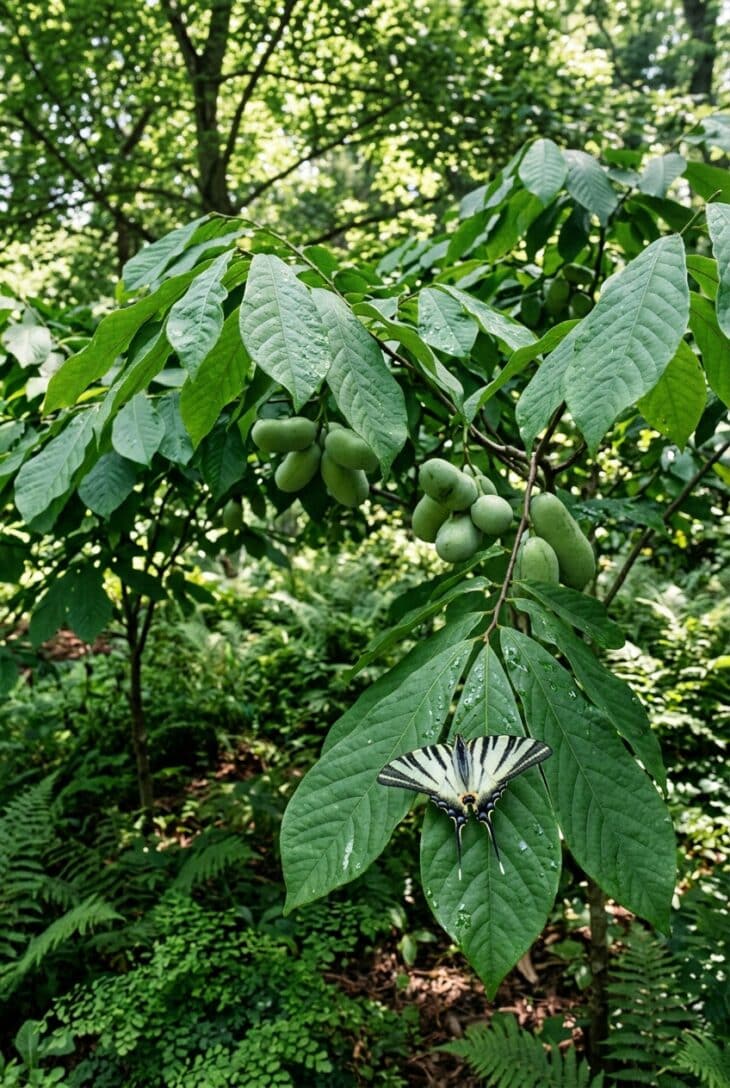
What you see A little grove of pawpaws fills a shady edge with large, drooping leaves that look as if they belong in the tropics, with clusters of green fruit hanging beneath. A zebra swallowtail, pale white striped boldly in black and trailing long sword-like tails, rests on one leaf.
Why it works Zebra swallowtail caterpillars eat only pawpaw, so the butterfly rarely strays far from the trees. Plant a patch and you give it a reason to stay; you also get the largest native fruit in North America, with custardy flesh that tastes of banana and mango. Pawpaws handle more shade than most fruit trees, which makes them useful where sun-loving plants would sulk.
How to get it Pawpaw (Asimina triloba) grows 15 to 20ft (4.5 to 6m) in zones 5 to 8, in moist, well-drained soil. Young trees need some shade for their first year or two, then fruit best in sun. Plant two different cultivars, such as ‘Shenandoah’ and ‘Susquehanna’, 8 to 10ft (2.4 to 3m) apart for cross-pollination. They grow a long, brittle taproot, so buy small container plants and never move them later. Let root suckers fill in if you have room, as a thicket is exactly what zebra swallowtails look for.
24. A California Native Butterfly Garden
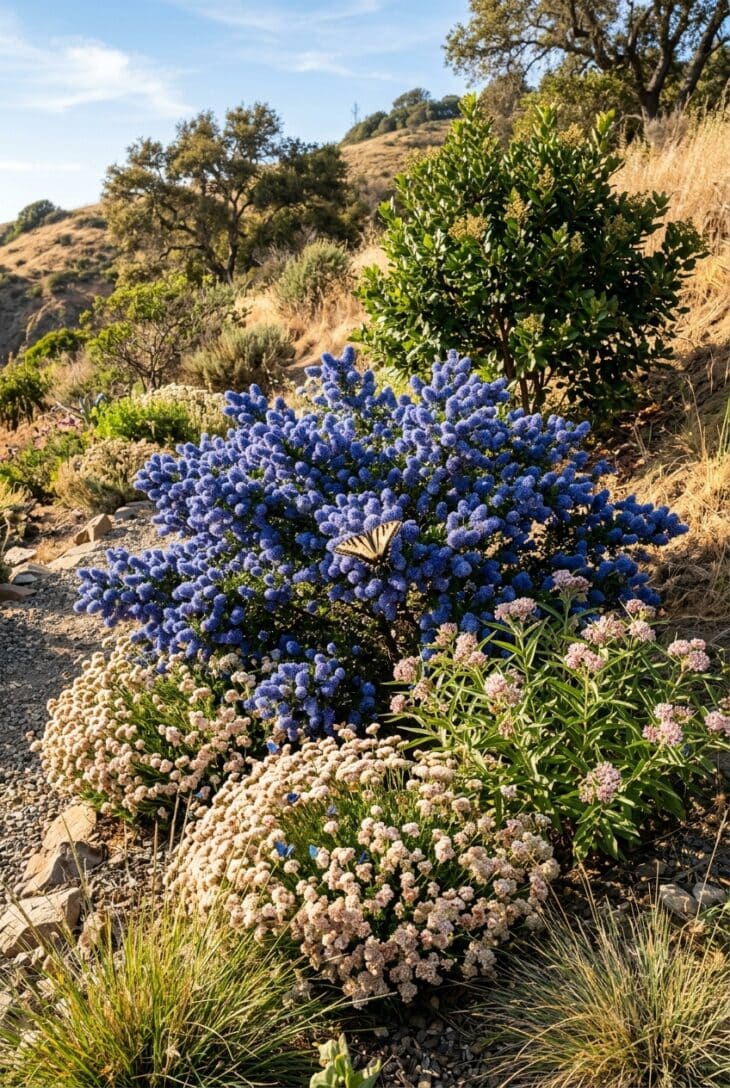
What you see A California lilac smothered in deep blue flowers anchors a dry, sunny slope, with mounds of California buckwheat whose cream flower heads slowly fade to rust, and clumps of narrowleaf milkweed in pale pink. A cream-and-black pale swallowtail feeds on the ceanothus, and tiny blue butterflies work the buckwheat.
Why it works California’s native plants and butterflies grew up together in a Mediterranean climate of wet winters and dry summers, and a garden built around them thrives with little summer water. Ceanothus hosts the pale swallowtail and California tortoiseshell, buckwheats feed a whole range of blues and hairstreaks and bloom for months, and narrowleaf milkweed is the right milkweed for western monarchs.
How to get it Plant in fall, just before the winter rains, so roots establish before the first dry summer. Choose a ceanothus to fit your space, such as ‘Ray Hartman’ (a small tree) or ‘Concha’ (about 6ft or 1.8m), then add California buckwheat (Eriogonum fasciculatum) and narrowleaf milkweed (Asclepias fascicularis), which dies back in winter. Toyon (Heteromeles arbutifolia) makes a fine evergreen backdrop, with summer flowers and red winter berries. Water occasionally through the first summer, then almost stop: summer watering is a leading cause of death in established ceanothus. Skip fertilizer and mulch with gravel or leaf litter.
25. A Late-Season Aster Border for Migrants
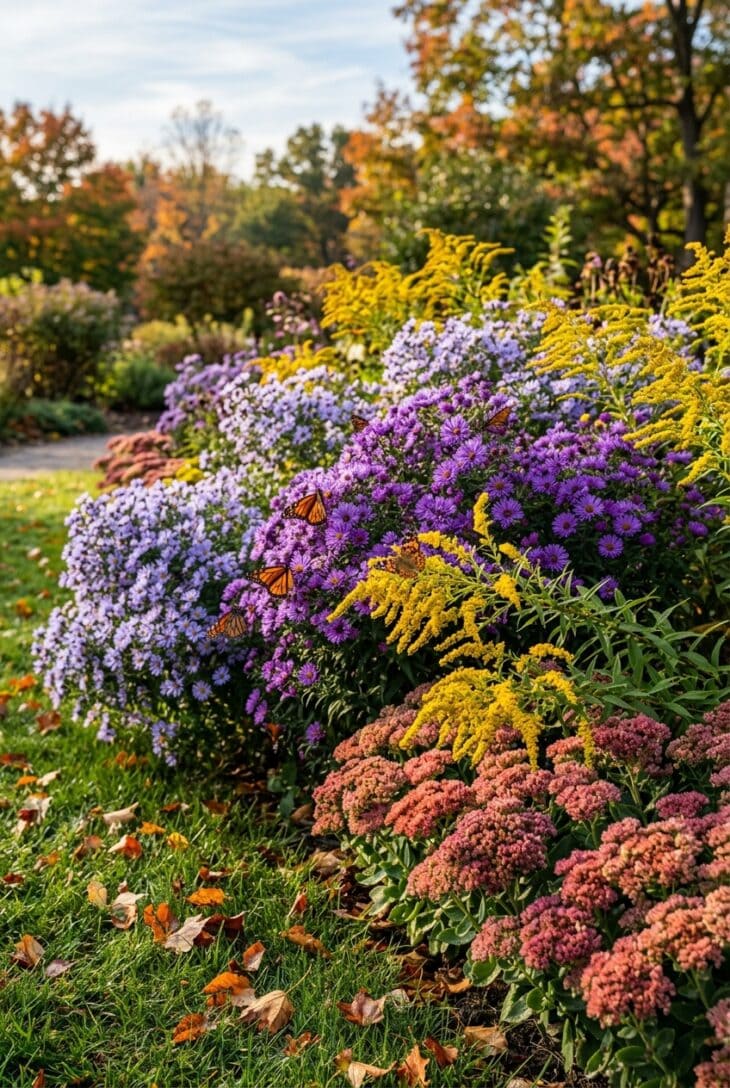
What you see By October the border is a haze of purple and gold: mounds of New England aster, clouds of lavender aromatic aster and arching sprays of goldenrod, with rusty sedum along the front. Monarchs, several at a time, drift in on their way south and stop to feed, joined by a painted lady and the last of the season’s sulphurs.
Why it works Monarchs heading for Mexico refuel as they travel and build up the fat that carries them through winter, so a late nectar stop matters as much as a summer one. Asters and goldenrod are the richest fall nectar sources across much of the country, and asters also host the pearl crescent, one of the most common garden butterflies. Goldenrod does not cause hay fever: that is ragweed, which blooms at the same time with green, inconspicuous flowers.
How to get it Plant New England aster (Symphyotrichum novae-angliae ‘Purple Dome’, 18 to 24in or 45 to 60cm), aromatic aster (Symphyotrichum oblongifolium ‘October Skies’) and a well-behaved goldenrod (Solidago rugosa ‘Fireworks’) in full sun, 18 to 24in (45 to 60cm) apart. Avoid Canada goldenrod (Solidago canadensis) in small gardens, since it spreads aggressively. Pinch taller asters back by half before early July to keep them bushy and stop them flopping. Add stonecrop (Hylotelephium ‘Autumn Joy’) at the front for extra late nectar. Leave the seedheads through winter for birds and cut everything back in spring.