A greenhouse on a clear January afternoon is the warmest, greenest place on the property, with lettuce growing a few feet from a snowdrift. It is also the one piece of garden equipment that changes what you can grow, not just how well. The ideas below show what that looks like in real yards.
Contents
- 01. Lean-to Greenhouse on a Sunny Wall
- 02. Classic Backyard Greenhouse with a Potting Bench
- 03. Snow-Ready Polycarbonate Greenhouse
- 04. Cold Frame Built from an Old Window
- 05. Hoop House Over a Raised Bed
- 06. Balcony Mini Greenhouse
- 07. Unheated Winter Salad Bench
- 08. In-Ground Root Crops and Leeks
- 09. Winter Herb Shelf
- 10. Early Strawberries in Pots
- 11. Potted Citrus Winter Shelter
- 12. Cut Flowers for Winter Bouquets
- 13. Bulb Forcing Bench
- 14. Succulent and Cactus House
- 15. Frost-Free Shelter for Tender Perennials
- 16. Seed-Starting Bench with Grow Lights
- 17. Propagation Bench with Heat Mat
- 18. Vertical Shelving and Hanging Baskets
- 19. Brick Floor and Gravel Path
- 20. Water Barrel Heat Sink
- 21. Automatic Vent Openers
- 22. Safe Electric Heater Setup
- 23. Gutter and Rain Tank by the Door
- 24. String Light Evening Glow
- 25. Greenhouse Sitting Nook
The range is wide. There are ideas for a full glass house and for a cold frame built from an old window, for a Zone 4 backyard buried in snow and for a Zone 8 yard that sees only a few hard frosts, and for budgets from next to nothing to a few thousand dollars. Some ideas are about crops, like winter salad, root vegetables, citrus and cut flowers, and others are about the systems that make a greenhouse work, like venting, heat and light.
A greenhouse does not cancel winter. In the northern half of the country the real limit is short days, not cold, and the ideas say plainly where heat, light or timing matters. Look up your average first fall frost date and your USDA zone, then pick the ideas that suit your climate, your space and your budget.
01. Lean-to Greenhouse on a Sunny Wall
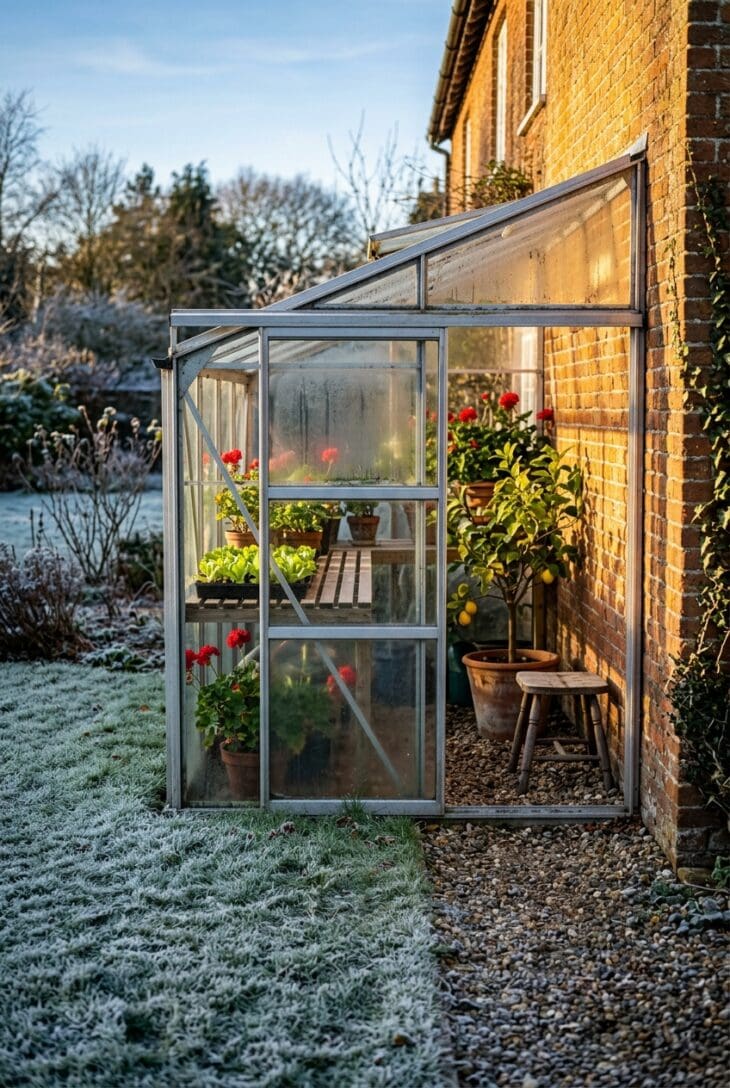
What you see A narrow glass lean-to rests against a sunlit brick wall, frost still silvering the lawn in front of it. Through the panes you can see red geraniums, a lemon tree in a terra-cotta pot and trays of lettuce on a slatted shelf, all green and unbothered. The low winter sun lights the bricks from the side until they glow amber, and a faint haze of condensation clings to the glass.
Why it works The house wall does half the work. It is one side you do not have to build, it soaks up sun all day and gives some of that warmth back after dark, and heat leaking through it from the house takes a little of the edge off the coldest nights. A lean-to is also the greenhouse you will actually use in January, especially with a door from the house, because there is no trek across the snow.
How to get it Pick the wall that gets the most winter sun, which in most of the country is south-facing, with southeast as a good second. Plan for at least 6ft (180cm) of depth so there is room for a bench and a walkway. Set the frame on a solid base such as a concrete footing or a row of concrete blocks, and flash the joint where the roof meets the wall so rain does not run behind it. Include a roof vent and a low vent or door, because a lean-to holds heat well and will overheat on sunny days. An attached structure often needs a building permit, so call your town office before you buy.
02. Classic Backyard Greenhouse with a Potting Bench
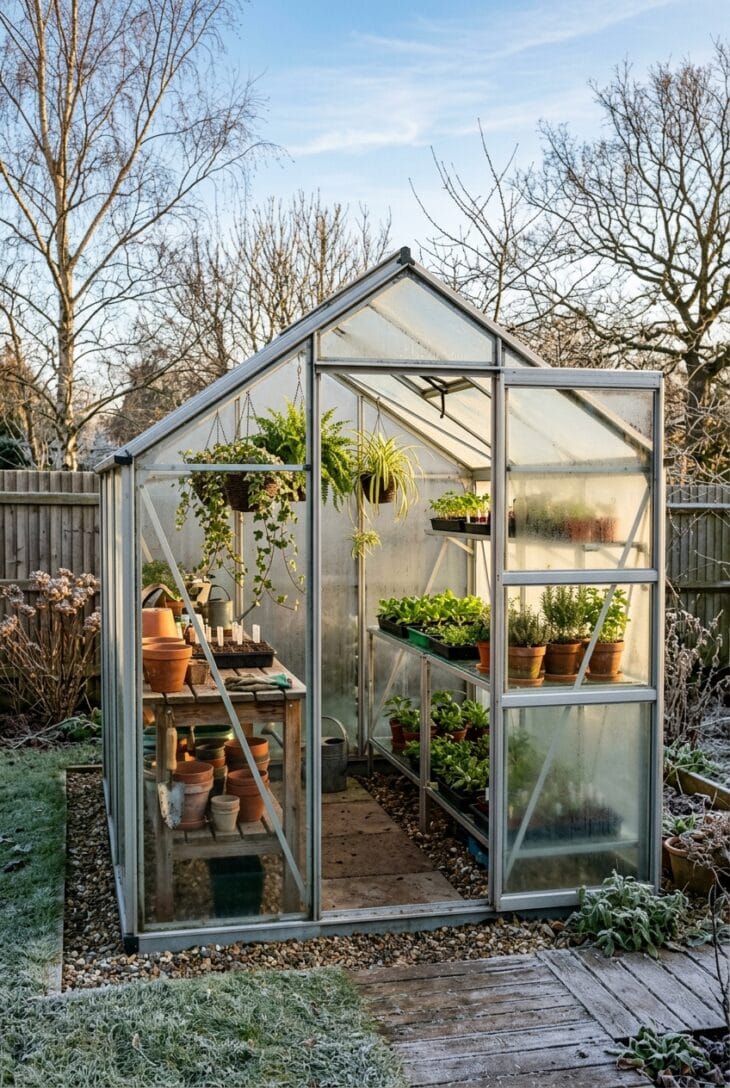
What you see A free-standing greenhouse sits in the middle of a frosty backyard with its door propped open. Inside, a cedar potting bench runs along one side, stacked with terra-cotta pots, a trowel and trays of seedlings, while baskets hang from the roof bars. Bare trees stand behind it and the morning light comes in low and gold.
Why it works This is the greenhouse most people picture, and its strength is placement. Because it stands alone, you can put it exactly where the winter light is best, with glass on every side. The bench is the part that earns its keep: potting, dividing and seed sowing all happen under cover while the soil outside is frozen.
How to get it An 8 by 10ft (240 by 300cm) kit is the common starter size, and gardeners often say they outgrow it fast, so measure for the next size up if the yard allows. For winter growing in the northern half of the country, run the long side east to west so the south wall catches the low sun. Put the bench on the north side so it never shades the plants, and build it to elbow height, usually 34 to 36in (85 to 90cm). Anchor the frame to a base, because wind can lift a lightweight greenhouse. Small structures are exempt from permits in many towns but not all, so check before you order.
03. Snow-Ready Polycarbonate Greenhouse
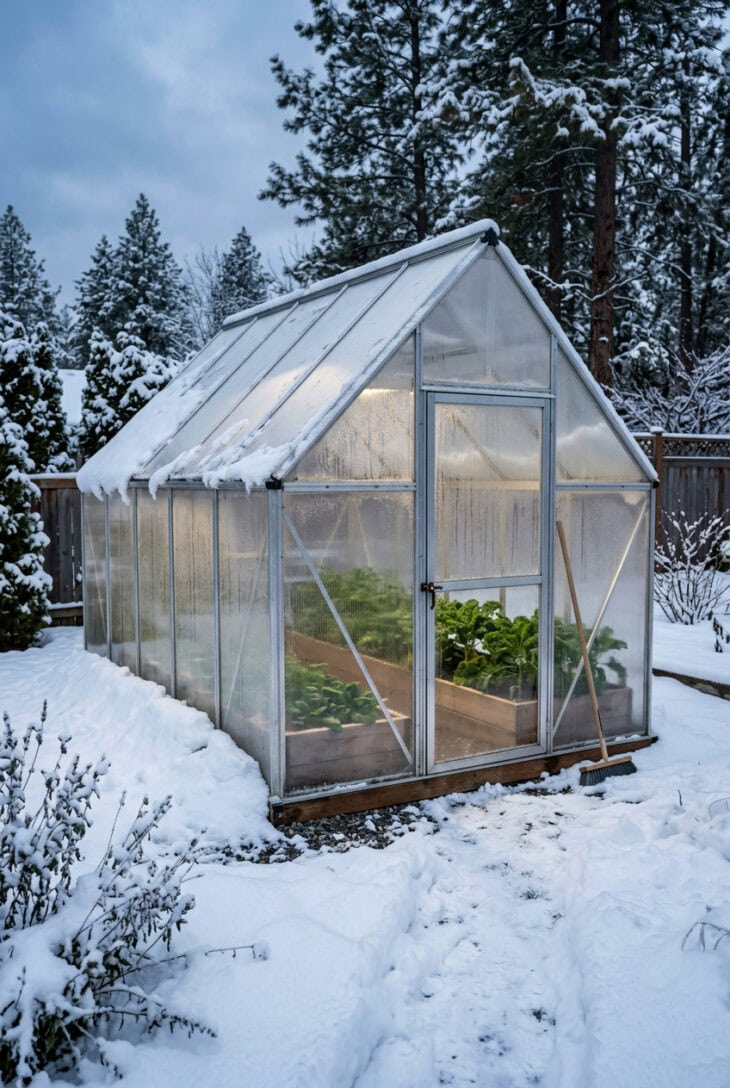
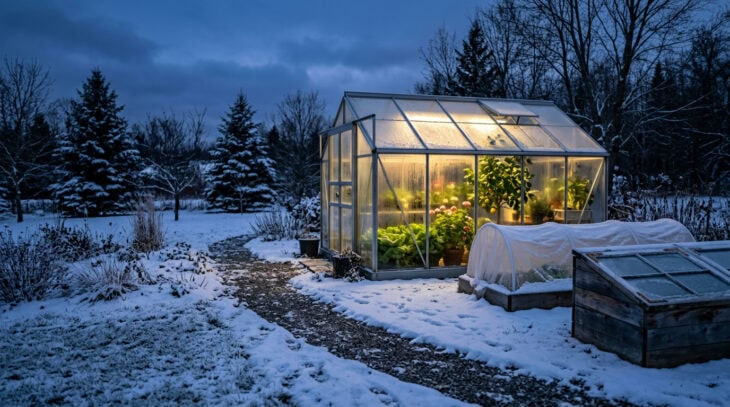
What you see Snow is banked against the base of a polycarbonate greenhouse, but its steep roof has shed most of the load. A shoveled path leads to the door, and inside the light is soft and even, falling on rows of kale and spinach. Condensation beads on the inner panels and the whole structure glows against the gray sky.
Why it works Twin-wall polycarbonate has an air gap between two skins, so it holds heat better than a single pane of glass, and it scatters light so leaves are less likely to scorch. It also shrugs off hail and falling branches. The trade-offs are honest ones: it can scratch and yellow over the years, and it lets through somewhat less light than clear glass.
How to get it In snow country the real danger is weight, not cold. Choose a model with a steep roof pitch and a snow load rating listed by the manufacturer in pounds per square foot, then compare it with your local ground snow load, which your building department can tell you. For cold winters, look for twin-wall panels about 3/8in (1cm) thick. After heavy, wet storms, push snow off from outside with a soft broom, never a shovel or hard tool that would scratch the panels, and keep the path to the door clear so you can get in.
04. Cold Frame Built from an Old Window
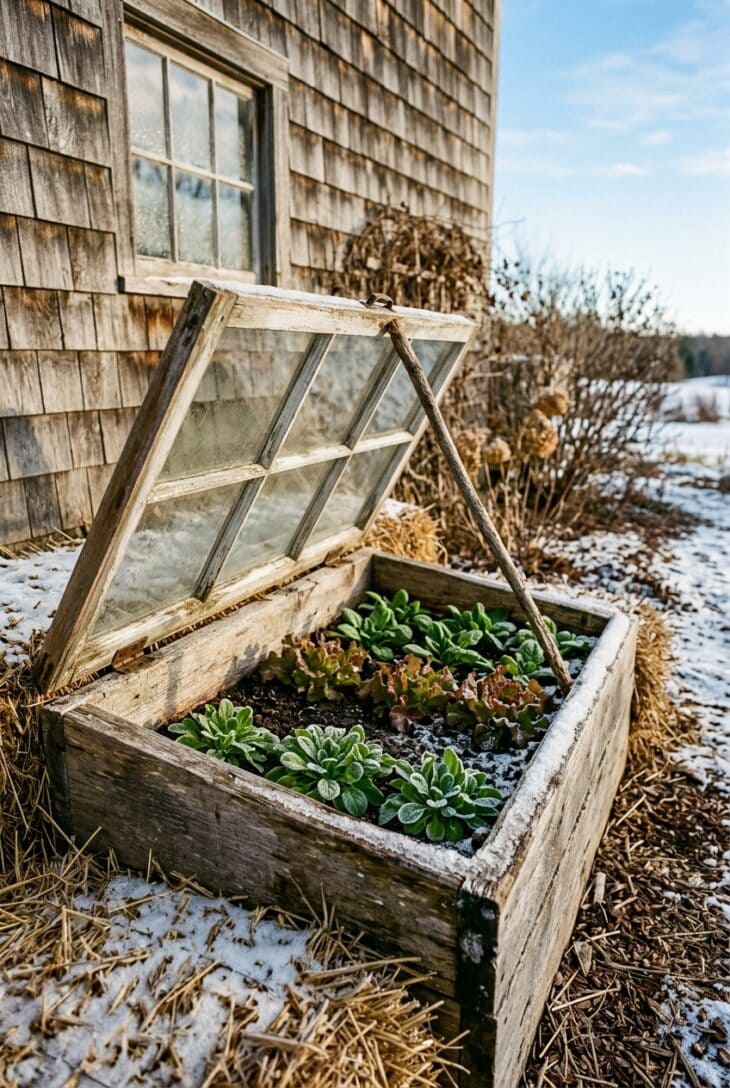
What you see A weathered wooden box wears an old six-pane window as a lid, propped open with a stick. Inside are neat rows of spinach, red lettuce and small rosettes of mâche, frost still sparkling on the outer leaves. Straw is banked around the sides, and a thin crust of snow lies along the edge.
Why it works A cold frame is a greenhouse with no walking room, and it can cost almost nothing if you scavenge the window. The sloped lid catches low winter sun and the walls block wind, which keeps the plants and soil inside several degrees warmer than the yard. Its weakness is overheating: extension guides warn that the air under a closed cover can climb past 100°F (38°C) on a sunny day, even when it is freezing outside.
How to get it Build the box about 18in (45cm) tall at the back and 12in (30cm) at the front, so the lid slopes toward the south sun. Hinge the lid or prop it open a crack on any sunny day, then close it in the afternoon to trap the warmth. Bank straw bales or bagged leaves against the outside for extra insulation. Sow hardy fall vegetable crops such as spinach, mâche (Valerianella locusta) and arugula. Old windows from before 1978 may carry lead paint, so test the paint with a lead check kit first, or use a new polycarbonate lid instead.
05. Hoop House Over a Raised Bed
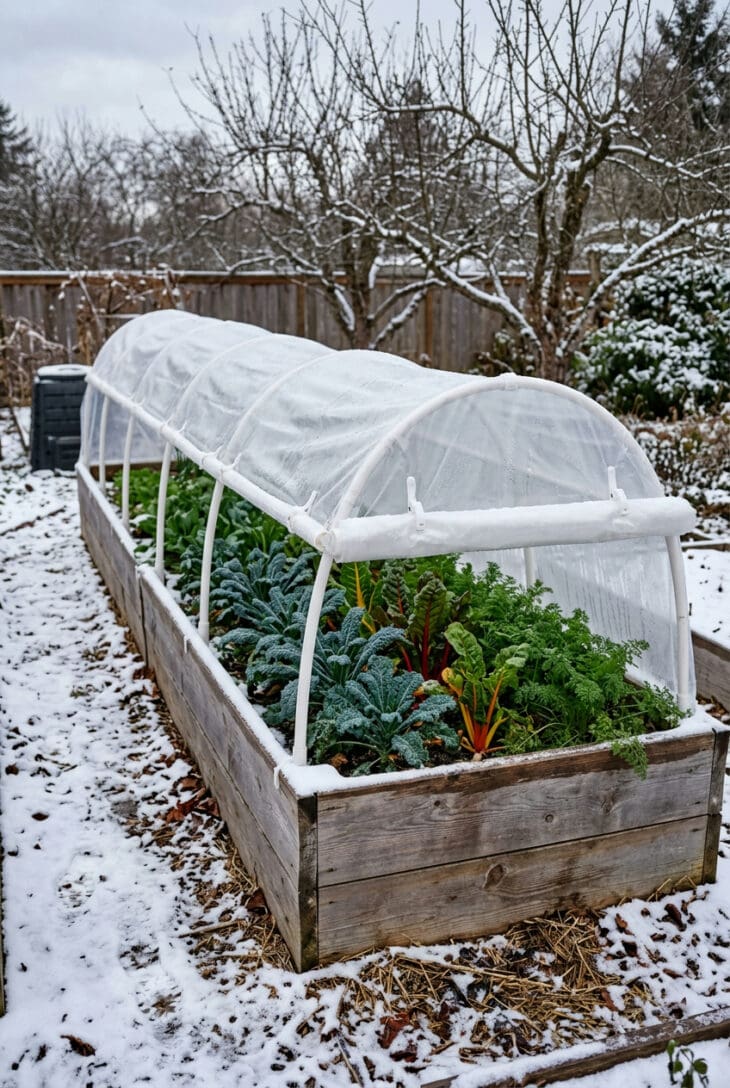
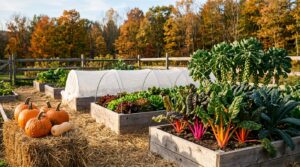
What you see A cedar raised bed wears a low tunnel of clear plastic stretched over curved white hoops. One end is rolled up, showing blue-green kale, rainbow chard and feathery carrot tops packed inside. Frost lies on the plastic and snow dusts the path, but the plants underneath are green.
Why it works A hoop house is the cheapest way to get greenhouse protection, and it turns a raised bed you already own into a mini greenhouse in an afternoon. The cover blocks wind and frost, and gardeners commonly report that a second layer of row cover inside buys a few more degrees. You can take it down in spring and store it flat, which suits a rented yard.
How to get it Bend 10ft (3m) lengths of 1/2in (1.3cm) PVC or electrical conduit into arches and set them every 3 to 4ft (90 to 120cm), pushing the ends onto rebar stakes or into brackets on the bed. Cover with 6-mil greenhouse plastic and clip it down along the sides, or choose heavy row cover for lighter protection. Open the ends on sunny days above freezing so the tunnel does not cook the plants or grow mold. Hardy crops such as kale (Brassica oleracea), chard and carrots do best, since a tunnel adds a few degrees of protection, not a heated room.
06. Balcony Mini Greenhouse
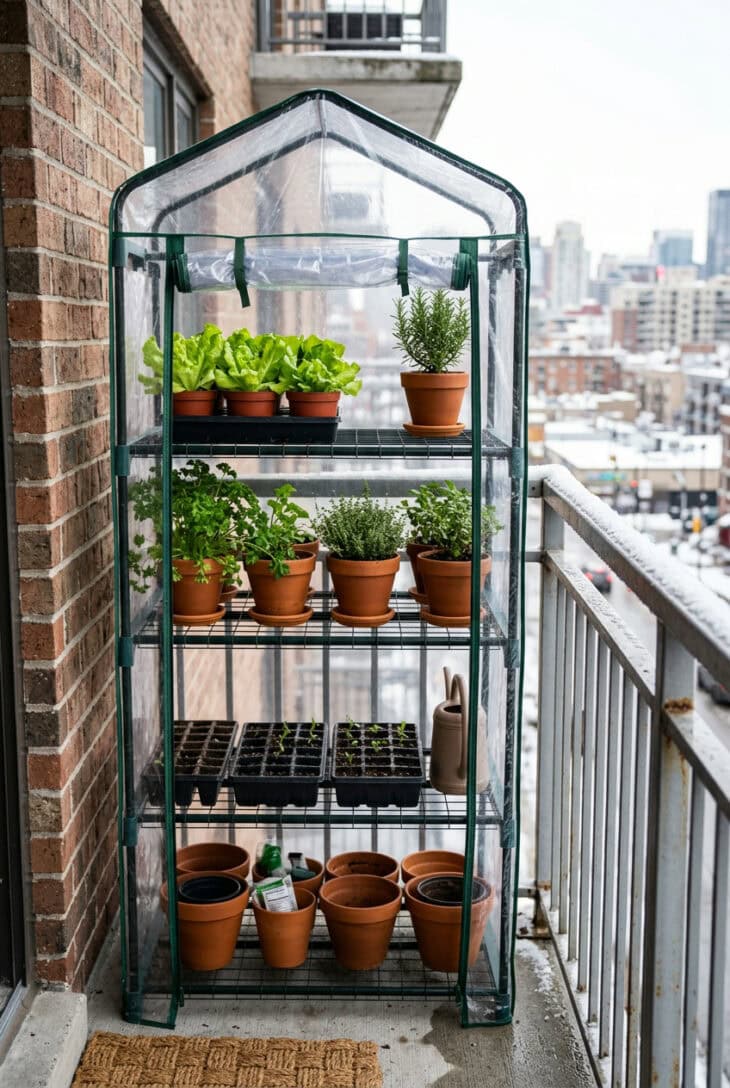
What you see A tall four-tier shelf unit stands against a balcony wall, wrapped in a clear plastic cover with the front panel rolled halfway up. Terra-cotta pots of parsley, thyme and lettuce fill the shelves, with a rosemary plant at the bottom and a tray of seedlings on top. Snowflakes cling to the metal railing, and the city is a soft blur beyond.
Why it works For renters with no yard, a shelf greenhouse is the entry-level balcony garden upgrade. It costs little, many kits fit a footprint of about 2 by 5ft (60 by 150cm), and it folds away. The cover stops wind and gives a little frost protection, but it does not make a heated room, so think of it as a buffer of a few degrees that keeps hardy herbs and greens going.
How to get it Put it on the sunniest side of the balcony, against the wall, and tie it to the railing or wall because wind will tip a tall frame. Roll the front up on any day above freezing so the inside does not overheat or turn humid. Stick to hardy plants such as parsley (Petroselinum crispum), thyme (Thymus vulgaris) and kale, and keep tender plants indoors on frosty nights. Wet pots are heavy, so check your building’s balcony load rules before you fill every shelf, and clear snow off the cover so it does not collapse the frame.
07. Unheated Winter Salad Bench
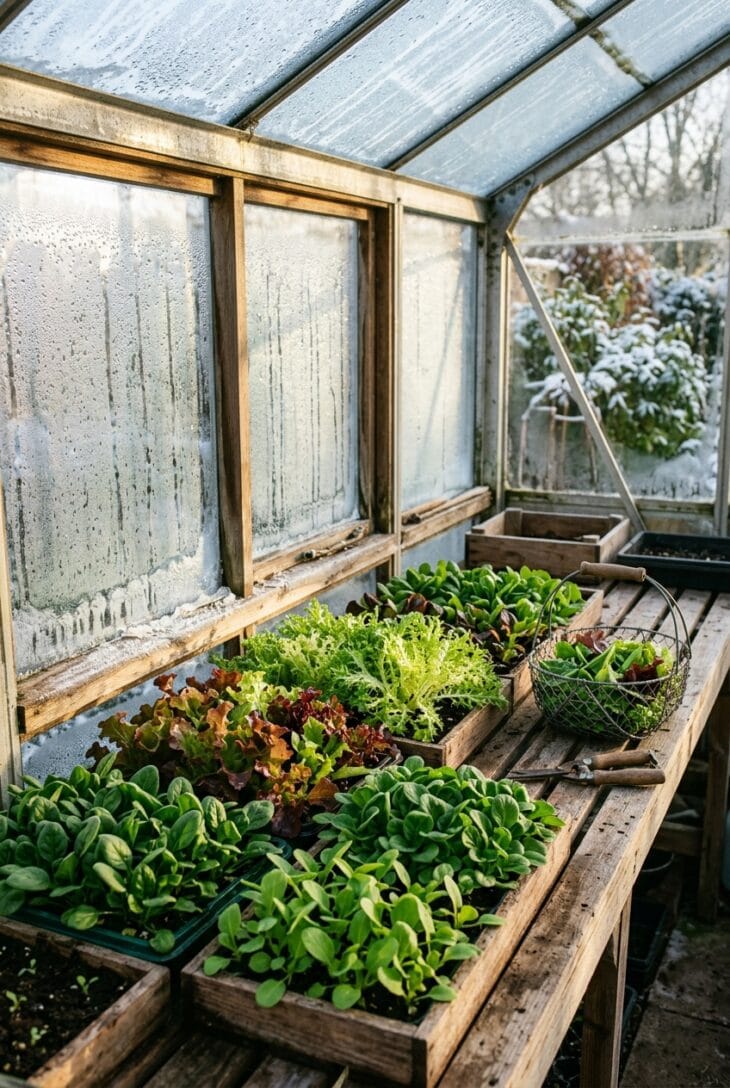
What you see A waist-high bench in a glass greenhouse holds shallow trays of salad greens in a patchwork of textures. Dark spinach sits beside red and green lettuce, frilly frisée, round mâche rosettes and flat, spoon-shaped claytonia leaves. Low sun pours in at an angle and a wire basket of freshly cut leaves sits at the end of the bench.
Why it works Cool-season greens need shelter from wind and the hardest freezes, not heat, so an unheated greenhouse suits them well. There is one hard limit: in much of the northern U.S., daylight drops to around 10 hours or less in midwinter and growth slows to a crawl. Plants sown early enough to reach near full size by then simply wait in the cold and can be picked as needed, so timing matters more than temperature.
How to get it Sow 8 to 10 weeks before your average first fall frost so plants are well established as the light fades. Good choices include spinach (Spinacia oleracea) ‘Winter Bloomsdale’, lettuce (Lactuca sativa) ‘Winter Density’ and ‘Rouge d’Hiver’, mâche ‘Vit’, claytonia (Claytonia perfoliata) and frisée (Cichorium endivia). Thin seedlings to 4 to 6in (10 to 15cm) apart and water lightly in the morning, because wet leaves overnight invite gray mold. Open a vent or the door on mild days to keep air moving, and wait until frozen leaves thaw before you pick them.
08. In-Ground Root Crops and Leeks
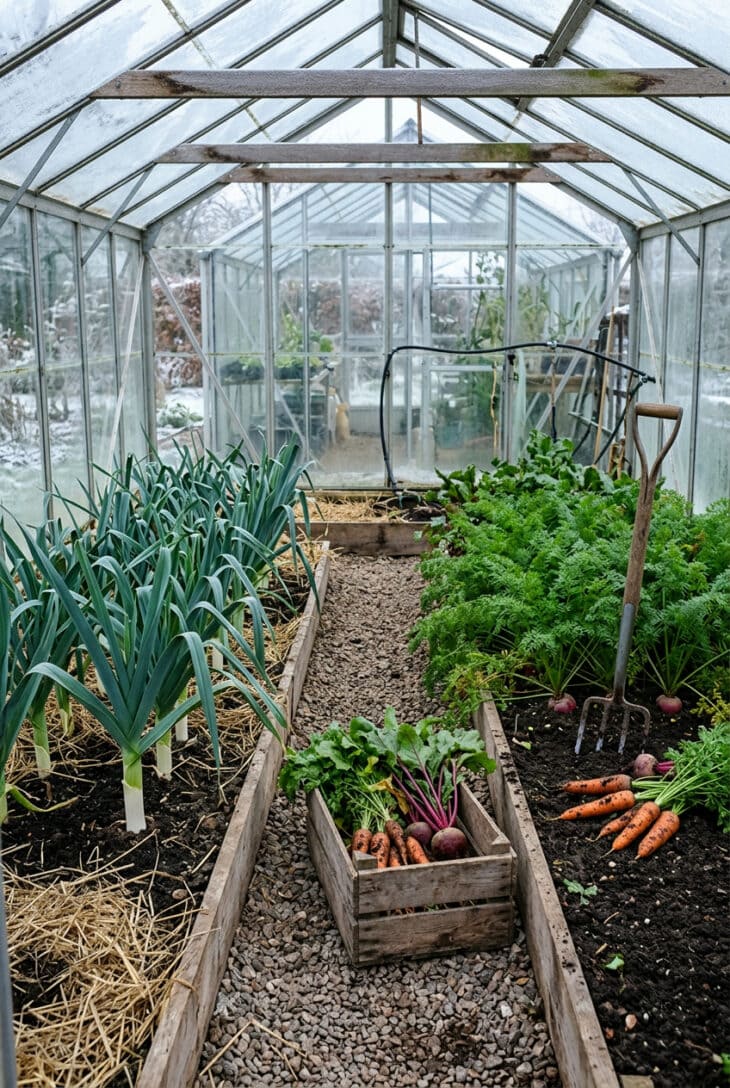
What you see Two in-ground beds run along a greenhouse path in midwinter. One is thick with feathery carrot tops and the red shoulders of beets pushing up through straw mulch, the other with tall leeks whose white shanks fade into blue-green flags. A garden fork stands in the soil, and a crate by the path holds carrots just pulled from the ground.
Why it works Roots store sugars when the weather cools, so carrots and beets taste sweeter in winter. Soil is also a slow-moving heat reservoir that cools more slowly than the air, so in all but the coldest climates the ground inside a greenhouse stays workable long after the yard freezes solid. That makes it a good place to hold root crops in the ground and dig them as needed, instead of storing them in a cellar.
How to get it Sow carrots in late summer, roughly 10 to 12 weeks before your first fall frost, and thin them to 2 to 3in (5 to 8cm). Set out leeks (Allium ampeloprasum) 6in (15cm) apart; ‘Bleu de Solaize’ is a classic cold-hardy variety. Mulch the rows with 3 to 4in (8 to 10cm) of straw to slow the soil from freezing. Treat the bed like an extension of your vegetable garden and keep the same rotation, so carrots do not follow carrots. Loosen the soil with a garden fork before pulling, so the roots do not snap.
09. Winter Herb Shelf
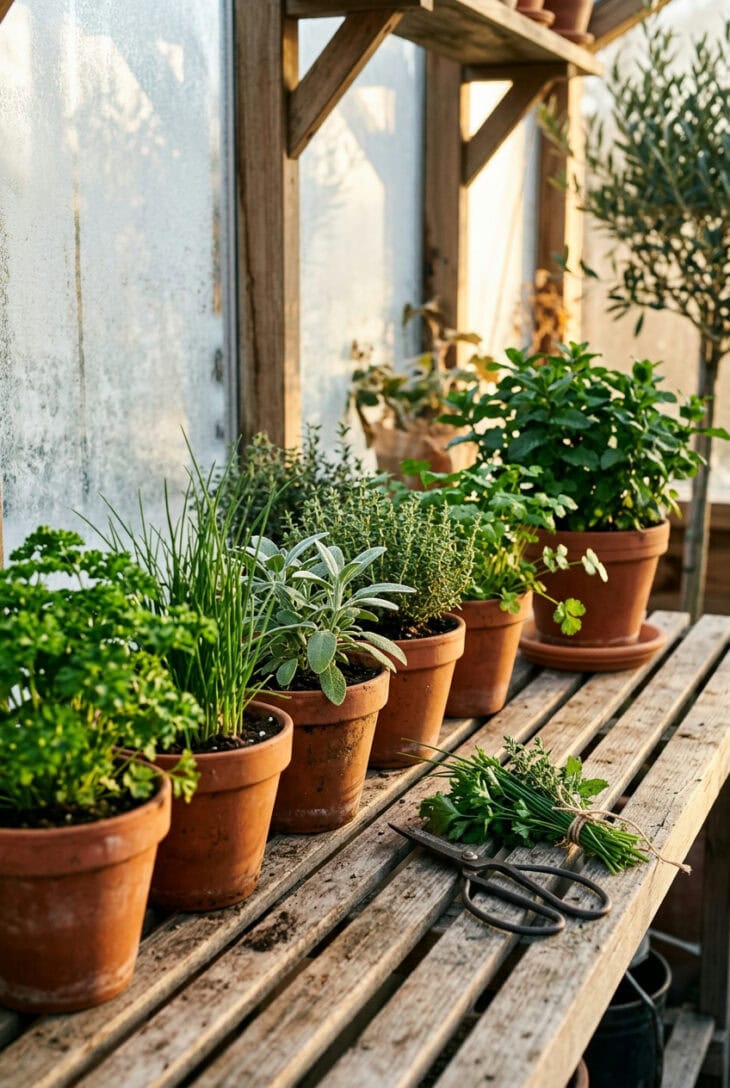
What you see A slatted shelf along a greenhouse wall is lined with terra-cotta pots of herbs. Curly parsley and chives crowd one end, silver-green sage and thyme sit in the middle, and cilantro and a pot of peppermint fill the rest. A pair of kitchen scissors rests next to a small cut bundle, and the glass behind is frosted at the edges.
Why it works Herbs are small, shallow-rooted and mostly cool-season, so they do better in a cool greenhouse than on a warm kitchen windowsill, where they tend to stretch and go leggy. Cool, bright conditions keep them sturdy. The main exception is basil, which suffers chilling injury below about 50°F (10°C) and belongs on a warm windowsill indoors.
How to get it Pot up chives, parsley and mint from your herb garden in early fall, then leave them outdoors until frost has cut the tops back before moving them in; chives in particular like a rest first. Use pots at least 8in (20cm) wide with drainage holes, and give peppermint (Mentha × piperita) a pot of its own, since it takes over any shared container. Water only when the top inch (2.5cm) of soil is dry, because overwatering in cold, low light is the usual way to lose herbs. Cut often, but never more than a third of a plant at a time.
10. Early Strawberries in Pots
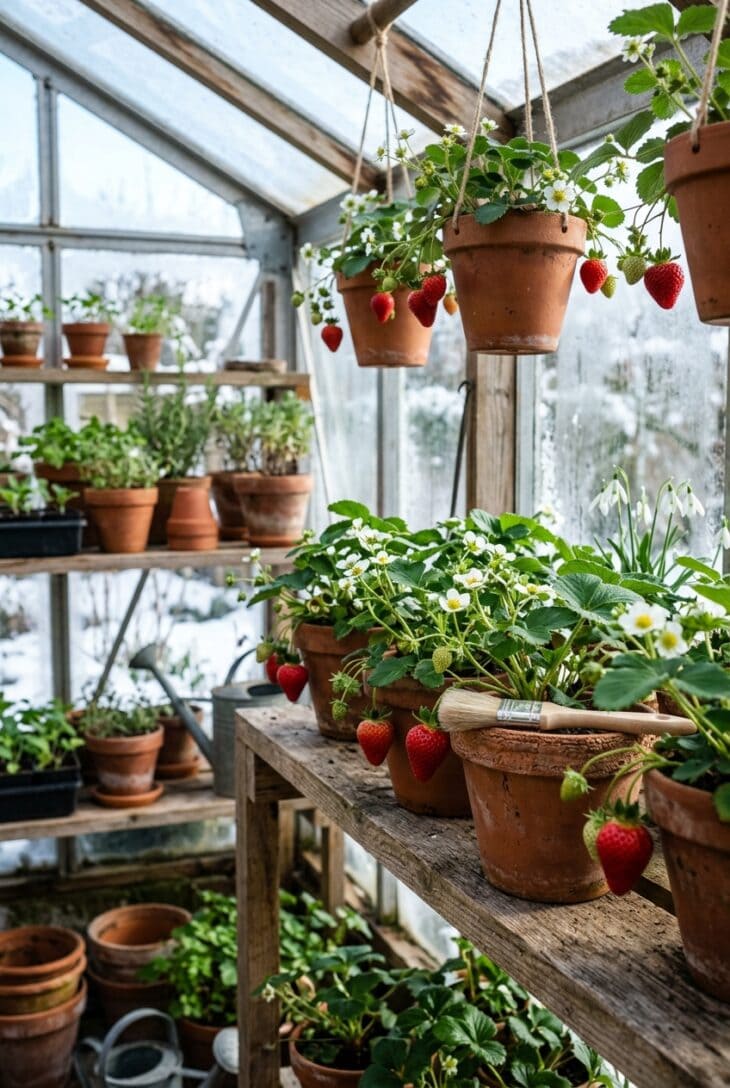
What you see Terra-cotta pots of strawberry plants sit on a greenhouse bench, white blossoms open among the leaves and the first red berries hanging over the rims. A soft paintbrush rests on one pot. Outside the glass it is still winter, with snowdrops in the bed.
Why it works A greenhouse can bring strawberries on ahead of the outdoor patch. The plants still need a cold winter rest first, so you move them under glass after that dormancy, and the warmth then wakes them early. The catch is pollination: with few insects around in late winter, you have to help the flowers along or you get small, misshapen berries.
How to get it Plant strawberries (Fragaria × ananassa, Zones 5–9) in pots at least 10in (25cm) wide in fall, and leave them outside through the coldest weeks, grouped together and mulched, since roots in pots are more exposed than roots in the ground. Move them into the greenhouse in late winter and keep them cool, then watch for flowers. Dab each open flower with a soft brush every day or two, moving pollen from flower to flower. Day-neutral varieties such as ‘Albion’ and ‘Seascape’ suit this best.
11. Potted Citrus Winter Shelter
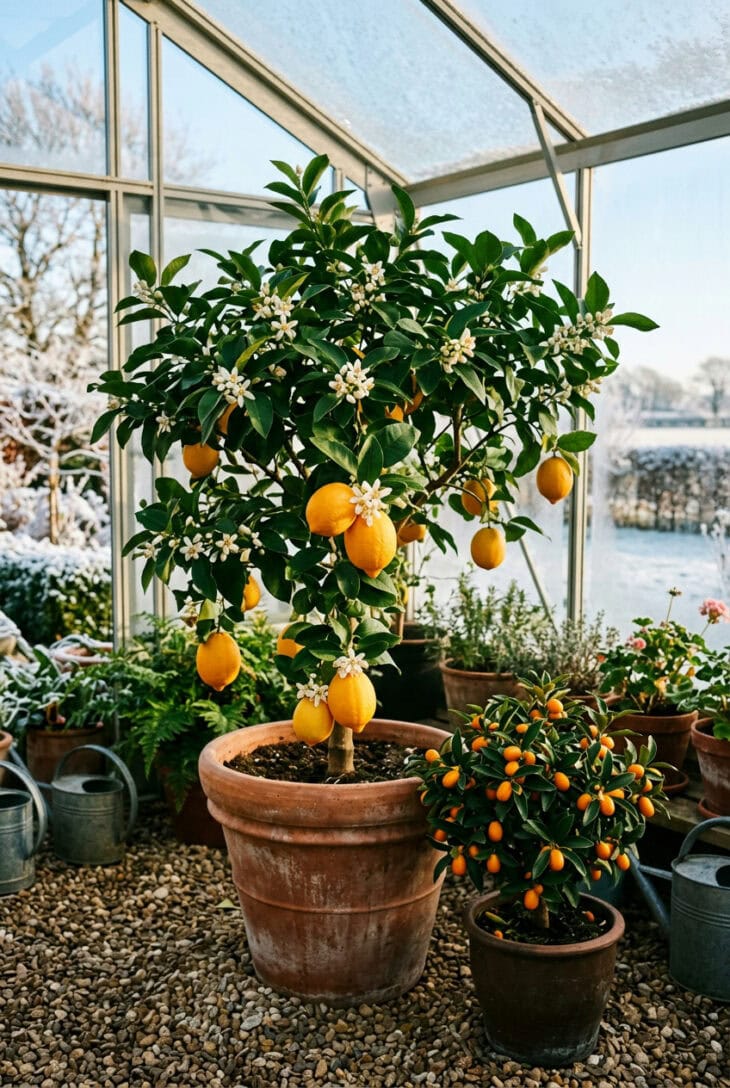
What you see A Meyer lemon in a big terra-cotta pot fills one corner, its glossy leaves dark green and ripe fruit hanging among a few white blossoms. Beside it a smaller kumquat is loaded with little orange fruits. The garden beyond the glass is frosted and bare.
Why it works Lemon (Citrus limon) is rated for Zones 9–11, so most of the country can grow it only in a pot. That is not a bad deal: the tree spends summer on the patio and winter in a protected greenhouse, which suits it better than a cold windowsill. The fruit ripens in winter, so like a Mediterranean garden, it is at its best exactly when the rest of the yard is not.
How to get it Bring the pot in before the first frost, since citrus cannot take a hard freeze. Growth slows to a halt in the cool months, so aim to keep the greenhouse above freezing and ideally at 45°F (7°C) or warmer. Water when the top 2in (5cm) of mix is dry, which is less often than in summer, and hold off on fertilizer until spring. Choose a pot at least 16in (40cm) wide with drainage holes. Check leaf undersides for scale and spider mites, which build up under glass, and move the tree outside only after your last frost, in stages, so the leaves do not sunburn.
12. Cut Flowers for Winter Bouquets
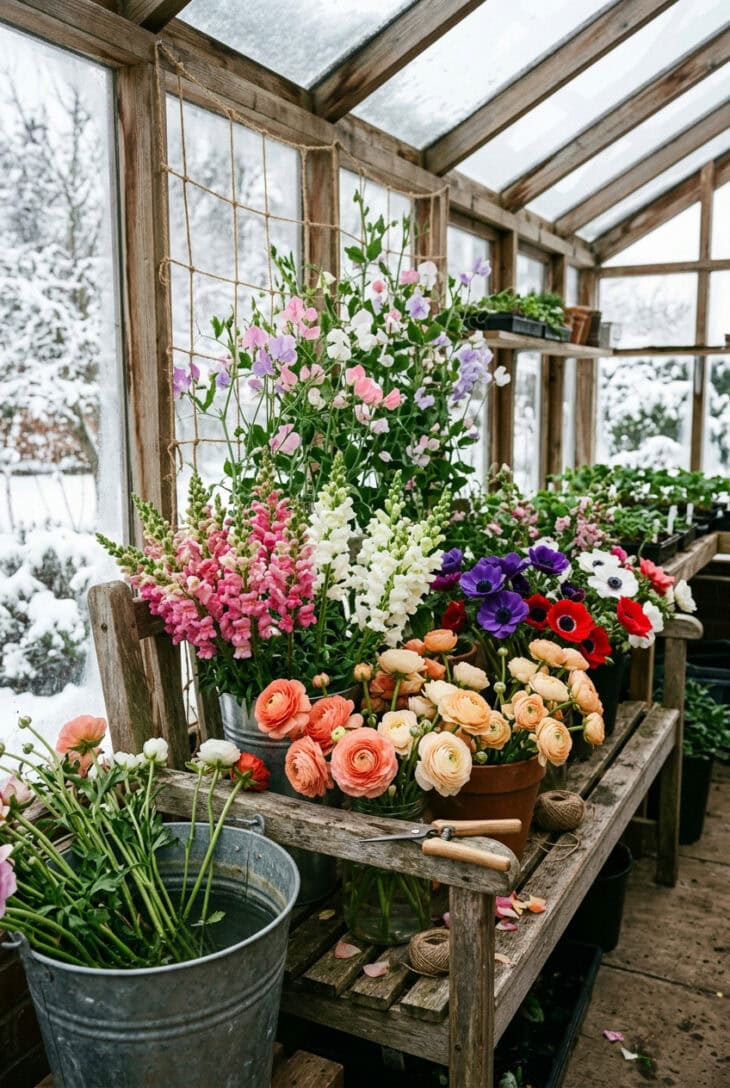
What you see A greenhouse bench in February is crowded with flowers. Spikes of pink and white snapdragons rise behind ruffled ranunculus in coral and cream and dark-eyed anemones in purple and red, while sweet peas climb a string trellis at the back. A galvanized bucket of fresh-cut stems and a pair of snips sit in front, with snow beyond the glass.
Why it works Winter flowers are the most expensive thing at the florist, and nothing else in the garden is blooming to cut. Cool-season flowers like snapdragons, ranunculus, anemones and sweet peas are happy in cool air and, in mild winters, need little more than shelter from frost. A greenhouse turns a few feet of bench into a cut flower garden at the one time of year you cannot have one outdoors.
How to get it Plant ranunculus and anemone corms in fall, and set out snapdragon (Antirrhinum majus) and sweet pea (Lathyrus odoratus) seedlings at about the same time. Cut snapdragons when the lower third of the flowers on the spike are open, and keep cutting to encourage more stems. For long vase life, add carnation (Dianthus caryophyllus, Zones 6–9) or lisianthus (Eustoma grandiflorum, Zones 8–10); lisianthus is slow, so buy plugs instead of starting seed. Sweet pea seeds and pods are toxic if eaten, so keep them away from children and pets.
13. Bulb Forcing Bench
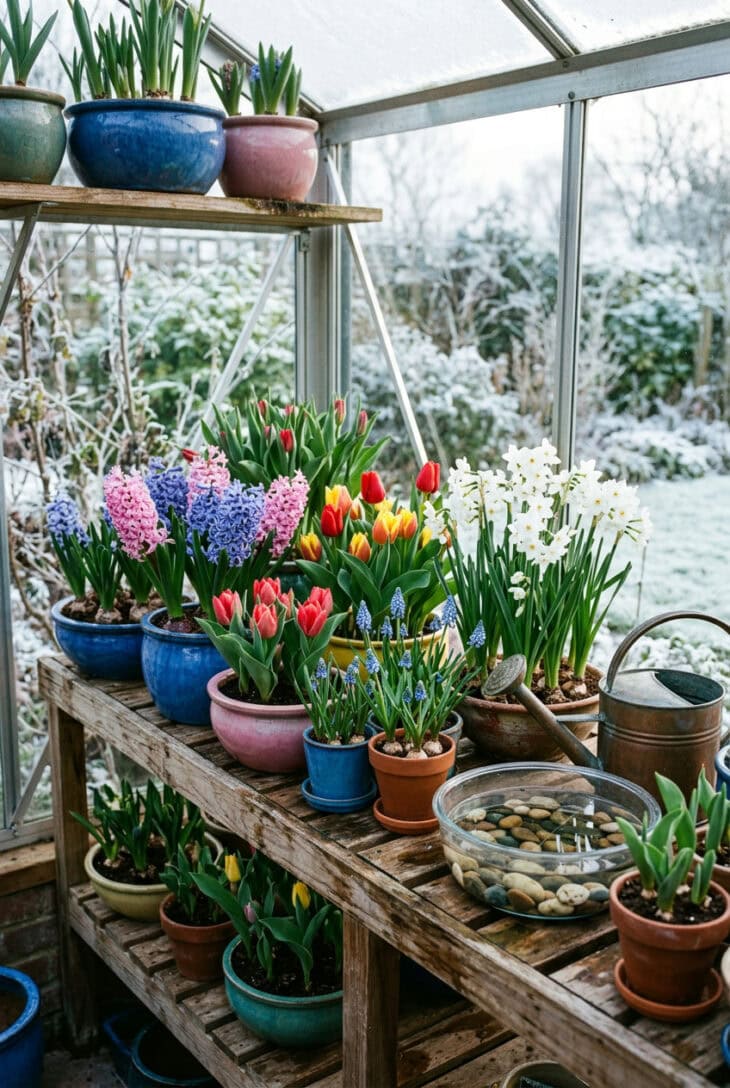
What you see Greenhouse shelves hold a crowd of forced spring bulbs weeks ahead of schedule. Pink and blue hyacinths stand beside red and yellow tulips, with blue grape hyacinths in front and white paperwhites in a shallow bowl of stones. A few pots at the back still show only green shoots, and the garden outside is frosted over.
Why it works Spring bulb forcing is really two jobs: chilling, then warming. Most hardy bulbs need roughly 12 to 16 weeks at 35 to 48°F (2 to 9°C), then bloom within a few weeks of moving into a cool, bright spot at 50 to 60°F (10 to 16°C). A greenhouse is excellent at the second stage and weak at the first, because it can swing warm on sunny days.
How to get it Pot bulbs in early fall, then chill them in an unheated garage, a spare refrigerator or a shaded cold frame, checking the package for the chill time. When the shoots are 2 to 3in (5 to 8cm) tall, move the pots into the greenhouse and keep them cool for the longest-lasting flowers. Grape hyacinth (Muscari armeniacum) is among the easiest to force, and paperwhite narcissus needs no chilling at all. If hyacinth flowers stay low in the bulb, cover the pot with a paper cone for a few days to draw the stem up. All of these bulbs are toxic if eaten, so keep them away from pets and children.
14. Succulent and Cactus House
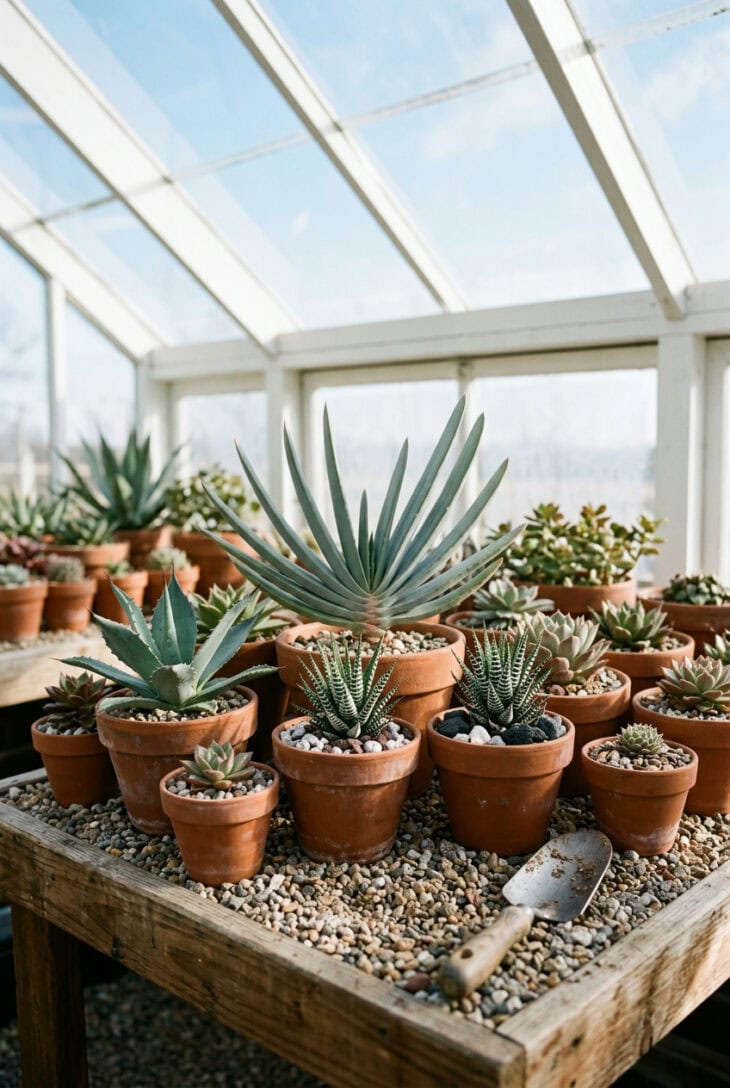
What you see A greenhouse bench is topped with pale gravel and lined with terra-cotta pots of succulents. Striped zebra haworthia sits beside a fan aloe with flat, blue-gray leaves and a young blue agave, with rosettes of smaller succulents in between. Winter sun slants across the leaves and a tiny hand trowel rests at the end of the bench.
Why it works Succulents hate cold, wet roots far more than cold air. A dry, cool, bright greenhouse is a better winter home than a dim heated living room, where they stretch and sulk. Dormant plants kept dry tolerate cooler nights than the same plants kept watered, though none of these will take a hard freeze.
How to get it Use a gritty mix of at least half pumice, coarse sand or fine gravel, and pots with drainage holes. Water sparingly in winter, as little as once a month, and not at all if the greenhouse stays near freezing. Zebra haworthia (Haworthiopsis attenuata, Zones 9–11) wants bright light but some shade from hot midday sun. Century plant (Agave americana, Zones 8–11) reaches 6 to 10ft (180 to 300cm) across at maturity, so start with a young plant and plan to move it outside for the summer. Agave leaf tips are sharp, so keep the pot away from the walkway.
15. Frost-Free Shelter for Tender Perennials
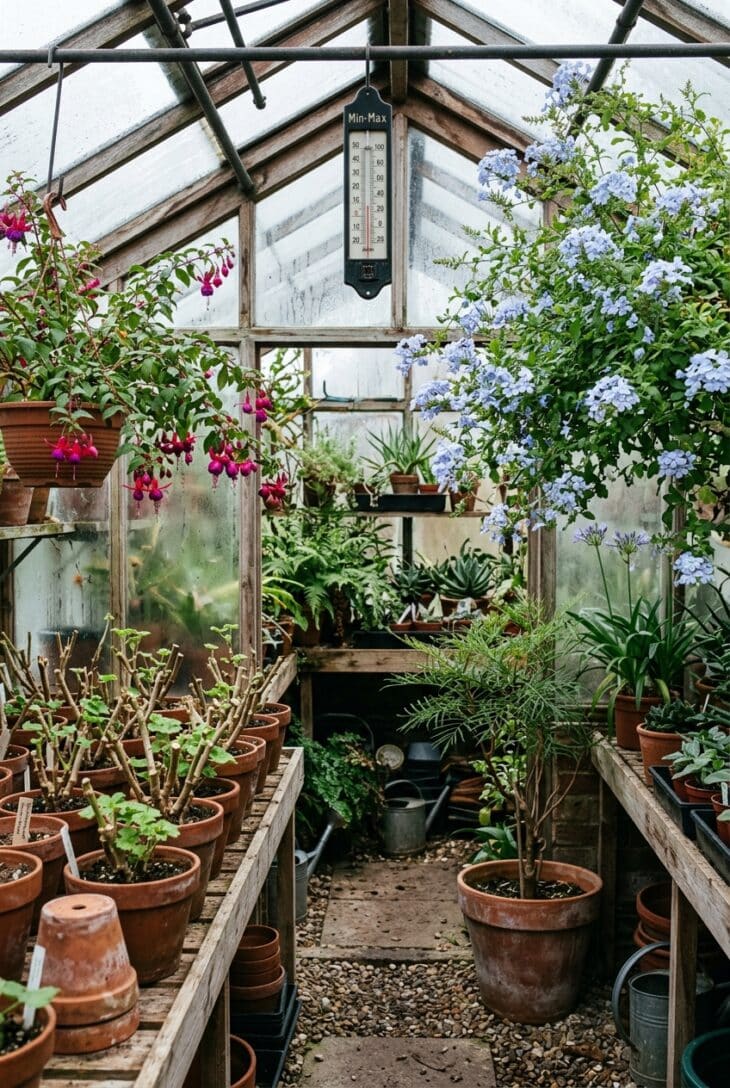
What you see A cool greenhouse is packed with pots that spent the summer on the patio. Red and pink geraniums have been cut back to stumpy stems with fresh leaves, a tall plumbago carries pale blue flower clusters, a fuchsia hangs with magenta blooms, and a young Mexican bird of paradise stands in a big pot. A thermometer hangs from a roof bar.
Why it works Many of the plants that give a tropical garden its summer color are perennials in warm climates and annuals everywhere else. A frost-free greenhouse lets you keep them for years. You do not need warmth, only protection from freezing, because the plants are resting and a cool, bright, dry winter is enough. That means a far lower heating bill than a growing house, and no buying large plants again in spring.
How to get it Bring pots in before the first frost, trim the tallest stems back by a third to a half, and check for aphids and whiteflies before they join the greenhouse. Water sparingly, just enough to keep the roots from drying out completely, and ventilate on mild days to prevent gray mold. Cape leadwort (Plumbago auriculata) and Mexican bird of paradise (Caesalpinia pulcherrima) are rated for Zones 9–11, while tender hybrid fuchsias and zonal geraniums (Pelargonium × hortorum) are treated as annuals in most of the country. Hold off on fertilizer until growth restarts in spring.
16. Seed-Starting Bench with Grow Lights
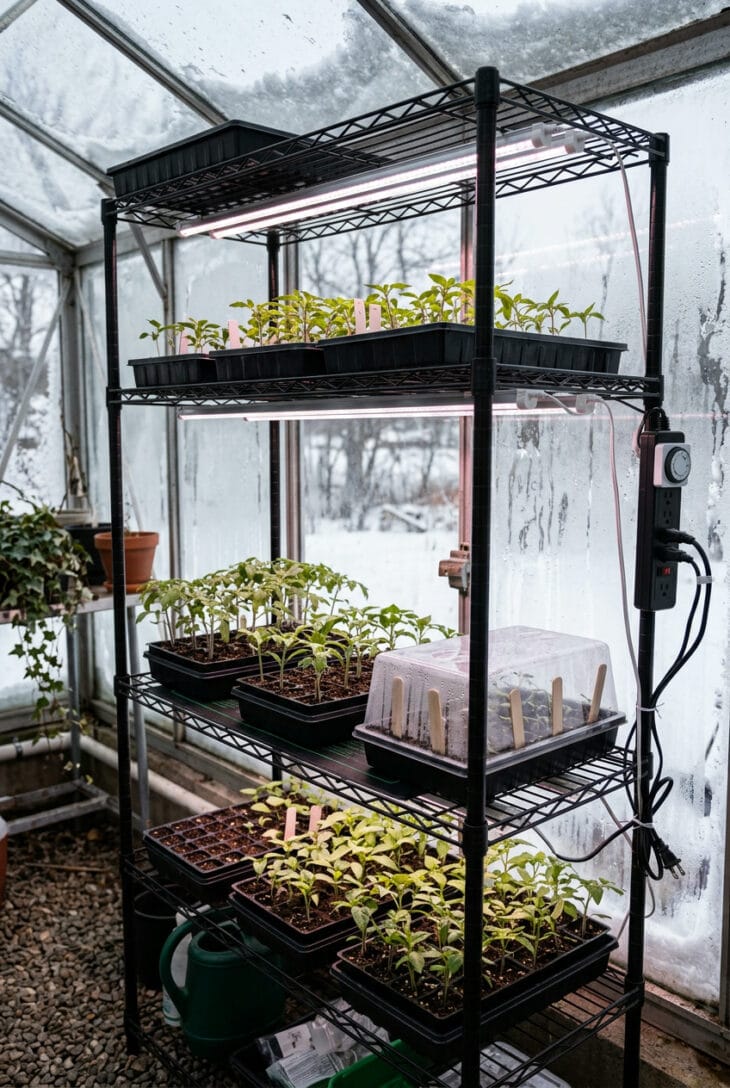
What you see Late winter, and a wire shelf unit in the greenhouse is glowing. White LED strips shine on trays of tomato and pepper seedlings in cell packs, a heat mat warms one tray, and a clear dome covers another where seeds are still germinating. Frost is on the glass behind, but the shelves are green.
Why it works February light is weak and short, even in a greenhouse, which makes seedlings pale and leggy. Lights under each shelf supply the strong, steady light they need, while the cool air of the greenhouse keeps growth sturdy and stocky instead of soft. A heat mat covers the other half of the problem, since most seeds germinate best when the mix is warm.
How to get it Keep LED or fluorescent fixtures 2 to 4in (5 to 10cm) above the seedlings, raising them as the plants grow, and run them 14 to 16 hours a day on a timer. Most seeds germinate best with the mix at 65 to 75°F (18 to 24°C); after they sprout, 65 to 70°F (18 to 21°C) by day and 55 to 60°F (13 to 16°C) at night is fine. Start tomatoes about 6 to 8 weeks before your last frost and peppers 8 to 10 weeks before. Greenhouse nights can drop below freezing, so move trays indoors on cold nights, or heat the space. Plug everything into a GFCI-protected outlet, since water and electricity share the same bench.
17. Propagation Bench with Heat Mat
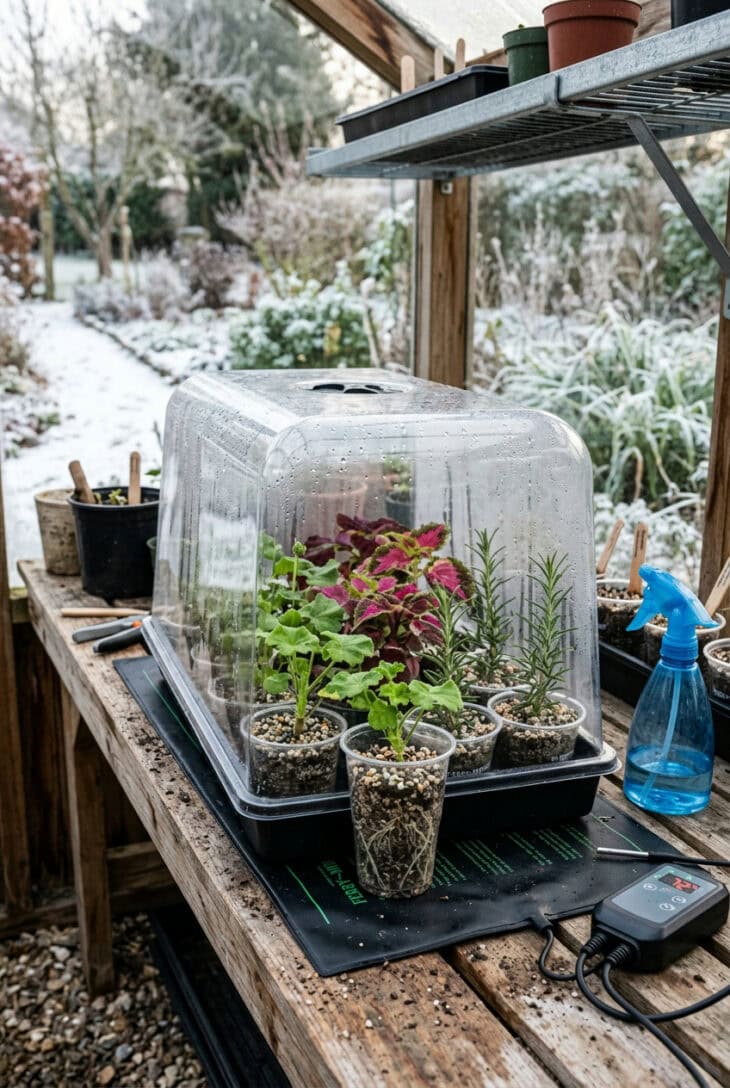
What you see A heat mat warms a tray under a clear dome, and inside it are rows of cuttings in small pots: geranium, coleus with pink and burgundy leaves, and rosemary. A clear plastic cup beside it shows white roots threading down the side. A spray bottle sits at the edge, and soft light filters through the glass.
Why it works Winter is a good time to multiply plants you already own, and a greenhouse is the right place to do it. A little bottom warmth and humid air wake stem tissue so cuttings root in weeks instead of sulking. It is also free: one geranium, coleus or rosemary can become a dozen plants for the next growing season.
How to get it Take cuttings 4 to 6in (10 to 15cm) long from healthy, non-flowering shoots, strip the lower leaves and push them into damp, perlite-rich mix. Hold the bottom heat around 70°F (21°C) with a thermostat on the mat, because an unregulated mat can cook cuttings. A clear dome keeps humidity high, but lift it for a minute every day to let fresh air in and prevent mold. Keep the tray out of direct sun, and pot the cuttings up once the roots are about 1in (2.5cm) long. Rosemary (Salvia rosmarinus) and zonal geranium (Pelargonium × hortorum) both root readily this way.
18. Vertical Shelving and Hanging Baskets
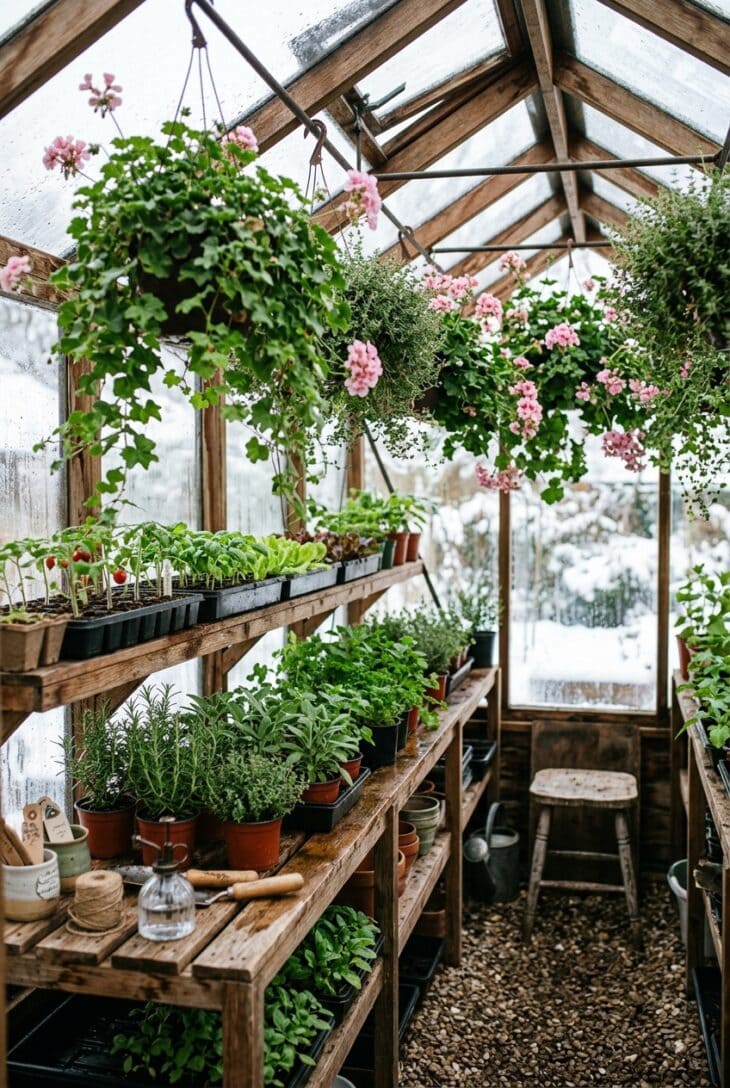
What you see Three tiers of slatted shelves climb a small greenhouse wall, holding seed trays and pots of herbs, while baskets of trailing ivy geranium with pink blooms and thyme hang from the roof bars. A narrow aisle runs down the middle with a stool at the end. Every surface is in use, and it still looks tidy.
Why it works Floor space is the scarcest thing in a greenhouse, and the same space-saving logic as a small garden applies: grow up. Shelves can triple the growing area. Air also stratifies, so the top shelves are warmest and brightest and the floor is coldest, where frost arrives first.
How to get it Borrow from vertical garden designs, using slatted or wire shelves about 12in (30cm) deep so water and air pass through, and stagger them so lower plants still get light. Put seedlings and tender herbs on the top shelf, and hardy greens and bulbs below, where it is cooler. Most greenhouse roof bars are not designed to carry weight, so check the manufacturer’s limit before hanging baskets, and keep them small. Rotate trays between shelves every week or two so growth stays even.
19. Brick Floor and Gravel Path
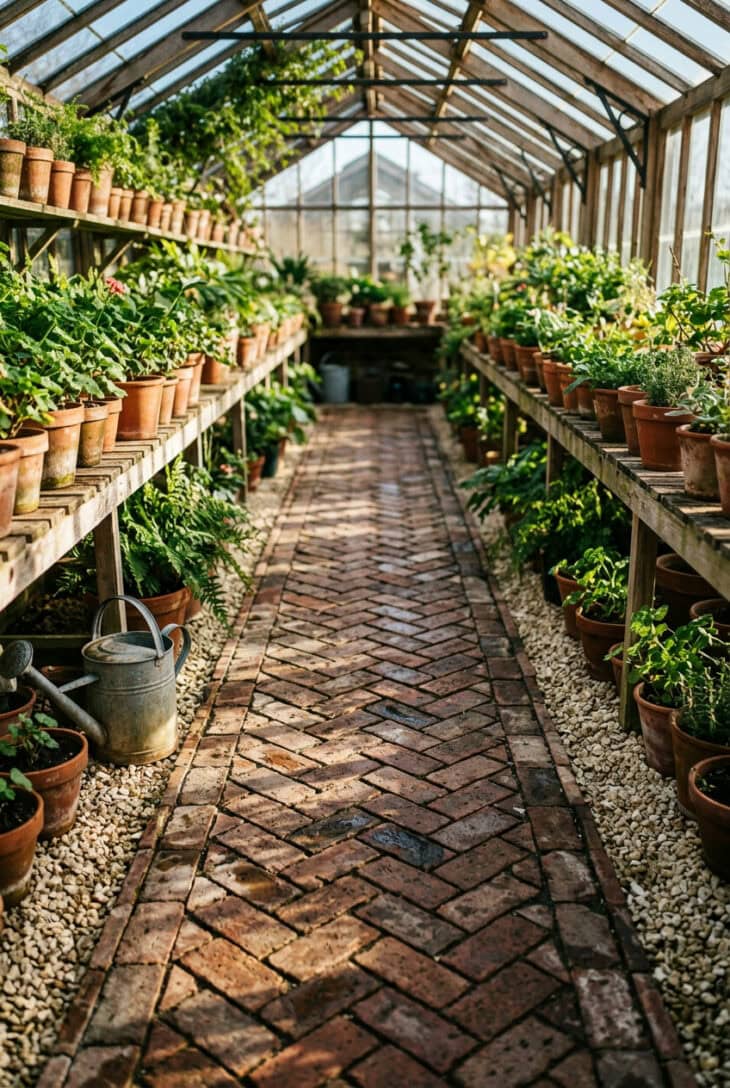
What you see A path of reclaimed bricks laid in a herringbone pattern runs down the middle of a greenhouse, edged in pale gravel. Benches of pots line both sides, and the low winter sun throws long shadows from the window frames across the floor. A few bricks are dark where a watering can has dripped.
Why it works A bare soil floor turns to mud in winter and breeds slugs and mold. Brick, pavers or gravel drain well, give you a firm place to stand while you water, and hold a little daytime warmth. They do not heat the house, but they smooth the swings, and a gravel floor is the cheapest option of the lot.
How to get it Dig out 4in (10cm) of soil, lay a weed barrier and fill with 4in (10cm) of compacted gravel, then add 1in (2.5cm) of sand under the bricks or pavers. Leave soil beds along the sides if you plan to grow in the ground. Slope the path slightly toward the door so water does not pool. Wet brick and moss are slippery, so choose a textured paver or leave gaps for gravel. If you like the look, the same materials work outside in a gravel garden or along a garden path.
20. Water Barrel Heat Sink
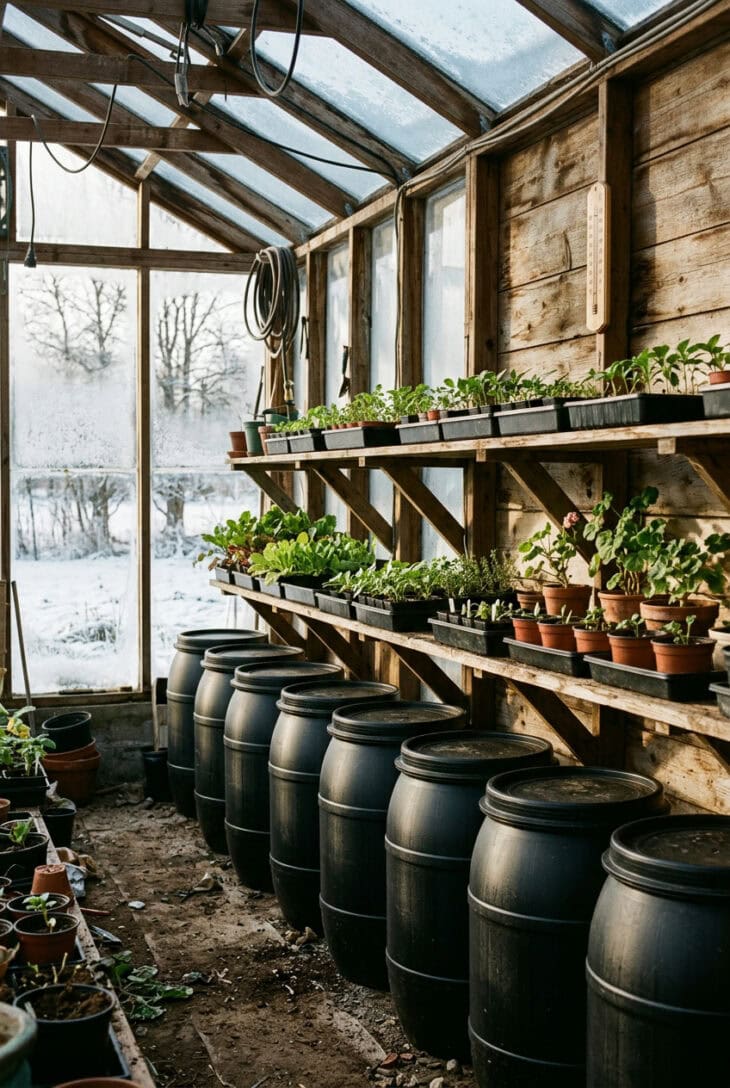
What you see A row of matte black barrels stands along the back wall of a greenhouse with the winter sun slanting across them. Wooden shelves above them hold trays of seedlings and potted plants, and a thermometer hangs on the wall. Frost covers the ground outside.
Why it works Water holds a lot of heat for its volume, so barrels filled with it soak up warmth on sunny days and release it slowly after dark. The effect is real but modest: expect it to even out temperature swings and buy a few degrees on a marginal night, not to keep a greenhouse above freezing through a hard cold snap. It costs only barrels and paint, and has no running cost.
How to get it Use food-grade or well-rinsed 55-gallon (208L) barrels with tight lids, painted matte black or dark blue so they absorb sunlight. Place them along the north wall, where they will not shade plants, on a firm, level base, because a full barrel weighs about 460 pounds (210kg). Keep the lids on to limit humidity and keep mosquitoes out. The more barrels you add, the bigger the effect, and a sturdy shelf on top turns them into usable growing space.
21. Automatic Vent Openers
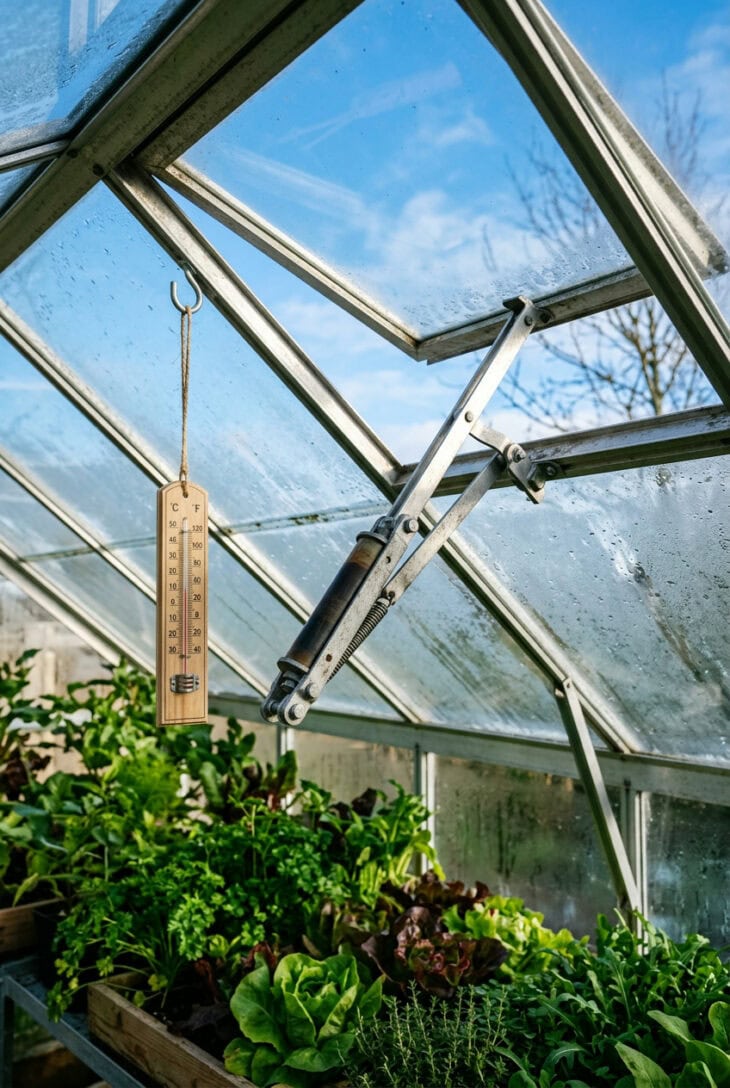
What you see A roof vent in a greenhouse is propped open on a bright, cold day by a small metal arm attached to its frame. The sky beyond the glass is blue, a thermometer hangs nearby, and the lettuce and herbs below are crisp and unwilted. A trace of fog clings to one pane.
Why it works A greenhouse in winter sun is a heat trap. On a clear day it can overheat while the air outside is still freezing, and one missed afternoon can cook seedlings. Venting also drops humidity, which is the main defense against gray mold (Botrytis). An automatic opener solves both, because the wax-filled cylinder expands with heat and pushes the vent open, with no electricity and no one at home.
How to get it Fit an opener on the highest vent, choosing a model rated for the weight of the vent, and set it to open at the temperature your plants like. Add a low vent or a louvered door so cool air comes in low and warm air leaves at the top. Hang a min-max thermometer at plant height, since it shows both the overnight low and the afternoon high, and adjust the opener based on what it reads. In spring, add shade cloth over the glass to stop heat build-up.
22. Safe Electric Heater Setup
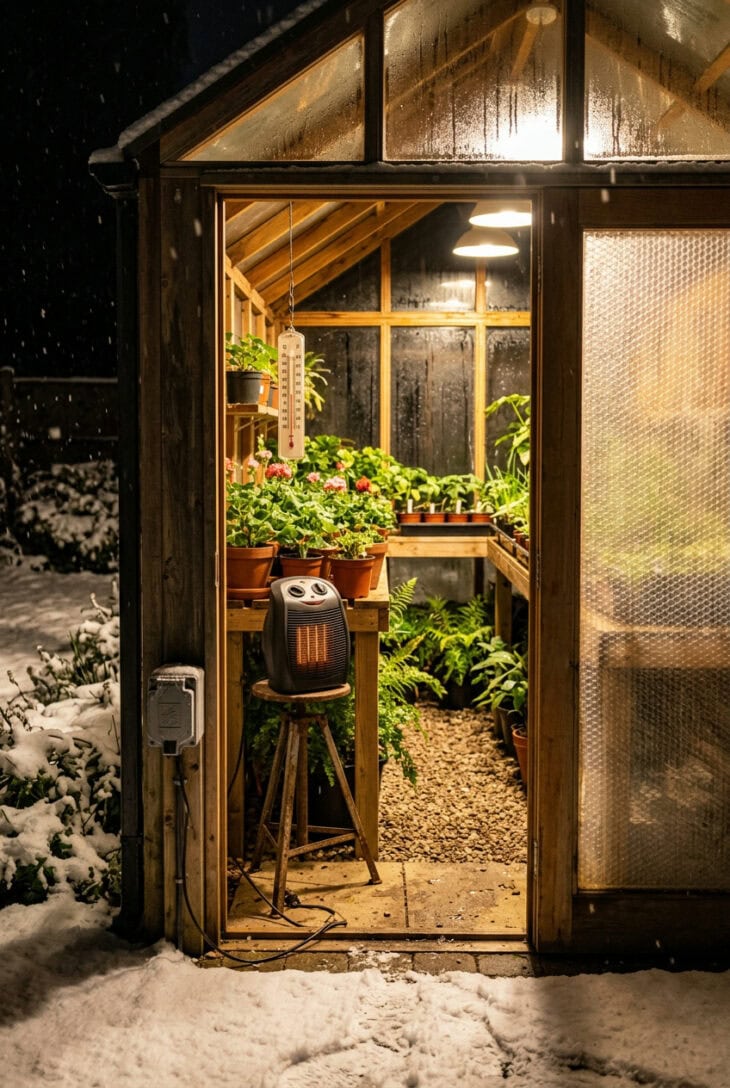
What you see A small fan heater on a metal stand sits near the door of a greenhouse on a snowy night. Plants are arranged well back from it, a thermometer hangs at plant height, and a weatherproof outlet box is mounted on a post. One wall is lined with clear bubble wrap, and the glow from inside colors the snow outside.
Why it works A little heat turns a greenhouse from a season extender into a true winter house, and the key word is little. Set the thermostat just above freezing, around 35 to 40°F (2 to 4°C), and the heater runs only on the coldest nights. Lining the glazing with horticultural bubble wrap cuts heat loss, so it runs even less.
How to get it Choose an electric heater with a built-in thermostat, rated for damp conditions, and run power to the greenhouse on a GFCI-protected circuit. Have an electrician install it, because a household extension cord is not a safe way to feed a heater drawing steady current. Never use unvented kerosene or propane heaters: they release carbon monoxide and other combustion gases, and sulfur dioxide can injure plant leaves. Keep plastic, bubble wrap and plants clear of the heater by the distance the manufacturer states.
23. Gutter and Rain Tank by the Door
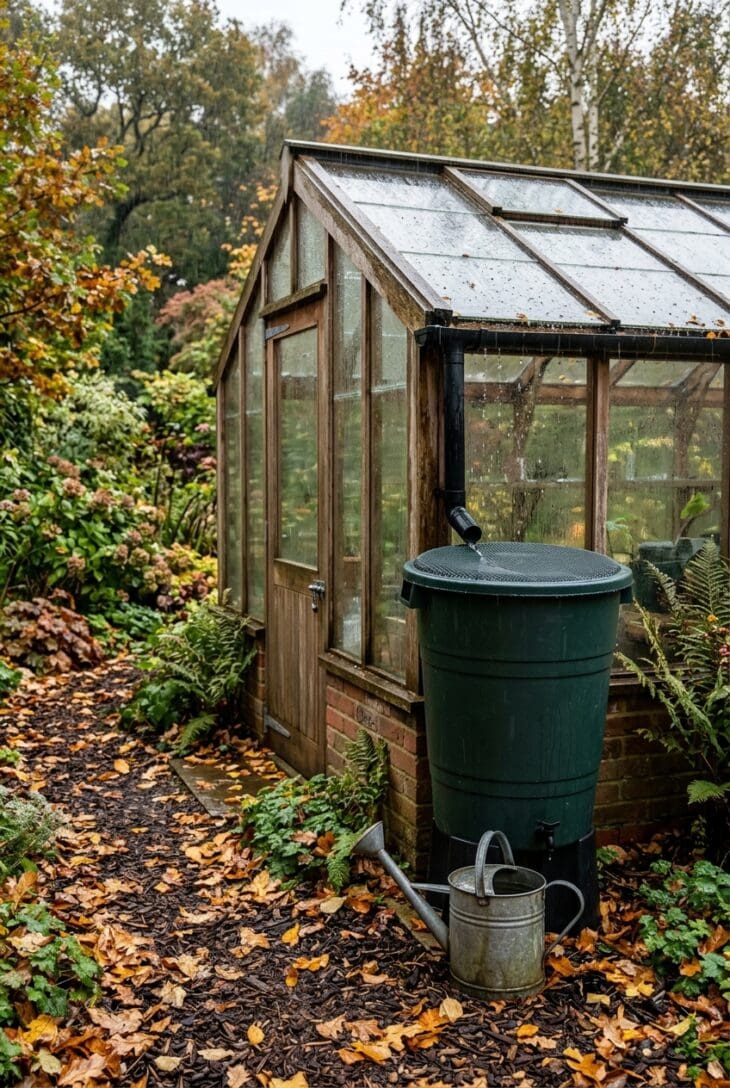
What you see A rain gutter runs along the eave of a glass greenhouse and drops into a green barrel beside the door. A mesh screen covers the top, a spigot sits near the base, and a metal watering can waits under it. A fine rain is falling and the mulched path is dotted with wet golden leaves.
Why it works A greenhouse roof is a ready-made rainwater catchment, and many gardeners prefer rainwater to hard tap water for pots and seedlings. Water kept inside the greenhouse sits at air temperature, which is gentler on roots than ice-cold water straight from a hose. It also saves on the water bill.
How to get it Fit a gutter and downspout to the roof edge, with a mesh screen over the barrel’s inlet to keep out debris and mosquitoes. Outdoor barrels that freeze solid can crack, so drain them before hard freezes, or keep a tank inside the greenhouse. Send the overflow to a rain garden or a downhill bed. Some states, mostly in the West, regulate rainwater collection, so check local rules before you install a system.
24. String Light Evening Glow
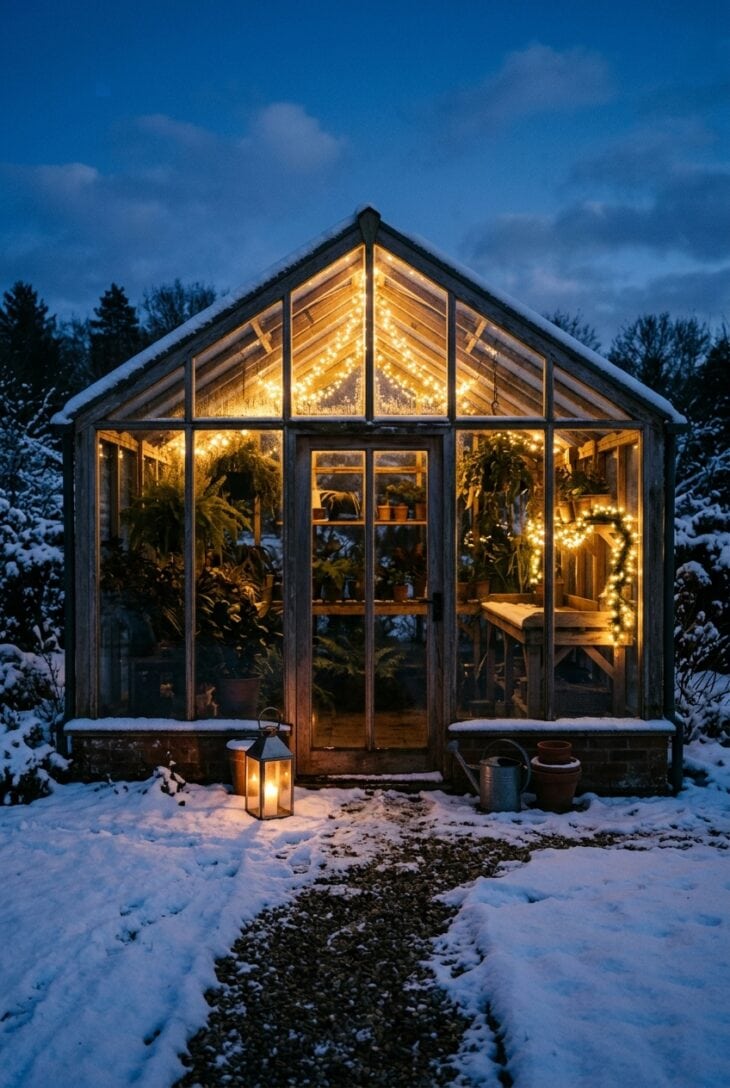
What you see At dusk, a glass greenhouse glows like a lantern. Warm-white lights run along the ridge and drape across a bench, picking out the shapes of potted plants. A thin dusting of snow lies on the roof, and a lantern marks the shoveled path to the door under a deep blue sky.
Why it works In winter you spend more of your garden time in the dark, and a lit greenhouse gives the yard a focal point you can see from the kitchen. LED strings stay cool, so there is no risk of scorched leaves, and the light turns the evening check on your plants into a pleasure. One caution: bloomers such as Christmas cactus (Schlumbergera) respond to the length of the night, and steady light after dusk can hold back their flowering.
How to get it Choose warm-white LED strings (around 2700K) rated for outdoor or damp use, run from a GFCI-protected outlet with a timer, and attach them with clips rather than staples or nails, which can crack glazing bars or pierce polycarbonate. Hang them along the ridge and over the benches for a layered look. Add low-voltage path lights for the walk from the house, since layering several sources works the same way as in any garden lighting scheme.
25. Greenhouse Sitting Nook
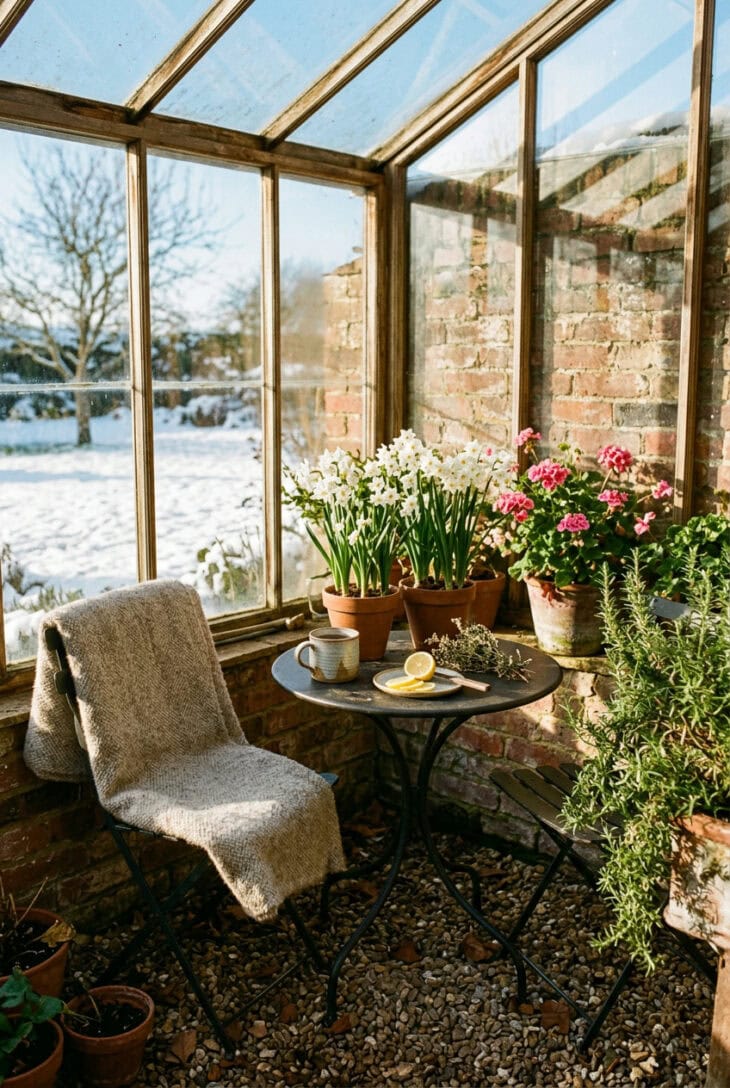
What you see A small metal café table and two chairs fill one corner of a glass greenhouse, a wool throw draped over the back of a chair. A mug and a plate with a cut lemon sit on the table, and pots of paperwhite narcissus, geraniums and rosemary crowd around. Snow lies on the lawn outside, but the low sun streaming in warms the glass.
Why it works On a clear day, a closed greenhouse can feel dramatically warmer than the yard, which makes it a pleasant place to sit in winter. It is also the best reason to build one, because a greenhouse you enjoy is one you visit daily and catch problems early in. The honest limit is cloud: on an overcast day an unheated greenhouse is just a cold shed.
How to get it Keep the seating to one corner and leave the bench space for plants. Choose weatherproof furniture such as powder-coated metal or resin, as you would for a patio garden, since humidity and watering splashes will ruin untreated wood and fabric cushions. Keep a throw and lightweight cushions you can carry in and out. Paperwhite narcissus (Narcissus papyraceus) gives scent from bulbs that need no chilling, though the bulbs are toxic if eaten. Open the vents before you sit down, because a closed greenhouse can get stuffy.