An English garden feels settled in a way few other styles do. Clipped hedges hold back a tumble of roses and perennials, paths wander toward a bench or a gate, and everything looks as if it has been loved for a hundred years, even when it was planted last spring.
Contents
- 01. Double Herbaceous Border
- 02. Formal Rose Garden in Box-Edged Beds
- 03. Rose Arch Over a Garden Gate
- 04. Knot Garden of Clipped Box
- 05. White Garden for Evening Glow
- 06. Yew Hedges That Make Garden Rooms
- 07. Wildflower Meadow with Mown Paths
- 08. Walled Kitchen Garden
- 09. Lavender-Lined Brick Path
- 10. Laburnum Tunnel
- 11. Hot Border in Red and Orange
- 12. Stone Terrace with Crevice Planting
- 13. Spring Woodland Walk
- 14. Mixed Hawthorn Hedgerow
- 15. Formal Lily Pool
- 16. Scented Arbor Seat
- 17. Peony and Iris Early-Summer Border
- 18. Espaliered Pears on a Brick Wall
- 19. Wisteria Across the House Front
- 20. Cutting Garden in Straight Rows
- 21. Small Town Garden, English Style
- 22. Terracotta Pots on Stone Steps
- 23. Sundial at the Heart of a Circular Bed
- 24. Spring Bulbs in an Orchard Meadow
- 25. Dry Gravel Garden, Beth Chatto Style
- 26. Autumn Border of Asters and Grasses
- 27. Pleached Hornbeam Screen
- 28. Hazel Hurdles and Woven Willow
- 29. Symmetrical Front Path with Box Balls
- 30. Winter Structure of Frost and Seedheads
The ideas below cover the whole tradition: grand double borders and intimate town plots, formal knot gardens and loose wildflower meadows, sunny terraces and shady woodland walks. Some are weekend projects that cost little more than a packet of seed, while others are long-term plantings that mature over a decade. Where a classic English plant struggles in American heat or turns invasive here, you will find a well-behaved substitute.
Scroll through for inspiration, or jump to the ideas that suit your space, light, and patience. Most of them combine happily, so even borrowing two or three will give your yard that timeless English feel.
01. Double Herbaceous Border
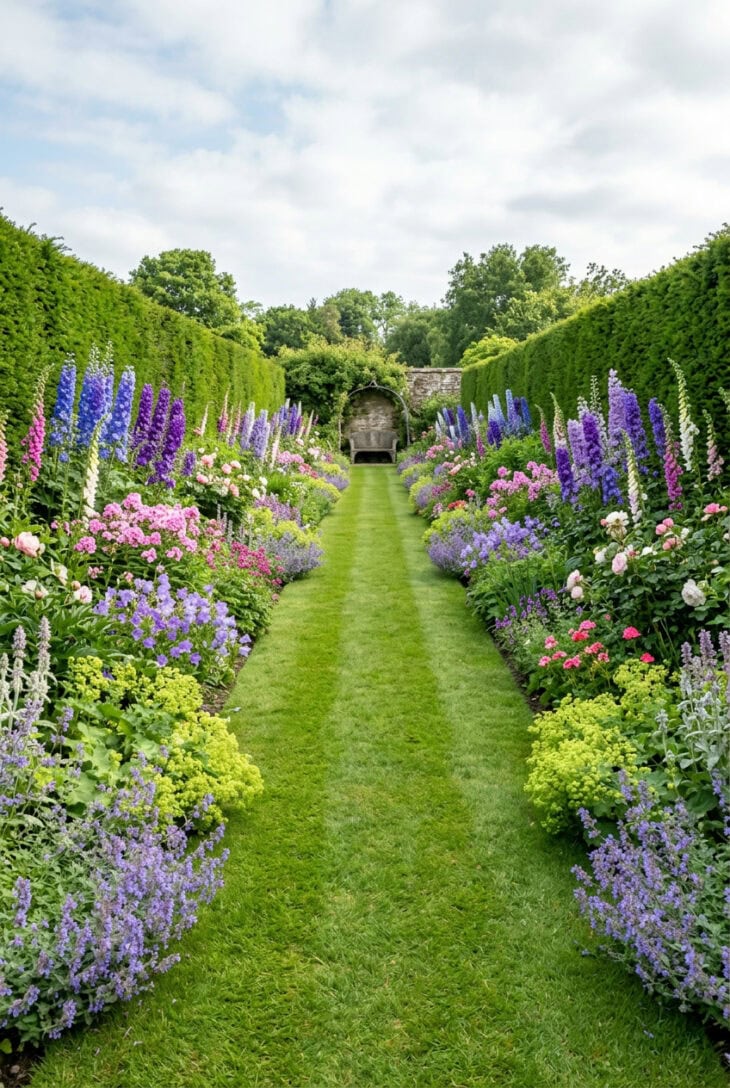
What you see Two deep borders face each other across a broad ribbon of lawn, each one rising from a froth of lavender-blue catmint and acid-green lady’s mantle to towering spires of delphinium at the back. Dark yew hedges hold the whole scene like a picture frame, and a stone bench waits at the far end.
Why it works Mirroring the planting on both sides doubles its impact and turns a simple path into a destination. The hedges give a dark, even backdrop that makes every flower color glow, and the tiered heights mean nothing gets lost. It is the grand gesture at the heart of the English style, and the root of most modern garden border ideas.
How to get it Make each border at least 6ft (180cm) deep and the path between them at least 5ft (150cm) wide so the scale feels generous. Dig in plenty of well-rotted compost or manure before planting, since these borders are hungry. Repeat the same groups on both sides, set in threes and fives about 18in (45cm) apart. In hot-summer areas swap delphiniums for sturdier spires such as false indigo (Baptisia australis) or Culver’s root (Veronicastrum virginicum). Stake tall plants in May, before they need it.
02. Formal Rose Garden in Box-Edged Beds
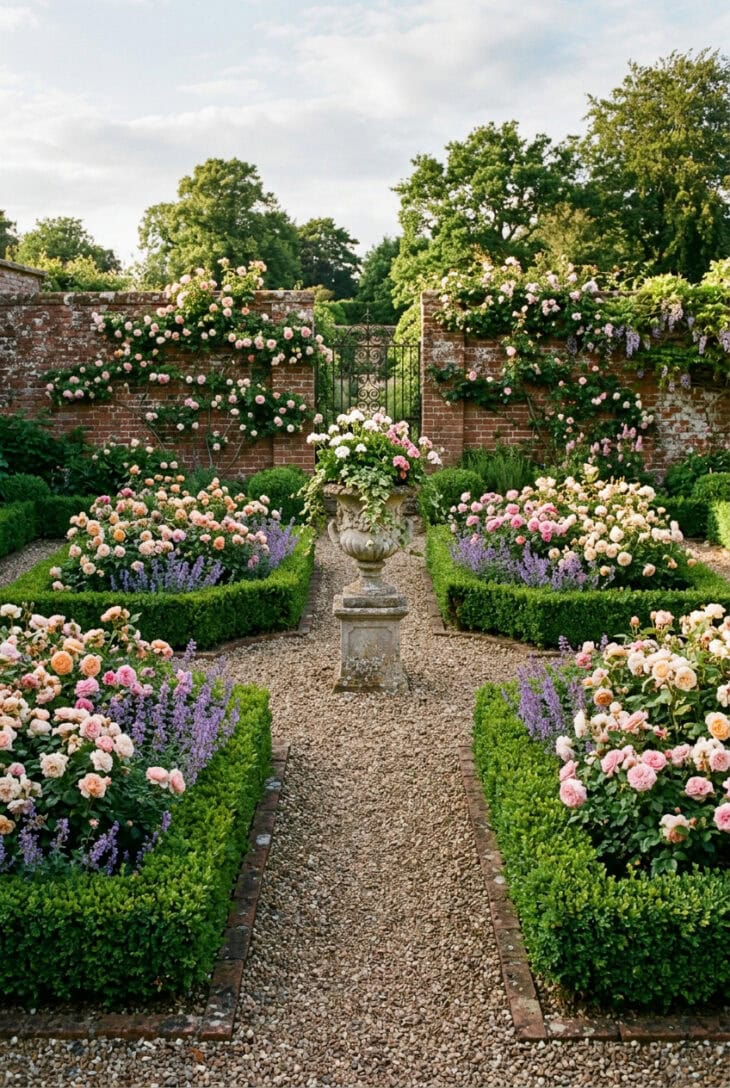
What you see Four square beds meet at a gravel crossing with a stone urn at its center. Inside neat, knee-high boxwood edges, shrub roses in blush pink, apricot, and cream stand shoulder to shoulder, their feet softened by a haze of blue catmint. The air smells of warm roses and the brick wall behind glows in the afternoon sun.
Why it works The crisp green frame of the box hedging keeps the roses looking tidy even when they sprawl or drop petals. Catmint is the classic partner: its blue flowers flatter every rose color, it hides bare rose stems, and it keeps flowering while the roses rest between flushes.
How to get it Choose disease-resistant repeat bloomers such as David Austin’s ‘Olivia Rose Austin’ and ‘Desdemona’, or the tough ‘Bonica’, and plant them about 3ft (90cm) apart. Edge the beds with a blight-resistant boxwood such as Buxus ‘NewGen Independence’, or use inkberry (Ilex glabra ‘Gem Box’) where box struggles. Tuck catmint (Nepeta × faassenii ‘Walker’s Low’) along the inside of the hedge, and shear it by half after its first flush for a second show. Give roses at least six hours of sun and good air flow to keep black spot down.
03. Rose Arch Over a Garden Gate
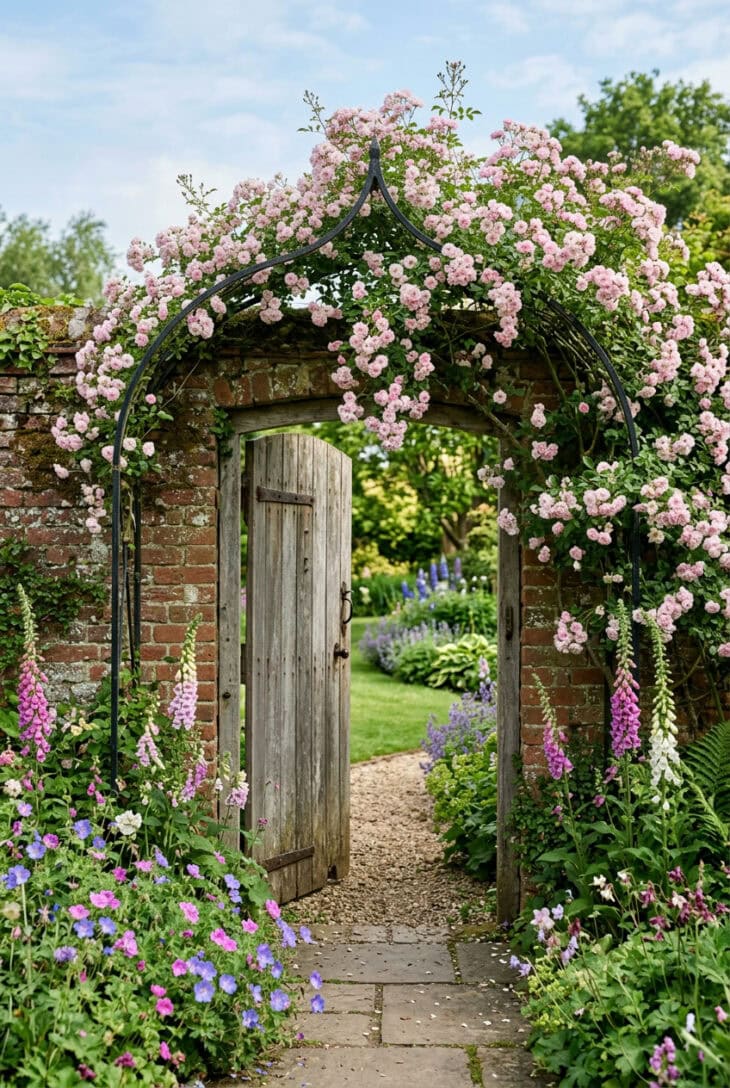
What you see A half-open wooden gate set into an old brick wall, crowned by an arch dripping with pale pink roses. Foxgloves lean against the brickwork, hardy geraniums spill across the threshold, and through the gap you glimpse a sunlit lawn and more flowers beyond.
Why it works An arch turns an ordinary entrance into a moment. It frames the view on the other side, adds height in a place where there is no room for a tree, and gives you roses at nose level. That glimpse through the gate is pure English romance, and a trick borrowed by every cottage garden design: it promises more garden than you can see.
How to get it Buy or build an arch at least 7ft (210cm) tall and 4ft (120cm) wide, and anchor the legs in concrete, since a mature rose is heavy. Choose a repeat-flowering climber such as ‘New Dawn’ or ‘Climbing Iceberg’ rather than a vigorous once-flowering rambler, which can swamp a small arch. Plant one rose on each side, 12in (30cm) out from the posts, and tie the canes in as horizontally as you can along the curve to encourage flowering shoots. Prune out old, unproductive canes each late winter.
04. Knot Garden of Clipped Box
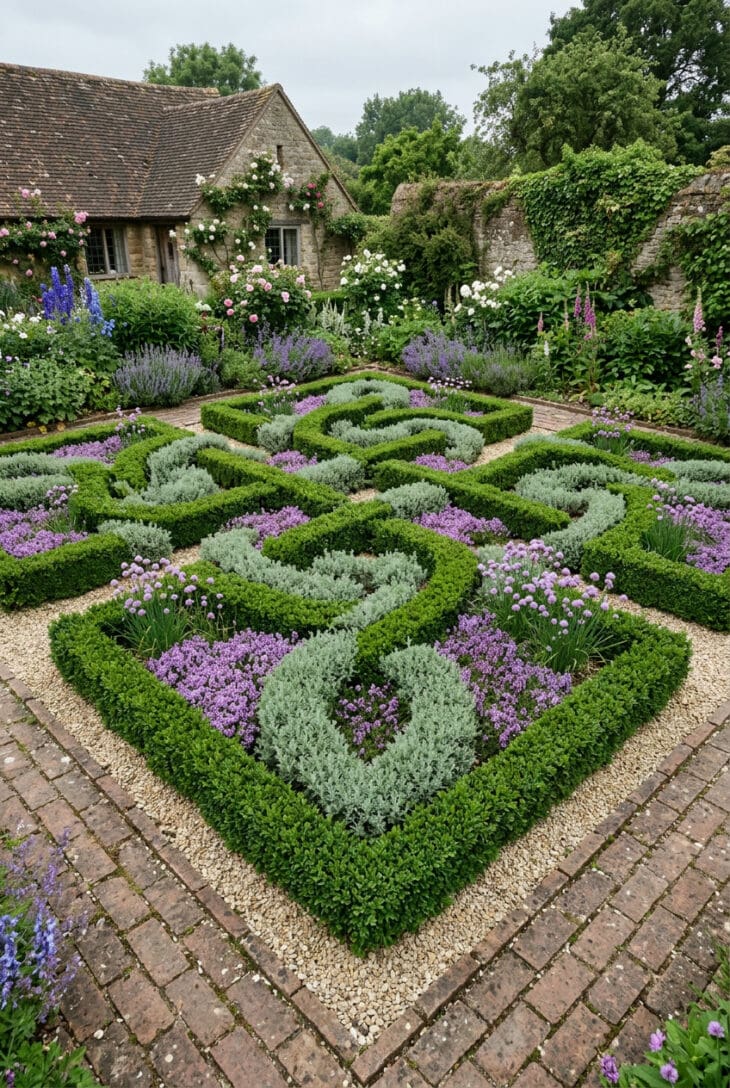
What you see Seen from an upstairs window, ribbons of dark green box and silvery germander loop over and under one another like a piece of embroidery. Pale gravel fills the gaps, with little tufts of flowering thyme and chives, and a brick path runs around the whole pattern.
Why it works Knot gardens date back to Tudor England and were designed to be looked down on, so they reward you all year, even under snow. The contrast of two hedge colors creates the illusion of strands crossing. Because the pattern does the work, a knot garden looks finished with very few flowers.
How to get it Keep the design simple and square, about 10 to 15ft (3 to 4.5m) across, and mark it out with string and sand before planting. Use small plants set 6 to 8in (15 to 20cm) apart: blight-resistant boxwood such as ‘Green Velvet’ or ‘NewGen Freedom’ for one strand and wall germander (Teucrium chamaedrys) for the other. Clip twice a year, in late spring and late summer, keeping hedges 10 to 12in (25 to 30cm) high. Fill the spaces with gravel or low cottage herbs that won’t hide the pattern.
05. White Garden for Evening Glow
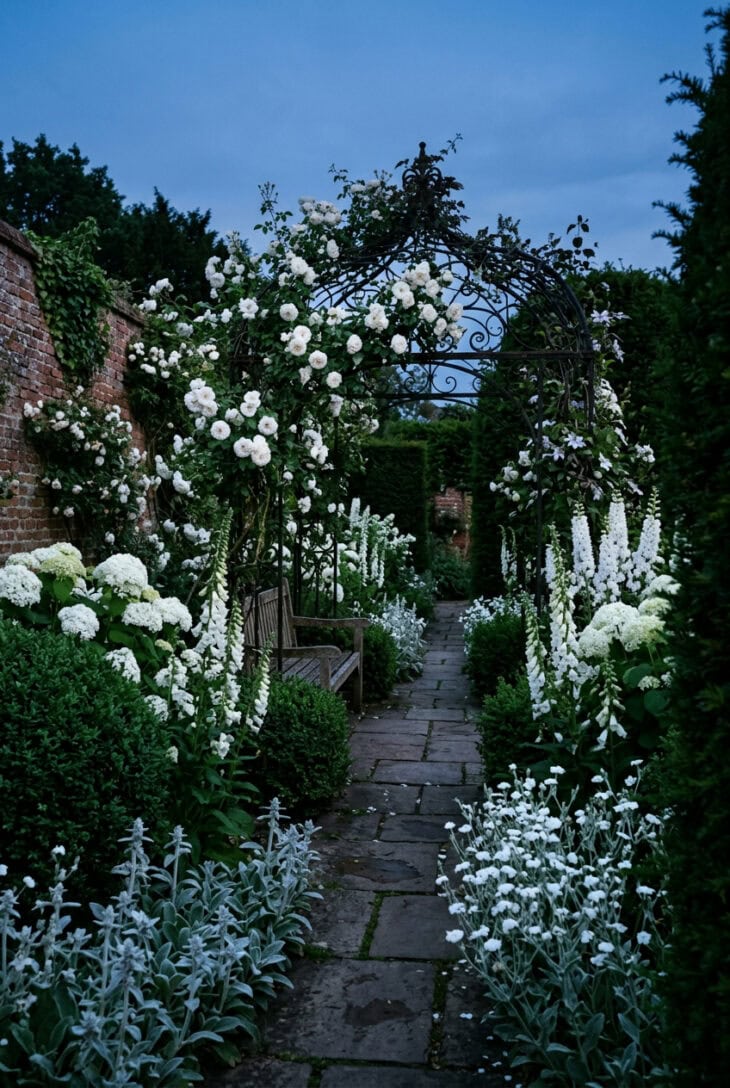
What you see At dusk this enclosed garden seems to light itself. White roses tumble over an iron arbor, white foxgloves and delphiniums stand like candles, and big snowball hydrangeas float above silver lamb’s ear. Everything else fades into the blue twilight while the white flowers glow.
Why it works Inspired by the famous white garden at Sissinghurst, a single-color scheme feels calm and sophisticated. White and silver reflect the last light, so this is the garden to plant near a patio you use after work. Varying the leaf textures, from felted to glossy to feathery, keeps a one-color bed from ever feeling flat.
How to get it Build around a few long-flowering anchors: the rose ‘Iceberg’, smooth hydrangea (Hydrangea arborescens ‘Annabelle’), and white rose campion (Lychnis coronaria ‘Alba’). Add white foxgloves, Japanese anemone (Anemone × hybrida ‘Honorine Jobert’) for late summer, and silver lamb’s ear (Stachys byzantina) along the front. Avoid pure white gravel or paving, which competes with the flowers. Deadhead diligently, since browning white petals show more than any other color. Annabelle hydrangea blooms on new wood, so cut it back hard in late winter without losing flowers.
06. Yew Hedges That Make Garden Rooms
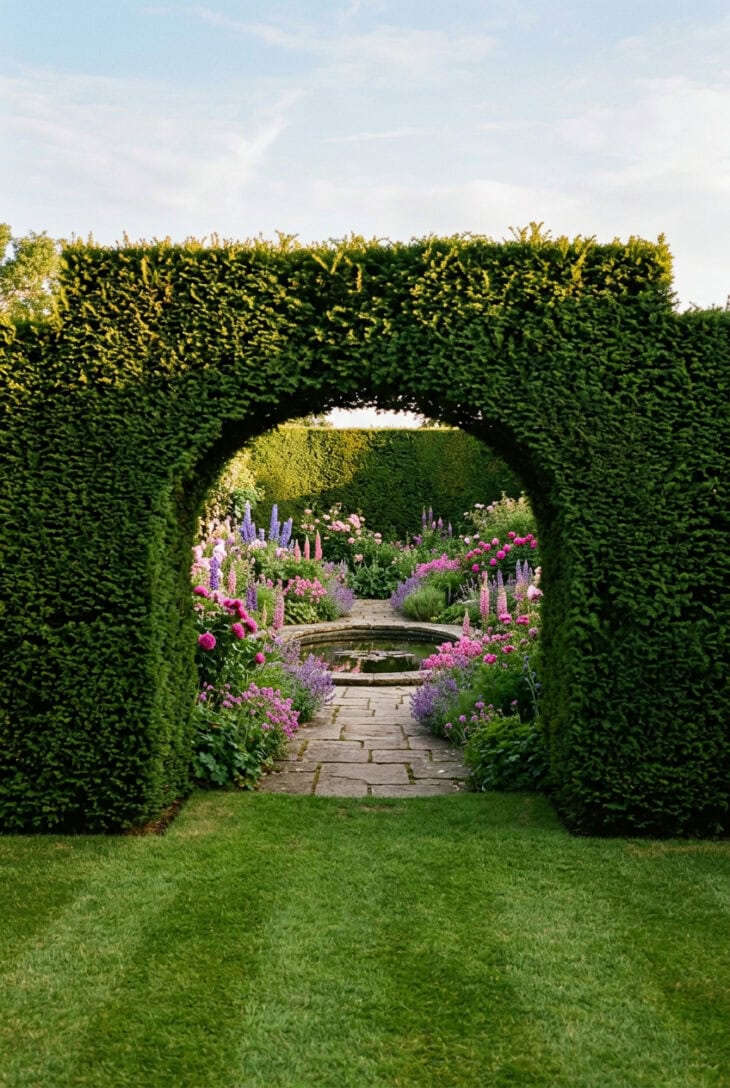
What you see A doorway cut cleanly through a tall, dark yew hedge. On this side is quiet lawn; through the opening lies a second garden altogether, bright with pink and purple flowers circling a small round pool. The late sun gilds the flat top of the hedge.
Why it works Hidcote and Sissinghurst made “garden rooms” famous: dividing a plot with hedges so each area has its own mood and you discover them one at a time. It makes a garden feel larger, not smaller, because you can never see everything at once. It also lets you try a hot color scheme in one room and a calm one in the next without clashes.
How to get it English yew (Taxus baccata) or the hardier hybrid yew (Taxus × media ‘Hicksii’) makes the densest walls; plant bare-root or potted plants 18 to 24in (45 to 60cm) apart in well-drained soil. Yew grows about 12in (30cm) a year, faster than its reputation, and takes hard pruning well. For quicker results, American hornbeam or beech hedges work too. Leave openings at least 3ft (90cm) wide and line them up to create long views across your backyard layout. Remember that all parts of yew are toxic to people and pets.
07. Wildflower Meadow with Mown Paths
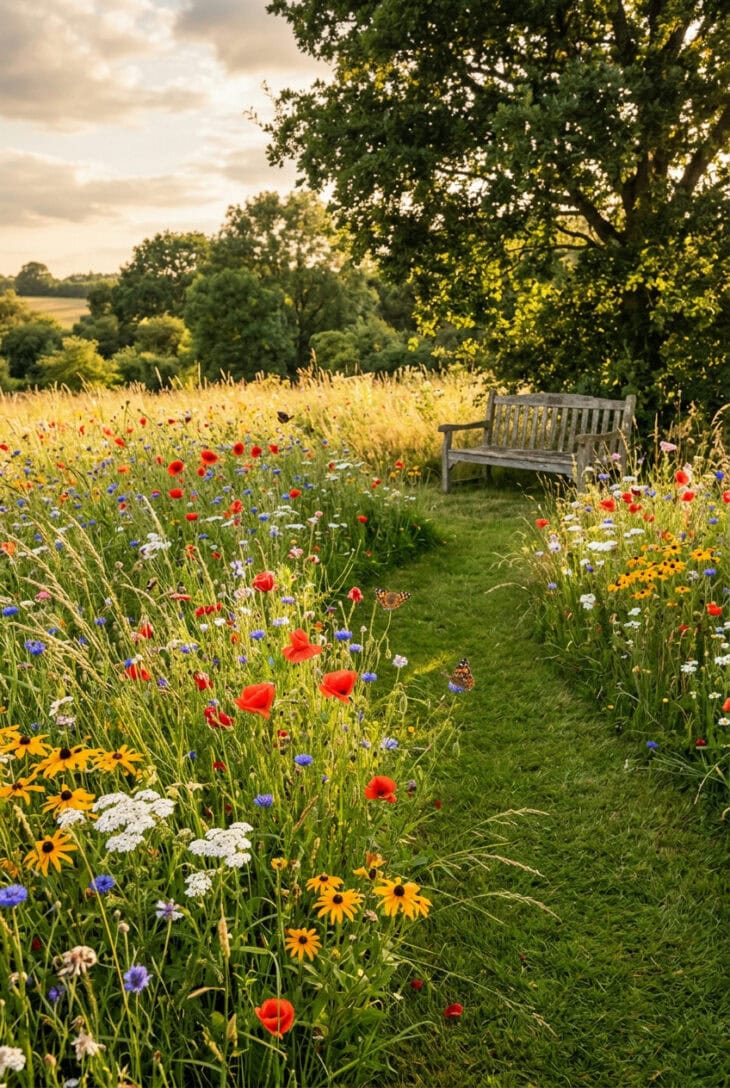
What you see Knee-high grasses sway with red poppies, blue cornflowers, white yarrow, and golden black-eyed susans, while butterflies drift over the seedheads. A crisp mown path curls through the middle to a weathered bench beneath a tree, inviting you to wander.
Why it works The mown path is the trick: it signals that the long grass is intentional, turning “unkempt lawn” into “meadow” at a glance. Great Dixter made this contrast of wild and neat a modern English signature. A meadow feeds bees and butterflies too, which makes it one of the best pollinator garden ideas for a large yard.
How to get it Meadows prefer poor soil, so strip the turf or skip fertilizer for a season before sowing. Use a regional native wildflower mix, since European mixes can include plants that are weedy in parts of the US. Sow in fall or early spring at the rate on the pack, usually around 1/4oz per 100sq ft (roughly 1g per square meter), and press the seed in rather than burying it. Mow the whole area once in late fall or early spring, and keep paths about 3ft (90cm) wide, mown weekly.
08. Walled Kitchen Garden
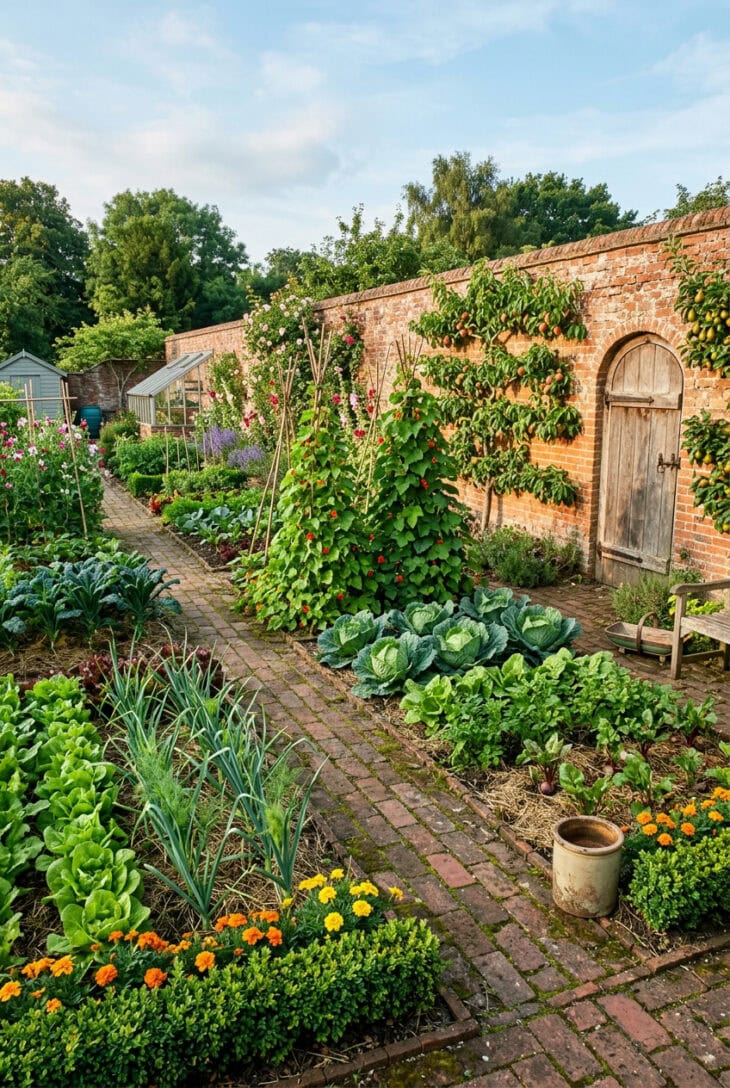
What you see Old brick walls enclose neat rectangles of lettuce, blue-green leeks, and ruffled cabbages, with runner beans scrambling up hazel wigwams. Low box hedges and orange marigolds edge each bed, and brick paths lead to a wooden door in the wall.
Why it works Victorian country houses fed their households from walled gardens, and the look is still irresistible because it makes vegetables decorative. Walls soak up heat and shelter crops from wind, extending the season. Geometry and edging keep the space handsome even when half the beds are harvested.
How to get it You don’t need a brick wall: a board fence, a hedge, or even a trellis screen gives the same enclosed feel. Lay out beds no wider than 4ft (120cm) so you can reach the middle, with paths at least 2ft (60cm) wide. Mix ornamental crops such as red-stemmed chard, purple kale, and blue leeks for a painterly effect. Edge beds with parsley, chives, or marigolds instead of box if you want every plant to earn its keep. Our vegetable garden ideas have more layouts to borrow.
09. Lavender-Lined Brick Path
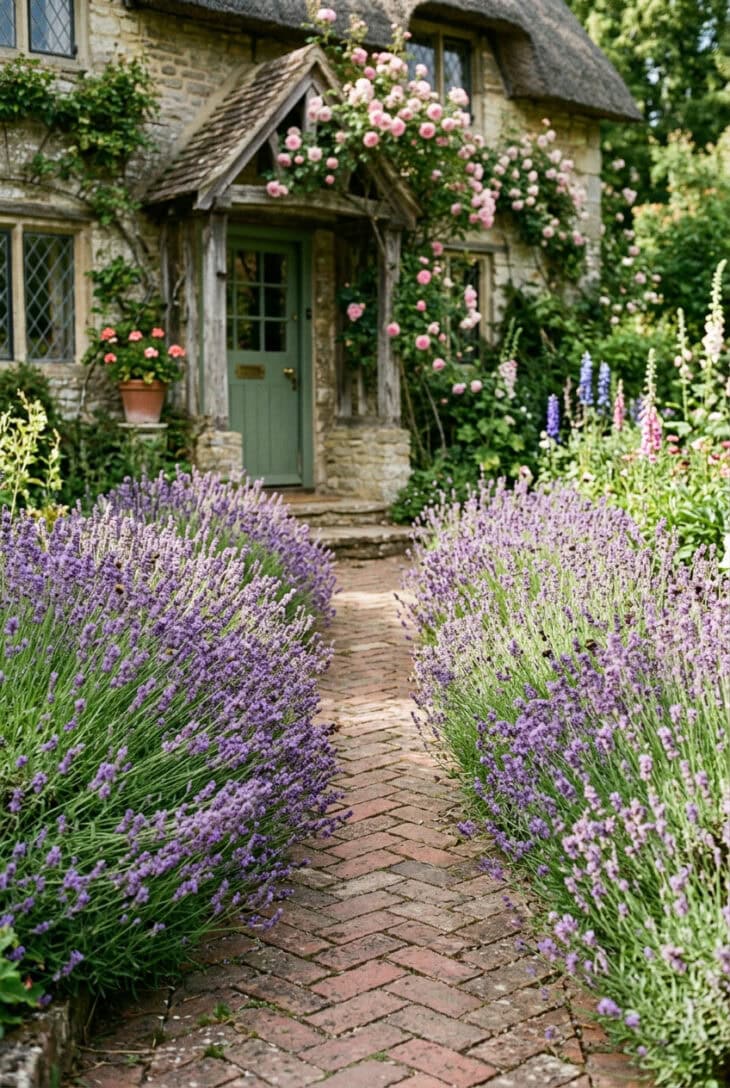
What you see A herringbone brick path runs to a cottage door between two soft purple hedges of lavender, the flower spikes leaning over the bricks and buzzing with bees. Brush past and the scent rises around you, while pink roses climb the house wall ahead.
Why it works Lavender is the quintessential English path plant: it forms a low hedge in a single season, releases fragrance when touched, and its gray foliage stays handsome all winter. Letting the plants lap onto the path softens hard edges and makes the walk feel older than it is.
How to get it Choose compact English lavender (Lavandula angustifolia ‘Hidcote’ or ‘Munstead’) and plant 12 to 18in (30 to 45cm) apart, set back about 12in (30cm) from the path edge. Lavender needs full sun and sharp drainage; in heavy clay, raise the bed slightly or mix in grit. Shear lightly right after flowering, but never cut into old bare wood, which rarely regrows. For a wider path, allow at least 3ft (90cm) between the lavender mounds. Browse our garden path ideas for other paving patterns.
10. Laburnum Tunnel
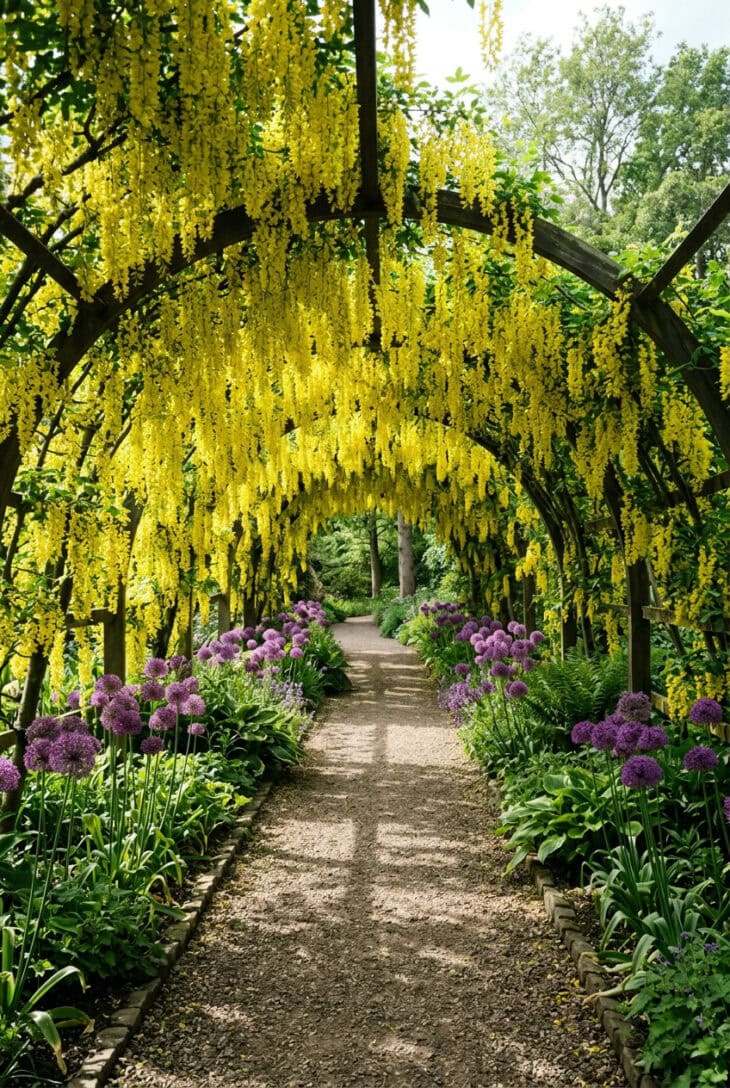
What you see A long tunnel dripping with golden chains of laburnum flowers, so dense that the light inside turns yellow. Below, purple allium globes stand in rows along a gravel path, and dappled sunshine flickers through the gaps in the canopy.
Why it works Made famous at Bodnant in Wales, the laburnum arch is one of the great spectacles of the English garden. It is brief, two or three weeks in late May, but unforgettable. The purple alliums flower at the same moment and make the gold look even brighter.
How to get it Build a sturdy metal or timber frame about 8ft (240cm) high and wide, then plant golden chain tree (Laburnum × watereri ‘Vossii’) about 4ft (120cm) apart along both sides. Tie in the flexible young branches across the frame and prune side shoots back to two or three buds each winter to create flowering spurs. Laburnum does best in zones 5 to 7 with cool summers. Every part of the plant, especially the seeds, is poisonous, so skip this idea where young children play. In hotter areas, American wisteria on the same frame is a good substitute.
11. Hot Border in Red and Orange
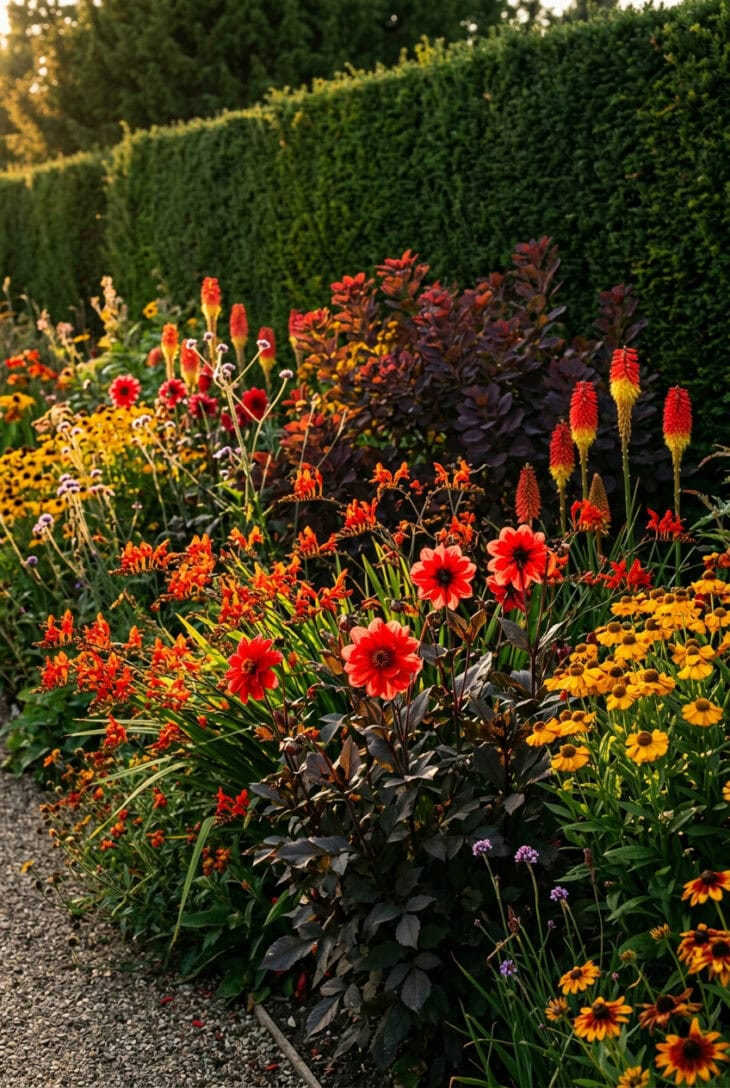
What you see Scarlet dahlias with near-black leaves, arching sprays of orange crocosmia, red hot pokers, and golden heleniums blaze against a dark hedge. Burgundy smoke bush foliage deepens the scheme, and the low evening sun turns the whole border into embers.
Why it works English gardens are not all pastels. Hidcote’s Red Borders and Great Dixter’s exotic garden proved hot colors can look just as classic. Dark purple foliage is the secret ingredient: it gives the eye somewhere to rest and makes the reds and oranges glow even harder. A hot border peaks in August and September, just as the pastel borders fade.
How to get it Anchor the back with a purple smoke tree variety such as Cotinus coggygria ‘Royal Purple’, cut hard each spring to keep it bushy and leafy. Add dahlia ‘Bishop of Llandaff’, crocosmia ‘Lucifer’, helenium ‘Moerheim Beauty’, and red hot poker (Kniphofia uvaria). Plant dahlias out after the last frost, about 2ft (60cm) apart, and in zones colder than 8 lift the tubers after the first frost blackens the leaves. Keep the color palette tight: red, orange, gold, and purple, with no pale pinks.
12. Stone Terrace with Crevice Planting
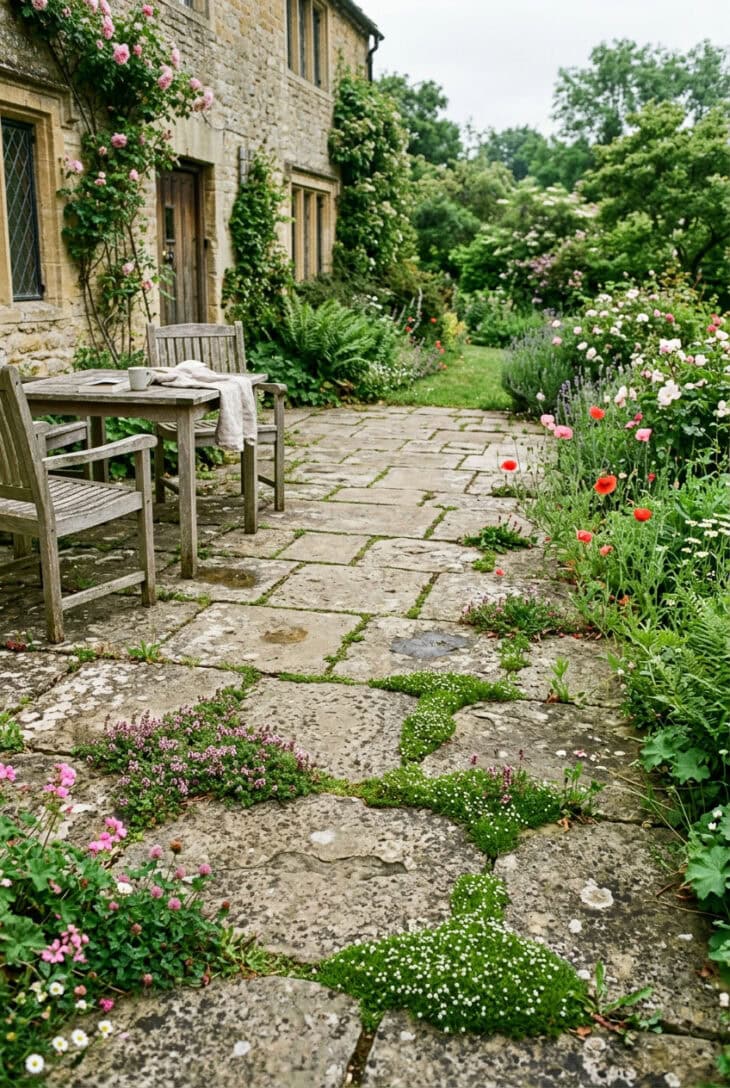
What you see Soft gray flagstones outside the back door, their joints stitched with cushions of creeping thyme and bright green mossy mats. Little pink and white flowers pop up between the stones, a few poppies have seeded themselves at the edge, and a table waits for morning coffee.
Why it works Plants growing in the paving blur the line between garden and terrace, so hard surfaces feel mellow and aged. Thyme releases scent when walked on, and low mats stop weeds from colonizing the cracks. It’s the easiest way to give a new patio garden an old English feel.
How to get it Lay stones on sand or gravel rather than mortar, leaving joints 1 to 2in (2.5 to 5cm) wide and filled with a gritty soil mix. Plant small plugs of creeping thyme (Thymus serpyllum), Irish moss (Sagina subulata), and blue star creeper (Isotoma fluviatilis) into the gaps. Keep crevice plants out of the main walking lines, where only thyme and Irish moss tolerate regular footfall. Scatter seed of breadseed poppies and Mexican fleabane (Erigeron karvinskianus) along the edges and let them self-sow.
13. Spring Woodland Walk
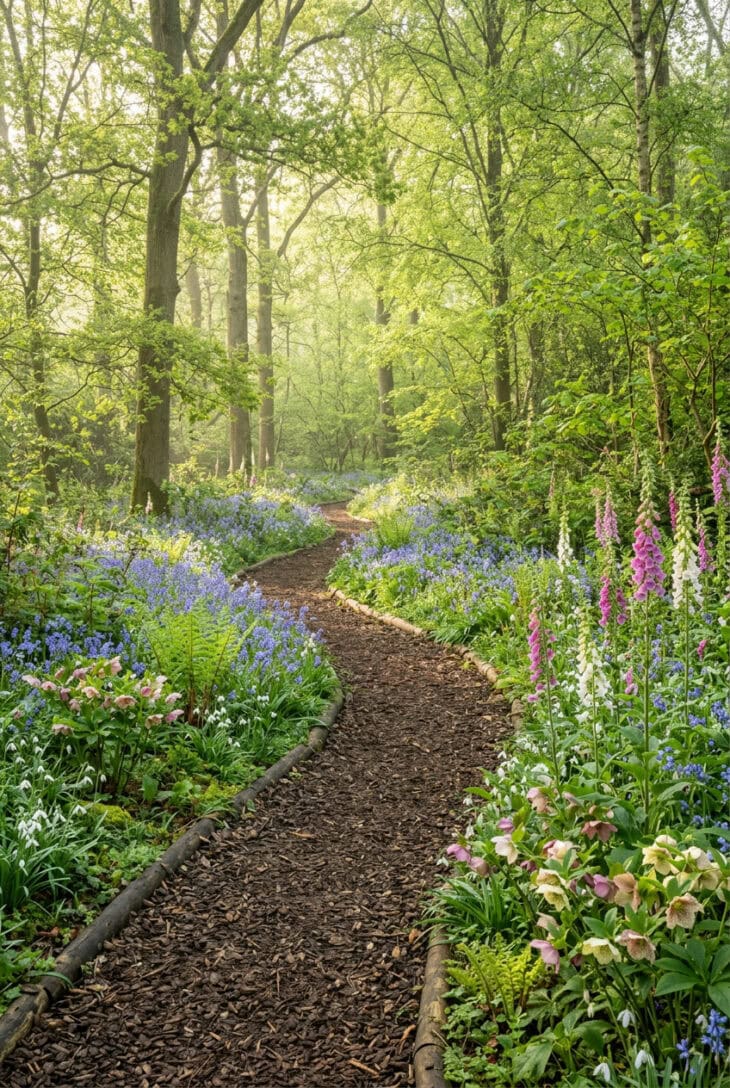
What you see A soft bark path meanders under tall trees just breaking into leaf. Pools of sky-blue bluebells cover the ground, nodding hellebores in cream and plum cluster by the path, ferns uncurl, and in a sunny clearing tall foxgloves rise through the mist.
Why it works English bluebell woods are one of Britain’s great spring sights, and the same layered effect works under any group of deciduous trees. Woodland plants flower before the canopy closes, then retreat into cool greenery for summer. It’s the answer to the dark corners covered in our shade garden ideas.
How to get it Instead of English bluebells, which hybridize and spread aggressively in parts of the US, plant native Virginia bluebells (Mertensia virginica) in groups of five, about 12in (30cm) apart. Add Lenten roses (Helleborus × hybridus), snowdrops (Galanthus nivalis) planted “in the green” after flowering, and foxgloves (Digitalis purpurea) for early summer. Mulch with shredded leaves each fall to mimic the forest floor. Foxgloves are biennial and toxic, so let a few set seed each year to keep the colony going and keep them away from grazing pets.
14. Mixed Hawthorn Hedgerow
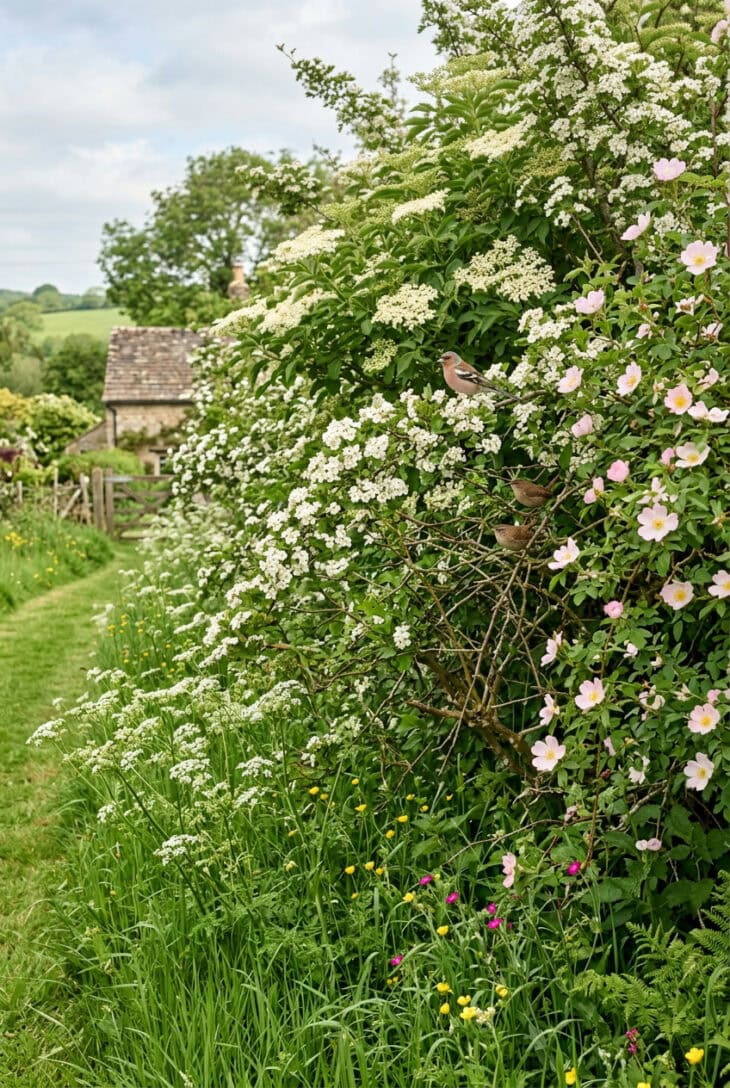
What you see A loose, living boundary foams with white hawthorn blossom, flat elder flowers, and single pink wild roses. Lacy white wildflowers and long grass gather at its base, and small birds dart in and out of the tangle.
Why it works The hedgerow is the thread that stitches the English countryside together, and it makes a far richer boundary than a fence or a single-species hedge. Mixing species gives flowers in spring, berries in fall, and shelter for nesting birds, which makes it one of the most valuable wildlife garden ideas you can plant.
How to get it Use American natives with the same character: Washington hawthorn (Crataegus phaenopyrum), American elderberry (Sambucus canadensis), gray dogwood (Cornus racemosa), and Virginia rose (Rosa virginiana). European common hawthorn is invasive in the Pacific Northwest, so our guide to hawthorn tree varieties can help you pick a native one. Plant bare-root whips in a staggered double row, about 18in (45cm) apart, in fall or early spring. Cut back by a third after planting to thicken the base, and trim only in late winter so you don’t disturb nesting birds.
15. Formal Lily Pool
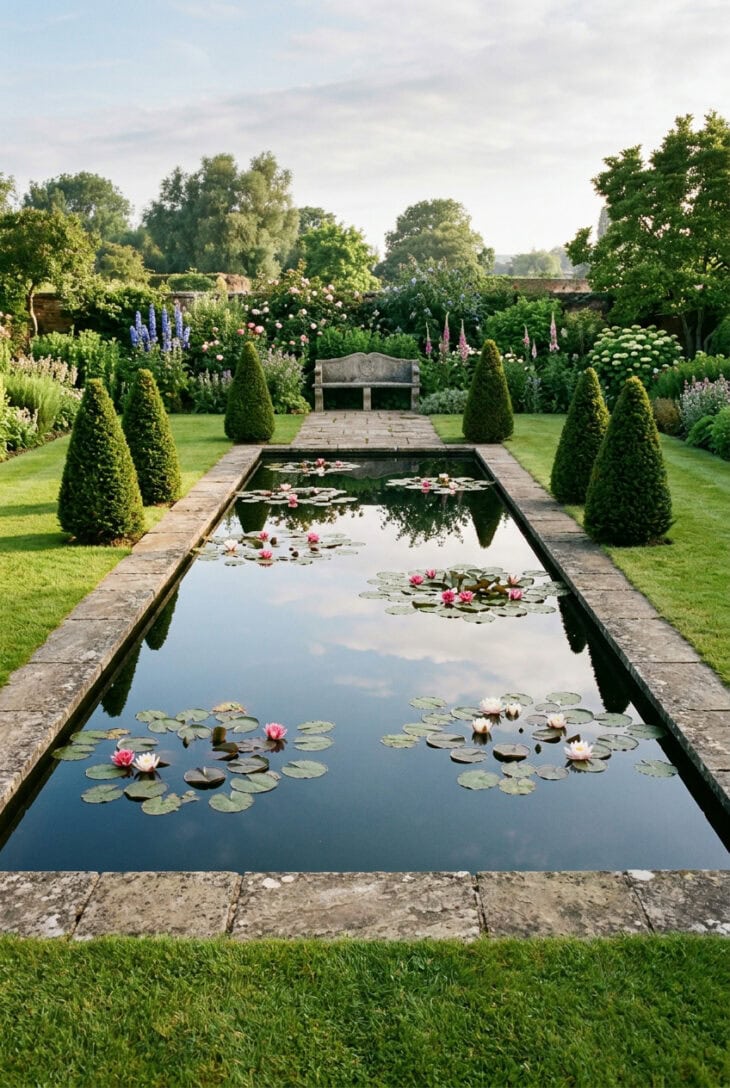
What you see A long rectangle of still, dark water sits in the lawn inside a wide stone rim. Pink and white water lilies float on its surface, clipped yew cones stand guard at the corners, and the sky and hedges are mirrored perfectly in the water.
Why it works A formal pool brings calm and light into a garden. It doubles the planting in its reflection, draws birds and dragonflies, and gives the eye a flat, quiet plane against all that exuberant flowering. The geometry ties it firmly to the house and the hedges, which is what makes it look English rather than natural.
How to get it A pool about 8 by 4ft (240 by 120cm) and 24in (60cm) deep suits a modest yard; line it with a heavy EPDM liner and finish the edge with stone coping that overhangs the water by 2in (5cm) to hide the liner. Keep planting sparse: one or two hardy water lilies such as Nymphaea ‘Marliacea Chromatella’ in baskets, with oxygenating plants below. Aim to cover about half the surface with lily pads, which shades the water and keeps algae down. Site it in full sun, away from overhanging trees that drop leaves.
16. Scented Arbor Seat
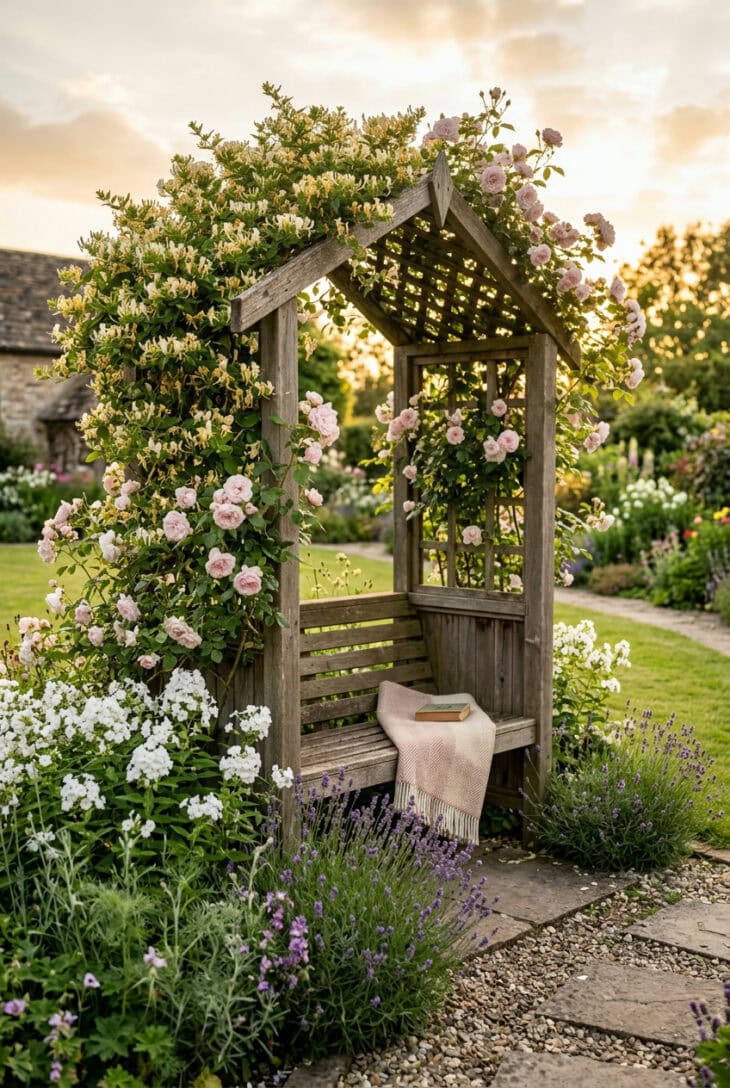
What you see A wooden arbor with a bench tucked beneath a canopy of creamy honeysuckle and blush climbing roses. White phlox and lavender surround the base, a blanket is folded on the seat, and the evening light makes the whole nook glow.
Why it works Every English garden needs a place to sit, and wrapping that seat in fragrance turns it into the favorite spot. Honeysuckle and summer phlox release most of their scent in the evening, exactly when you want to sit out. Enclosing a bench on three sides makes it feel sheltered and private, even in an open yard.
How to get it Face the arbor toward the best view in the garden, ideally catching evening sun. Plant a climbing rose such as ‘Madame Alfred Carrière’ on one side and a native trumpet honeysuckle (Lonicera sempervirens) or a fragrant non-invasive hybrid such as Lonicera × heckrottii ‘Goldflame’ on the other; avoid Japanese honeysuckle, which is invasive. Add garden phlox (Phlox paniculata ‘David’) and lavender around the base. Set climbers 12in (30cm) from the posts in generously amended soil and water them well for the first summer.
17. Peony and Iris Early-Summer Border
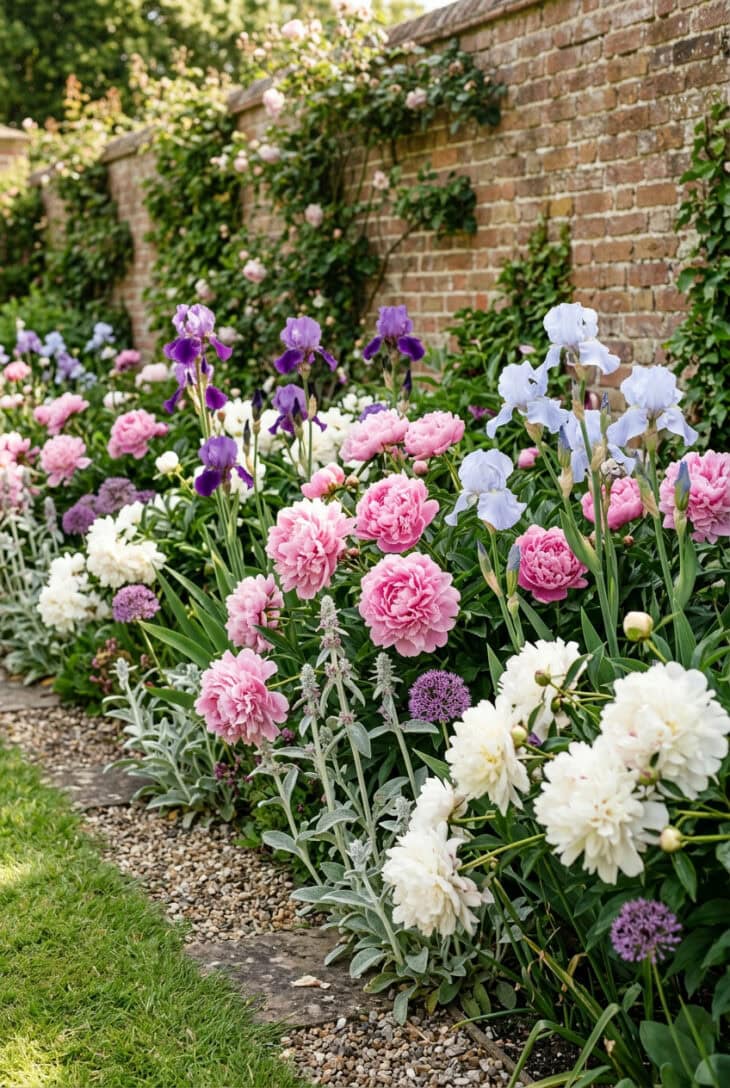
What you see Huge, ruffled peonies in pink and white lean against sword-leaved bearded irises in purple and sky blue. Allium globes float between them, and a mellow brick wall catches the late morning light.
Why it works Peonies and irises flower together in late May and June, bridging the gap between spring bulbs and the high summer border. Their shapes contrast beautifully: round, soft peony blooms against the upright iris leaves. Both are long-lived and tough, so a planting made now will still be flowering in thirty years.
How to get it Plant peonies in fall with the pink “eyes” no more than 2in (5cm) below the soil, or they won’t flower; space them 3ft (90cm) apart. Choose reliable cultivars such as ‘Sarah Bernhardt’ and ‘Festiva Maxima’, and use a grow-through support before the stems lengthen. Bearded iris (Iris germanica) wants the top of its rhizome exposed to the sun, so plant it shallowly at the front of the border, not smothered by neighbors. Divide irises every three to four years in late summer.
18. Espaliered Pears on a Brick Wall
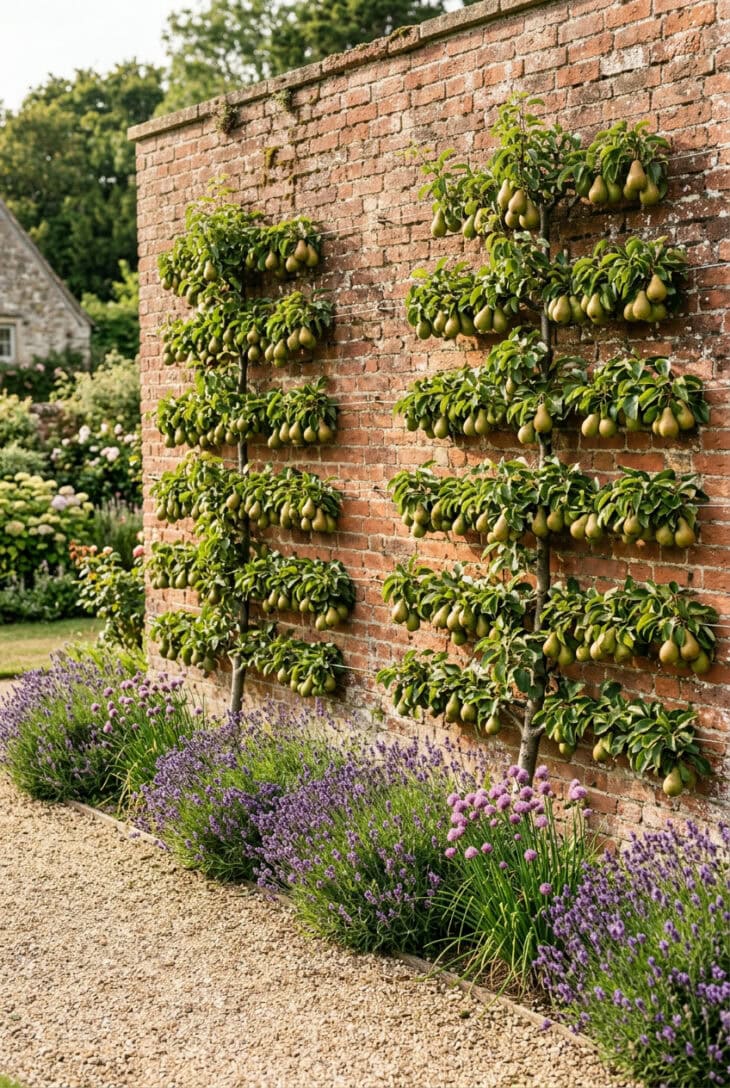
What you see Two pear trees are trained flat against a warm brick wall, their branches running out in perfectly level tiers like the rungs of a ladder. Green-gold pears hang along each arm, and a narrow strip of lavender and chives softens the base.
Why it works Espalier gives you fruit in a space only 12in (30cm) deep, and the wall’s stored warmth ripens it earlier. It’s also beautiful in every season: blossom in spring, fruit in late summer, and a strong architectural pattern on bare winter branches. Few features say “old English garden” as clearly.
How to get it Fix horizontal wires to the wall at 18in (45cm) intervals, held 4in (10cm) off the surface with vine eyes. Buy a pre-trained espalier or start with a one-year-old whip on a dwarfing rootstock and train one tier each year. Pears, apples, and figs all suit the technique; for pears, grow two compatible cultivars, such as ‘Bartlett’ and ‘Bosc’, for pollination. Prune in summer, cutting new side shoots back to three leaves, to keep the shape crisp and encourage fruiting spurs.
19. Wisteria Across the House Front
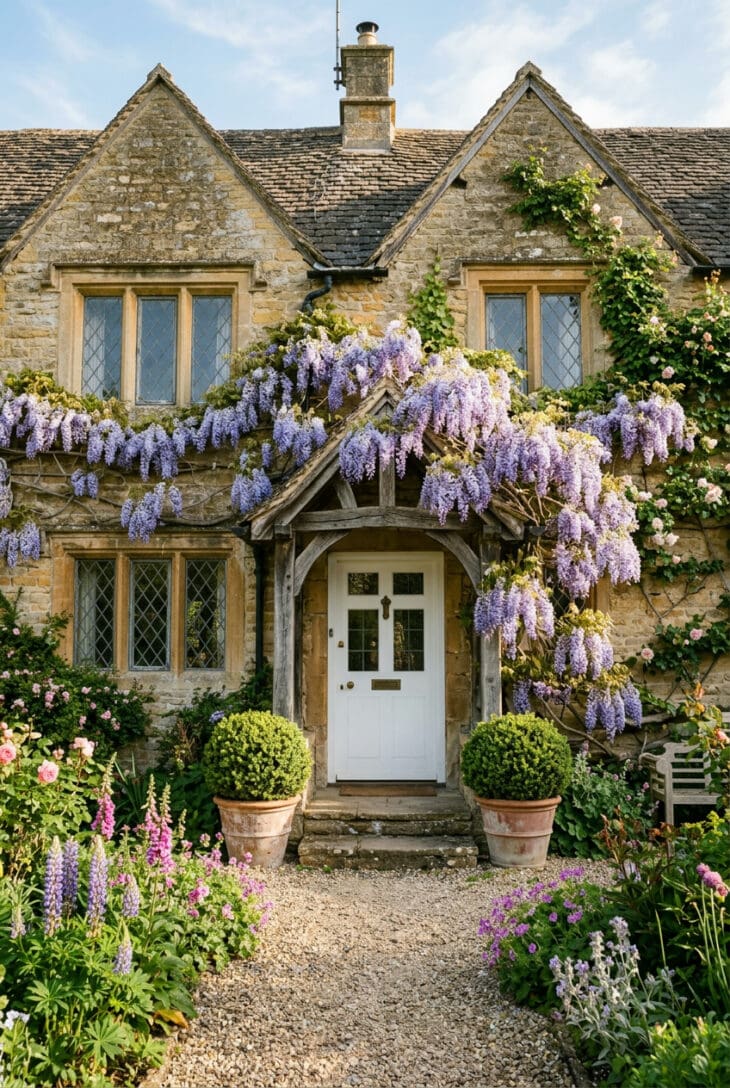
What you see An old stone house wears a curtain of lavender-blue wisteria, the flower clusters hanging in neat rows above the windows and framing a white front door. Clipped box balls in terracotta pots stand either side of the steps.
Why it works Wisteria on a house front is the ultimate English country image, and it knits a building into its garden like nothing else. Training the vine along horizontal wires shows off the flowers and keeps it off gutters and windows. For the full picture of welcoming entrances, see our front garden ideas.
How to get it Chinese and Japanese wisteria are invasive in much of the eastern US and can damage buildings, so plant American wisteria (Wisteria frutescens ‘Amethyst Falls’) or Kentucky wisteria (Wisteria macrostachya ‘Blue Moon’), which are less rampant and flower young. Run stout wires horizontally across the wall at 18in (45cm) spacing. Prune twice a year: in July cut the long whippy shoots back to five or six leaves, then in February shorten them again to two or three buds. Keep it clear of roof tiles, gutters, and shutters.
20. Cutting Garden in Straight Rows
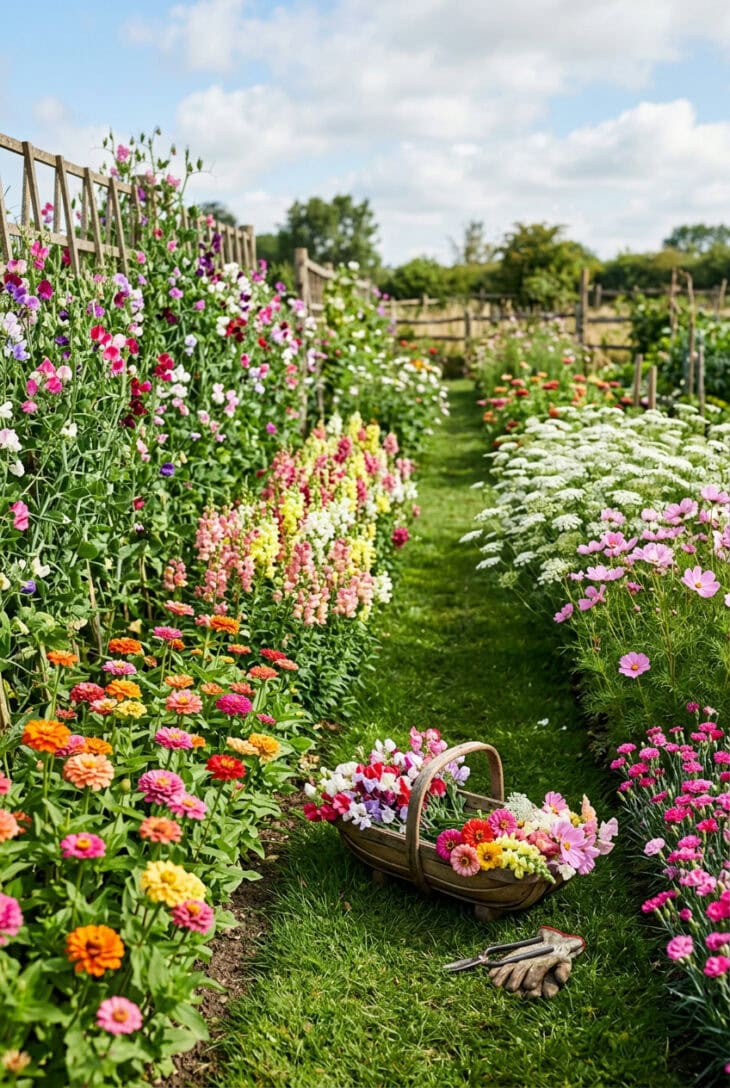
What you see Straight rows of flowers grown just for picking: sweet peas scrambling up a trellis, zinnias, snapdragons, pink cosmos, clove-scented pinks, and lacy white bishop’s flower. A wooden trug on the grass path is already brimming with the morning’s harvest.
Why it works English country houses kept their cutting gardens out of sight so the borders never looked plundered. Growing flowers in rows, like vegetables, makes them easy to weed, stake, and pick. The more you cut, the more most annuals flower, so a small patch fills vases from June to frost.
How to get it Set aside a sunny strip, even one 4 by 12ft (120 by 360cm) bed, and sow in rows 12 to 18in (30 to 45cm) apart. Start sweet peas indoors in late winter for a strong early crop, and direct-sow zinnias and cosmos once the soil is warm. Include fillers such as bishop’s flower (Ammi majus) and fragrant pinks or carnations (Dianthus caryophyllus). Cut in the cool of the morning and put stems straight into water. Stretch netting horizontally over the rows early to hold tall stems upright.
21. Small Town Garden, English Style
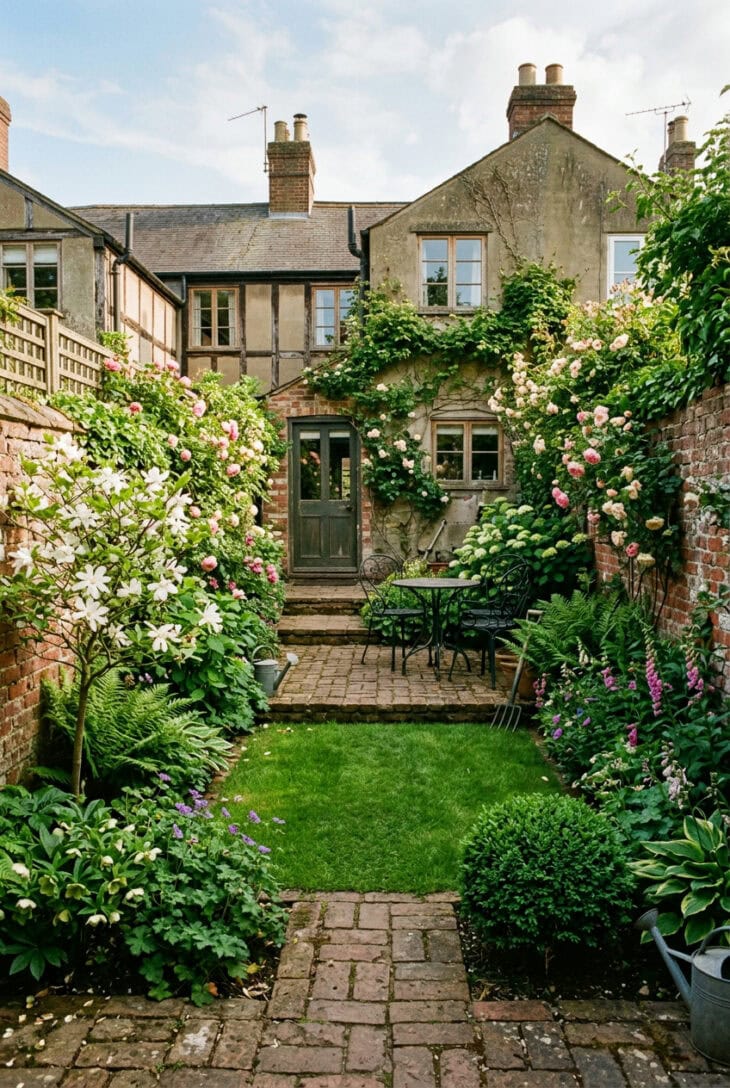
What you see Behind a row house, a small walled plot is packed with greenery: a neat square of lawn, deep borders of roses, hydrangeas, ferns, and hardy geraniums, a little star magnolia in the corner, and a bistro table set on old brick by the back door.
Why it works London’s town gardens prove that English style is not about acres. Generous borders on every side hide the boundaries, so the space feels enclosed and lush rather than cramped. A single small tree adds height and a ceiling of leaves, and one clipped shape brings order to the abundance.
How to get it Make the borders deeper than feels natural, at least 3ft (90cm), and shrink the lawn or paving to match. Choose one multi-season tree: star magnolia (Magnolia stellata) or a serviceberry both stay under 20ft (6m); our magnolia pros and cons covers the trade-offs. Cover the walls with climbers so the boundary disappears. Repeat a few plants rather than using one of everything, and see our small garden ideas for more space-stretching tricks.
22. Terracotta Pots on Stone Steps
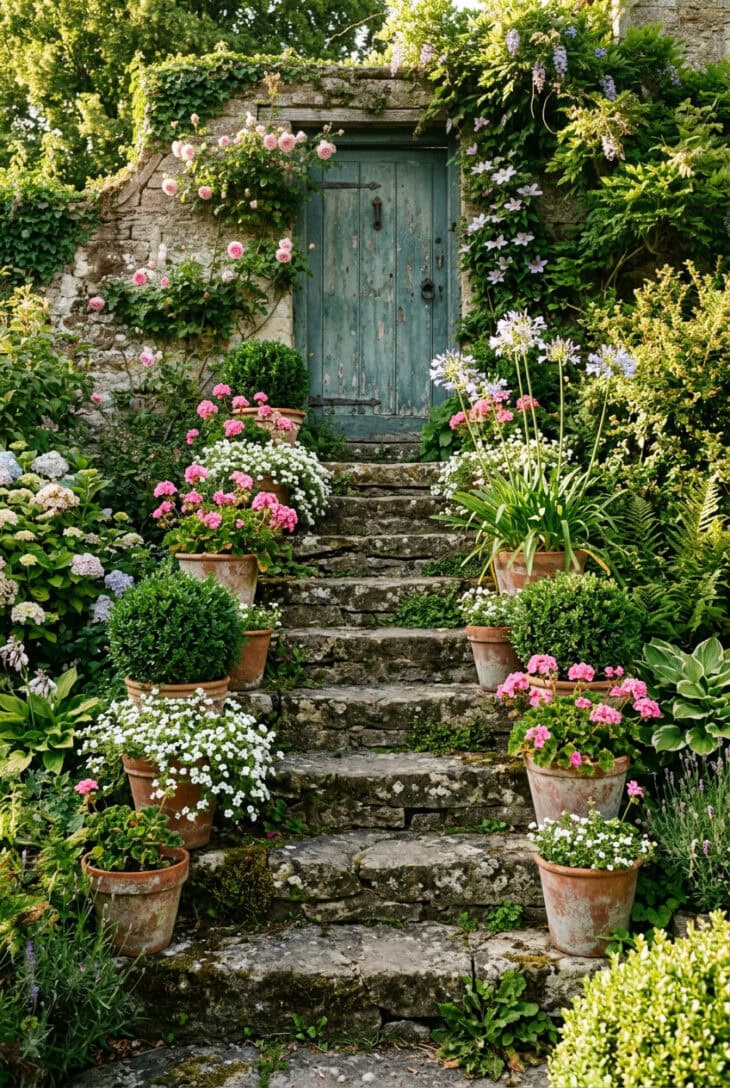
What you see Worn stone steps climb to a garden door, every tread crowded with old terracotta pots. Pink pelargoniums, pale blue agapanthus, trailing white bacopa, and a few tight box balls tumble together, with a little moss creeping into the corners of the stone.
Why it works Grouped pots bring a garden right up to the house and let you change the display with the seasons. Terracotta weathers to soft pinks and grays that sit comfortably with old brick and stone. Clustering pots in odd numbers of different heights looks collected over time, not bought in one go.
How to get it Use frost-resistant terracotta if you garden in a cold zone, and move smaller pots into a garage over winter. Mix permanent evergreens (box, bay, or dwarf yew) with seasonal flowers so the steps never look bare. Leave at least half of each step clear so they stay safe to use. Water daily in summer, since terracotta dries out fast, and feed flowering plants every two weeks. Our container garden ideas have plenty of planting recipes.
23. Sundial at the Heart of a Circular Bed
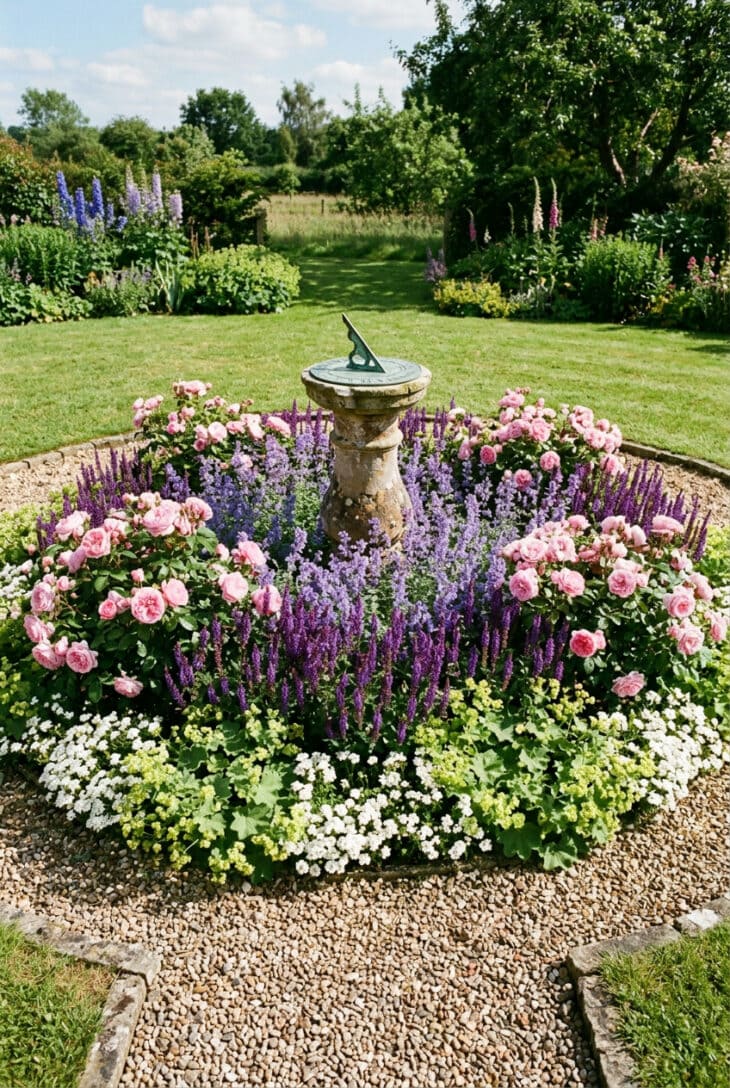
What you see In the middle of the lawn, a stone sundial rises from a round bed planted in rings: pink roses near the center, purple salvia and blue catmint around them, and a crisp outer edge of white candytuft and lady’s mantle. A gravel path circles the whole bed.
Why it works A focal point gives a lawn a purpose and draws people out into the garden. The circle is a classic English device because it looks good from every direction. Planting in concentric rings, tallest in the middle, keeps the sundial visible and the bed tidy, a formula you can adapt for many flower bed ideas.
How to get it Mark the circle with a stake and string, making it at least 8ft (240cm) across so each ring has room. Set the ornament on a firm gravel or concrete pad first. Plant compact roses such as ‘The Fairy’ in the inner ring, salvia (Salvia nemorosa ‘Caradonna’) next, and finish with evergreen candytuft (Iberis sempervirens) at the edge for white flowers in spring. Swap the sundial for a birdbath, urn, or armillary sphere if you prefer.
24. Spring Bulbs in an Orchard Meadow
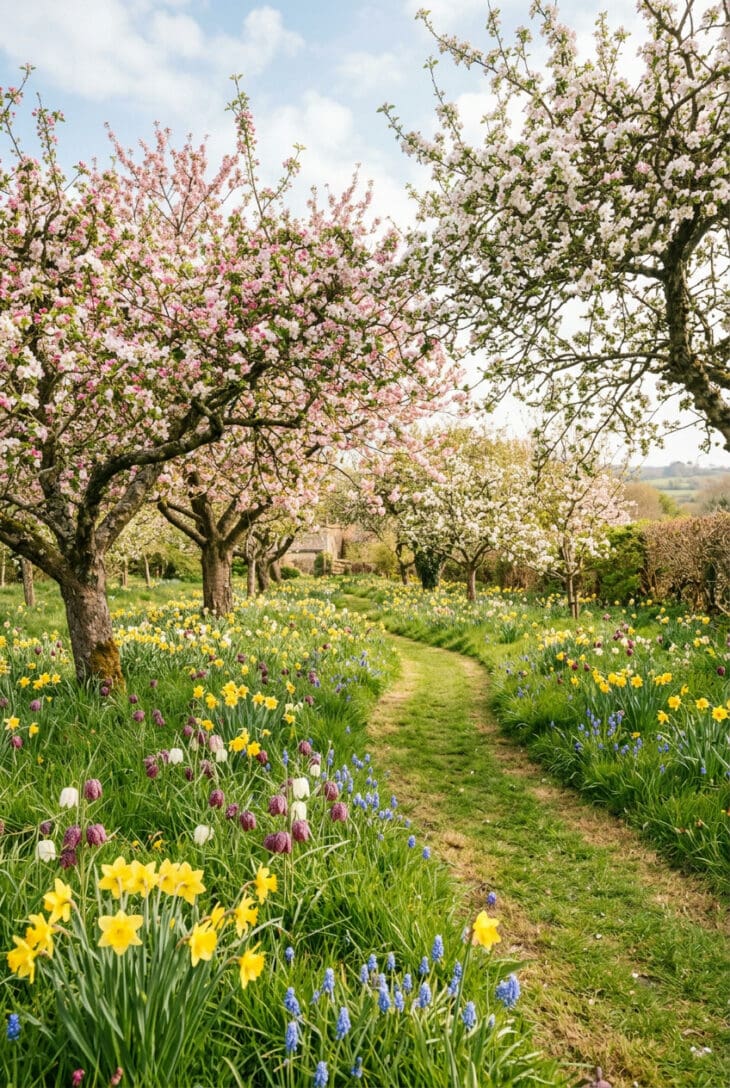
What you see Old fruit trees in full pink and white blossom stand in long grass sprinkled with nodding daffodils, pools of blue grape hyacinths, and purple checkered fritillaries. A mown path runs between the trunks, and petals drift down in the breeze.
Why it works Naturalizing bulbs in grass is a cheap, easy way to make spring feel abundant, and they come back for decades. The trees give height and blossom, the bulbs flower below before the grass grows up, and after that the grass hides the fading leaves. Even two or three spring flowering trees are enough to get the look.
How to get it Plant bulbs in fall, scattering them by the handful and planting them where they land for a natural look. Daffodils go 6in (15cm) deep; grape hyacinths (Muscari armeniacum) and crocuses about 3in (8cm). Checkered fritillary (Fritillaria meleagris) likes moister ground. The key is to wait six weeks after flowering before mowing so the bulbs can recharge. Choose trees on semi-dwarf rootstocks for a small yard.
25. Dry Gravel Garden, Beth Chatto Style
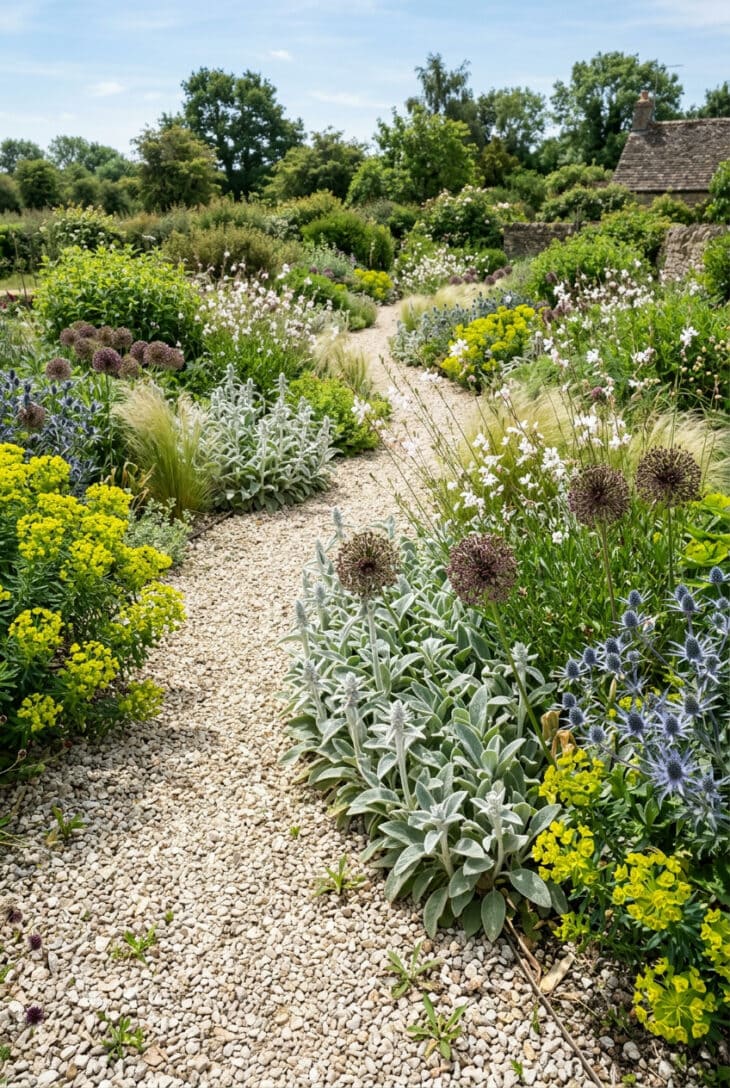
What you see Pale gravel stretches like a dry riverbed, scattered with clumps of silver lamb’s ear, spiky blue sea holly, acid-yellow euphorbia, and airy white gaura dancing on wiry stems. Soft grasses catch the light, and there is no clear edge between path and planting.
Why it works Beth Chatto famously turned an old parking lot in Essex into a gravel garden that is never watered. It’s the English answer to dry summers and a smart choice for sunny, fast-draining yards across the US. Gravel mulch keeps crowns dry, suppresses weeds, and lets plants self-seed into a natural pattern. Our gravel garden ideas go deeper into the style.
How to get it Loosen the soil but don’t enrich it, then plant small plants into it before spreading 2 to 3in (5 to 8cm) of pea gravel on top. Choose tough sun-lovers: whirling butterfly plant (Gaura lindheimeri), sea holly (Eryngium planum), lamb’s ear (Stachys byzantina), and catmint. Water weekly for the first summer only. Allow self-seeders to fill the gaps and edit out any that land in the wrong place.
26. Autumn Border of Asters and Grasses
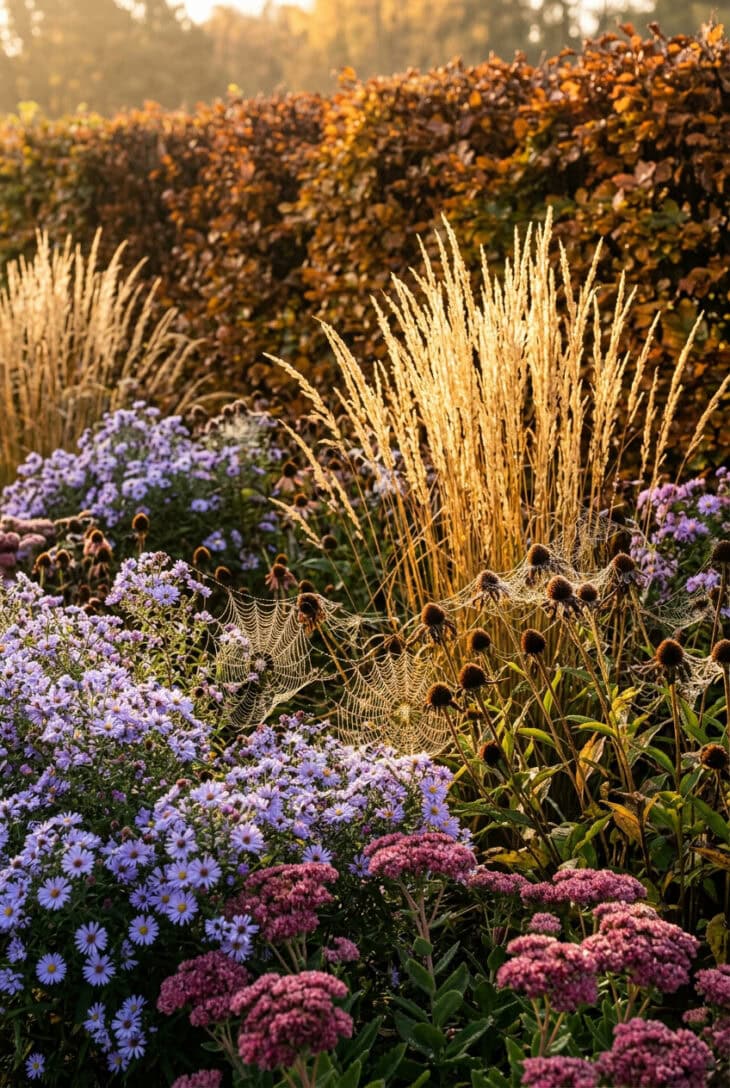
What you see Clouds of lavender-blue and purple asters crowd against rosy sedum heads and the dark cones of coneflowers gone to seed. Tall grasses rise behind, their plumes lit gold by the low October sun, and dew glitters on spider webs strung between the stems.
Why it works English gardeners call asters Michaelmas daisies, after the late September feast, and they carry a border well past the point where most gardens give up. Pairing them with grasses and seedheads makes autumn feel like a second peak rather than a decline. Many of these asters are North American natives, so they are easy to grow here.
How to get it Plant New England aster (Symphyotrichum novae-angliae ‘Purple Dome’), aromatic aster (Symphyotrichum oblongifolium ‘October Skies’), and sedum ‘Autumn Joy’ in drifts about 2ft (60cm) apart. Add switchgrass (Panicum virgatum ‘Shenandoah’) or maiden grass behind for height and movement. Pinch tall asters by half in early June for bushier plants that need no staking. Leave coneflower seedheads standing for the birds. Our perennial garden ideas have more long-season combinations.
27. Pleached Hornbeam Screen
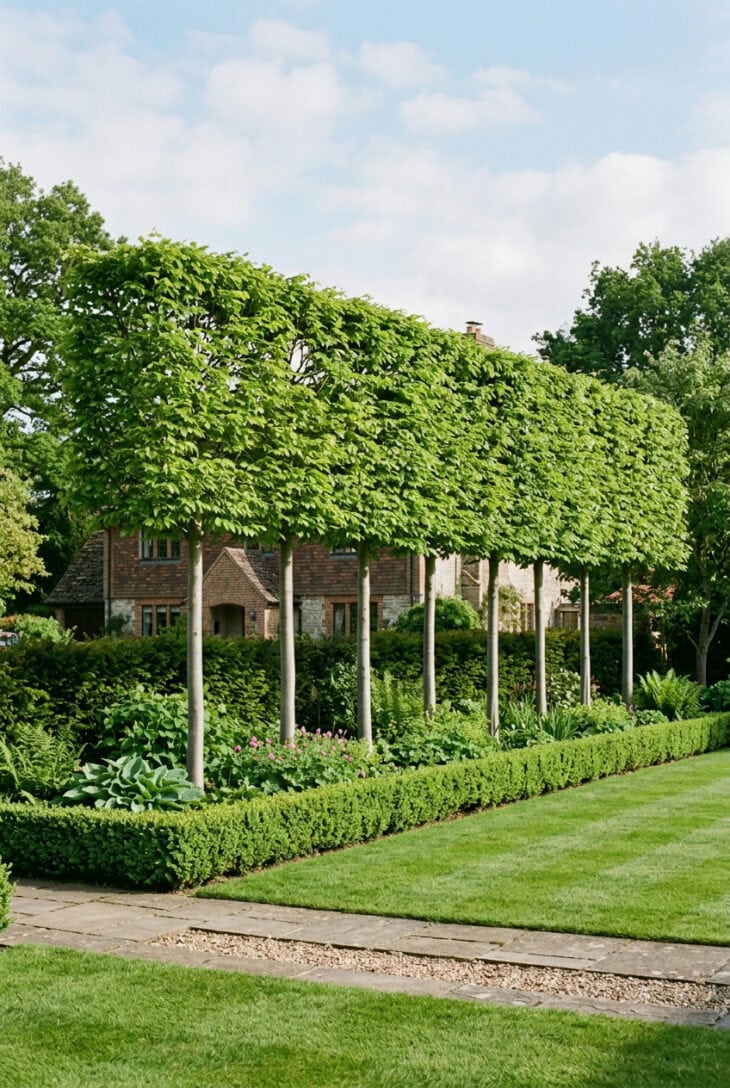
What you see A row of clean gray trunks holds up a flat, rectangular panel of fresh green leaves, like a hedge on stilts. Below it, a low clipped hedge and a strip of lawn keep the ground open, and the house next door has vanished behind the screen.
Why it works Pleaching blocks the view exactly where you need it, at the height of upstairs windows, without taking up ground space. It’s a centuries-old English technique that looks sharp and modern at the same time. For more ways to screen out neighbors, see our garden privacy ideas.
How to get it The quickest route is to buy ready-trained pleached trees with a frame of about 4 by 4ft (120 by 120cm) on a 6ft (180cm) stem, and plant them 5 to 6ft (150 to 180cm) apart. European hornbeam (Carpinus betulus ‘Frans Fontaine’ or ‘Fastigiata’) is ideal because it takes clipping and holds its dead brown leaves through winter. Tie young branches to a bamboo or wire frame until they meet their neighbors. Trim once a year in late summer, keeping the panels flat and square.
28. Hazel Hurdles and Woven Willow
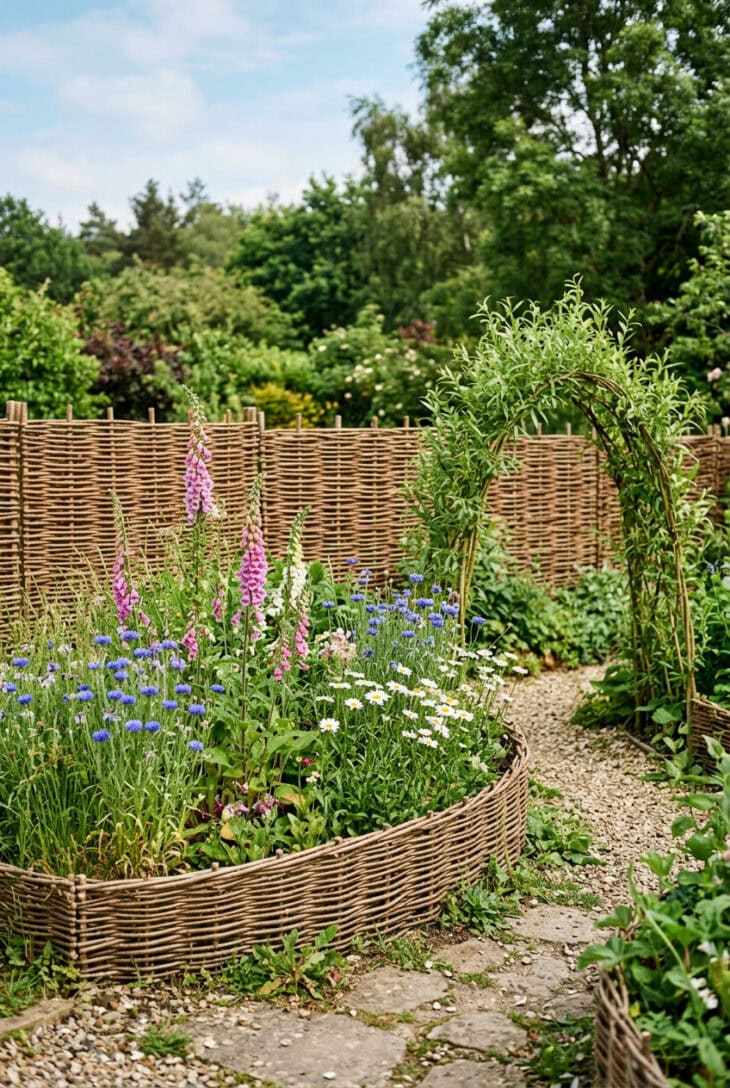
What you see Panels of woven hazel run along the boundary in warm brown tones, and a low willow basket-weave edging holds a raised bed of pink foxgloves, blue cornflowers, and white daisies. Nearby, a living willow arch has sprouted fresh green leaves.
Why it works Hurdles and woven willow have been made in English villages for centuries, and they bring a handmade warmth no fence panel can match. They filter wind rather than blocking it, which is kinder to plants, and they weather to silvery gray. They also suit the budget-conscious, since willow rods are cheap and weaving is an easy skill to learn.
How to get it Buy hurdles ready-made, usually 6ft (180cm) wide, and wire them to sturdy posts driven 2ft (60cm) into the ground; expect them to last eight to ten years. For edging, hammer hazel stakes in 12in (30cm) apart and weave dry willow rods through them. A living arch uses freshly cut willow rods pushed 12in (30cm) into moist soil in winter, and they root by spring. Keep living willow well away from drains and foundations. Our garden fence ideas include more natural materials.
29. Symmetrical Front Path with Box Balls
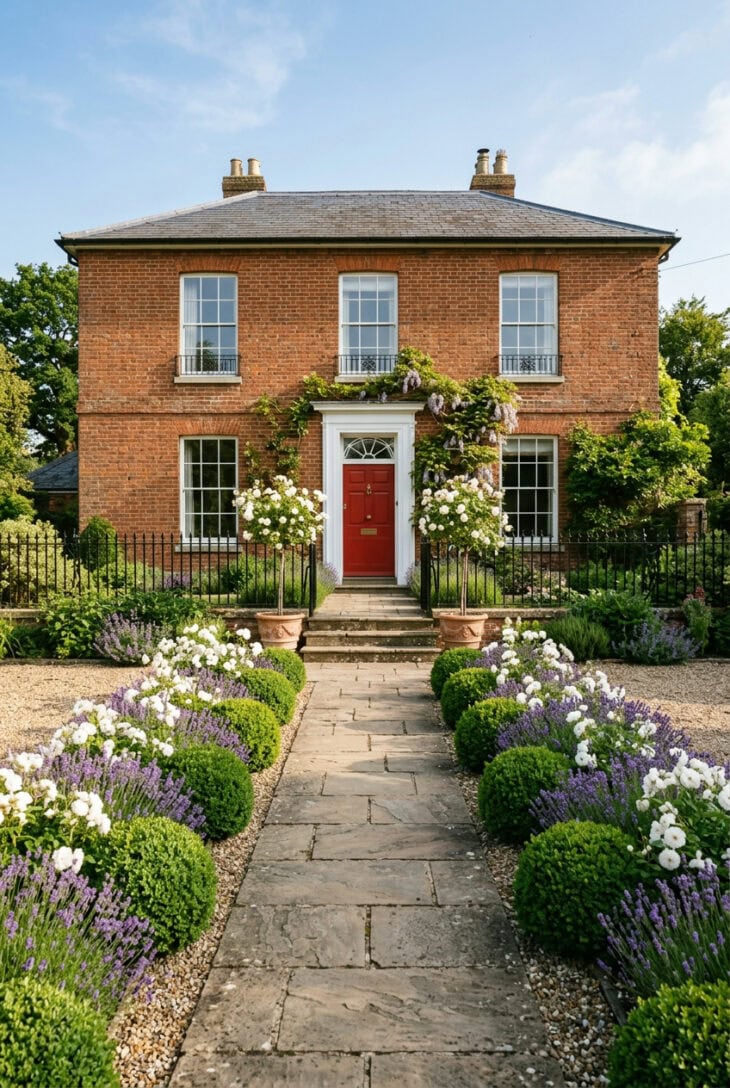
What you see A straight stone path leads to a glossy red front door, lined on both sides by a row of clipped box balls, evenly spaced like buttons. Behind them lavender and white roses soften the scene, and a pair of standard roses marks the steps.
Why it works Symmetry is calming and suits the formal lines of most houses. Repeated box balls create rhythm and lead the eye straight to the door, while the looser flowers behind stop it from feeling stiff. It’s elegant all year, since the evergreens hold the design through winter.
How to get it Space box balls, or inkberry or dwarf yew alternatives, 3 to 4ft (90 to 120cm) apart, and set them 12in (30cm) back from the path. Clip once in early summer and again in late summer to keep the spheres crisp. Plant lavender and a compact rose such as ‘Iceberg’ behind the balls, and put two standard (tree-form) roses in pots at the door. Keep the path at least 4ft (120cm) wide so two people can walk side by side. A crisp line of garden edging finishes the look.
30. Winter Structure of Frost and Seedheads
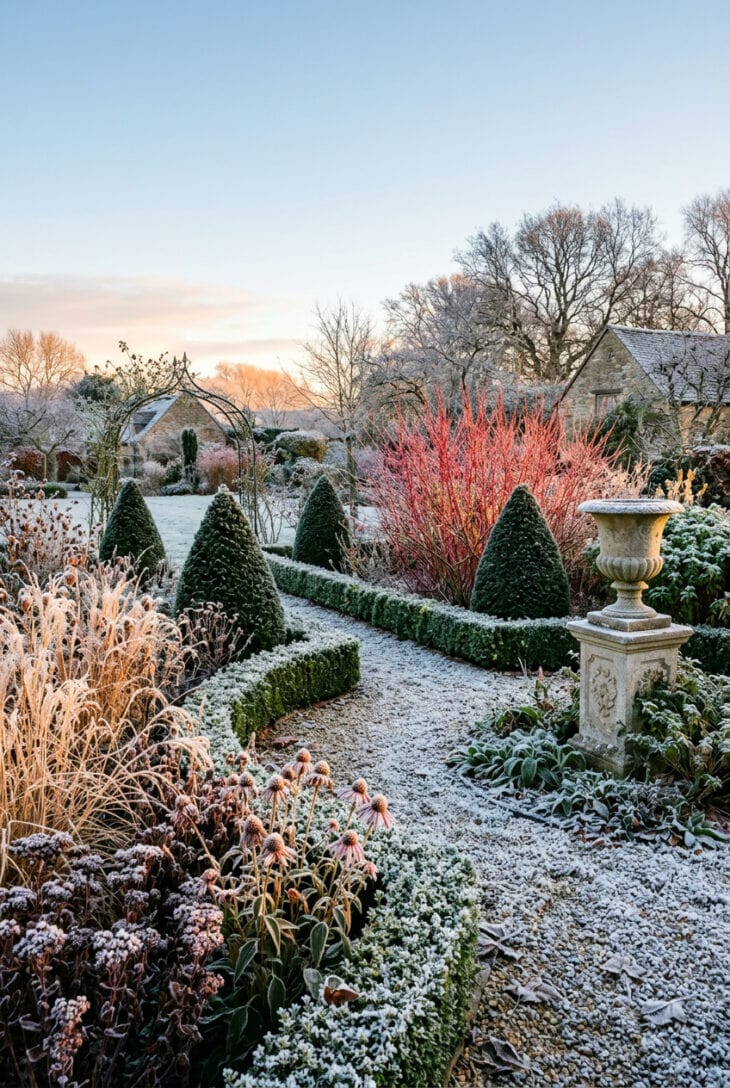
What you see A frosty morning outlines everything in white: the clipped yew cones, the box hedges, and the standing seedheads of grasses, sedum, and coneflowers. A stone urn stands in the middle, and bright red dogwood stems glow in the low sunrise.
Why it works A great English garden is designed to look good in January too. Its “bones”, the hedges, topiary, paths, and ornaments, take center stage once the flowers are gone. Leaving seedheads standing adds texture, catches frost, and feeds birds through the hardest months.
How to get it Walk around your yard in winter and note where the view goes flat, then add evergreen structure there: a yew cone, a box hedge, or a small evergreen tree. Plant red-twig dogwood (Cornus sericea ‘Arctic Fire’) in groups of three and cut a third of the oldest stems to the ground each spring to keep the color bright. Delay cutting back perennials and grasses until late winter. Add one strong ornament, such as an urn, a bench, or a sundial, positioned where you can see it from the kitchen window.