Ornamental grasses are the plants that make a garden move. They catch every breeze, glow when the sun drops low behind them, and keep their seedheads standing through frost and snow, long after the flowers around them have given up.
Contents
- 01. Plant a Prairie-Style Matrix
- 02. Backlight a Drift of Switchgrass
- 03. Float a Cloud of Pink Muhly
- 04. Line a Modern Walk With Feather Reed Grass
- 05. Spill Japanese Forest Grass Down Shady Steps
- 06. Build a Blue Palette in Gravel
- 07. Crown a Pot With Purple Fountain Grass
- 08. Ripple a Dry Bed With Feather Grass
- 09. Swap Lawn for Pennsylvania Sedge Under Trees
- 10. Leave Seedheads Standing for Winter
- 11. Edge a Driveway With Fountain Grass and Catmint
- 12. Fill a Rain Garden With Sedges and Rushes
- 13. Grow a Summer Screen of Tall Native Grass
- 14. Hold a Bank With Native Bunchgrasses
- 15. Plant a Hellstrip With Blue Grama
- 16. Go Coastal With Beach Grass and Switchgrass
- 17. Grid Autumn Moor Grass in a Courtyard
- 18. Pair Golden Sedge With Fall Mums in Planters
- 19. Weave Grasses Through Asters and Goldenrod
- 20. Soften a Cottage Border With Tufted Hair Grass
- 21. Grow Annual Grasses for Bouquets
- 22. Uplight Grasses After Dark
- 23. Windproof a Balcony With Grass Troughs
- 24. Pair Deer Grass With Agave in a Desert Yard
- 25. Mow a Path Through a Tall Grass Meadow
The ideas below run from a 6in (15cm) sedge lawn under oaks to a 6ft (180cm) summer screen, and from a single pot on a balcony to a meadow with a mown path through it. There are grasses for dry shade, wet clay, salt spray and desert heat, and most of them are North American natives that feed birds and shelter insects through winter.
Scroll through for inspiration, or jump to the ideas that suit your light and soil. Each one names the exact grasses to buy, how far apart to plant them, and the one or two mistakes that usually cause a grass planting to flop.
01. Plant a Prairie-Style Matrix
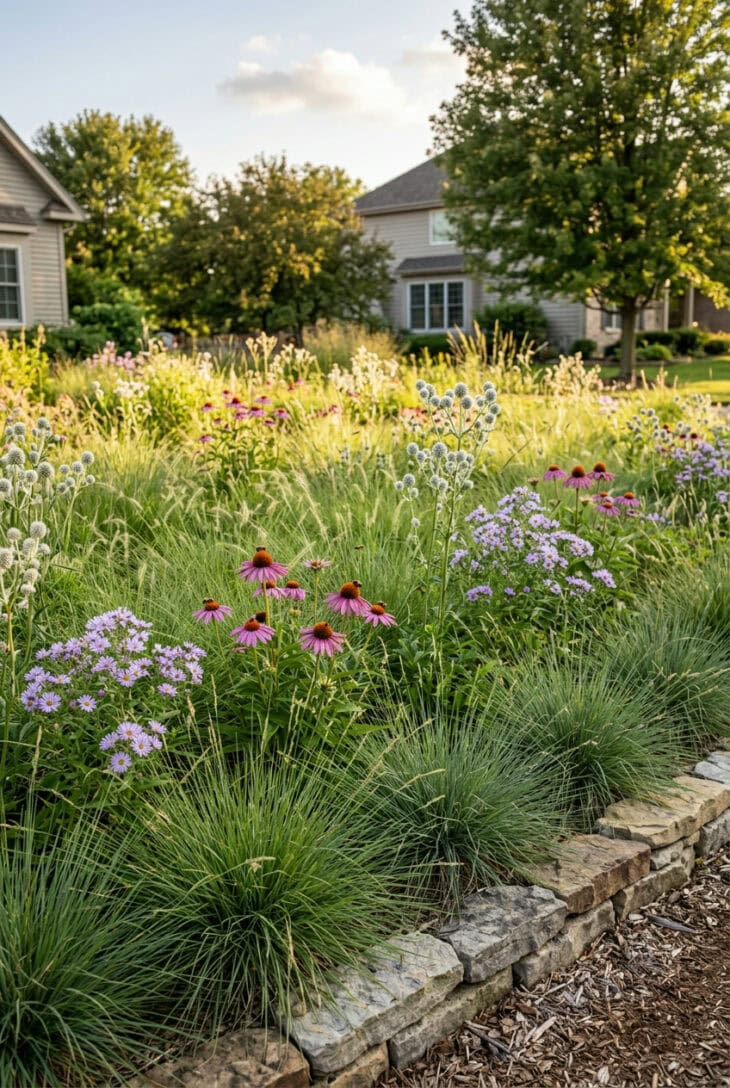
What you see A sea of fine green grass, soft enough to look brushed, with flowers floating up through it in loose clusters. Purple coneflowers, silver spheres of rattlesnake master and lavender asters seem to have arrived on their own. Bees work the coneflowers, and the whole bed shifts a little whenever the wind picks up.
Why it works This is matrix planting, the approach popularized by designers Piet Oudolf and Roy Diblik. A low grass covers most of the ground the way it does on a real prairie, so there is no bare soil for weeds, and the flowers read as highlights instead of competing for attention. Because the grass carries the look from spring to the following February, the bed never has an empty season, which is what most perennial garden designs struggle with.
How to get it Let grass make up about two thirds of the plants: prairie dropseed (Sporobolus heterolepis) and little bluestem (Schizachyrium scoparium ‘Standing Ovation’), both hardy in Zones 3–9. Plant them from plugs 15 to 18in (40 to 45cm) apart, then tuck in purple coneflower (Echinacea purpurea), rattlesnake master (Eryngium yuccifolium) and aromatic aster (Symphyotrichum oblongifolium) singly or in threes through the gaps. Prairie dropseed is slow, so expect the bed to look sparse for two summers and fill in by the third. Leave everything standing over winter and cut it all to 4in (10cm) in late winter, before new growth starts.
02. Backlight a Drift of Switchgrass
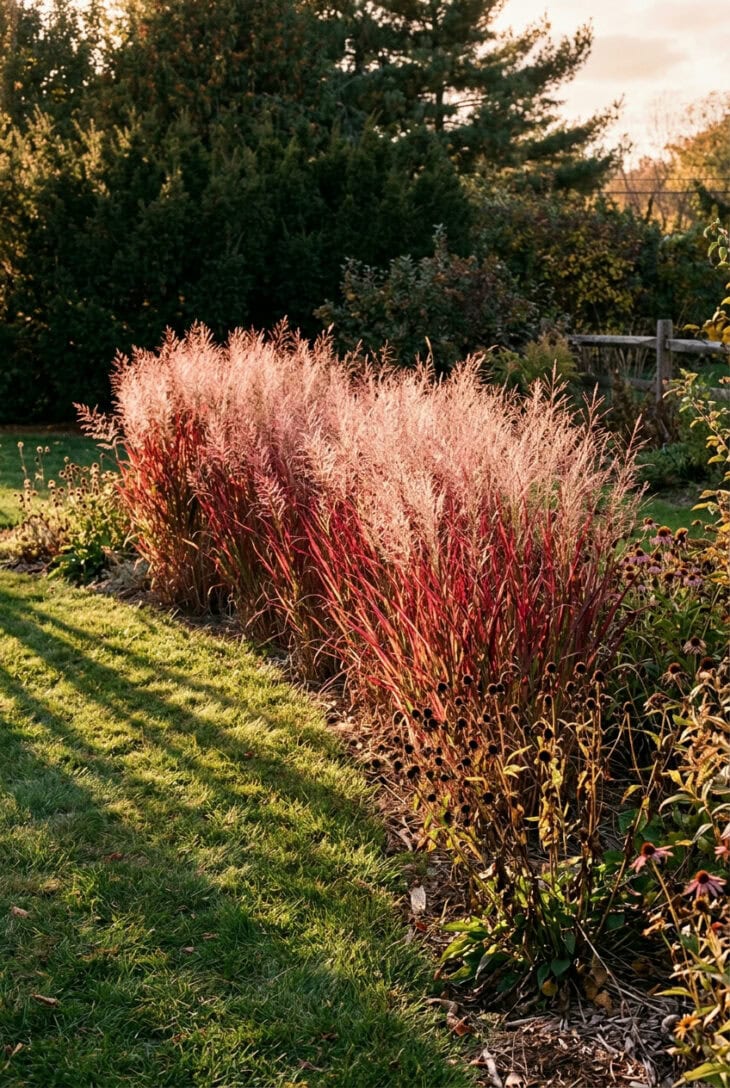
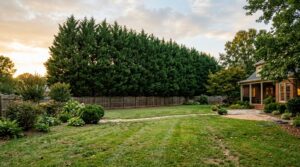
What you see A row of upright grass clumps turning wine-red at the tips, topped with a haze of tiny seeds that lights up pink and gold as the sun sinks behind them. Dark evergreens at the back make the glow stand out. Long shadows stretch across the lawn toward you.
Why it works Grass seedheads are translucent, so they only really shine when light comes through them rather than onto them. Planting between yourself and the setting sun turns a pleasant border into the best view of the evening, and switchgrass holds that show from late summer well into winter. It is one of the easiest ways to add drama to a fall garden without adding a single flower.
How to get it Stand where you usually sit in the evening, note where the sun sets in September and October, and plant on that line. Red switchgrass (Panicum virgatum ‘Shenandoah’) reaches about 3 to 4ft (90 to 120cm) and is hardy in Zones 5–9; plant it in groups of five or more, 24in (60cm) apart. Give it full sun and lean soil, because shade or rich, heavily fed beds make switchgrass flop open by August. A dark backdrop of arborvitae, yew or a stained fence doubles the effect.
03. Float a Cloud of Pink Muhly
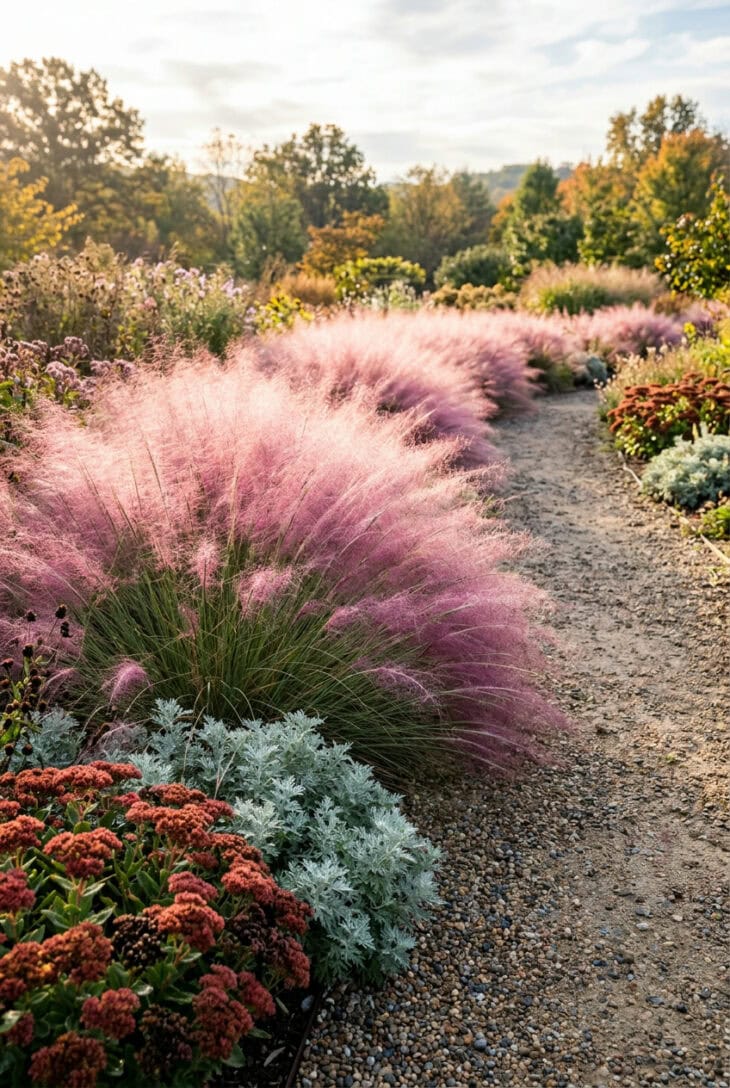
What you see A soft pink haze hovering at knee height along a gravel path, so fine you can see the plants behind it. Dew catches on the flower threads in the low morning sun. Rusty sedum heads and silver artemisia sit in front like stepping stones.
Why it works Pink muhly spends all summer as a tidy green mound, then erupts into color in September and October, just as most of the garden fades. The bloom is airy rather than solid, so a long sweep reads as one cloud instead of a row of shrubs. It is native from the Central and Eastern US south to Central America, which makes it tough in heat and drought once settled.
How to get it Plant pink muhly (Muhlenbergia capillaris) in full sun, 24 to 30in (60 to 75cm) apart, in a line or drift of at least five; one plant alone looks thin. It grows 2 to 3ft (60 to 90cm) tall and is listed for Zones 5–9, but it is only reliable from Zone 6 south. Drainage decides whether it survives winter: wet clay kills it, so plant on a slight mound or into gravelly soil. Do not cut it back in fall; trim to 4in (10cm) in late winter.
04. Line a Modern Walk With Feather Reed Grass
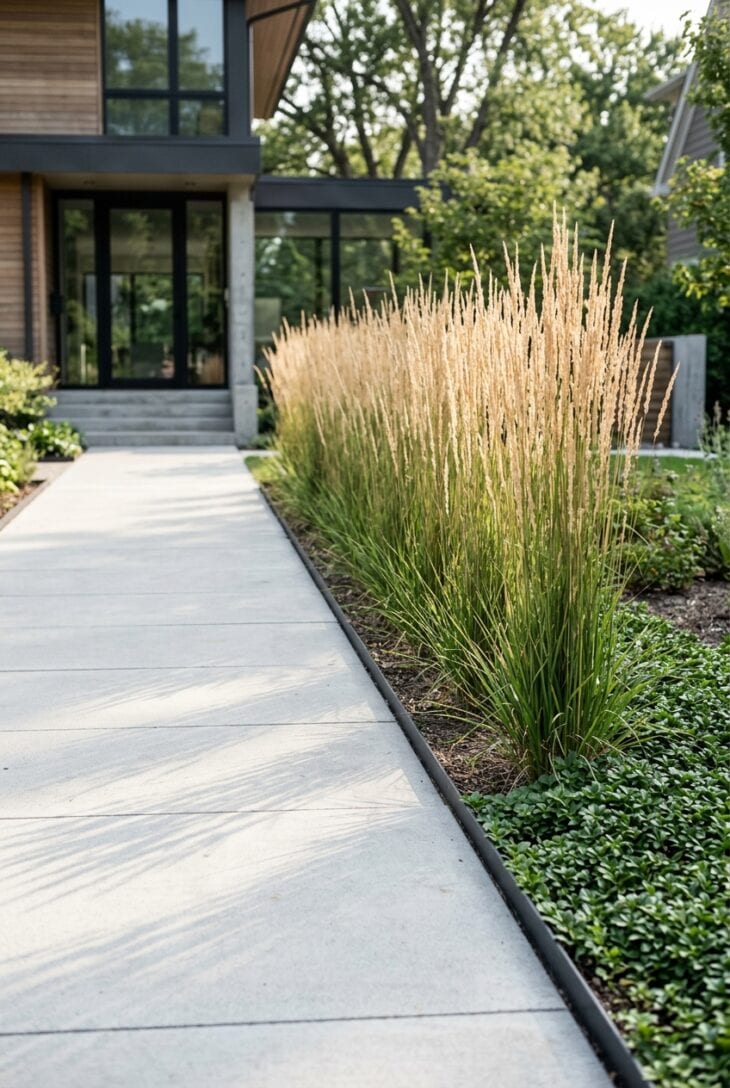
What you see A row of narrow grass columns marching beside a pale concrete walk, each one topped with tight wheat-colored plumes at chest height. Their shadows stripe the pavers in the afternoon sun. Below them, a low dark groundcover and a line of black steel keep everything crisp.
Why it works Feather reed grass grows straight up instead of arching, so it behaves like a living fence post: strong, repeated verticals that suit sharp lines and plain materials. Repetition is the whole trick in modern garden design, and a single grass repeated a dozen times does it better than a mix. It still moves in the wind, which keeps the look from feeling stiff.
How to get it Use feather reed grass (Calamagrostis × acutiflora ‘Karl Foerster’), hardy in Zones 4–9 and about 4 to 5ft (120 to 150cm) tall in flower. Space plants exactly 18 to 24in (45 to 60cm) apart on a string line; uneven gaps are what make a row look accidental. It flowers in early summer, earlier than most grasses, and the seedheads do not ripen into seedlings, so it stays where you put it. It handles clay better than most grasses, but cut it back in early spring, because it starts growing while the soil is still cold.
05. Spill Japanese Forest Grass Down Shady Steps
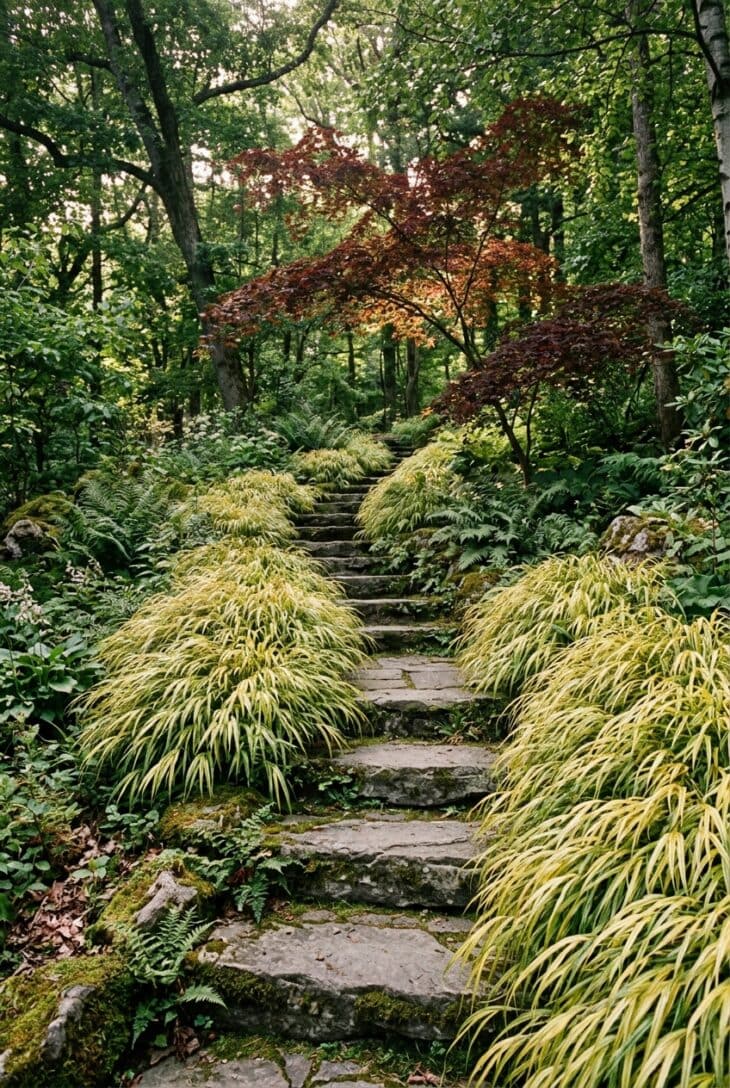
What you see Stone steps climbing through dappled shade, their edges hidden under waterfalls of gold-and-green grass. Every blade arches the same way, as if combed downhill. A red-leaved maple leans over the top step, and moss fills the joints.
Why it works Most grasses need sun; this one is the exception, and its gold leaves brighten a dark corner the way a patch of sunlight would. The mounds all lean in one direction, so on a slope or a step edge they look like flowing water, the effect it is famous for in Japanese garden design. It is also one of the few grasses with real fall color, turning pink and copper before it goes dormant.
How to get it Golden Japanese forest grass (Hakonechloa macra ‘Aureola’) is hardy in Zones 5–9 and grows 12 to 18in (30 to 45cm) tall. Plant it 18in (45cm) apart in moist, rich soil with morning sun or bright dappled shade; hot afternoon sun scorches the leaves, and deep shade turns them green. It spreads slowly, so buy enough plants to fill the space rather than waiting for it. A Japanese maple (Acer palmatum) overhead completes the picture, and the pairing works in most shade garden designs.
06. Build a Blue Palette in Gravel
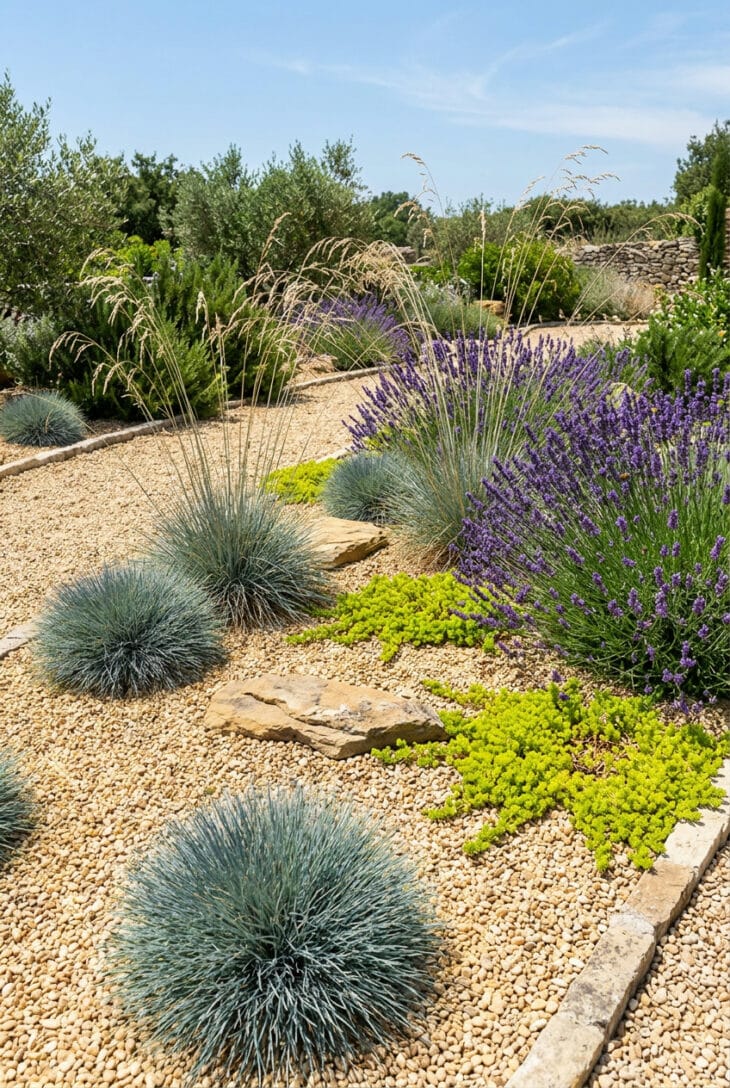
What you see Pale gravel dotted with steel-blue tufts, some low and round like pincushions, some taller and fountain-shaped with tan flower stems arching out. Purple lavender hums with bees between them. A chartreuse carpet of sedum creeps around half-buried sandstone rocks.
Why it works Blue foliage and pale gravel are made for each other: the gravel reflects light and heat, and the blue leaves look cool against it. Both grasses come from dry, stony hillsides in southern Europe, so they want exactly what a gravel garden gives them, which is sharp drainage and no wet feet in winter. The two heights, one ball-shaped and one fountain-shaped, keep a single color from looking flat.
How to get it Combine blue fescue (Festuca glauca ‘Elijah Blue’), 9 to 12in (23 to 30cm) tall, with blue oat grass (Helictotrichon sempervirens), 2 to 3ft (60 to 90cm) tall; both are hardy in Zones 4–8. Space fescue 12in (30cm) apart and oat grass 24in (60cm) apart, then add English lavender (Lavandula angustifolia ‘Hidcote’) and golden sedum (Sedum rupestre ‘Angelina’). Both grasses rot in humid, wet summers, so this is a better fit for the West, the Mountain states and the cooler North than the Southeast. Blue fescue is short-lived: divide or replace clumps every two to three years when the centers go brown.
07. Crown a Pot With Purple Fountain Grass
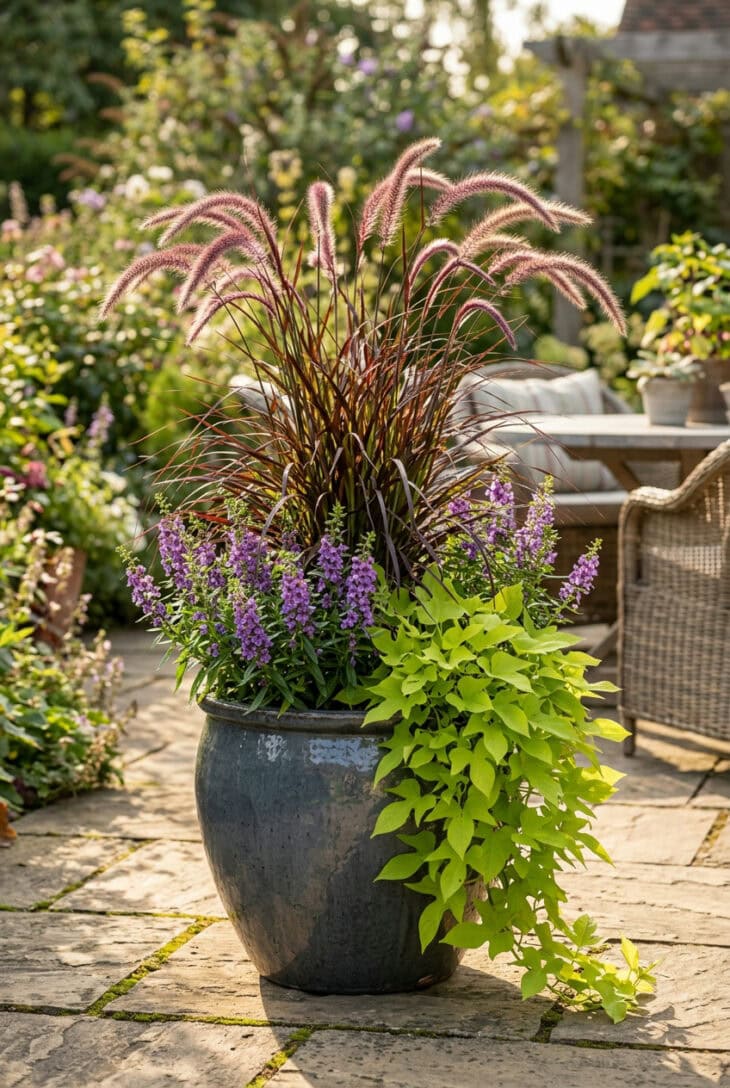
What you see A big charcoal pot on a warm stone patio, crowned with a fountain of burgundy blades and fuzzy rose-purple plumes that nod over the rim. Purple-blue angelonia stands at its feet. Chartreuse sweet potato vine pours down the side and onto the stone.
Why it works Purple fountain grass is the classic “thriller” for a mixed pot: tall, arching and dark, so everything around it looks brighter. A grass adds height without the heavy, top-weighted look of a shrub, and it moves when people walk past. The burgundy against chartreuse is one of the most reliable color pairings in container gardening.
How to get it Use a pot at least 18in (45cm) across, with purple fountain grass (Pennisetum × advena ‘Rubrum’, often sold as P. setaceum ‘Rubrum’) in the center, three summer snapdragons (Angelonia angustifolia) around it and sweet potato vine (Ipomoea batatas ‘Margarita’) at the edge. It is hardy only in Zones 9–11, so everywhere else treat it as an annual and compost it after frost. ‘Rubrum’ is considered sterile, but its green parent species is invasive in Arizona, California and Hawaii, and some invasive-plant groups there advise against planting any fountain grass. Plant after your last frost, when nights stay above 50°F (10°C).
08. Ripple a Dry Bed With Feather Grass
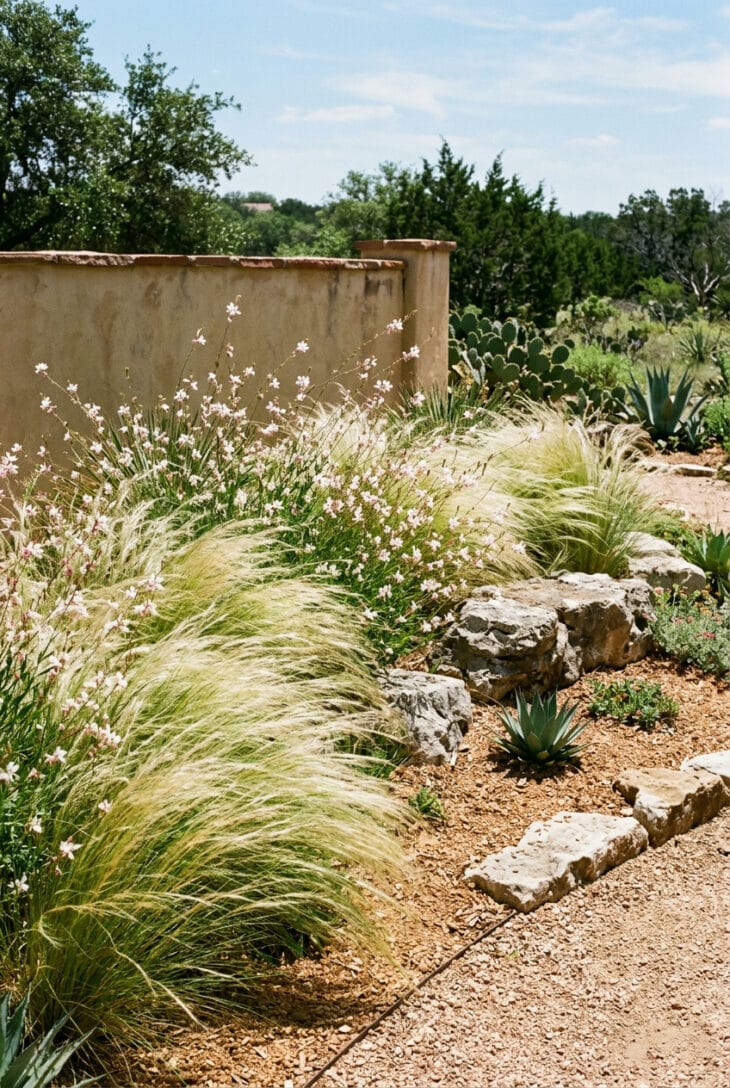
What you see A drift of grass so fine it looks like blonde hair, rippling in waves every time the breeze moves. White and pale pink gaura flowers flutter above it on thin wands. Limestone boulders and a low stucco wall frame the scene in strong sun.
Why it works Nothing shows wind like Mexican feather grass: its threads respond to the faintest air, so the bed is never still. It is native to Texas and New Mexico, where it thrives on heat, poor soil and little water. Paired with whirling butterfly plant (Gaura lindheimeri), another Texas native that moves in the breeze, it makes a bed that looks soft but is as tough as anything you can grow.
How to get it Plant Mexican feather grass (Nassella tenuissima) 12 to 18in (30 to 45cm) apart in full sun and gritty, well-drained soil; it grows 1 to 2ft (30 to 60cm) tall and is hardy in Zones 7–10. Know its drawback before you buy: it seeds prolifically, and the California Invasive Plant Council lists it as an invasive plant, so California gardeners should skip it entirely. Elsewhere, pull seedlings each spring and keep it away from open land. East of the Rockies, prairie dropseed (Sporobolus heterolepis) gives a similar fine texture with no seeding problem.
09. Swap Lawn for Pennsylvania Sedge Under Trees
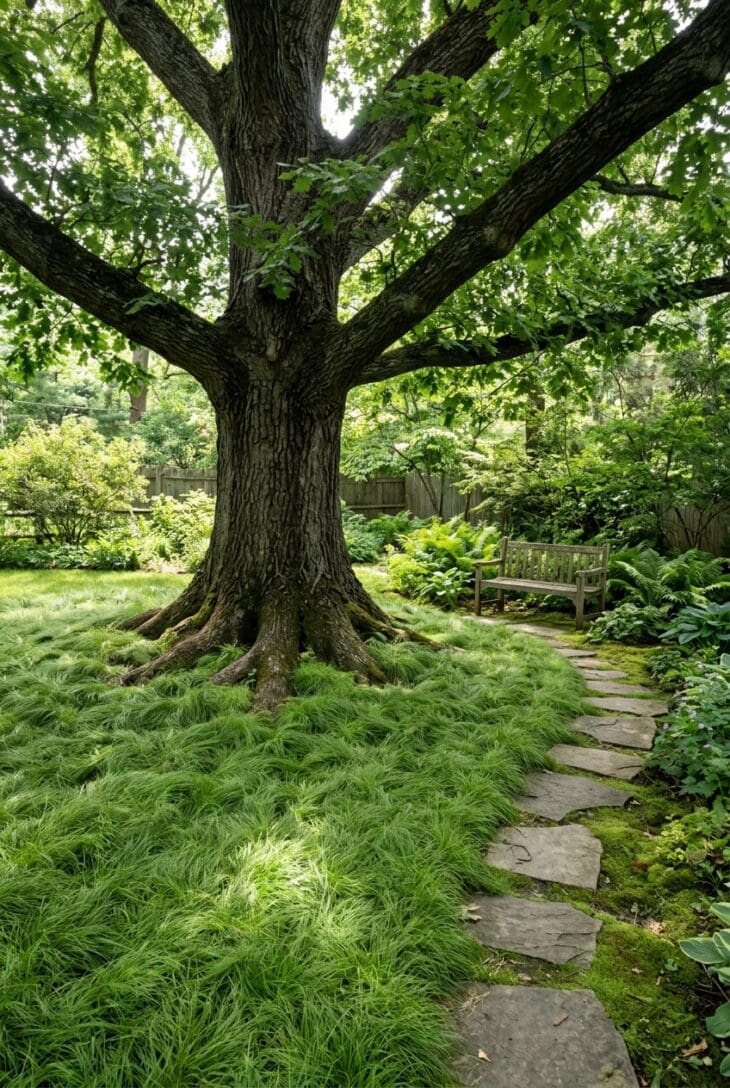
What you see A soft, shaggy green carpet under a big oak, flowing right up to the trunk where turf would have given up. Flat stepping stones cross it toward a wooden bench. Dappled light moves across the surface like light on water.
Why it works Turf grass needs sun and fights tree roots for water, which is why the ground under big trees is so often bare dirt and moss. Pennsylvania sedge evolved in exactly that spot, in dry eastern oak woods, so it fills in where lawn never will. It stays low and fine enough to read as a lawn from a distance, but needs no mowing, feeding or watering once established, one of the best low-maintenance ideas for a shady yard.
How to get it Pennsylvania sedge (Carex pensylvanica) is hardy in Zones 3–8 and grows 6 to 8in (15 to 20cm) tall. Buy it as plugs and plant them 8 to 12in (20 to 30cm) apart in spring or early fall; closer spacing fills in within two seasons. Water weekly for the first summer, then leave it alone. It takes light foot traffic, not football, so lay stepping stones on any regular route.
10. Leave Seedheads Standing for Winter
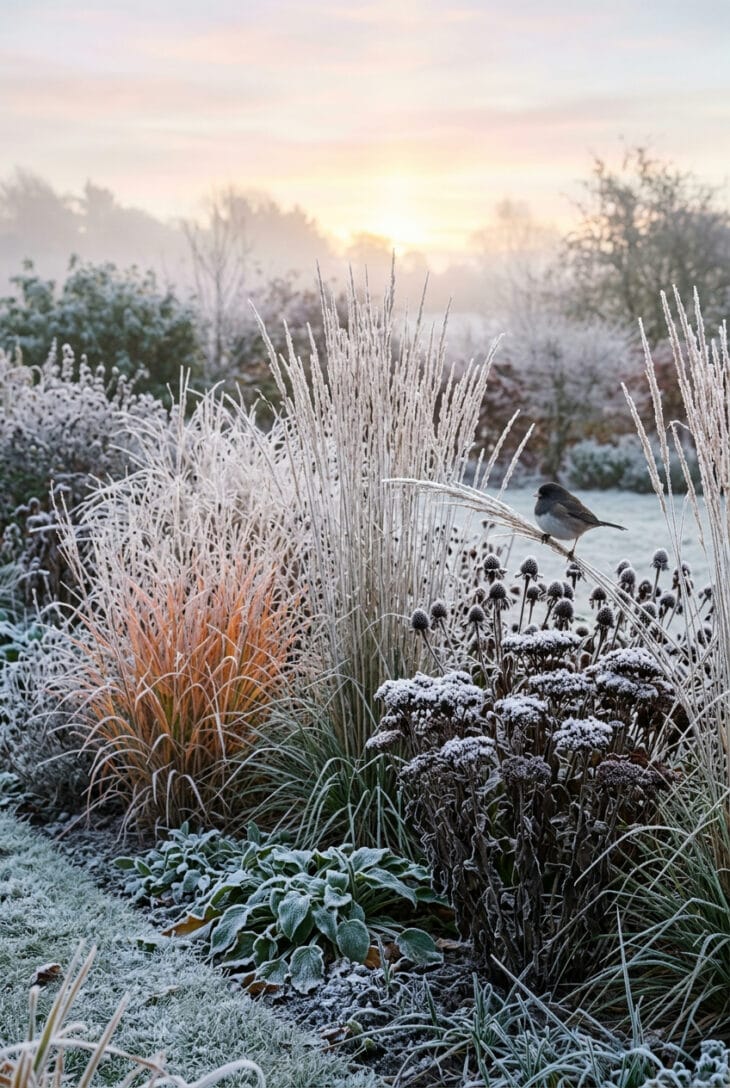
What you see Tan and copper grasses outlined in white frost at sunrise, every seedhead sparkling. Dark coneflower heads wear little caps of ice. A junco balances on a bent grass stem, picking at the seeds.
Why it works Grasses hold their shape after frost, so a bed cut back in October is bare for five months, while a bed left standing keeps its structure all winter. The seedheads feed sparrows, juncos and finches, and the hollow stems and clumps shelter overwintering insects, which makes this one of the simplest wildlife garden ideas there is. It is also less work: one cleanup in late winter instead of one in fall.
How to get it Choose grasses that stand up to snow: feather reed grass, switchgrass ‘Northwind’ and little bluestem all hold well, and they pair with other plants that look good all winter. Leave them until late winter, then cut to 4 to 6in (10 to 15cm) before new green shoots appear. The fast way is to wrap each clump tightly with twine or a bungee cord first and cut below it with a hedge trimmer, so the whole top lifts off in one bundle. In wildfire country, dry grass is fuel, so cut back anything within 5ft (1.5m) of the house in fall instead.
11. Edge a Driveway With Fountain Grass and Catmint
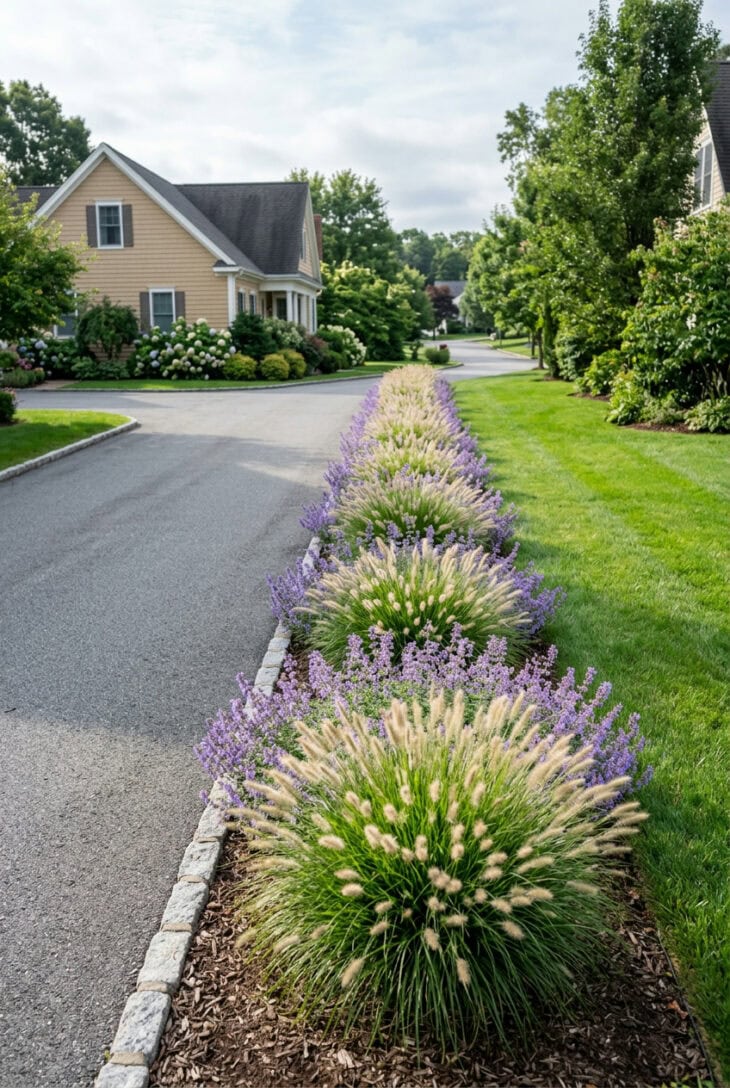
What you see A strip beside the driveway where rounded grass fountains, covered in fuzzy cream plumes, alternate with billows of lavender-blue catmint. The pattern repeats all the way to the street. In the morning light the plumes look soft enough to stroke.
Why it works A driveway strip is hot, narrow and usually ignored, and both plants shrug off reflected heat, drought and road dust. The soft mounds hide the hard edge of the asphalt, and the simple A-B-A-B rhythm reads as deliberate from the street, which does a lot for front yard curb appeal. Catmint blooms in late spring and again after a trim, then the grass takes over from late summer.
How to get it Alternate dwarf fountain grass (Pennisetum alopecuroides ‘Hameln’), 2 to 3ft (60 to 90cm) tall and hardy in Zones 5–9, with catmint (Nepeta ‘Walker’s Low’), spacing both 24 to 30in (60 to 75cm) apart. Keep both 12in (30cm) back from the paving so they don’t get run over or plowed. The species has become a weed in parts of the Mid-Atlantic, and ‘Hameln’ reseeds far less, but pull any seedlings you find. If you would rather avoid the risk entirely, prairie dropseed fills the same role.
12. Fill a Rain Garden With Sedges and Rushes
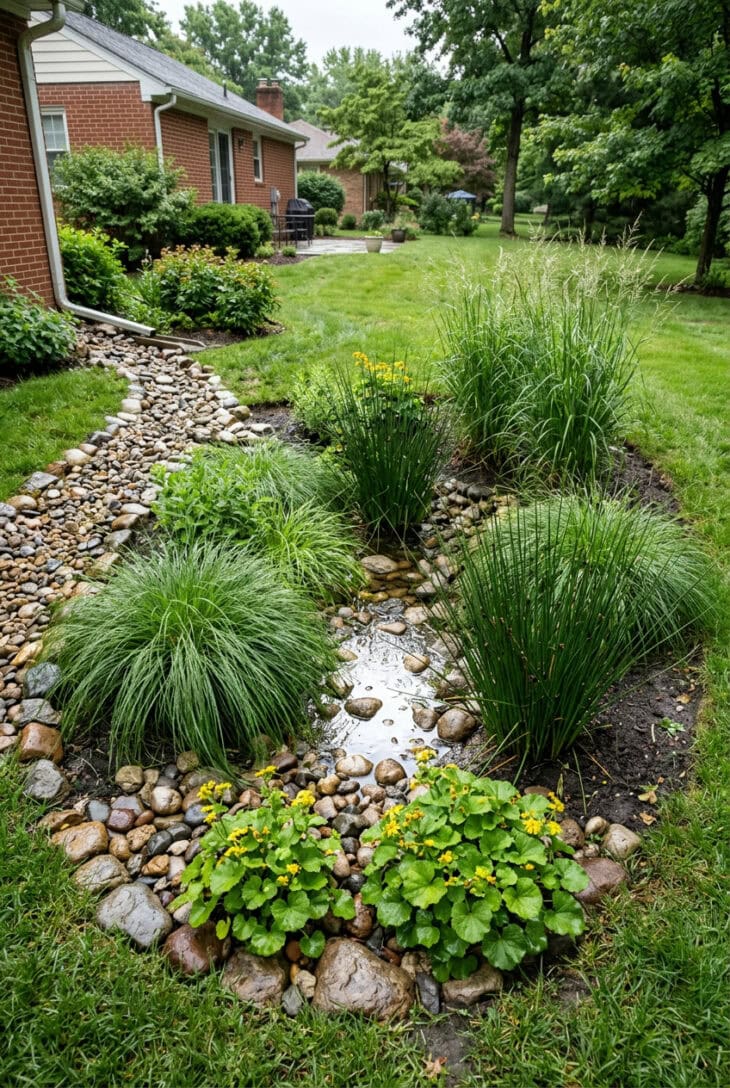
What you see A shallow bowl in the lawn with puddles shining between river rocks after a shower. Fountain-shaped sedges and stiff dark green rushes fill the low ground, with a clump of switchgrass on the drier rim. A stone channel carries water in from the downspout.
Why it works Sedges and rushes grow naturally in wet meadows that flood and then dry out, which is exactly what a rain garden does after every storm. Their dense, fibrous roots open up heavy soil so water soaks in faster, and they look tidy year-round where many wetland flowers sprawl. Grassy foliage also hides the bare mud that a rain garden shows in its first year.
How to get it In the bottom of the bowl, plant tussock sedge (Carex stricta), fox sedge (Carex vulpinoidea) and soft rush (Juncus effusus), all native to wet ground across much of the East and Midwest, about 12 to 18in (30 to 45cm) apart. On the rim, where it only floods briefly, add switchgrass (Panicum virgatum) and golden ragwort (Packera aurea). Site the bowl at least 10ft (3m) from the house foundation and dig it 4 to 8in (10 to 20cm) deep. Plugs establish faster than seed in wet soil and resist being washed out.
13. Grow a Summer Screen of Tall Native Grass
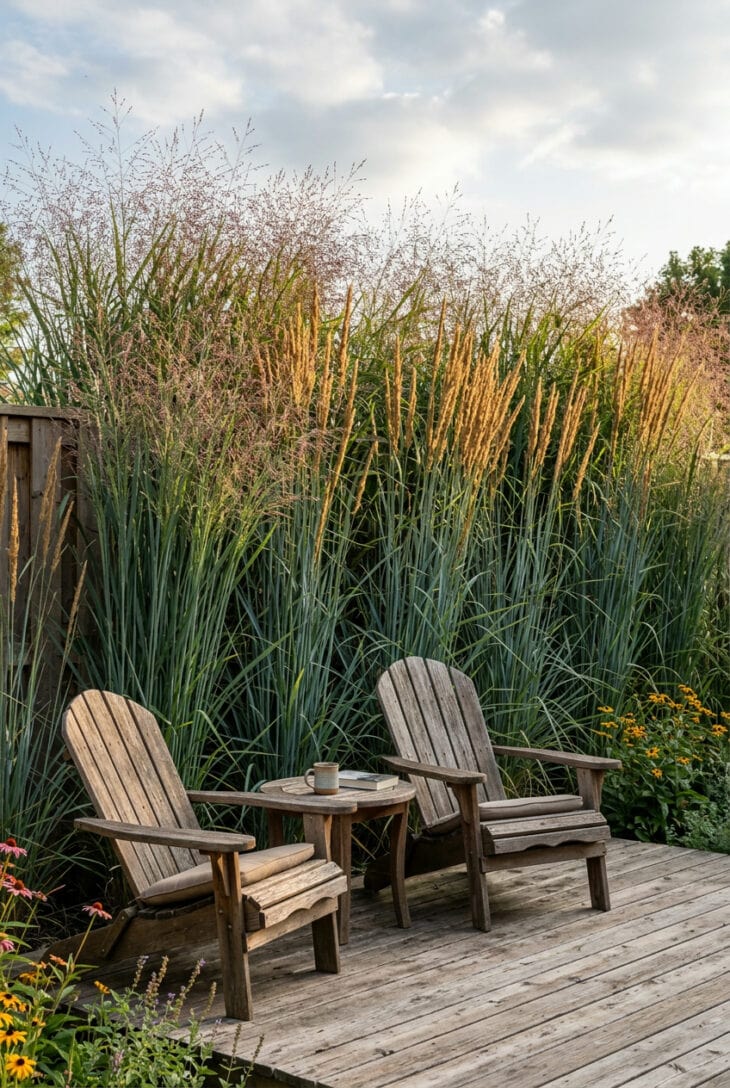
What you see A wall of tall blue-green grass, higher than a standing person, wrapping the back of a small patio. Golden-bronze plumes sway along the top. You cannot see the neighbor’s yard at all, only grass and sky.
Why it works Tall native grasses reach full height in a single summer from a 1-gallon pot, which no shrub can match, and they cost a fraction of a hedge. They screen softly, with movement and sound, rather than looking like a barrier. The trade-off is honest: they are cut back in late winter, so the screen is gone from March until early summer, which is fine for a patio you use in warm months and the wrong choice among year-round privacy ideas.
How to get it Plant a staggered double row of switchgrass (Panicum virgatum ‘Northwind’), 5 to 6ft (150 to 180cm) tall, and Indian grass (Sorghastrum nutans ‘Sioux Blue’), 5 to 7ft (150 to 210cm), 24 to 30in (60 to 75cm) apart. Both are North American natives for full sun, and both are hardy across most of the country. You will see Chinese silver grass (Miscanthus sinensis) sold for the same job, but it has escaped into roadsides and woodland edges and is reported invasive in more than a dozen eastern states, so skip it. Dry grass burns readily, so keep a tall screen away from a fire pit or grill.
14. Hold a Bank With Native Bunchgrasses
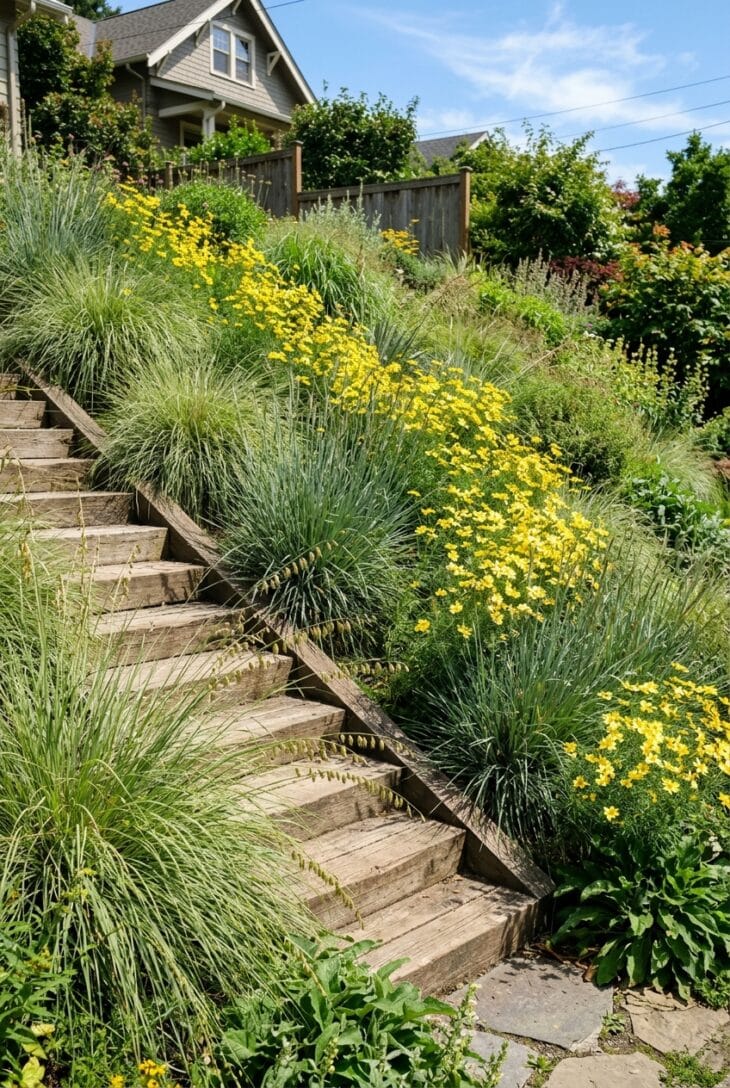
What you see A steep bank that used to be mown is now a thick quilt of blue-green and fine green grass clumps. Yellow coreopsis glows in drifts between them, and sideoats grama dangles its little seeds along one side of each stem. Timber steps climb up beside it.
Why it works Mowing a slope is dangerous and turf roots are shallow, so banks tend to scalp and erode. Prairie bunchgrasses send dense, fibrous roots far deeper than lawn grass, which binds the soil, and they never need mowing. It is the easiest of all sloped garden ideas to maintain: one cut in late winter.
How to get it Mix little bluestem (Schizachyrium scoparium), prairie dropseed (Sporobolus heterolepis) and sideoats grama (Bouteloua curtipendula), then add threadleaf tickseed (Coreopsis verticillata ‘Zagreb’) for color. Lay biodegradable jute or coir netting over the bare slope first, cut slits and plant plugs through it 12 to 15in (30 to 40cm) apart in a staggered pattern so there is no straight channel for water to run down. Plugs are better than seed on a steep bank, since rain washes seed off before it sprouts. Water through the first summer; after that, the grasses are drought tolerant.
15. Plant a Hellstrip With Blue Grama
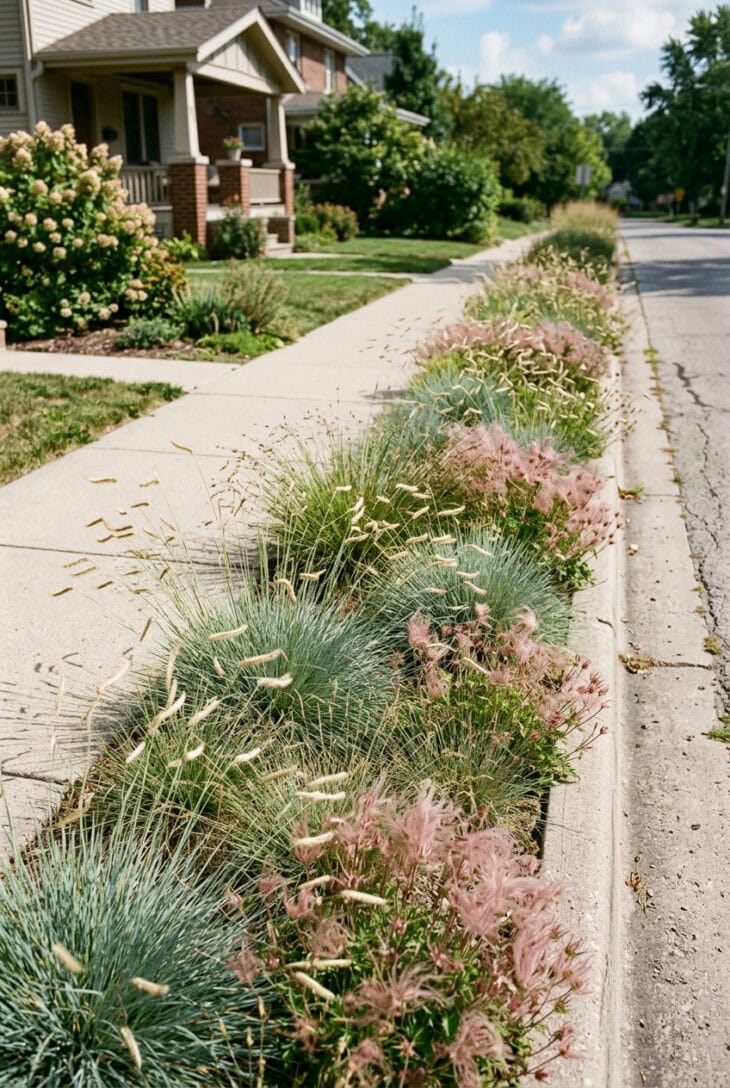
What you see The strip between the sidewalk and the curb, usually patchy turf, filled with low blue-green grass. Blonde seed heads shaped like tiny eyelashes hang sideways from thin stems all over it. Feathery pink plumes of prairie smoke tuck in near the walk.
Why it works The hellstrip is the hottest, driest, most trampled ground on the lot, and blue grama is a shortgrass prairie native that grows naturally in dry, sunny plains. It stays low enough to keep sightlines clear for drivers, and the eyelash seed heads give passersby something to look at. Once settled it rarely needs watering outside long droughts.
How to get it Plant blue grama (Bouteloua gracilis ‘Blonde Ambition’), hardy in Zones 4–9, 18 to 24in (45 to 60cm) apart, with prairie dropseed and, in northern yards, prairie smoke (Geum triflorum), which prefers cool summers. Check with your city first: many towns set a height limit or rules for curb strips, and utility lines often run underneath, so call 811 before digging. Keep anything taller than 24in (60cm) away from driveways and corners. Leave a stepping-stone gap or two where people get out of parked cars.
16. Go Coastal With Beach Grass and Switchgrass
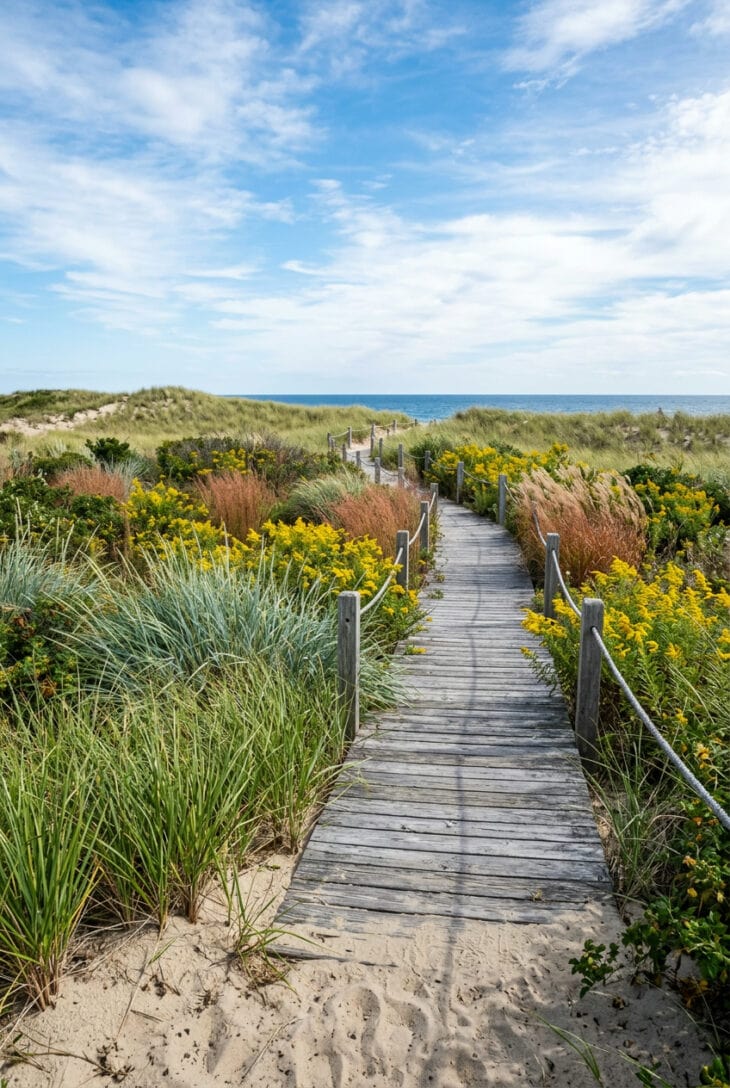
What you see A weathered boardwalk running through sand toward a strip of blue ocean. Beach grass bends in the wind on either side, giving way to blue-green switchgrass and copper little bluestem. Seaside goldenrod blazes yellow between them.
Why it works Wind, salt spray and sand defeat most garden plants, but these are the grasses that grow wild on Atlantic dunes and back-dune meadows. Their flexible blades bend rather than tear, and beach grass actually thrives on being buried by blowing sand. The planting looks like the landscape around it, which is the goal of good coastal garden design.
How to get it On loose sand nearest the water, plant American beach grass (Ammophila breviligulata), 2 to 3ft (60 to 90cm) tall, as bare-root stems 12 to 18in (30 to 45cm) apart, 8in (20cm) deep. Behind it, use switchgrass (Panicum virgatum), little bluestem (Schizachyrium scoparium) and seaside goldenrod (Solidago sempervirens). Many coastal towns regulate any work on dunes, so check with your local conservation office before planting there. Add a little compost to the planting holes back from the dune, but skip fertilizer; these plants are adapted to poor sand.
17. Grid Autumn Moor Grass in a Courtyard
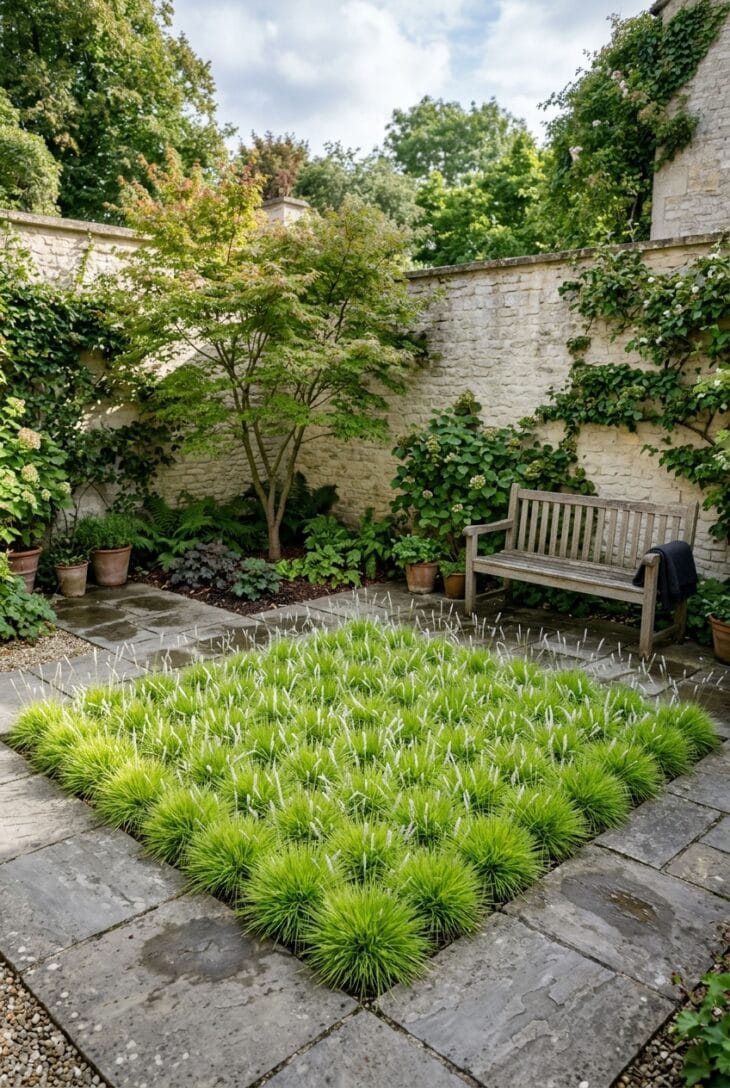
What you see A square bed in a stone courtyard, filled with identical lime-green mounds lined up in neat rows like a checkerboard. Slim silver flower spikes rise from each one. A single small tree and a wooden bench complete the room.
Why it works A grid of one grass is calm and architectural, and it suits the hard lines of an enclosed courtyard far better than a mixed border. The soft mounds keep the order from feeling rigid. Autumn moor grass is a good fit because it tolerates the part shade that walls cast, and its bright foliage lights up a gray enclosure.
How to get it Use autumn moor grass (Sesleria autumnalis), 12 to 24in (30 to 60cm) tall and hardy in Zones 4–9. Plant it 12 to 15in (30 to 40cm) apart on a measured grid, marking every position with spray paint or stakes first, since the effect depends on even spacing. It flowers in late summer and fall and stays semi-evergreen in milder zones, so it looks good for most of the year. Comb out dead leaves with your fingers in early spring instead of cutting it back hard.
18. Pair Golden Sedge With Fall Mums in Planters
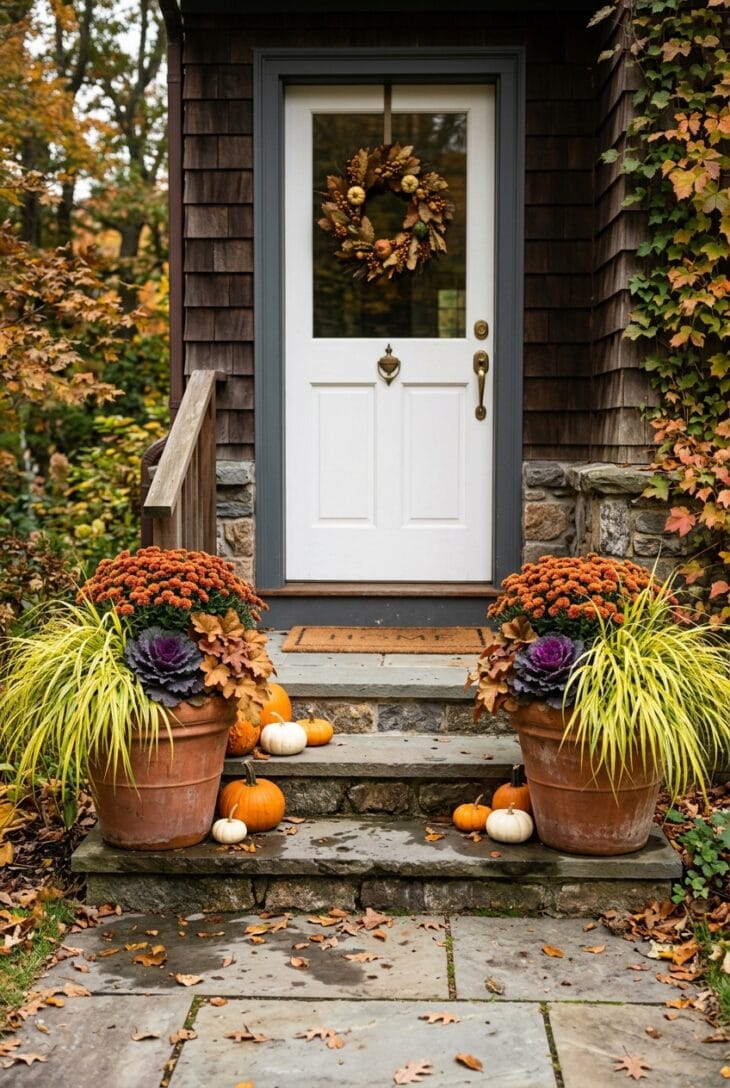
What you see A pair of terracotta planters by the front door, each spilling a fountain of gold-striped sedge over the rim. A rust-orange mum sits in the middle, with caramel heuchera and a purple ornamental kale tucked beside it. Little pumpkins sit at their feet.
Why it works Most fall pots are all round shapes: mums, kale, pumpkins. A spilling grass adds the line and movement they lack, and its gold leaves repeat the warm tones of the mums. Unlike the mums, the sedge is evergreen in mild winters, so it keeps fall planters looking finished into December.
How to get it Use golden sedge (Carex oshimensis ‘Everillo’), hardy in Zones 5–9 and 12 to 18in (30 to 45cm) tall, at the edge of a pot at least 16in (40cm) across. Add one garden mum (Chrysanthemum × morifolium), one heuchera (Heuchera ‘Caramel’) and one ornamental kale (Brassica oleracea). When the mums finish, plant the sedge and heuchera into a part-shade bed instead of composting them; both are true perennials. Water when the top inch (2.5cm) of soil is dry, since a full pot dries out fast even in cool weather.
19. Weave Grasses Through Asters and Goldenrod
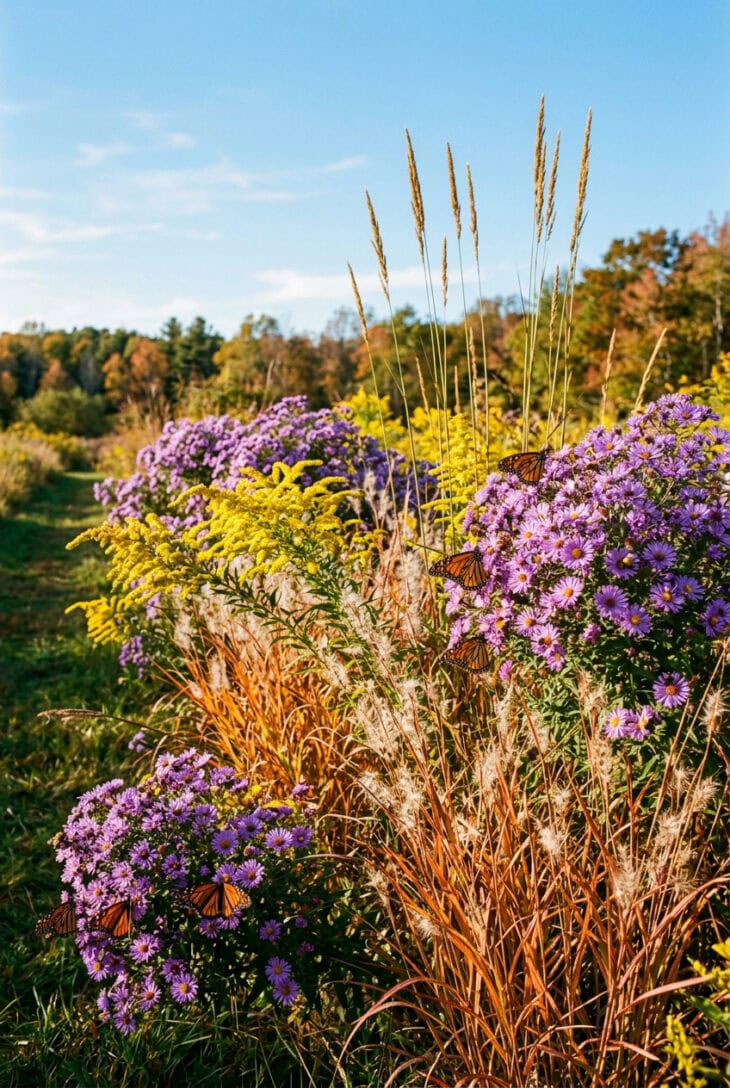
What you see A fall border alive with purple asters and arching yellow goldenrod, threaded with bronze-plumed Indian grass and copper little bluestem. Monarchs and bees crowd the aster flowers. The low sun turns the grass plumes to gold.
Why it works Asters and goldenrod are the last big nectar source of the year, feeding migrating monarchs and bees stocking up for winter, and grasses grow with them naturally on every eastern prairie. The grasses hold the asters upright, so they flop less, and their fine texture calms the bright purple and yellow. As pollinator garden ideas go, this one peaks when almost everything else has finished. And goldenrod does not cause hay fever: its pollen is heavy and carried by insects, while ragweed, blooming at the same time, is the real culprit.
How to get it Combine Indian grass (Sorghastrum nutans) and little bluestem (Schizachyrium scoparium) with New England aster (Symphyotrichum novae-angliae) and a clumping goldenrod such as Solidago rugosa ‘Fireworks’, which spreads far less than wild Canada goldenrod. Space grasses 24in (60cm) apart and asters and goldenrod 18 to 24in (45 to 60cm) apart. Pinch New England asters back by a third in early summer, before July, so they bloom shorter and sturdier. Full sun and average soil are all they need; richer soil only makes them taller and floppier.
20. Soften a Cottage Border With Tufted Hair Grass
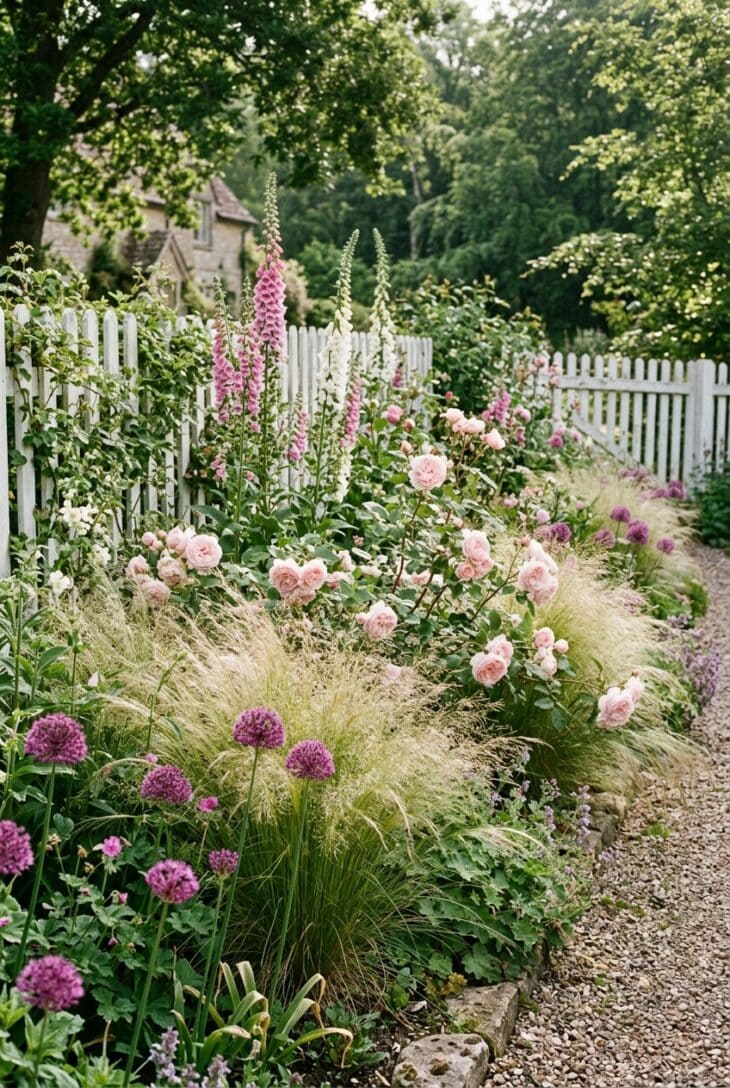
What you see A cottage border by a white picket fence, with pink and white foxgloves standing tall behind blush roses. Between them, low grass mounds send up a fine golden-silver haze that drifts over everything like a veil. Purple allium globes dot the front edge.
Why it works A cottage border full of big, bold flowers can tip into clutter, and a see-through grass fixes that by giving the eye a soft pause between the color. Tufted hair grass blooms in early summer alongside foxgloves and roses and, unlike most grasses, it is happy in part shade. It brings the loose, natural feel that cottage garden planting aims for without adding more color.
How to get it Plant tufted hair grass (Deschampsia cespitosa ‘Goldtau’), about 2ft (60cm) tall in flower and hardy in Zones 4–9, in groups of three spaced 18in (45cm) apart through the middle of the border. Pair it with foxglove (Digitalis purpurea), shrub roses and ornamental onion (Allium ‘Purple Sensation’). It is a cool-season grass that likes moist soil and sulks in hot, humid summers, so it does best in the North and the Pacific Northwest. Every part of foxglove is poisonous to people, and the ASPCA lists it as toxic to dogs, cats and horses, so plant it away from where pets or small children play.
21. Grow Annual Grasses for Bouquets
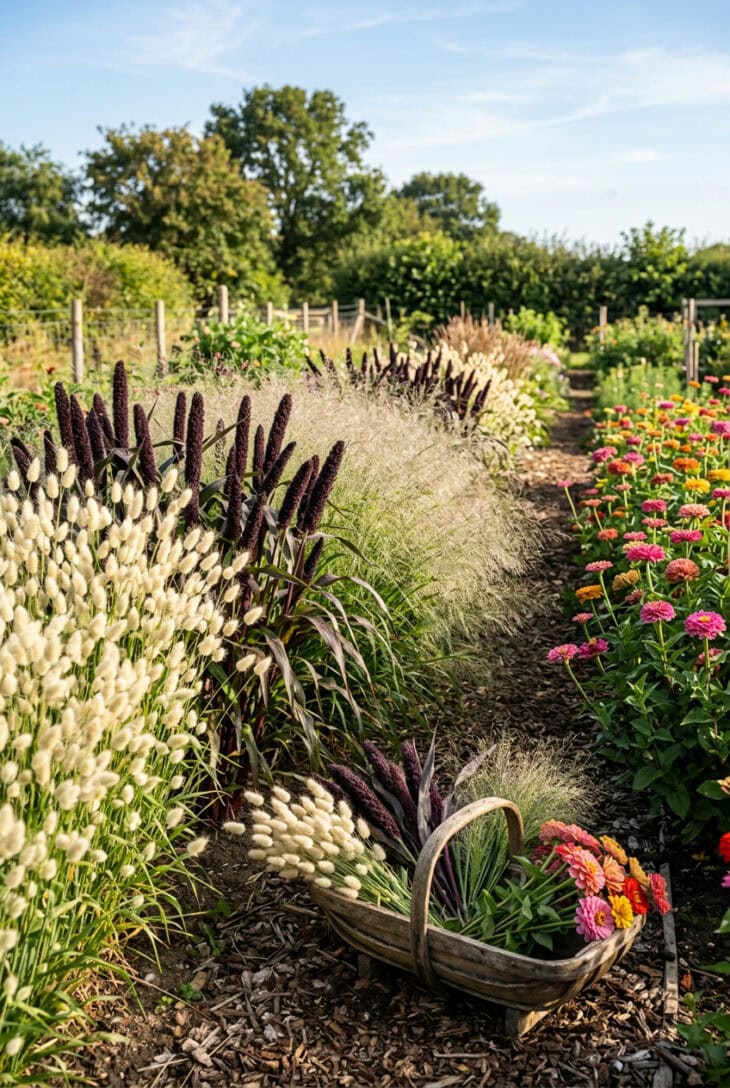
What you see A sunny cutting row with fluffy cream bunny tails, towering purple millet spikes and an airy cloud of fine grass. Zinnias bloom in the next row over. A wooden trug on the path already holds a bundle of freshly cut stems.
Why it works Grasses are the filler that turns a bunch of flowers into an arrangement, giving it texture and a looser, more natural shape. Annual grasses grow from seed in one season, cost a few dollars a packet, and dry perfectly for winter bouquets. They earn their row in any cut flower garden.
How to get it Sow bunny tails (Lagurus ovatus), 12 to 24in (30 to 60cm) tall, ornamental millet (Pennisetum glaucum ‘Purple Majesty’), 3 to 5ft (90 to 150cm), and ‘Frosted Explosion’ panic grass (Panicum elegans) after your last frost, or start them indoors 6 weeks earlier for faster flowers. Thin to 9 to 12in (23 to 30cm) apart. Cut stems as soon as the heads are fully out, before they shed seed, and hang them upside down in a dry, shady spot to dry. Bunny tails has naturalized on sandy ground along the California coast, so gardeners there should cut every head before it ripens.
22. Uplight Grasses After Dark
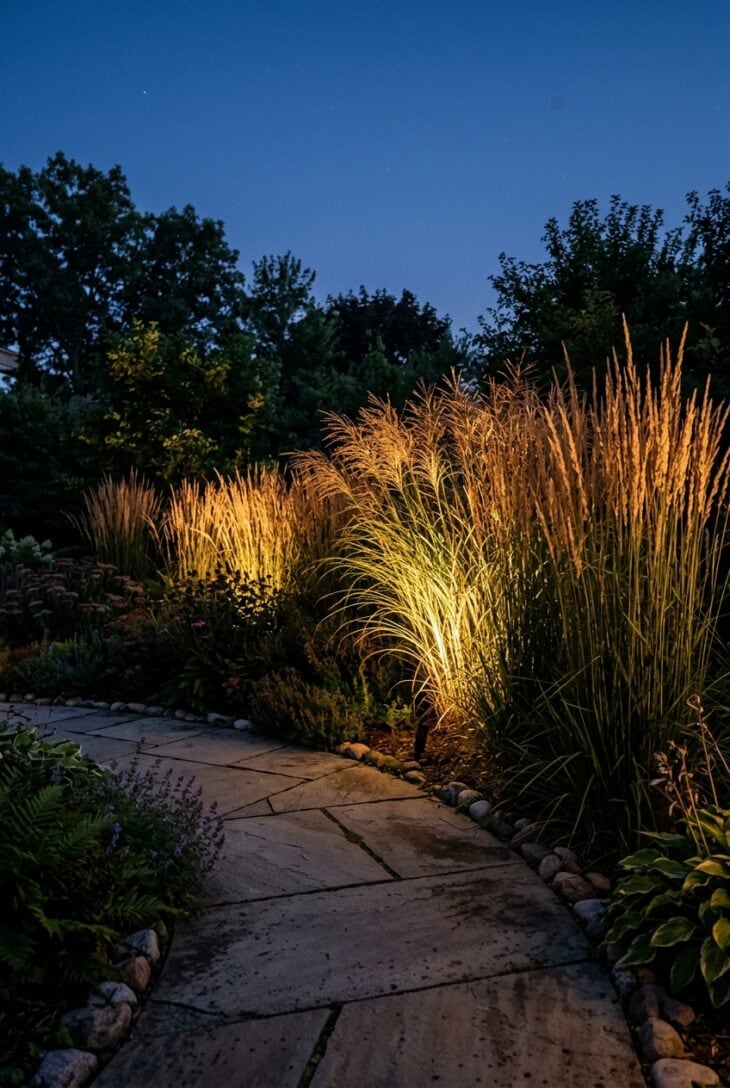
What you see Tall grass plumes glowing warm gold against a deep blue twilight sky, lit from somewhere low and out of sight. Every blade and seedhead stands out sharply. When the breeze moves them, the light flickers like candles.
Why it works Grass plumes are thin and pale, so they catch light better than almost any other plant, and a single spotlight turns a clump into a glowing sculpture. Because grasses stand all winter, the effect lasts from summer through the long dark evenings of January. It is one of the cheapest, highest-impact garden lighting ideas.
How to get it Use upright grasses such as feather reed grass (Calamagrostis × acutiflora ‘Karl Foerster’) or switchgrass (Panicum virgatum ‘Northwind’). Place a low-voltage LED spotlight in warm white (2700 to 3000K) about 12in (30cm) in front of each clump, angled up, or behind it for a silhouette. A plug-in 12-volt transformer with a timer is a safe DIY job; a new outdoor outlet or any line-voltage wiring is a job for a licensed electrician. Bury the cable a few inches down along the bed edge, away from where you will cut back the grass.
23. Windproof a Balcony With Grass Troughs
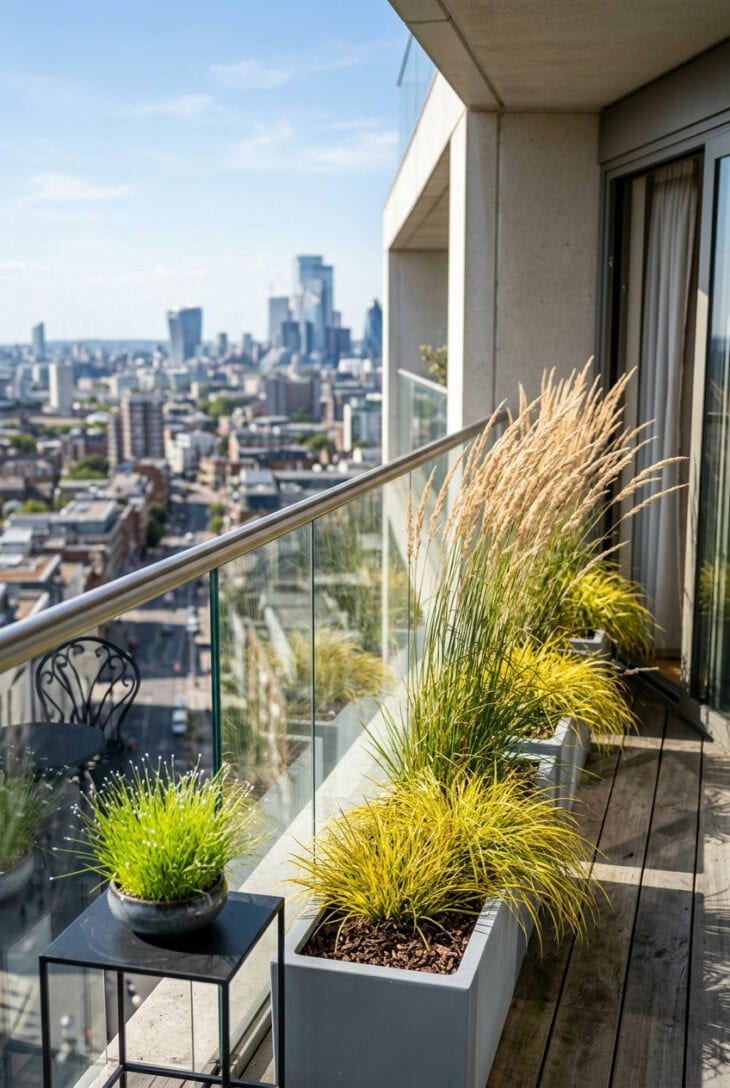
What you see A high balcony with long gray troughs along the railing, filled with tall tan grass plumes and low golden mounds bending in the wind. A small bowl of fiber optic grass sits on the side table with its tiny silver tips. The city skyline blurs behind.
Why it works Wind is the problem that defeats most balcony gardens, tearing big leaves and snapping flower stems. Grasses evolved in open, windy places, so they bend and spring back, and they look their best on exactly the gusty days that wreck petunias. A row of tall grass also softens the railing and gives some screening from the neighbors.
How to get it Use troughs at least 12in (30cm) deep, in lightweight fiberglass rather than concrete, and check your building’s load limit before filling them. Plant feather reed grass (Calamagrostis × acutiflora ‘Karl Foerster’) 18in (45cm) apart with golden sedge (Carex oshimensis ‘Everillo’) at the front. Roots in a container get much colder than in the ground, so gardeners commonly choose perennials hardy to one or two zones colder than their own; both of these are hardy to Zone 4 or 5. For a small table pot, fiber optic grass (Isolepis cernua) likes constant moisture and is grown as an annual outside Zones 8–10.
24. Pair Deer Grass With Agave in a Desert Yard
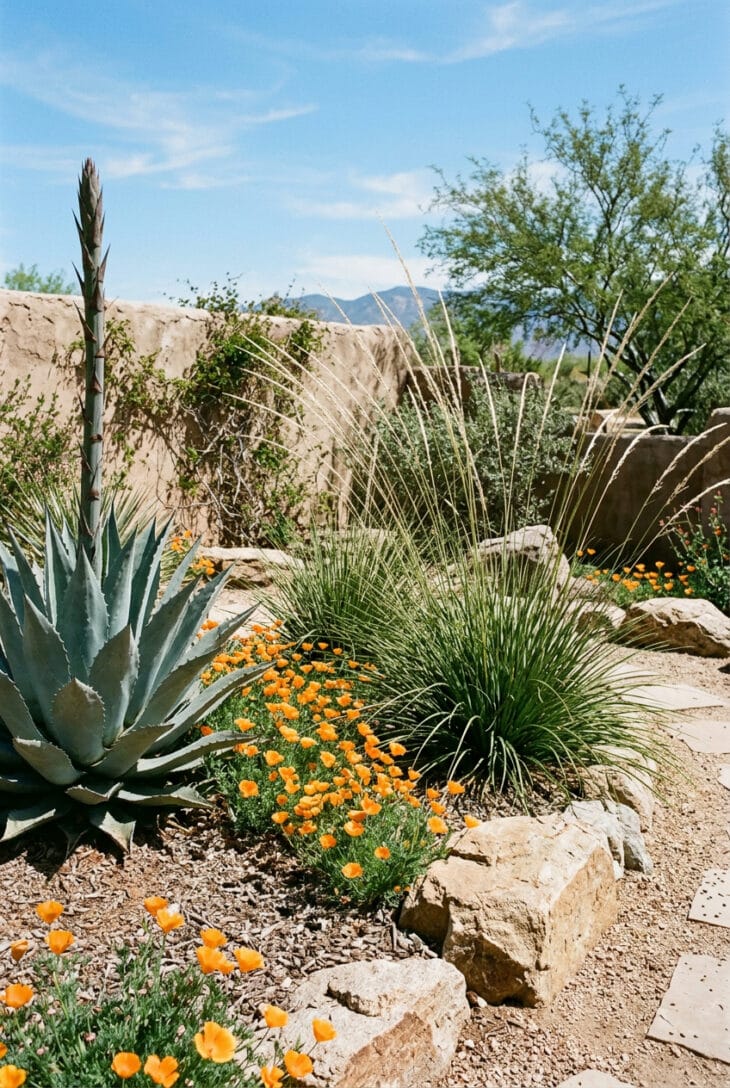
What you see Big fountains of grass with slender straw-colored spikes arching out, set beside the stiff blue-gray leaves of a huge agave. Orange California poppies carpet the decomposed granite between them. An adobe wall glows in the clear spring sun.
Why it works Desert planting can feel static, all spikes and rosettes, and a fine, moving grass is the perfect foil for an agave’s rigid geometry. Deer grass is native to California and the Southwest, so it takes heat and long dry spells in stride. It is one of the most useful plants in drought-tolerant garden design, as soft as a fountain grass but without the invasive risk.
How to get it Plant deer grass (Muhlenbergia rigens), roughly hardy in Zones 6–10, at least 4ft (120cm) apart: clumps reach 3 to 4ft (90 to 120cm) tall and as wide, with flower spikes higher. A century plant (Agave americana) grows 6ft (180cm) or more across with sharp spines, so set it well back from paths and kids’ play areas; in a small yard, Parry’s agave (Agave parryi) is a more compact choice. Scatter California poppy (Eschscholzia californica) seed in fall to bloom between them the following spring. Water deer grass every week or two through its first summer, then only in long droughts.
25. Mow a Path Through a Tall Grass Meadow
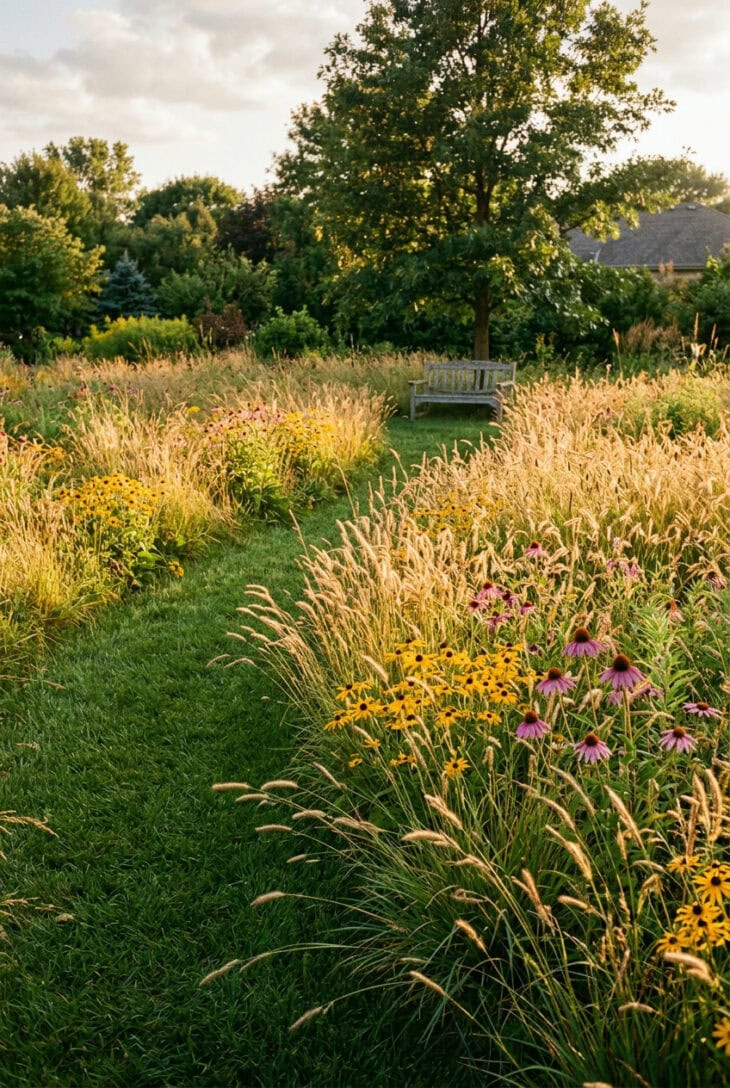
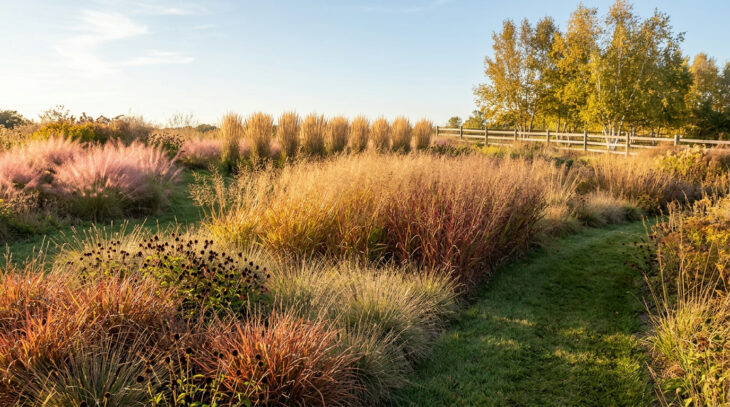
What you see A curving strip of short green grass winding through a waist-high meadow of switchgrass, little bluestem and Indian grass. Black-eyed susans and coneflowers glow among the seed heads. The path leads to a bench under a tree at the far end.
Why it works A meadow without a path is something you look at; a meadow with a path is somewhere you walk, and kids love disappearing into it. The crisp mown edge also tells neighbors and code inspectors that the tall grass is deliberate, not neglect. It replaces hours of weekly mowing across a whole backyard with one 4ft (120cm) strip.
How to get it Kill the existing lawn by smothering it under cardboard or by solarizing it through summer, then sow a regional native grass and wildflower mix in late fall so the seed gets a natural winter chill. Native meadows are slow: gardeners describe the first year as “sleep”, the second as “creep” and the third as “leap”, so mow the whole area to 6in (15cm) a few times in the first summer to keep weeds from shading out the seedlings. After that, mow the path weekly and the meadow once in late winter. Many towns have tall-grass rules, so check yours and keep a neat 2ft (60cm) mown edge along the street.