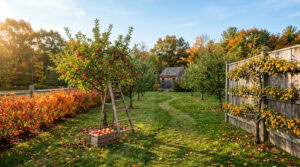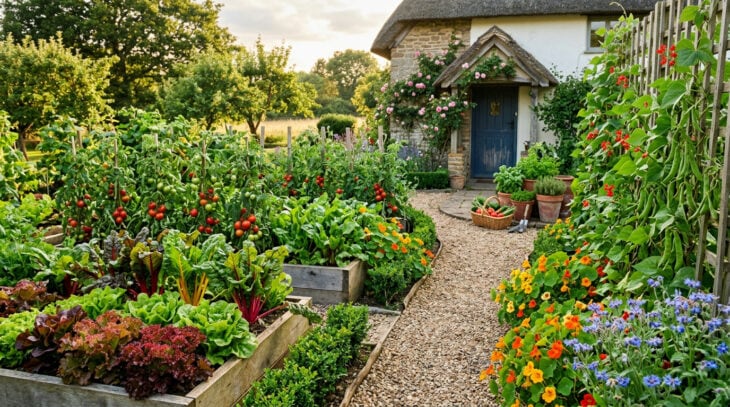
The best kitchen gardens are the ones you can reach in your slippers while the pan heats up. They are planted for the next meal, with herbs, salad, a few tomatoes and something sweet to pick, and they are laid out so they look good from the window too.
Contents
- 01. Kitchen-Door Starter Garden
- 02. Four-Square Potager with a Central Obelisk
- 03. Cattle Panel Bean and Cucumber Arch
- 04. Edible Flower Edging
- 05. Burgundy and Bronze Foliage Bed
- 06. Rhubarb and Globe Artichoke Backbone
- 07. Blueberry and Raspberry Corner
- 08. Alpine Strawberry Path Edging
- 09. Edible Hedge of Serviceberry and Cornelian Cherry
- 10. Cottage Kitchen Garden with Sweet Peas and Sunflowers
- 11. Gravel-Mulched Sun-Baked Herb Garden
- 12. Part-Shade Greens Bed
- 13. Fenced Kitchen Garden for Deer and Rabbit Country
- 14. Winter Leek and Kale Bed
- 15. Salsa Garden
- 16. Stir-Fry Garden of Asian Greens
- 17. Grape Arbor Seating Nook
- 18. Front-Yard Edible Border
- 19. Insectary Flower Strip
- 20. Dwarf Fruit Trees in Terrace Containers
- 21. Grow-Bag Kitchen Garden for Renters
- 22. Short-Season Garden for Zones 3 and 4
- 23. Heat-Loving Kitchen Garden for the South
- 24. Terraced Kitchen Garden on a Slope
- 25. Waist-High Accessible Kitchen Garden
That mix of beauty and use is what sets a kitchen garden apart from a full vegetable garden, which is planned around bulk crops and winter storage. The 25 ideas below run from a 4 by 6ft (120 by 180cm) bed beside the back door to a fenced four-square potager, and from edible hedges and berry corners to grow bags on a rented patio. They cover full sun and part shade, short northern summers and long Southern ones, and budgets from a few seed packets to a custom-built arbor.
Each idea shows what you are looking at, why the design works and how to get it, with varieties, spacing and timing. Timing is given against your frost dates, so look up your average last spring frost and first fall frost before you start, then pick the ideas that suit your space and your climate.
01. Kitchen-Door Starter Garden
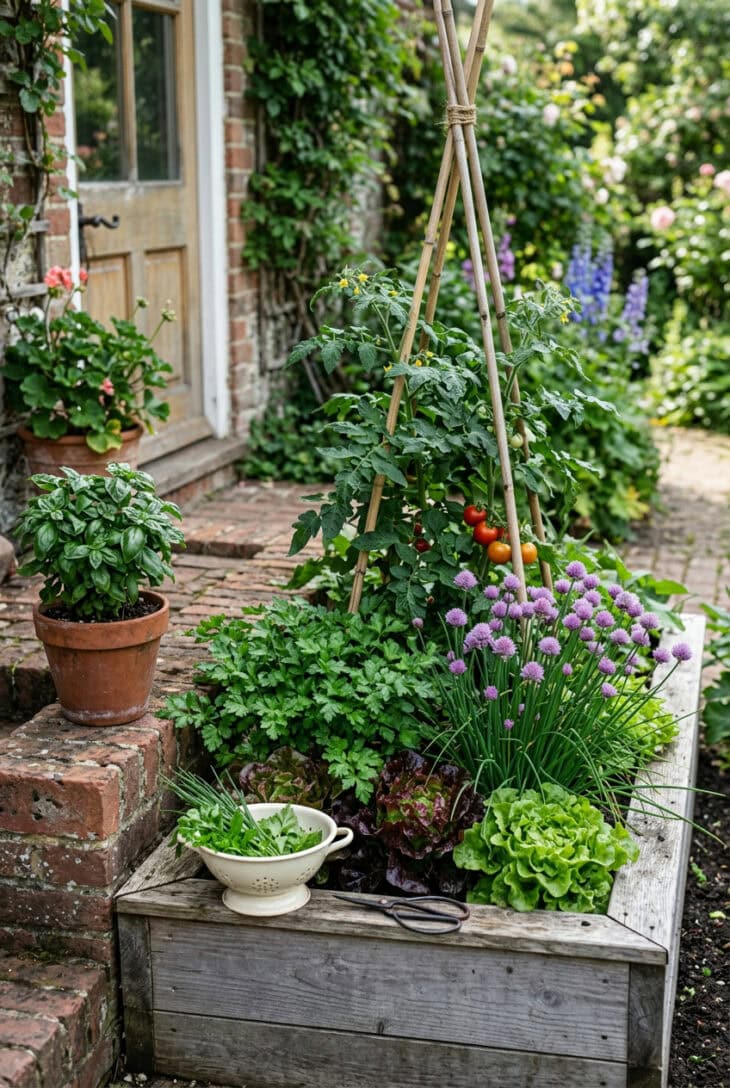
What you see A compact cedar bed sits against a brick doorstep in the morning sun, packed with red and green lettuce, ruffled parsley and chives topped with purple pompoms. A cherry tomato climbs a bamboo teepee at the back, its first fruit just turning red. A pot of basil stands on the step and a colander of freshly cut herbs rests on the bed edge, which shows how little distance there is between the plants and the pan.
Why it works Distance decides whether a kitchen garden gets used. A bed within about 10 steps of the kitchen door gets picked from every day, so lettuce is cut young, herbs stay trimmed and soft, and a pest or a dry spell is noticed before it does damage. Dense planting also shades the soil, which keeps weeds down and stops the bed drying out.
How to get it Build the bed 4ft (120cm) wide, so you can reach the middle from either side, and 6ft (180cm) long, with 10 to 12in (25 to 30cm) of good soil in a spot that gets at least 6 hours of direct sun. Sow loose-leaf lettuce such as ‘Red Sails’ as soon as the soil can be worked in spring. Plant a cherry tomato such as ‘Sungold’ about 1 to 2 weeks after your last frost date, 18in (45cm) in from the back with a stake or teepee behind it. Fill the gaps with chives, parsley and thyme, and keep basil in a pot on the step so you can carry it indoors on a cold night. A few pots of other kitchen herbs beside it make the doorstep part of the garden.
02. Four-Square Potager with a Central Obelisk
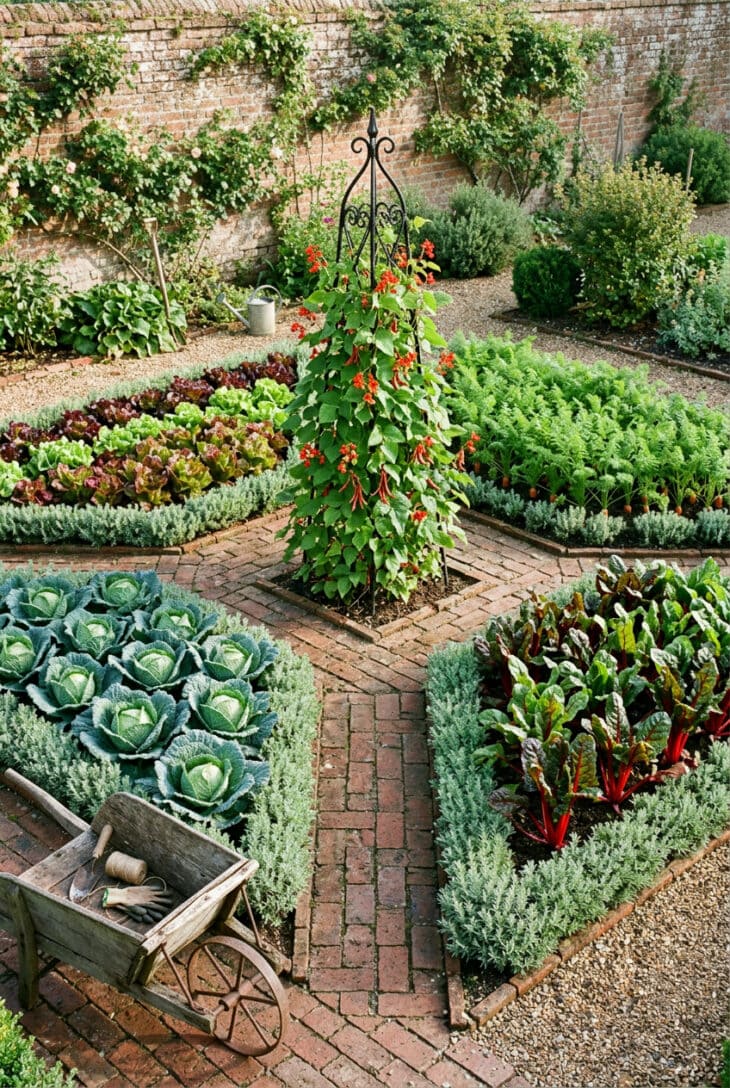
What you see Two brick paths cross at the center of a square garden, where a black iron obelisk carries scarlet runner beans in bright red flower. Each of the four beds is planted in blocks: lettuce, feathery carrot tops, blue-green cabbage and ruby chard. A low clipped hedge outlines every bed, so even half-bare soil looks deliberate.
Why it works Symmetry is what makes vegetables look designed. The crossing paths give you easy access to every bed, the central feature gives the eye somewhere to land, and the hedge keeps the lines crisp when the crops inside are between plantings. Four beds also suit crop rotation: moving brassicas, legumes, roots and fruiting crops one bed around each year helps break pest and disease cycles.
How to get it Make the whole garden 12 to 16ft (360 to 490cm) square, with beds about 5 to 6ft (150 to 180cm) across and brick paths 3ft (90cm) wide so a wheelbarrow fits. For the hedge, germander (Teucrium chamaedrys, Zones 5 to 9) clips to 8 to 12in (20 to 30cm). Boxwood is the traditional choice, but boxwood blight and box tree moth are problems in parts of the country, so check with your extension office first. Plant runner beans such as ‘Scarlet Emperor’ (Phaseolus coccineus) around the obelisk after your last frost date. They drop their flowers in hot weather, so where summer days regularly pass 85°F (29°C), use a heat-tolerant pole bean like ‘Rattlesnake’ instead.
03. Cattle Panel Bean and Cucumber Arch
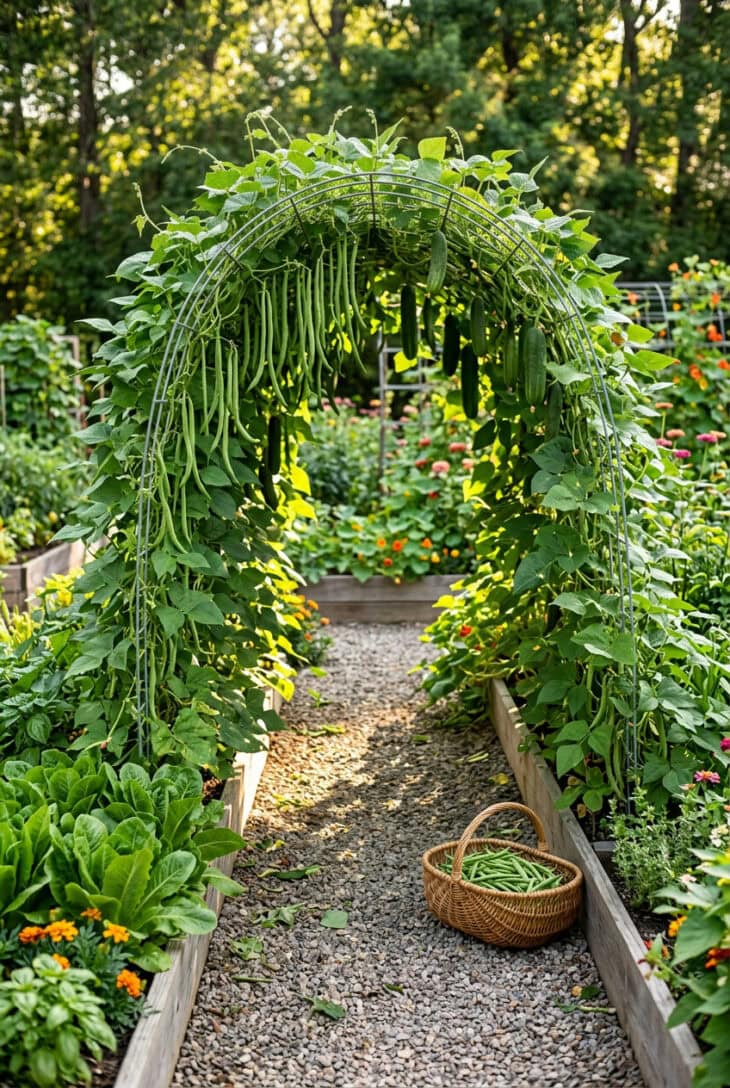
What you see A curved wire arch spans the path between two raised beds, and every inch of it is leaf. Long green bean pods hang down inside the tunnel at picking height, and cucumbers dangle straight and clean among them. Sunlight reaches the gravel in patches, and a basket of beans waits at the side of the path.
Why it works Vines grown overhead are easier to see and pick, and cucumbers hang straight instead of curling on the ground. Air moves freely through the foliage, which helps keep powdery mildew down. The shade underneath is a bonus, since lettuce and spinach planted at the base of the arch stay cooler and bolt later in summer.
How to get it A 16ft (4.9m) cattle panel bent into an arch spans roughly 6 to 8ft (180 to 240cm) and stands about 6 to 7ft (180 to 210cm) tall, so set your two beds or rows of posts at that spacing and anchor the panel ends to steel T-posts. Bending takes two people and gloves, and the cut wire ends should be capped or bent over, since they are sharp. Sow pole beans such as ‘Kentucky Wonder’ and cucumbers such as ‘Marketmore 76’ at the base 1 to 2 weeks after your last frost date, once the soil has reached about 60°F (16°C). Gardeners commonly grow beans among the companion plants for cucumber, though that rests on experience more than on research. Pick beans every few days so the vines keep producing.
04. Edible Flower Edging
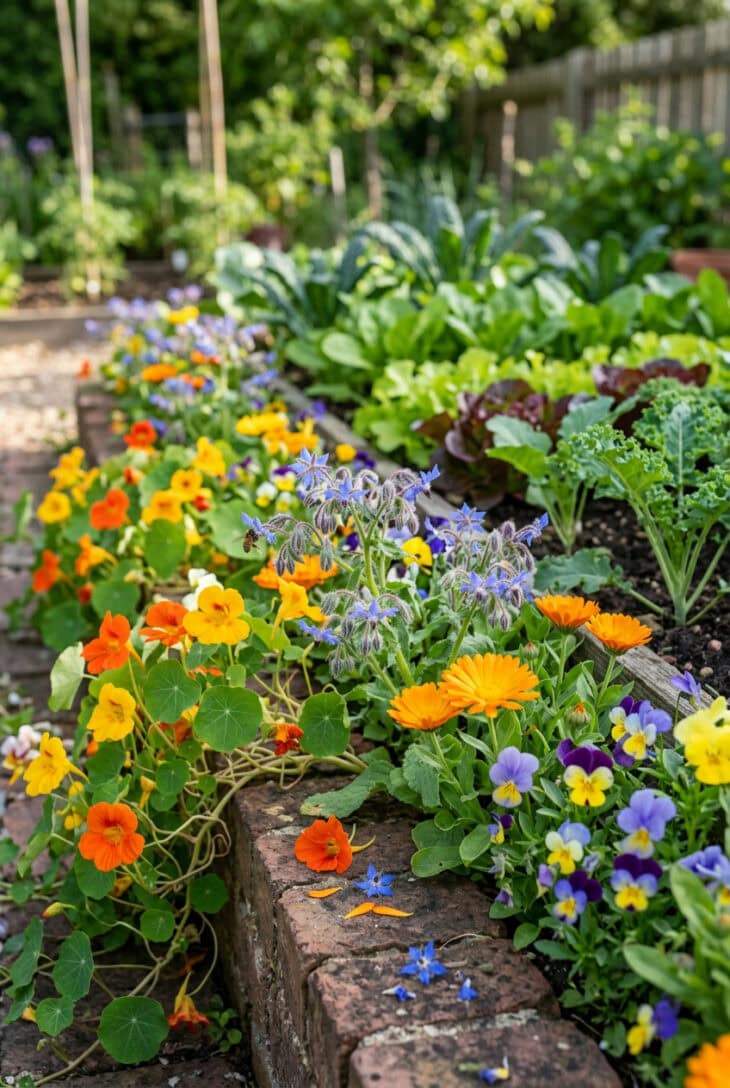
What you see A ribbon of color runs along the front of the vegetable bed: orange and yellow nasturtiums tumbling over a low brick edge, glowing calendula, blue star-shaped borage and tiny violas in purple and yellow. Rows of lettuce and young kale stand behind them. A bee is working the borage, and a few fallen petals lie on the brick.
Why it works Flowers at the front make a vegetable plot look planned rather than patched, and every plant in this edging can go on a plate. Borage and calendula also draw bees and hoverflies into the garden. All three of the main plants grow easily from seed, so the whole edge costs less than a single bedding plant.
How to get it Sow nasturtium (Tropaeolum majus) seed 1/2in (1cm) deep and 10 to 12in (25 to 30cm) apart about 1 to 2 weeks after your last frost date, and keep the soil lean, since rich soil gives lots of leaves and few flowers. Calendula (Calendula officinalis) and borage (Borago officinalis) can go in from seed 2 to 4 weeks before last frost, and both self-sow. Violas (Viola × wittrockiana) can go in as transplants in early spring or fall. Eat only flowers you have identified yourself and grown without pesticides, never florist or garden center flowers, and never assume a pretty flower is edible. Pick in the morning, shake out any insects, and scatter the petals over salads.
05. Burgundy and Bronze Foliage Bed
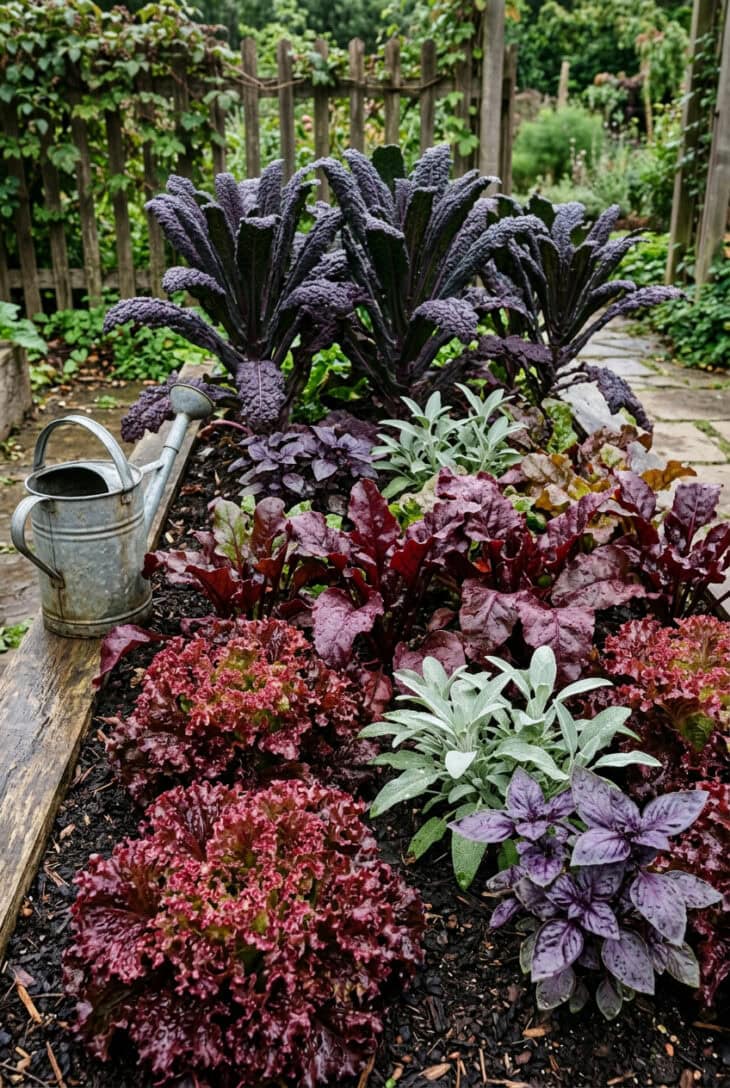
What you see Every plant in this bed wears a shade of burgundy, plum or bronze. Tall ‘Redbor’ kale stands at the back, ‘Bull’s Blood’ beet leaves glow dark red in the middle, and ruffled ‘Lollo Rosso’ lettuce frills the front. Glossy purple basil and a few silver-gray sage plants add contrast, and dew sits on the leaves in the soft light.
Why it works Dark foliage reads as ornamental, so this bed can go where a flower border might, while still filling the salad bowl. Sticking to one color family ties very different crops together, and a pale silver plant like sage makes the dark leaves look richer. The effect lasts all season, instead of waiting on a bloom.
How to get it Plant kale (Brassica oleracea var. sabellica ‘Redbor’) 18 to 24in (45 to 60cm) apart, beets (Beta vulgaris ‘Bull’s Blood’) 4in (10cm) apart, and lettuce (Lactuca sativa ‘Lollo Rosso’) 8in (20cm) apart. Sow the beets and lettuce 2 to 4 weeks before last frost. Add purple basil (Ocimum basilicum ‘Red Rubin’) only once nights stay above 50°F (10°C), since it is tender. Lettuce bolts in heat, so resow every 2 weeks or tuck it into the shade of the kale. Thin the beets for greens in the salad bowl, and use sage (Salvia officinalis, Zones 5 to 8) as the silver edge.
06. Rhubarb and Globe Artichoke Backbone
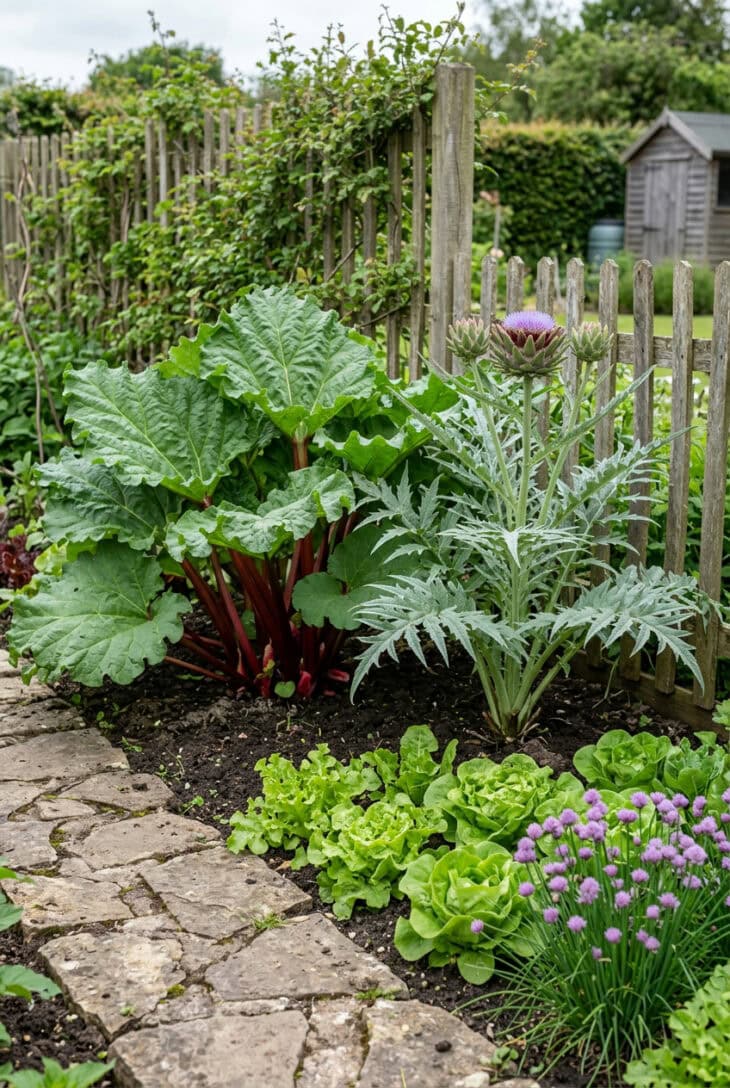
What you see At the back of the garden, a rhubarb clump throws up leaves as wide as umbrellas on ruby-red stalks. Beside it, a globe artichoke rises in silver, deeply cut foliage with a fat purple-tinged bud forming at the top. Low lettuce and chives fill the foreground, which makes the big plants look even bigger.
Why it works Most vegetables stay low and leafy, so one or two large-scale plants give a kitchen garden structure, a backbone you can see from the house. Both are perennial crops, which means you plant once and harvest for years. They also solve the awkward back corner where nothing else seems tall enough.
How to get it Plant rhubarb (Rheum rhabarbarum) crowns 3ft (90cm) apart in rich, well-drained soil, and pick no stalks in the first year. Rhubarb does best where winters freeze, roughly Zones 3 to 7, and struggles in hot summers. Eat only the stalks: the leaves and roots are toxic, and rhubarb is a problem for dogs and cats too, so keep trimmings away from pets. Globe artichoke (Cynara cardunculus Scolymus Group) is a perennial in about Zones 7 to 10 and needs 3 to 4ft (90 to 120cm) of room. In colder zones, grow a variety like ‘Imperial Star’ as an annual, starting seed indoors and giving seedlings a couple of weeks of cool weather, below about 50°F (10°C), so the plants set buds in their first year.
07. Blueberry and Raspberry Corner
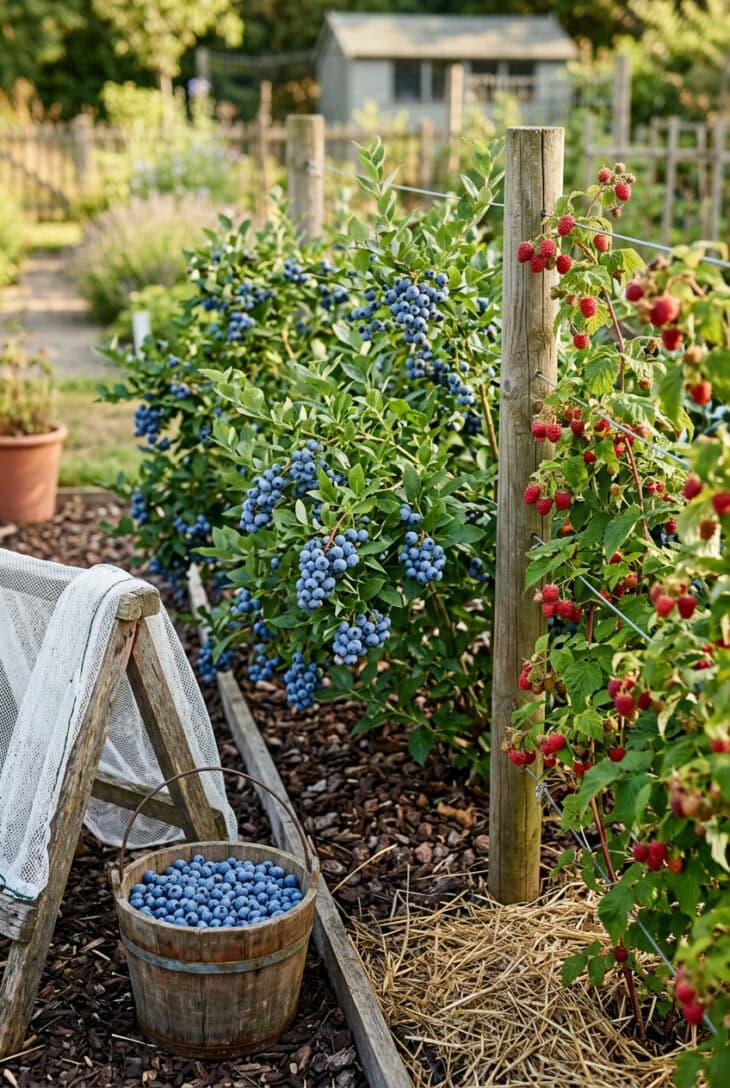
What you see Three blueberry shrubs sit in dark pine-bark mulch, their branches weighed down with clusters of blue fruit in every stage from green to ripe. Next to them, raspberry canes lean on a wire trellis with bright red berries hidden under the leaves. A wooden bucket of just-picked blueberries stands in the path, and folded bird netting waits on a frame nearby.
Why it works Berries are expensive to buy and easy to grow once the soil is right, and these plants keep producing for many years. Blueberries also give fall color, with leaves that turn red and orange, so the corner looks good after the fruit is gone. Keeping the berries together makes them easy to net and gives the blueberries the acid soil they need.
How to get it Highbush blueberries (Vaccinium corymbosum) need acidic soil with a pH of 4.5 to 5.5, so test yours first and work in elemental sulfur well before planting if it is higher, or grow them in large pots of acidic mix. Plant two varieties such as ‘Bluecrop’ and ‘Jersey’ (Zones 4 to 7) 4 to 5ft (120 to 150cm) apart, since cross-pollination gives bigger crops, and mulch with 3 to 4in (8 to 10cm) of pine bark. In the Deep South, choose southern highbush or rabbiteye types instead. For raspberries (Rubus idaeus), fall-bearing ‘Heritage’ is the easy one: cut every cane to the ground in late winter and it fruits on the new canes from late summer. Both crops need netting once the fruit colors, or the birds will take the lot.
08. Alpine Strawberry Path Edging
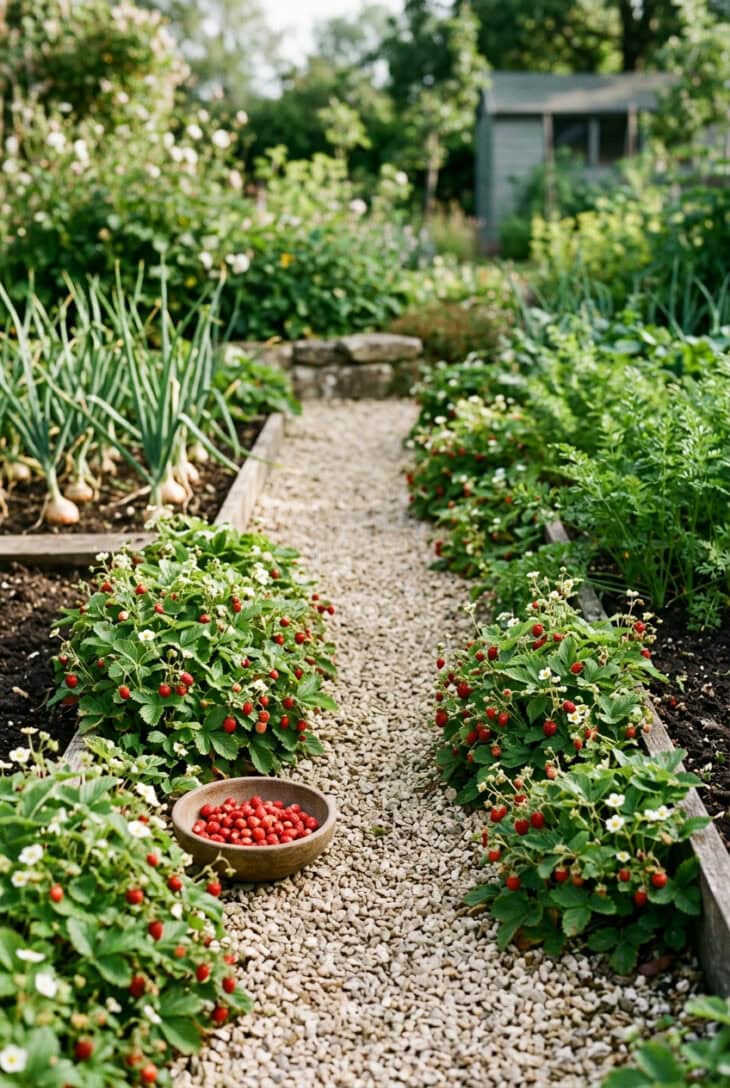
What you see A pale gravel path runs between two low hems of alpine strawberries, each tidy clump studded with white flowers and tiny red berries. Behind them, onion tops and carrot foliage stand in neat rows. A small wooden bowl of berries sits at the path edge, picked on the way past.
Why it works Alpine strawberries do what most edging plants cannot: they look good, stay put and produce food from early summer until frost. The clump-forming kinds send out no runners, so the edge stays neat instead of wandering into the beds. The berries are small but intensely flavored, and there is never a glut to deal with.
How to get it Choose a runnerless alpine type such as ‘Mignonette’ or ‘Alexandria’, which are forms of wild strawberries (Fragaria vesca, hardy in about Zones 3 to 9). Set plants 10 to 12in (25 to 30cm) apart along the path, in full sun or light shade; afternoon shade is welcome in hot summers. To grow from seed, sow indoors 8 to 10 weeks before last frost and leave the seed uncovered, since it needs light to germinate. Pick every couple of days, because the ripe berries are small and easy to miss. Plants slow down after about 3 years, so divide or replace them then.
09. Edible Hedge of Serviceberry and Cornelian Cherry
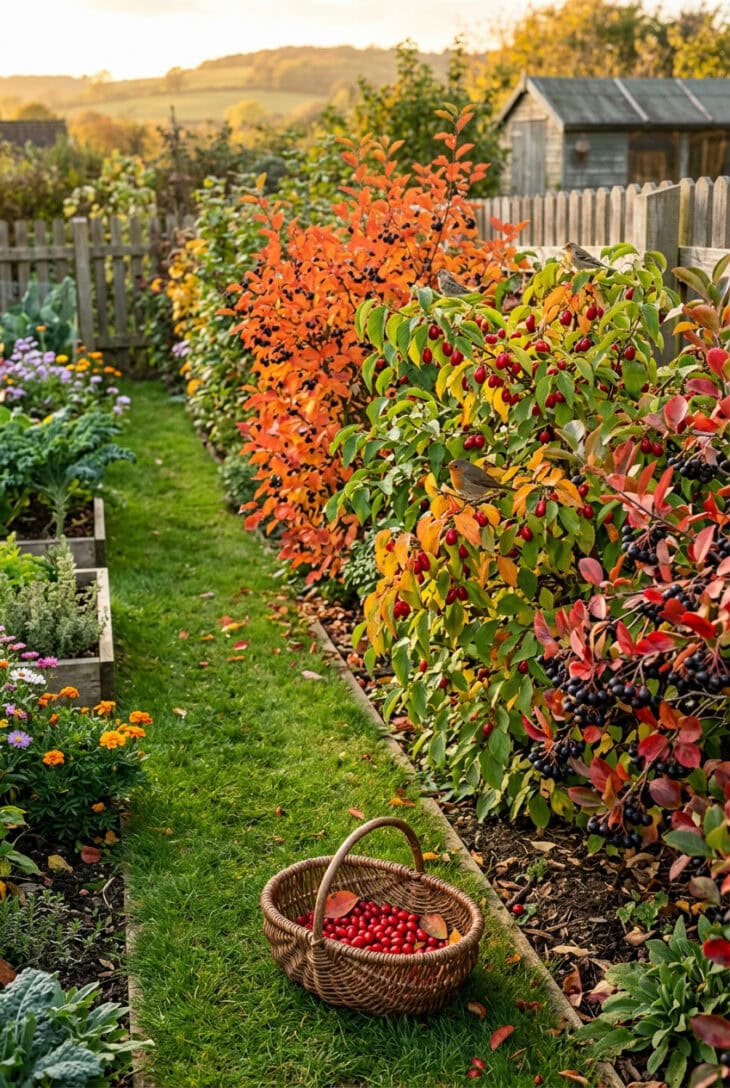
What you see A long hedge runs along the back boundary in early fall, and every plant in it bears fruit. Serviceberry leaves are turning orange-red, glossy red cornelian cherries hang among the branches, and black chokeberry carries dark clusters over red foliage. A basket of picked cornelian cherries sits on the grass, and small birds are working the far end.
Why it works A hedge that feeds you does the same job as any other boundary planting, giving screening and shelter, and then adds fruit, spring blossom and fall color. Mixing three or four species means a pest or a bad frost year seldom takes out the whole crop. It is also one of the lowest-effort ways to add fruit, since shrubs like these need little more than occasional pruning once established.
How to get it Combine Allegheny serviceberry (Amelanchier laevis), cornelian cherry (Cornus mas) and black chokeberry (Aronia melanocarpa), all hardy in roughly Zones 4 to 8, with chokeberry going to Zone 3. Space them 5 to 6ft (150 to 180cm) apart for an informal hedge; they will knit together, and you can prune to keep them to 8 to 10ft (240 to 300cm). Cornelian cherry’s yellow flowers open in late winter before the leaves, and the tart red fruit ripens in late summer. Chokeberries are astringent raw and are best cooked into jam or juice. Expect the birds to take their share, and plant a few more shrubs than you strictly need.
10. Cottage Kitchen Garden with Sweet Peas and Sunflowers
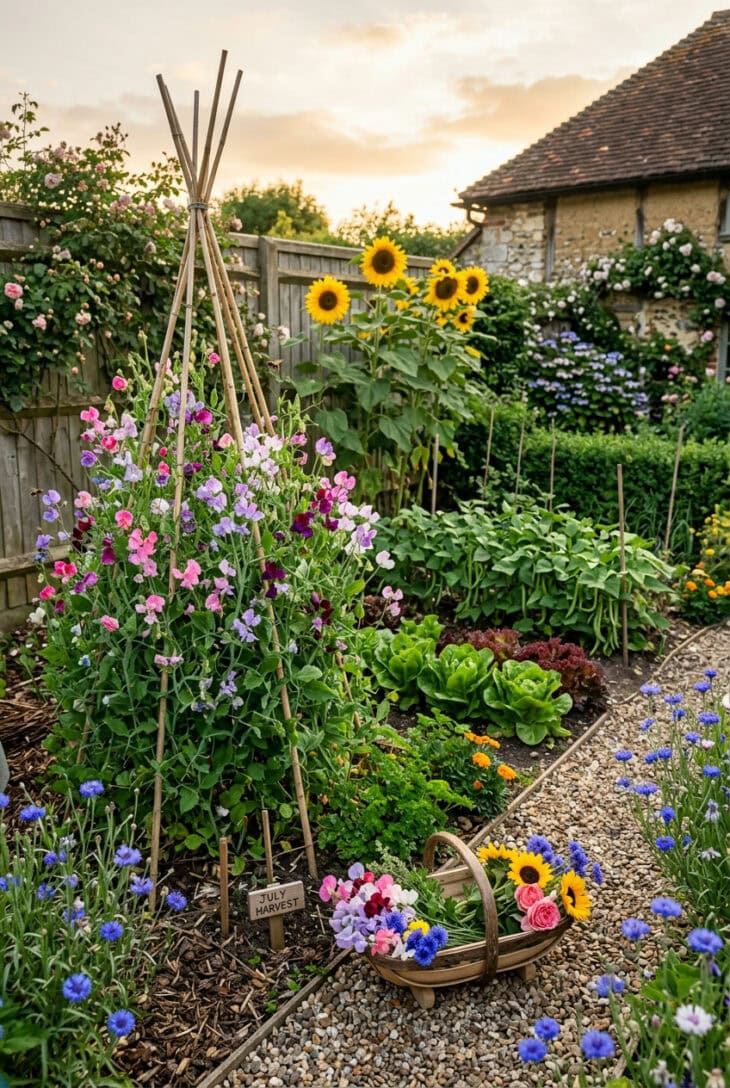
What you see A bamboo teepee at the center of the garden is wrapped in pink, purple and white sweet peas, and bees move between the blooms. Golden sunflowers stand against the back fence, and rows of beans and lettuce fill the ground in front. Blue cornflowers line the path, and a wicker trug of cut flowers waits on the gravel.
Why it works This is the cottage garden approach applied to the vegetable patch, with flowers jostling the crops instead of being fenced off from them. The flowers bring pollinators in, the sunflowers give some shade and a windbreak, and a vase of cut flowers on the kitchen table is a perk of the plot. The mix suits a relaxed gardener who does not mind a little wildness.
How to get it Sow sweet peas (Lathyrus odoratus) in fall in Zones 7 and warmer, or as soon as the soil can be worked in spring elsewhere, since they like cool weather. Treat them as ornamentals: the seeds are toxic, and the edible garden pea is a different plant (Pisum sativum). Sow sunflowers such as ‘Autumn Beauty’ after your last frost date, 12in (30cm) apart, and leave the heads standing for the birds in fall. Sweet peas and cornflowers (Centaurea cyanus) both make good cut flowers, and the more you cut, the longer they bloom. Keep the tall plants on the north side so they do not shade the lettuce.
11. Gravel-Mulched Sun-Baked Herb Garden
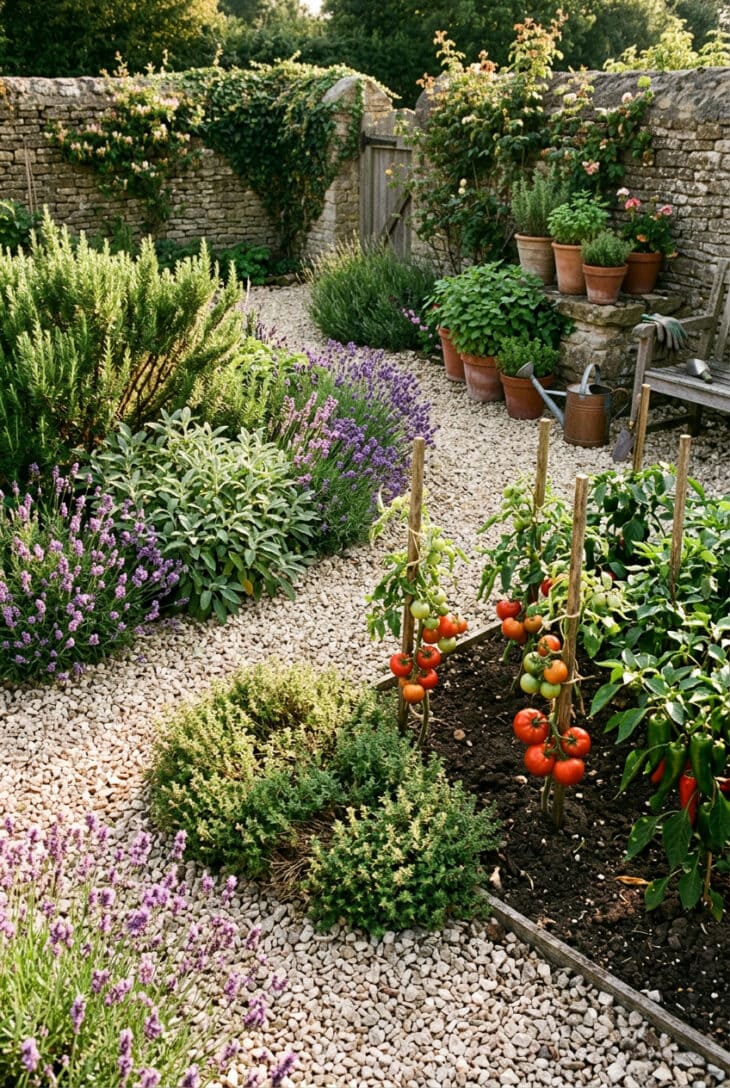
What you see Pale crushed stone covers the ground between clumps of rosemary, silver-green sage, creeping thyme and flowering lavender, with a low stone wall holding the afternoon heat behind them. At one side, staked tomatoes loaded with red fruit and a few pepper plants grow in a patch of dark soil. A terracotta pot or two and long shadows complete the Mediterranean mood.
Why it works Mediterranean herbs come from lean, fast-draining ground and dislike wet feet, and gravel is the closest match, which is why gravel gardens suit them so well. The stones reflect heat, keep the base of the plants dry and suppress weeds. Hot, dry gardens benefit most, since established herbs need very little water.
How to get it Spread a 2in (5cm) layer of crushed stone, 1/4 to 3/8in (6 to 10mm), over bare soil or landscape fabric and plant through it. Rosemary (Salvia rosmarinus, Zones 7 to 10, with a few hardier types such as ‘Arp’ surviving in Zone 6), sage (Salvia officinalis), thyme (Thymus vulgaris) and English lavender (Lavandula angustifolia) all want full sun and sharp drainage. Give tomatoes and peppers their own pockets of amended soil, since they need richer ground, and water them through drip lines at the roots. Keep gravel away from seedling rows, which struggle to push through it.
12. Part-Shade Greens Bed
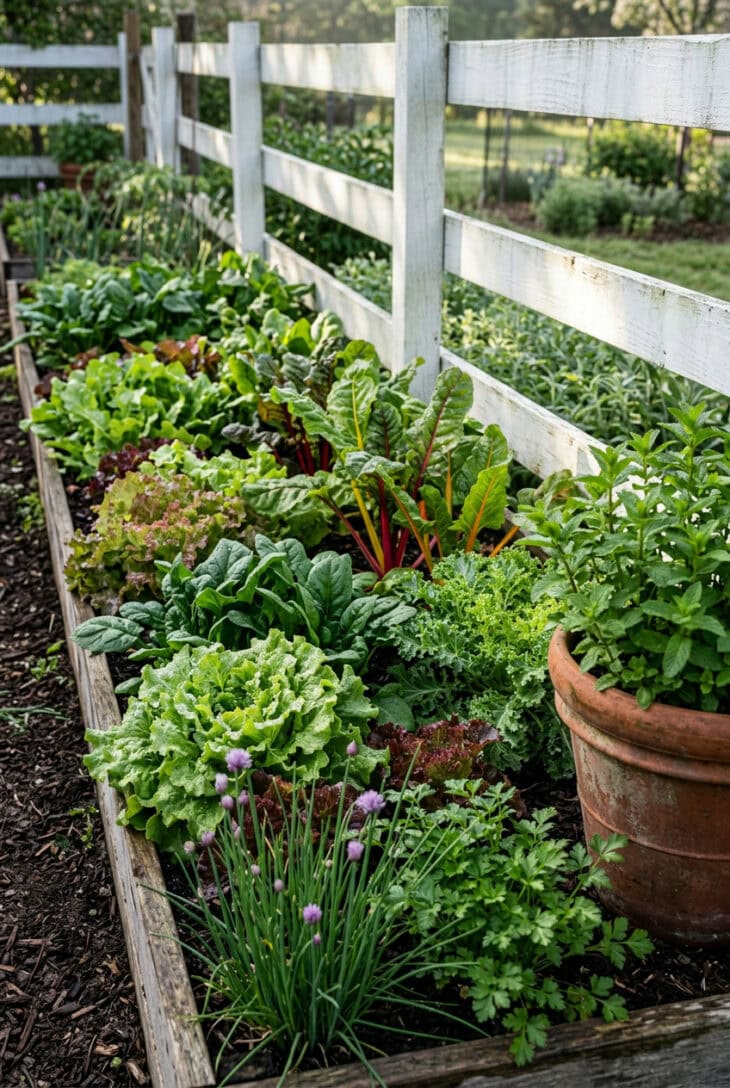
What you see Lettuce in ruffles of green and red, flat spinach leaves and rainbow chard fill a bed beside a white-painted fence, with light filtering in from one side. Frilly curly endive adds texture, chives and parsley edge the front, and a large clay pot of mint sits at the end. Dew still beads on the lettuce, and the white fence bounces extra light onto the leaves.
Why it works Few gardens have a spot with eight hours of sun, but plenty have a corner with three or four. Leafy greens and many herbs will crop on that, more slowly than in full sun, and in hot summers they do better with some afternoon shade, which delays bolting. A light-colored fence or wall behind the bed adds reflected light.
How to get it Aim for at least 3 to 4 hours of direct sun, ideally in the morning. Root crops and fruiting crops such as tomatoes need 6 hours or more, so leave those for a sunnier spot, and look to shade garden ideas if the light is lower still. Sow lettuce, spinach (Spinacia oleracea), arugula and chard about 4 weeks before your last frost and again 6 to 8 weeks before your first fall frost, spacing lettuce 6 to 8in (15 to 20cm) apart. Mint (Mentha spp.) spreads by runners, so keep it in a pot. Slugs love shade: check under boards at dusk and hand-pick them, or use iron phosphate bait and follow the label.
13. Fenced Kitchen Garden for Deer and Rabbit Country
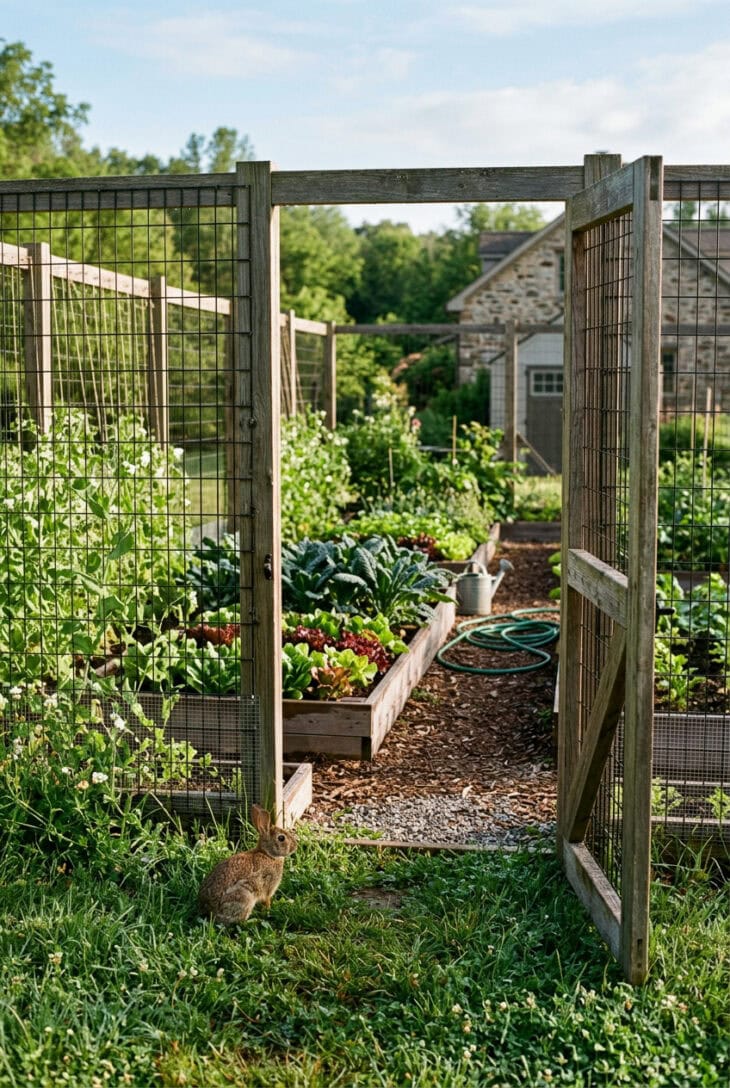
What you see A tall black mesh fence on wooden posts encloses a kitchen garden in early summer, its wooden gate standing open. Inside, raised beds of kale and lettuce are untouched and snap peas climb the wire. A rabbit sits in the grass outside, looking in at a garden it cannot reach.
Why it works Nothing is more disheartening than a bed of lettuce eaten overnight, and a well-built fence, in any of the garden fence styles that suit your yard, is the only reliable protection against deer and rabbits. ‘Deer resistant’ plant lists help, but a hungry deer will sample almost anything. Planting peas or cucumbers along the fence makes the barrier work as a trellis too.
How to get it Extension services generally recommend a deer fence 8ft (240cm) high, in woven wire or plastic mesh on sturdy posts. A cheaper option is two 4ft (120cm) fences set 3 to 4ft (90 to 120cm) apart, which deer are reluctant to jump. For rabbits, add 2ft (60cm) of 1in (2.5cm) mesh or hardware cloth along the bottom, with the lowest 6in (15cm) buried and bent outward. Hang the gate so there is no gap beneath it, and put the latch where you can work it with full hands. No fence is a guarantee, so look for the first sign of a breach and fix it quickly.
14. Winter Leek and Kale Bed
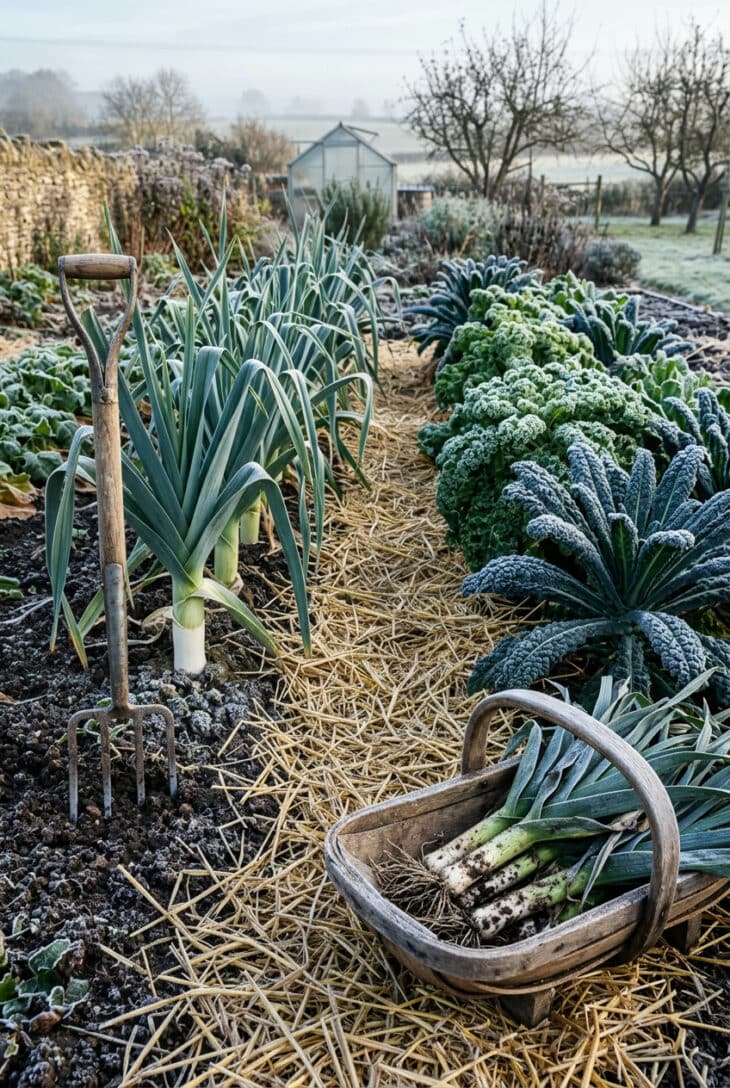
What you see Frost crystals edge the leaves of curly and lacinato kale, and a row of tall leeks stands beside them with thick white shafts and blue-green flags. Golden straw covers the soil between the rows. A garden fork is stuck in the ground, and a trug of just-lifted leeks, soil still on their roots, waits next to it.
Why it works Winter is when this bed earns its keep. Both leeks and kale tolerate hard frost, and kale tastes sweeter after cold weather as the leaves turn starch into sugar. Together they turn the bed into a source of fresh vegetables when the rest of the garden is mulched and asleep.
How to get it Start leek (Allium porrum) seed indoors 8 to 10 weeks before last frost, or buy transplants, and set pencil-thick seedlings in 6in (15cm) deep holes made with a broom handle, 6in (15cm) apart. Water them in and leave the holes unfilled, so the stems blanch as they thicken. Choose a hardy variety such as ‘Giant Musselburgh’, and mulch with 6in (15cm) of straw in fall. In Zone 6 and warmer you can harvest through winter, while in colder zones you should lift them before the ground freezes solid. Sow kale in midsummer for this bed; most fall vegetable crops are timed backward from your first frost in the same way.
15. Salsa Garden
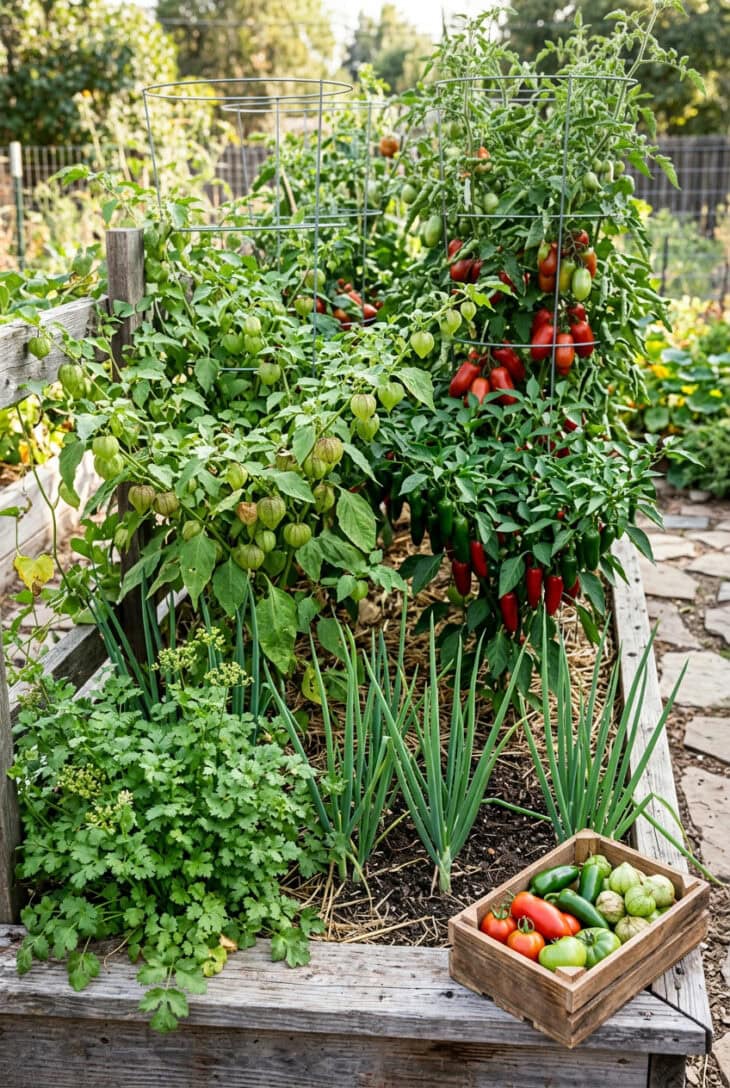
What you see Caged paste tomatoes heavy with red fruit stand at the back of a raised bed, with compact jalapeno plants carrying glossy green and red peppers in front. A sprawling tomatillo plant is hung with papery husks, and cilantro and green onions run along the edge. A wooden crate of the harvest sits on the ledge, just about ready to be chopped.
Why it works Planting a dish rather than a list of crops keeps the garden focused and cuts waste, since everything ripens in the same few weeks. Tomatoes, peppers, tomatillos and onions all love heat and sun, so one bed in the sunniest spot serves them all. It is a satisfying first project for a gardener who cooks.
How to get it Plant paste tomatoes such as ‘San Marzano’ or ‘Roma’ 24in (60cm) apart, and set them out 1 to 2 weeks after your last frost, once nights stay above 50°F (10°C). Tomatillos (Physalis philadelphica) need at least two plants to set fruit, since they are not self-fertile, and need strong cages. Cilantro (Coriandrum sativum) bolts in heat, so sow it every 3 weeks in spring and fall, or choose a slow-bolting variety such as ‘Calypso’. Before you fill the gaps, check which companion plants for tomatoes and which companion plants for peppers really earn their place, because much of the advice is folklore. Wear gloves when handling hot peppers.
16. Stir-Fry Garden of Asian Greens
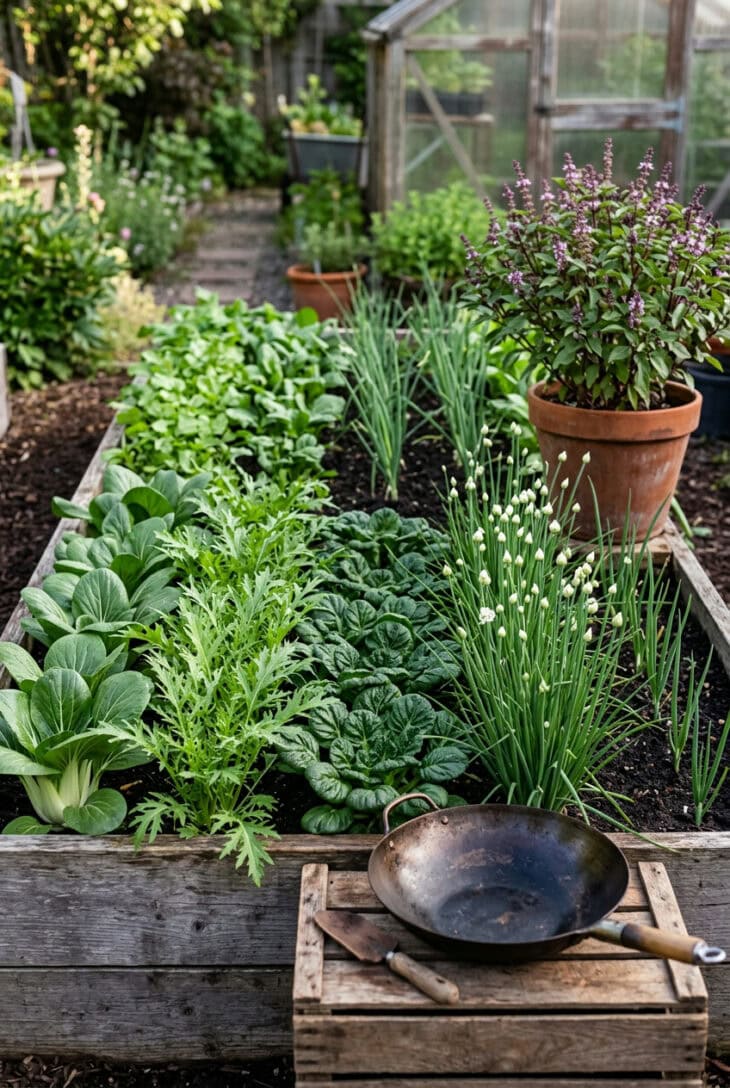
What you see Glossy pak choi with white stems, feathery mizuna and flat rosettes of tatsoi share a bed with clumps of garlic chives and rows of green onions. A pot of Thai basil, purple-stemmed and in flower, stands at one end. An empty wok sits on a wooden crate at the edge of the bed, as if dinner is about to be picked.
Why it works A stir-fry takes minutes, so the best garden for one is made of quick crops grown beside the stove. Asian greens mature in roughly 30 to 60 days, much faster than most vegetables, so the bed turns over several times a season. The flavors store-bought greens rarely match come from the fresh herbs, and Thai basil and garlic chives are the big wins.
How to get it Sow pak choi (Brassica rapa subsp. chinensis), mizuna and tatsoi about 4 weeks before last frost, or 6 to 8 weeks before first fall frost, since long summer days and heat push them to bolt. Cover the bed with fine row cover to stop flea beetles, which riddle the leaves with tiny holes. Plant Thai basil (Ocimum basilicum var. thyrsiflora) once nights stay above 50°F (10°C). Shiso (Perilla frutescens) is a fine addition but self-sows freely, so deadhead it before the seed forms. Lemongrass (Cymbopogon citratus) is perennial only in about Zones 9 to 11, so grow it in a pot and bring it indoors elsewhere.
17. Grape Arbor Seating Nook
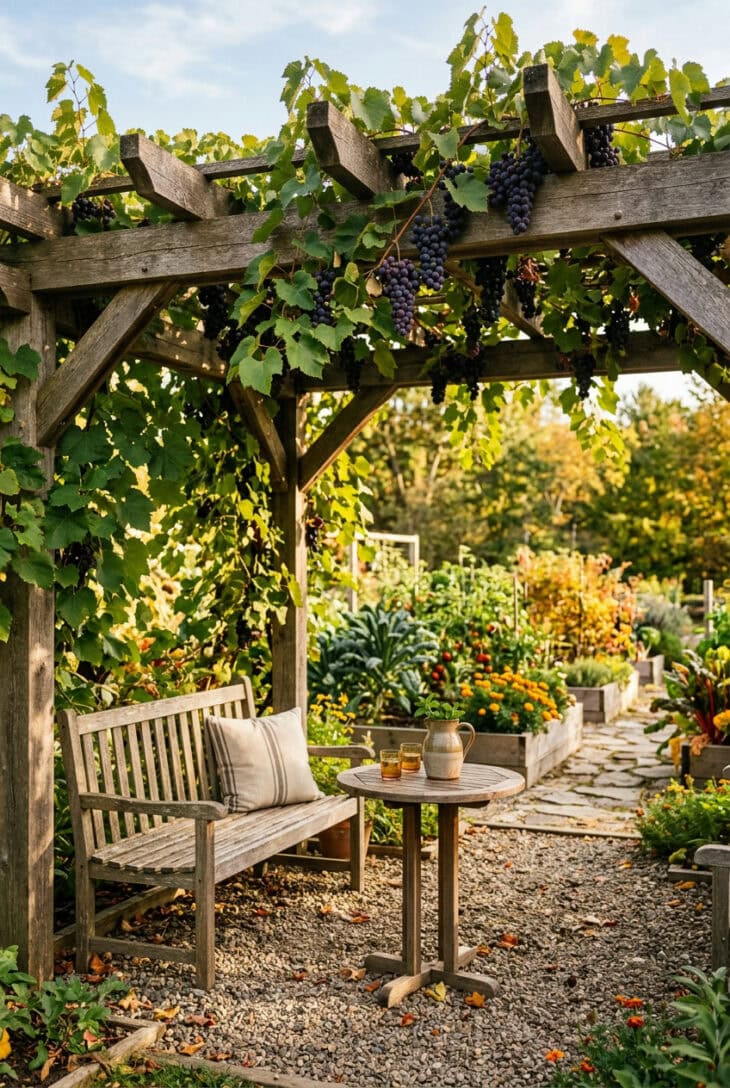
What you see A wooden pergola shades a small gravel seating area, its beams draped with grapevines and heavy purple clusters hanging at eye level. A bench and a small round table with a jug and two glasses sit in the dappled light. Through the posts you can see the raised beds of the kitchen garden beyond.
Why it works The best place to enjoy a kitchen garden is inside it, and a seat in the shade turns the garden from a place for chores into a place to sit. A grapevine gives a roof that grows itself, with shade in summer and sun in winter once the leaves drop. It also gives fruit at arm’s reach.
How to get it Build a sturdy pergola at least 8ft (240cm) square, with posts set in concrete, because a mature vine is heavy. Choose a variety for your climate: ‘Concord’ and ‘Niagara’ (Vitis labrusca) suit Zones 4 to 8, while muscadines (Vitis rotundifolia) suit the Southeast, Zones 7 to 10. Train one trunk up a post and cordons along the beams, and prune hard in late winter while dormant, since grapes fruit on new shoots from last year’s canes. Expect little fruit for the first 2 to 3 years. In humid regions, black rot is the main disease, so favor resistant varieties.
18. Front-Yard Edible Border
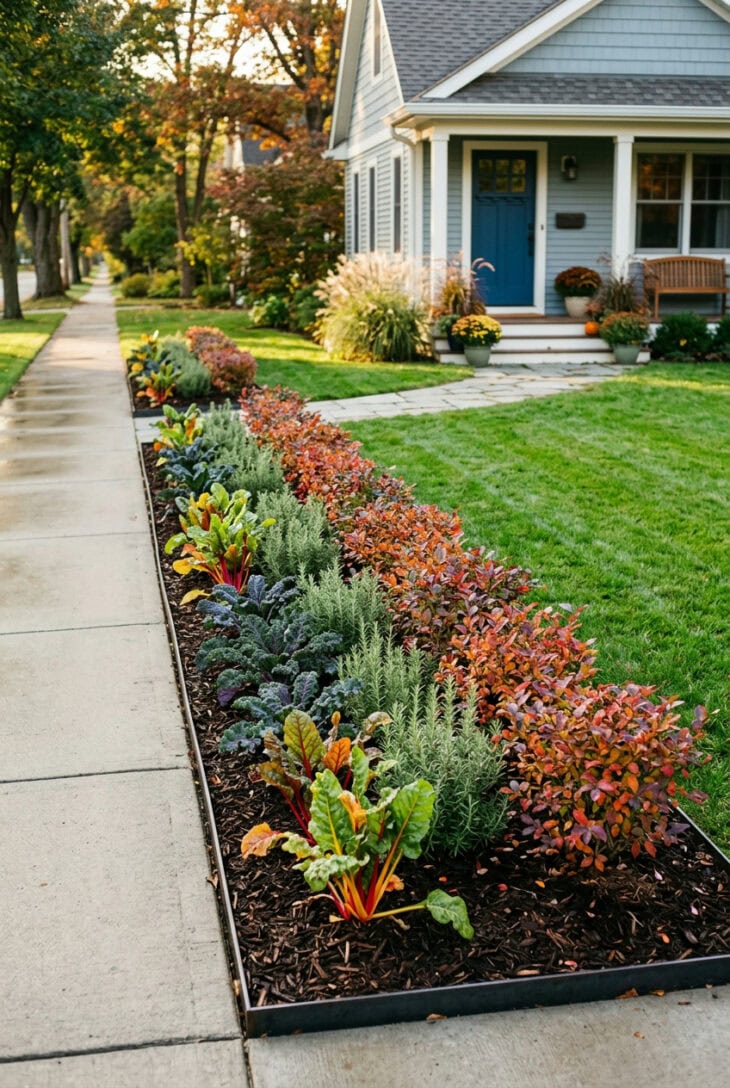
What you see Along the front walk, a border of rainbow chard, dark red kale, gray-green rosemary and blueberry bushes with red fall leaves is planted in tidy repeated blocks. A crisp steel edge and fresh dark mulch hold the lines against a mown lawn. The porch and painted front door behind make it clear this is the front of a house, and the border looks like any well-kept planting.
Why it works The front yard often gets the best sun on the property, and most of it is lawn. An edible border uses that sun while still passing as one of the front garden ideas that boost curb appeal. Repetition, edging and mulch are what stop it reading as a vegetable patch.
How to get it Check your homeowners’ association rules and city code before planting, since some restrict front-yard vegetables or plant height. Soil beside old painted houses and busy roads can carry lead, so test it before growing food there. Use ornamental edibles first: chard such as ‘Bright Lights’, kale, rosemary, blueberries, thyme and chives. Set plants in groups of 3 or 5, repeat them down the border, and finish with garden edging in steel or brick. Keep sprawling crops like squash for the back yard so the border looks good in every season.
19. Insectary Flower Strip
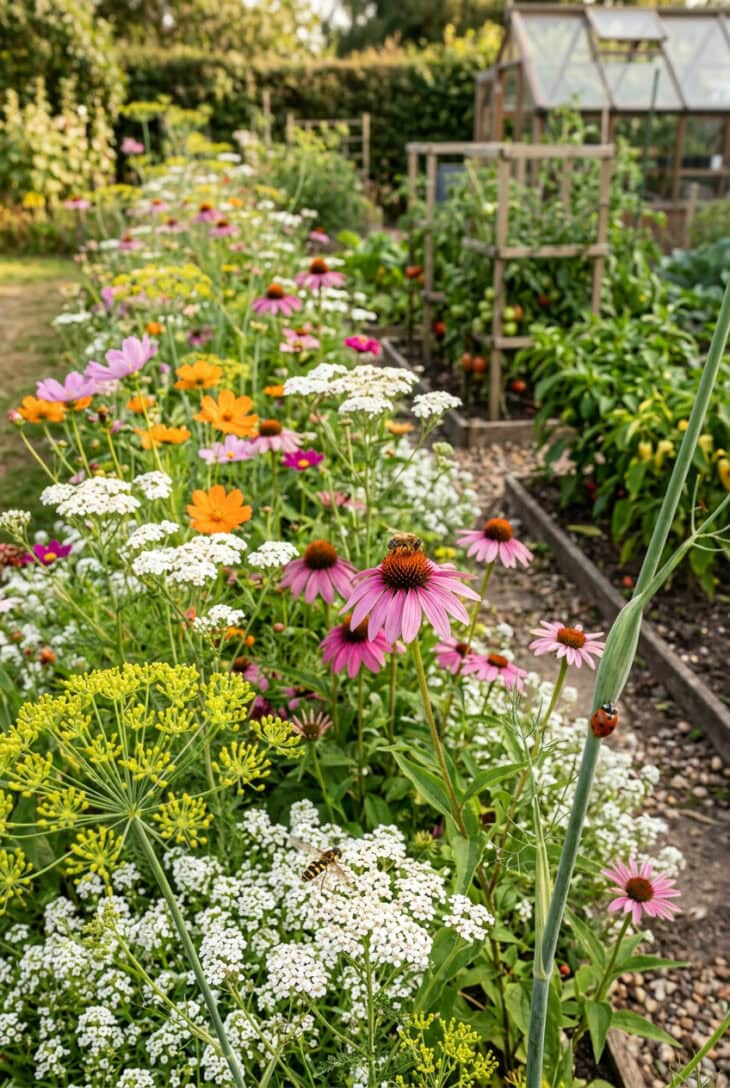
What you see A wide ribbon of flowers runs beside the vegetable beds: feathery yellow-green dill heads, a low froth of white sweet alyssum, pink coneflowers and orange-and-pink cosmos. A hoverfly hangs over the alyssum, a ladybug climbs a dill stem and a honeybee works a coneflower. The tomato cages and pepper plants of the vegetable bed are just visible behind.
Why it works Small flowers like dill and alyssum feed hoverflies, lacewings and parasitic wasps, whose larvae or young eat aphids and other pests. Studies of flowering strips show they can raise numbers of these beneficial insects, though the effect on crop yield varies, so treat the strip as a help rather than a cure. The same flowers support bees and butterflies, in line with the wider aims of pollinator garden ideas.
How to get it Make the strip at least 2 to 3ft (60 to 90cm) wide along one side of the beds. Sow dill (Anethum graveolens) and sweet alyssum (Lobularia maritima) from seed 2 to 4 weeks before last frost, add cosmos after last frost, and plant pink coneflower (Echinacea purpurea) as a perennial anchor. Choose open, small-flowered types over double-flowered ones, which can hide the nectar. Insecticides, even organic ones, can kill the helpers along with the pests, so spray only as a last resort and follow the label.
20. Dwarf Fruit Trees in Terrace Containers
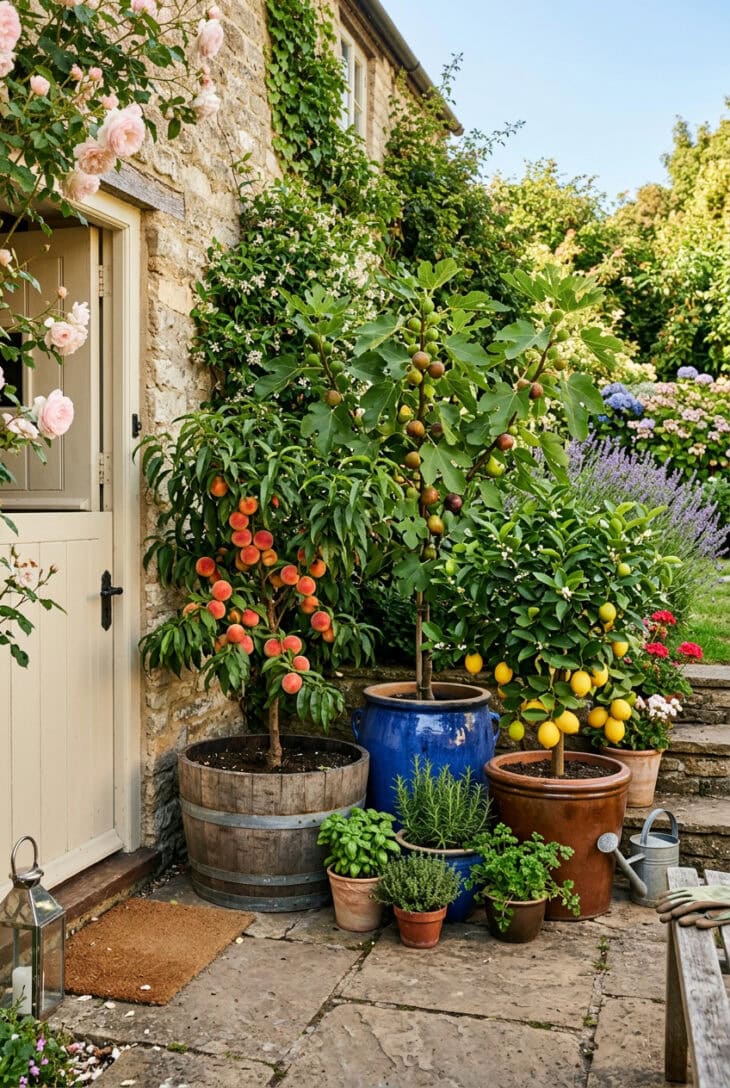
What you see On a sunny stone terrace beside the kitchen door, three big planters carry a dwarf peach with ripe orange-red fruit, a fig in broad lobed leaves with green-purple figs, and a Meyer lemon with glossy leaves and yellow lemons. Small pots of herbs crowd around their feet. The corner looks like a miniature orchard a step from the kitchen.
Why it works Fruit trees in large containers give you fruit where there is no soil, and let you move tender trees indoors for winter. That makes lemon and fig possible for gardeners in colder climates. It is also an easy way to start a small backyard orchard before committing any ground.
How to get it Use containers of at least 15 to 20 gallons (57 to 76L) with drainage holes, filled with a good potting mix. ‘Bonanza’ is a genetic dwarf peach (Prunus persica) for roughly Zones 5 to 9 that stays about 5 to 6ft (150 to 180cm) tall. Fig ‘Chicago Hardy’ (Ficus carica) can survive winters outdoors in about Zone 5 with protection, dying back and resprouting, and in the open ground fig is generally grown in Zones 7 to 10. Meyer lemon (Citrus × meyeri) is tender, so bring it inside before the first frost and give it your sunniest window. Pots dry out quickly in summer, so check them daily.
21. Grow-Bag Kitchen Garden for Renters
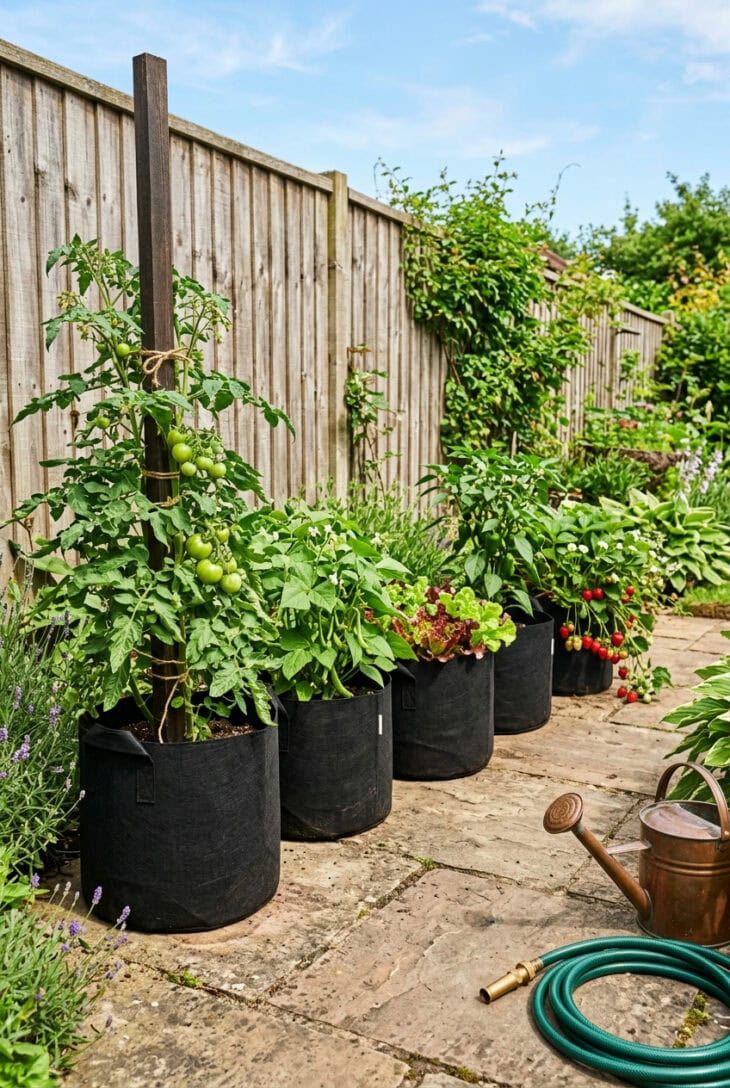
What you see A row of black fabric grow bags lines a paved patio against a wooden fence. A tomato in the largest bag climbs a tall stake, peppers carry small green fruit, lettuce and bush beans fill the smaller bags, and strawberries trail red berries over the side of another. A watering can sits at the end of the row.
Why it works Fabric bags need no building and no digging, so there is nothing to ask a landlord about. They are light when empty, fold flat for storage and move with you when you leave. The fabric also lets air reach the roots and stops them circling, which suits tomatoes and peppers well.
How to get it Use bags of 15 to 20 gallons (57 to 76L) for tomatoes, 5 to 7 gallons (19 to 26L) for peppers and strawberries, and 3 to 5 gallons (11 to 19L) for lettuce, filled with bagged potting mix, not garden soil. Fabric dries quickly, so water daily in hot weather and feed every 2 to 3 weeks with a balanced fertilizer, since frequent watering leaches nutrients. Everbearing strawberries (Fragaria × ananassa) do well in a bag, with the crown kept at soil level. If this is a balcony garden, check the weight limit with your landlord first, since wet bags are heavy.
22. Short-Season Garden for Zones 3 and 4
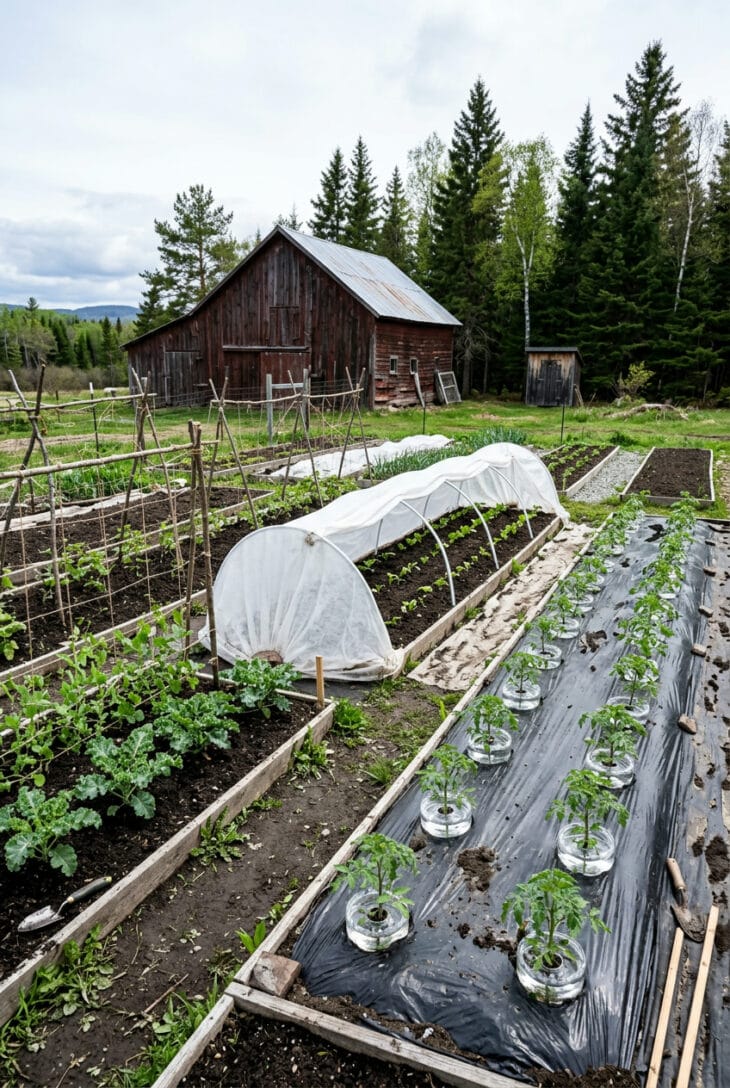
What you see In a northern garden under a bright cool sky, one bed is arched with white fabric row cover, and young tomato plants rise through black plastic mulch, each ringed by a clear water-filled protector. A row of kale and peas grows uncovered beside them. Spruce trees and a weathered barn stand in the distance.
Why it works In Zones 3 and 4 the frost-free season can be little more than 100 days, so the plan matters more than the plants. The answer is varieties bred to ripen fast, plus tricks that warm the soil and the air around the crop. Together they add weeks at both ends of the season.
How to get it Start tomatoes indoors 6 to 8 weeks before last frost and choose early varieties such as ‘Sungold’, ‘Stupice’ or ‘Glacier’, which ripen about 55 to 70 days after transplanting. Warm the soil in spring with black plastic, and protect plants with row cover or water-filled protectors for the first weeks. Sow cold-hardy crops such as peas, kale, radishes and lettuce as soon as the soil can be worked. A cold frame or small greenhouse adds several more weeks at either end of the season. Set out tender crops only after the last frost has passed, and cover them overnight if a late frost threatens.
23. Heat-Loving Kitchen Garden for the South
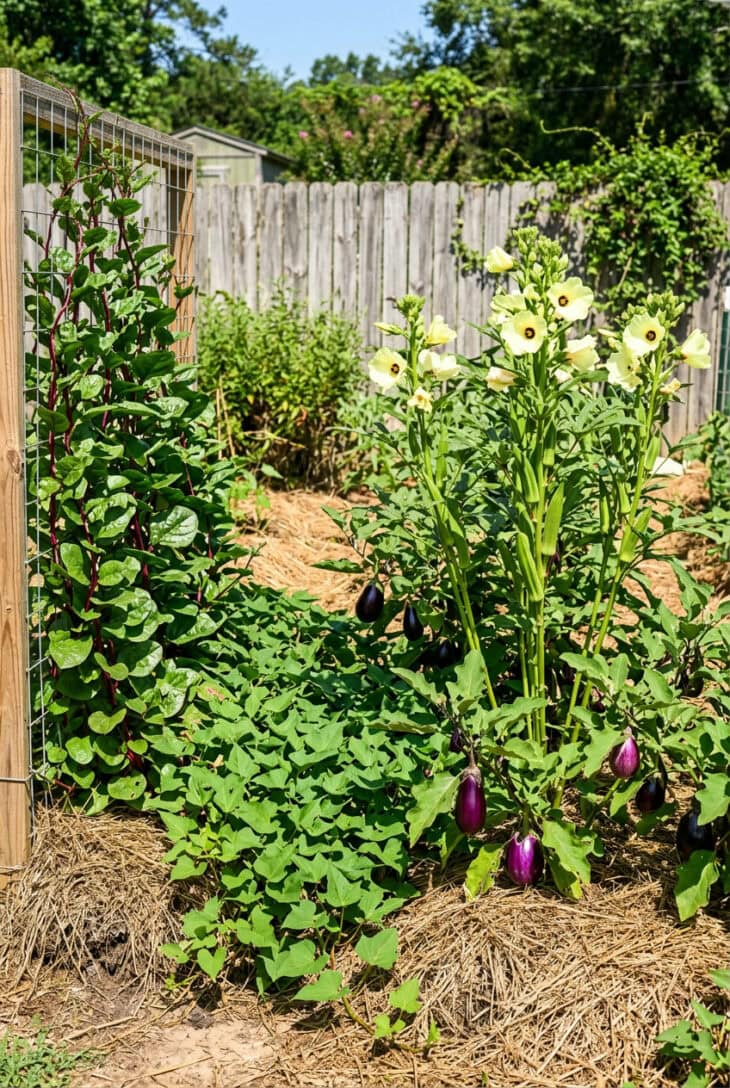
What you see Okra plants stand shoulder-high in full sun, their pale yellow hibiscus-like flowers opening beside green pods. A trellis carries glossy Malabar spinach with purple stems, sweet potato vines spread across the ground, and eggplants hang their glossy purple fruit. Thick straw mulch covers the soil, and the light is bright and hot.
Why it works In the South the problem is not a short season but too much heat, and cool-season favorites sulk in July. The answer is to grow crops that evolved for it. These plants do not just put up with heat; they use it to grow.
How to get it Sow okra (Abelmoschus esculentus) when the soil has warmed to about 65°F (18°C) or more, and cut pods at about 3in (8cm). Wear long sleeves and gloves, since the leaves and pods can irritate skin. Grow shorter crops in the shade of the okra; the list of companion plants for okra shows which ones work. Malabar spinach (Basella alba) is perennial only in Zones 9 to 11 and is grown as an annual elsewhere; it makes a leafy substitute for spinach, which bolts in heat. Tomatoes stop setting fruit when days pass about 90°F (32°C) and nights stay above about 75°F (24°C), so plant early for a spring crop and again in midsummer for fall. Mulch with 3 to 4in (8 to 10cm) of straw to keep the roots cool.
24. Terraced Kitchen Garden on a Slope
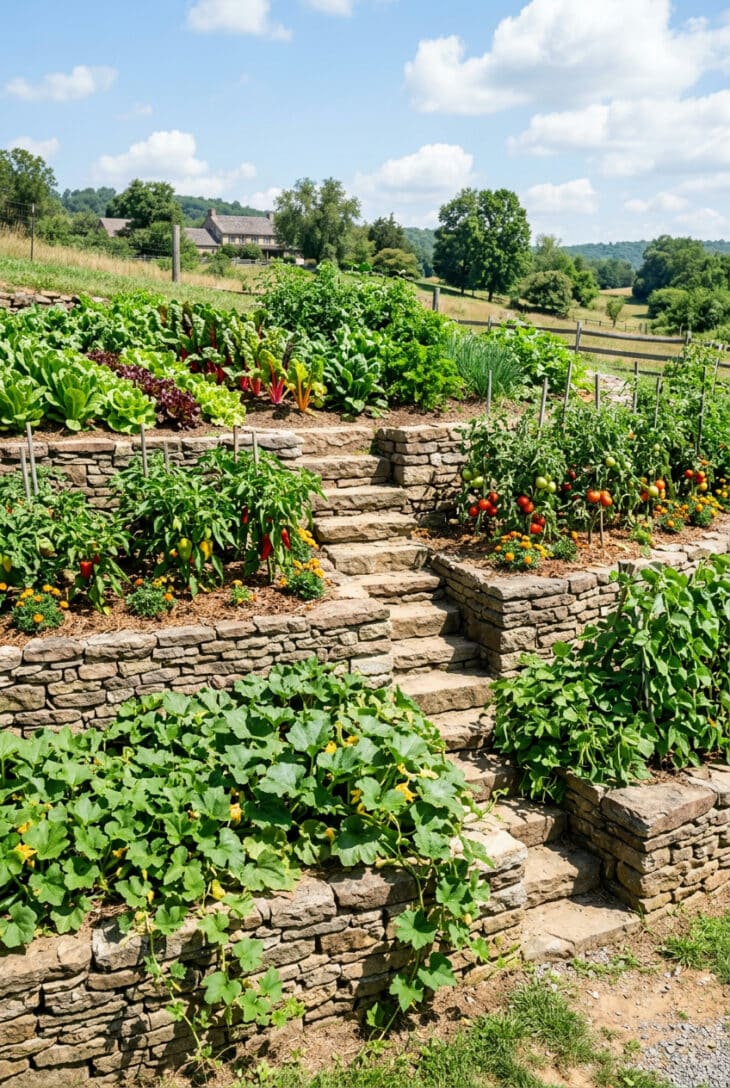
What you see Three stepped terraces climb a gentle slope, each held by a dry-laid stone wall and planted with its own crop. Lettuce and chard grow on the top level, tomatoes and peppers fill the middle, and squash and beans spill over the bottom wall. A narrow stone staircase in the center connects them all, in bright summer sun.
Why it works A slope sheds water and washes soil downhill, but terraces, like those in our sloped garden ideas, turn it into level beds that hold both. The stone walls store warmth and give it back at night. A south-facing slope also warms earlier in spring, which suits early kitchen crops.
How to get it Make each terrace 3 to 4ft (90 to 120cm) deep so you can reach across, and set the beds level from front to back. Walls higher than about 3 to 4ft (90 to 120cm) usually need an engineer and sometimes a permit, so check local code or hire a professional for anything taller. Lower walls can be dry-stacked stone, timber or block. Backfill with gravel behind each wall so water drains out instead of pushing it over. Put frost-tender crops mid-slope rather than at the bottom, where cold air collects on still nights.
25. Waist-High Accessible Kitchen Garden
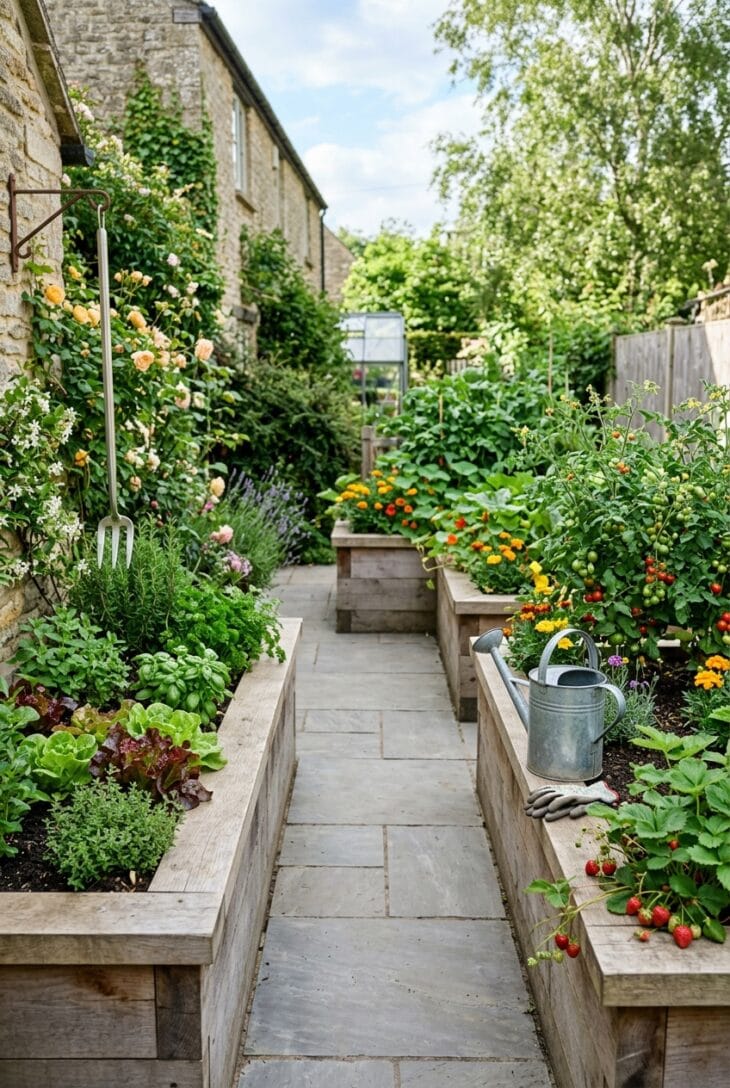
What you see Raised beds stand at waist height, each with a broad wooden ledge along the top, and smooth paths wide enough for a wheelchair run between them. Lettuce, herbs, strawberries and cherry tomatoes grow within easy reach, with a few bright flowers for color. A watering can sits on a ledge and a long-handled tool hangs from a hook on the nearby wall.
Why it works A garden you cannot reach is not a garden you can use. Beds at 24 to 30in (60 to 76cm) high mean no kneeling and little bending, which helps with wheelchairs, bad knees and bad backs. The same design suits any gardener who wants to stay comfortable for years to come.
How to get it Build raised beds 24 to 30in (60 to 76cm) high and no more than 24in (60cm) wide if you reach from one side only, or 4ft (120cm) if you reach from both. Keep paths at least 36in (90cm) wide, with a 5ft (150cm) turning space at corners, on a firm, smooth surface such as compacted gravel or pavers. A 4 by 8ft (120 by 240cm) bed 2ft (60cm) tall takes about 2.4 cubic yards (1.8m³) of fill, so cost it out first, and mix topsoil with compost (our guide to types of compost helps you choose). Add a drip line and a timer so watering is never a chore.