Fall is the season when a garden finally shows what it was built for. The light drops low and golden, maples catch fire, grasses turn to copper, and the last asters hum with bees that are fattening up for winter. If your yard looks tired by September, the fix is usually not more summer flowers but plants that save their best for the cool months.
Contents
- 01. Make a Japanese Maple the Focal Point
- 02. Sow an Aster and Goldenrod Meadow
- 03. Plant a Grass Drift to Catch the Low Sun
- 04. Build a Border That Peaks in September
- 05. Plant Hardy Mums in the Ground, Not Just in Pots
- 06. Pot Up a Fall Container Trio by the Door
- 07. Swap Burning Bush for Native Shrubs That Blaze
- 08. Plant a Red Shade Tree for the Long Game
- 09. Plant a Grove of Gold
- 10. Choose a Small Tree With Three Seasons
- 11. Grow a Berry Border for the Birds
- 12. Plant a Crabapple or Hawthorn for Winter Fruit
- 13. Leave the Seedheads Standing
- 14. Turn Fallen Leaves Into Free Mulch
- 15. Cover a Wall in Crimson Boston Ivy
- 16. Train a Crimson Vine Over the Pergola
- 17. Float a Pink Cloud of Muhly Grass
- 18. Cut Dahlias Until the First Frost
- 19. Fill a Bed With Hot-Colored Annuals
- 20. Grow an Ornamental Edible Bed
- 21. Light Up Shade With Golden Leaves
- 22. Plant Bulbs That Bloom in Fall
- 23. Layer Spring Bulbs in a Pot Now
- 24. Let Hydrangeas Dry on the Shrub
- 25. Build a Border Around Smoke Bush Foliage
- 26. Plant a Corner for Fall Fragrance
- 27. Let a Gravel Garden Go Gold and Rust
- 28. Bring Fall Color to a Balcony
- 29. Create a Lantern-Lit Fall Seating Nook
- 30. Give the Garden an Evergreen Backbone
The ideas below cover the whole range: trees you plant once for decades of red and gold, native shrubs, late perennials, grass drifts, berries for birds and a few quick wins in pots for a porch or balcony. Some suit a big suburban lot and others a shady side yard or a dry, sunny strip. Budgets run from a flat of hardy mums to a specimen maple, and most ideas work from zone 4 to zone 8, with notes for the South where it matters.
Scroll through for inspiration, or jump to the ideas that suit your space and light. Fall is also the best planting season of the year for trees, shrubs and perennials, since warm soil and cool air let roots settle before winter, so if something catches your eye, there is a good chance you can plant it this month.
01. Make a Japanese Maple the Focal Point
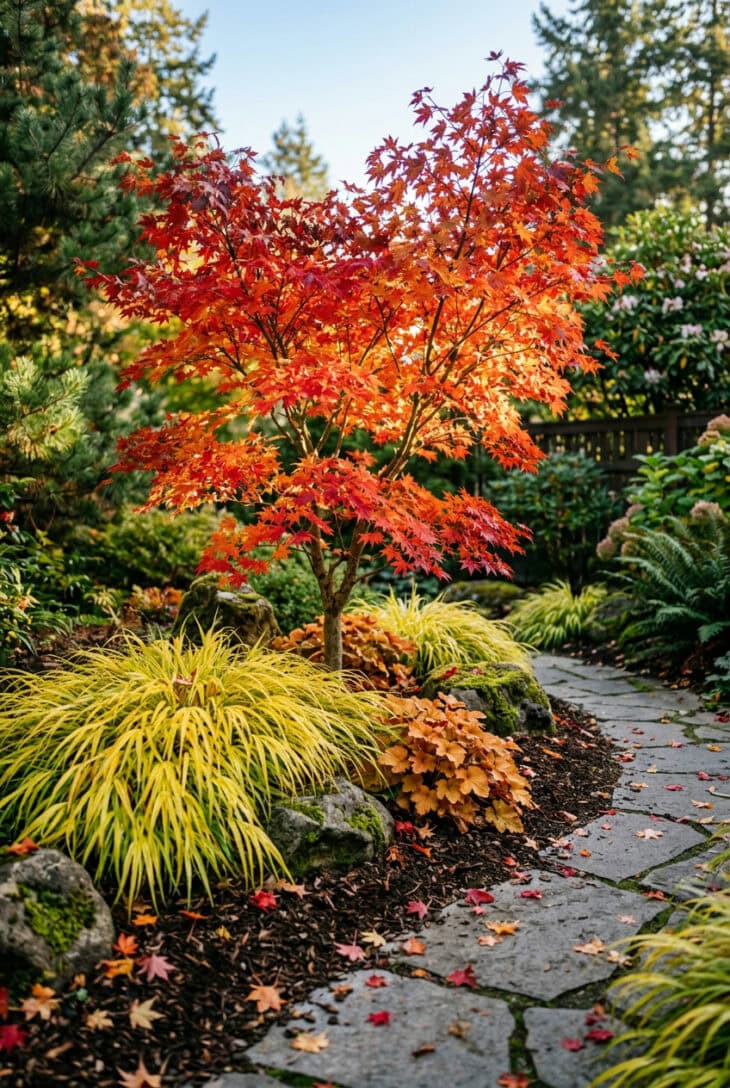
What you see A small maple with tiered branches glowing scarlet in the low October sun, its leaves lit from behind like stained glass. Golden forest grass pours around its feet, caramel heuchera fills the gaps, and a few mossy boulders anchor the scene. Fallen red leaves scatter across the dark mulch and the gray stone path.
Why it works One tree with outstanding fall color does more for autumn than a dozen scattered plants, because the eye goes straight to it and the rest of the bed becomes its setting. The gold underplanting repeats the warm tones at ground level and holds the look together after the maple drops its leaves. It is the same principle behind many Japanese garden designs: a single tree, a few stones, and space around them.
How to get it For the brightest red, choose Japanese maple (Acer palmatum ‘Osakazuki’), which grows 15 to 20ft (4.5 to 6m) in zones 5 to 8; for a smaller yard, ‘Seiryu’ turns orange-gold and stays nearer 12ft (3.6m). Site it where it gets morning sun and some afternoon shade, since hot afternoon sun scorches the leaves in summer. Underplant with Japanese forest grass (Hakonechloa macra ‘Aureola’) and heuchera (Heuchera ‘Caramel’) spaced 15in (38cm) apart. Plant in early fall, keep the root flare level with the soil surface, and water weekly until the ground freezes. Avoid piling mulch against the trunk, which invites rot.
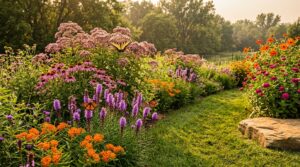
02. Sow an Aster and Goldenrod Meadow
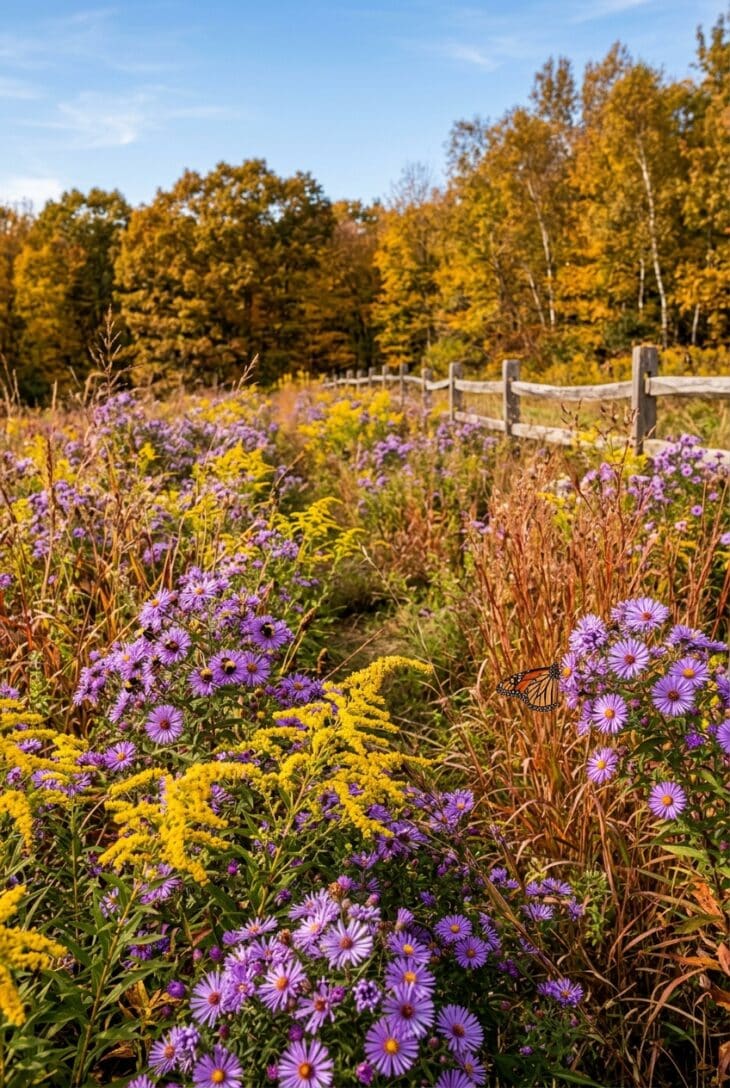
What you see A loose, knee-to-waist-high sweep of violet asters and golden goldenrod sprays, threaded with russet grass. Bumblebees work every flower head, and a monarch opens its wings on a purple bloom. A split-rail fence and yellowing trees frame the scene under a clean October sky.
Why it works Purple and yellow sit opposite each other on the color wheel, so this pairing reads from across the yard without any help. Both are native, bloom when little else does, and feed migrating monarchs and late bumblebees, which makes this the backbone of most pollinator garden ideas for fall. And goldenrod does not cause hay fever: the culprit is ragweed, which blooms at the same time with green, wind-blown pollen.
How to get it Plant New England aster (Symphyotrichum novae-angliae), choosing compact ‘Purple Dome’ at 18 to 24in (45 to 60cm) if you want to skip staking. Pair it with a clump-forming goldenrod such as ‘Fireworks’ (Solidago rugosa), which stays put rather than running like wild Canada goldenrod. Add aromatic aster (Symphyotrichum oblongifolium ‘October Skies’) at the front for the latest blue flowers of all. Space plants 18in (45cm) apart in full sun and ordinary soil; rich soil makes them flop. Pinch the taller asters back by a third in early June for sturdier, bushier plants.
03. Plant a Grass Drift to Catch the Low Sun
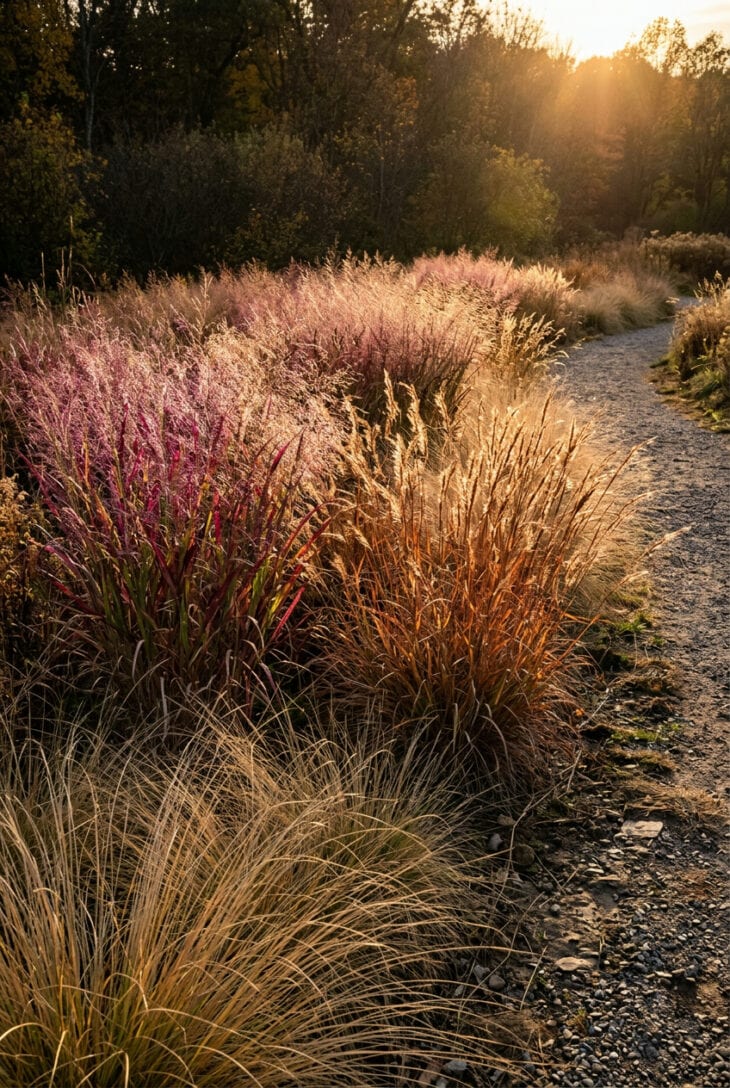
What you see A sea of grasses lit from behind by the evening sun. Switchgrass holds up airy clouds of seed with wine-red tips, little bluestem burns copper and orange, and fine tufts of prairie dropseed catch the light along the front edge. Every blade has a bright rim, and the whole drift sways in the breeze beside a narrow gravel path.
Why it works Grasses peak just as flowers fade, and their seedheads turn low autumn light into something you can see. Planted in drifts rather than single specimens, they read as a single glowing surface. They stay standing through winter, need one haircut a year, and fit neatly into low-maintenance garden ideas for anyone who would rather watch the garden than work in it.
How to get it Put the drift where you will see it with the sun behind it: west of a patio for evening glow, or east of the kitchen window for morning light. Use switchgrass (Panicum virgatum ‘Shenandoah’) at the back, 3 to 4ft (90 to 120cm) tall, then little bluestem (Schizachyrium scoparium ‘Standing Ovation’) and prairie dropseed (Sporobolus heterolepis) toward the front, whose seedheads smell faintly of popcorn. All three suit zones 4 to 9, full sun and lean soil. Plant in groups of five to nine, 18 to 24in (45 to 60cm) apart. Leave them standing until late winter, then cut back to 4in (10cm) before new growth starts.
04. Build a Border That Peaks in September
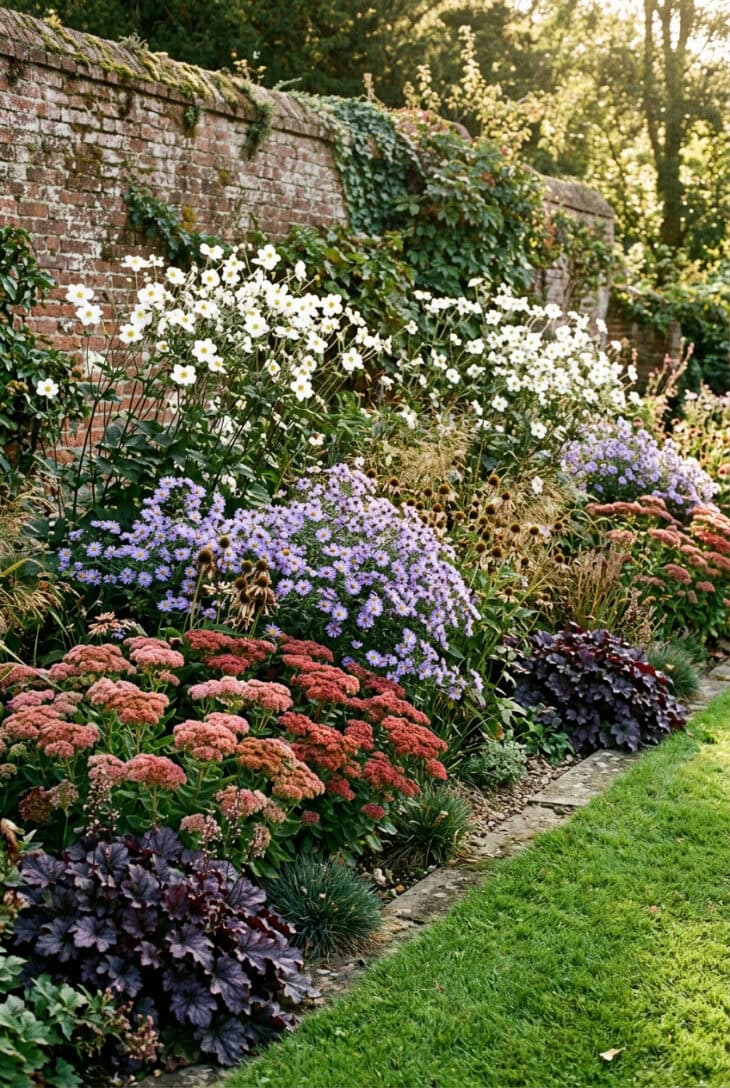
What you see A border that has saved its show for the end of the season. Tall white anemones with golden eyes nod at the back against an old brick wall, lavender asters foam through the middle, and broad, rusty-pink heads of sedum sit along the lawn edge. The light is soft and gold, and the whole bed looks fresh at a time when most gardens look spent.
Why it works Most borders are planned around June, which leaves them flat by fall. Building one around late bloomers flips that, and the soft palette of white, lavender and dusty pink feels restful after summer’s hot colors. Every plant here is a long-lived perennial, so it earns a place alongside our perennial garden ideas: planted once, repeating every year.
How to get it Put Japanese anemone (Anemone × hybrida ‘Honorine Jobert’) at the back, where its 3 to 4ft (90 to 120cm) stems can lean on a wall; it spreads slowly, so give it room or edge it in. Fill the middle with Frikart’s aster (Aster × frikartii ‘Mönch’), which blooms from August to frost. Line the front with autumn sedum (Hylotelephium ‘Herbstfreude’, often sold as ‘Autumn Joy’) and heuchera (Heuchera ‘Palace Purple’), 15 to 18in (38 to 45cm) apart. The bed wants full sun to light shade and well-drained soil. Anemones sulk for a year after planting, so be patient, and resist cutting the sedum heads, which turn brick red and stand all winter.
05. Plant Hardy Mums in the Ground, Not Just in Pots
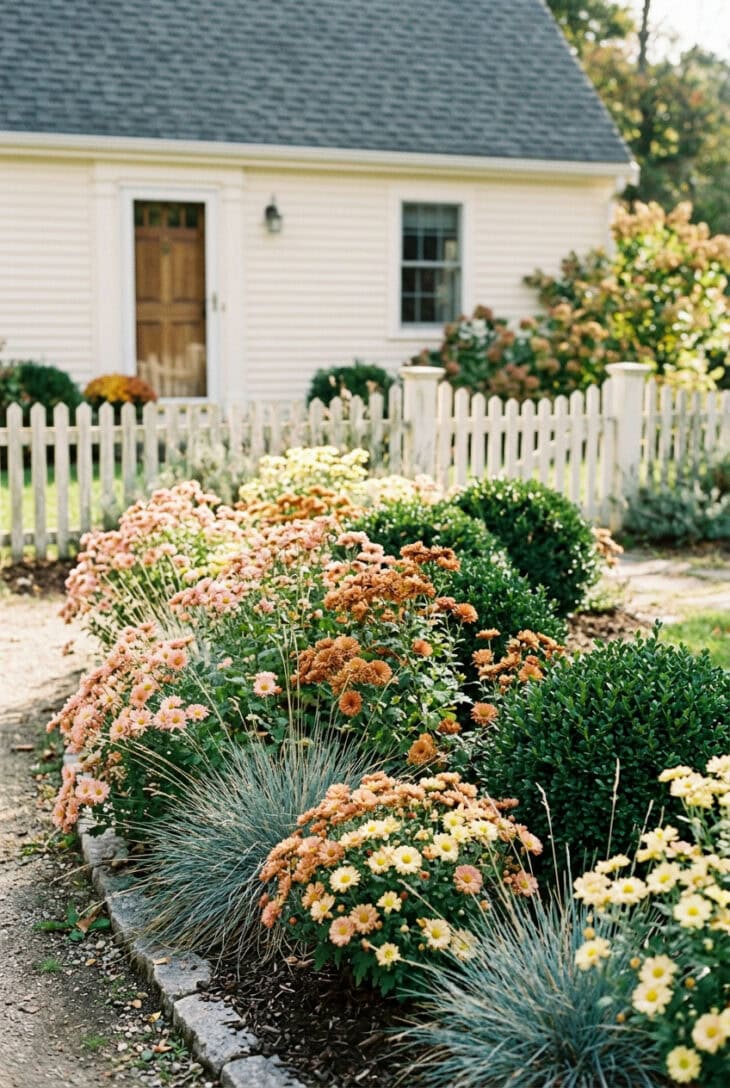
What you see A front bed full of relaxed clumps of daisy-flowered mums in peach-pink, bronze and pale butter yellow. Blue-gray grass and small green boxwood balls break up the color, and a cream clapboard wall and white picket fence sit softly behind. These mums look like garden plants, loose and natural, not tight domes in plastic pots.
Why it works The tidy mums sold at every store in September are bred for one season in a pot, and most die over winter in cold zones. True hardy garden mums come back for years, bloom later and longer, and grow into loose, graceful clumps. Mixed with evergreens and grass, they make a permanent fall feature in any of these flower bed ideas.
How to get it Look for varieties like ‘Sheffield Pink’ and ‘Clara Curtis’ (Chrysanthemum × rubellum), both reliable in zones 5 to 9. Plant in spring, not fall, so the roots have a full season to establish before their first winter. Give them full sun, well-drained soil and 18 to 24in (45 to 60cm) of space. Pinch the stem tips by half every few weeks until early July for a bushier plant with more flowers. Leave the old stems standing over winter to protect the crowns, then cut back in spring once new shoots appear.
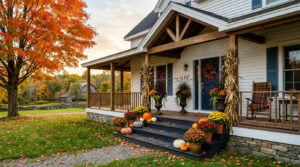
06. Pot Up a Fall Container Trio by the Door
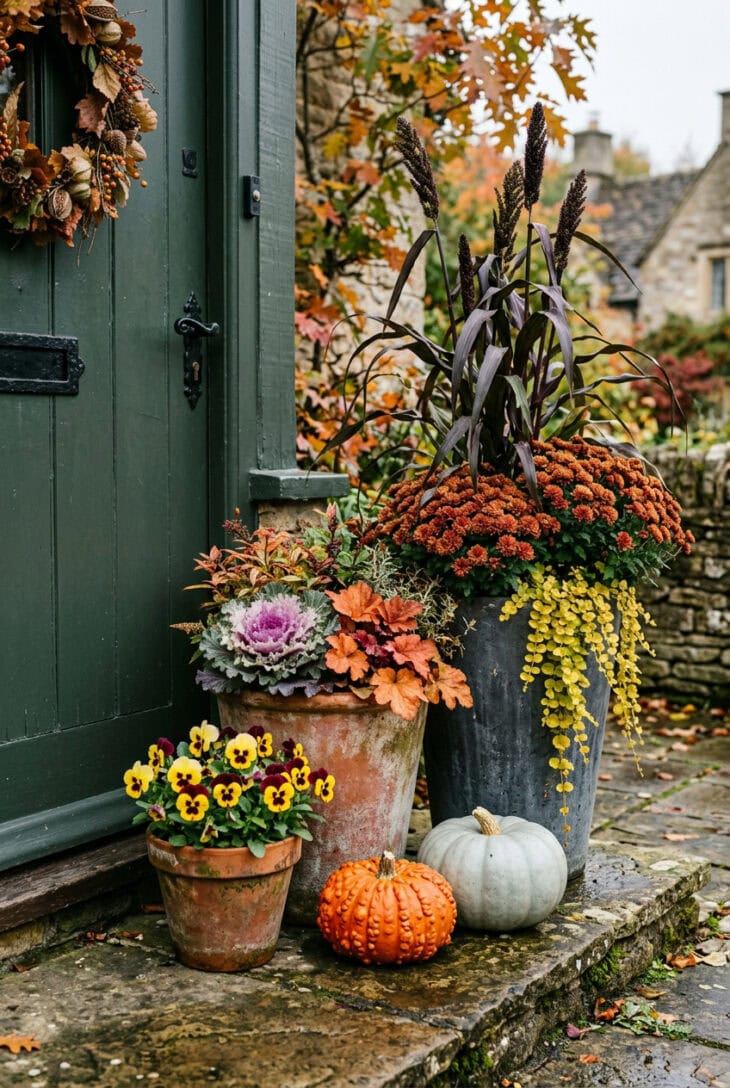
What you see Three pots of different heights clustered beside a dark green door. The tallest sends up purple millet spikes over a bronze mum, with golden creeping jenny spilling over the rim. The middle pot holds frilled purple-and-cream kale with deep orange heuchera, and the smallest glows with yellow and burgundy pansies. A blue-gray pumpkin and a warty orange one sit at their feet.
Why it works Grouping pots of three heights gives a small doorstep a layered look, like a mini border. Every plant here handles frost, so the display lasts from September to Thanksgiving rather than a couple of weeks. The same principles run through our container garden ideas, and it is easy to push toward the spooky end with a few of our Halloween garden ideas as October goes on.
How to get it Use pots at least 14in (35cm) across for the smallest and 18in (45cm) for the tallest; tiny pots dry out and look sparse. For height, plant ornamental millet (Pennisetum glaucum ‘Purple Majesty’), which lasts until the first hard frost. Around it, set a mum (Chrysanthemum × morifolium), ornamental kale (Brassica oleracea), heuchera (Heuchera ‘Marmalade’), pansies (Viola × wittrockiana) and creeping jenny (Lysimachia nummularia ‘Aurea’). Plant tightly, nearly touching, since there is no time for plants to fill in. Water when the top inch is dry, and move the heuchera and creeping jenny into the ground in November.
07. Swap Burning Bush for Native Shrubs That Blaze
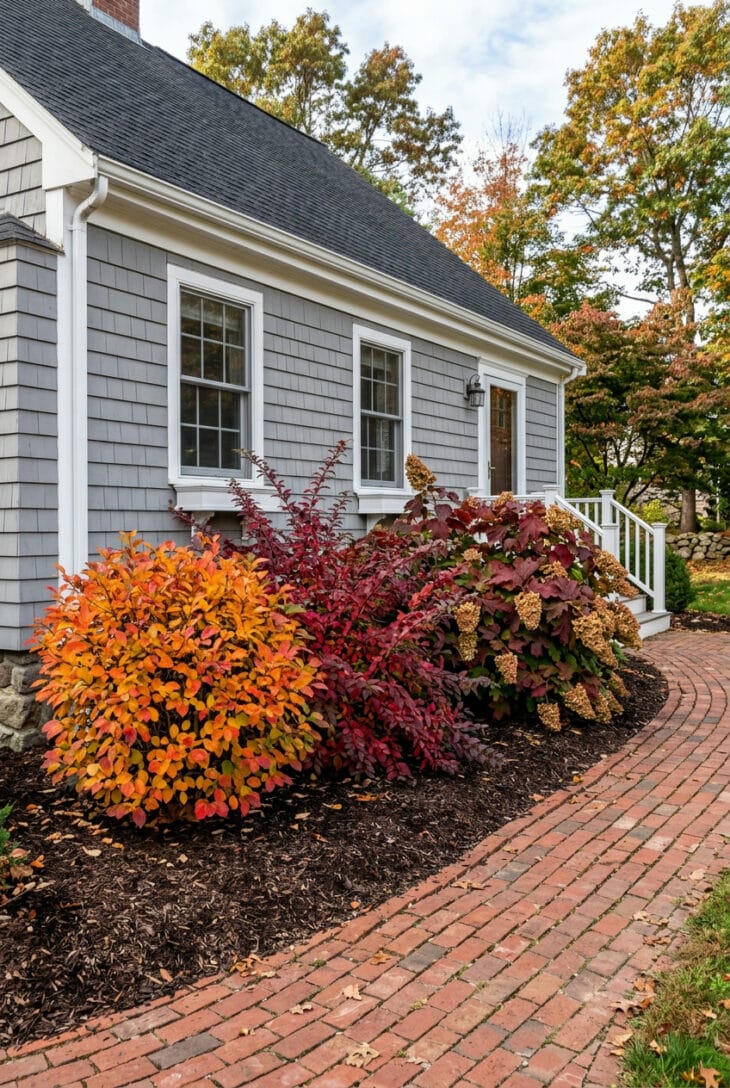
What you see A row of shrubs along a gray-shingled house, each burning a different shade. Fothergilla is a patchwork of orange, yellow and scarlet on the same branch, sweetspire arches in deep wine red, and oakleaf hydrangea holds big burgundy leaves with papery tan flower heads still attached. A curved brick path leads past them to the door.
Why it works For decades burning bush (Euonymus alatus) was the default for fall red, but it seeds into woodlands and is now banned from sale in several states. These three natives color just as brightly, flower in spring, feed pollinators and never escape. Mixed together, they give a front garden three textures and three shades of fire instead of one flat red wall.
How to get it Choose fothergilla (Fothergilla × intermedia ‘Mount Airy’), 5 to 6ft (1.5 to 1.8m) tall in zones 5 to 8, which colors best in sun and acidic soil. Virginia sweetspire (Itea virginica ‘Henry’s Garnet’) reaches 3 to 4ft (90 to 120cm), handles wet spots and suits zones 5 to 9. Oakleaf hydrangea (Hydrangea quercifolia ‘Ruby Slippers’) stays around 4ft (120cm) and takes part shade. Space each 4 to 5ft (120 to 150cm) apart and at least 3ft (90cm) out from the foundation. If you are removing an old burning bush, dig out the roots and pull seedlings for a few years after.
08. Plant a Red Shade Tree for the Long Game
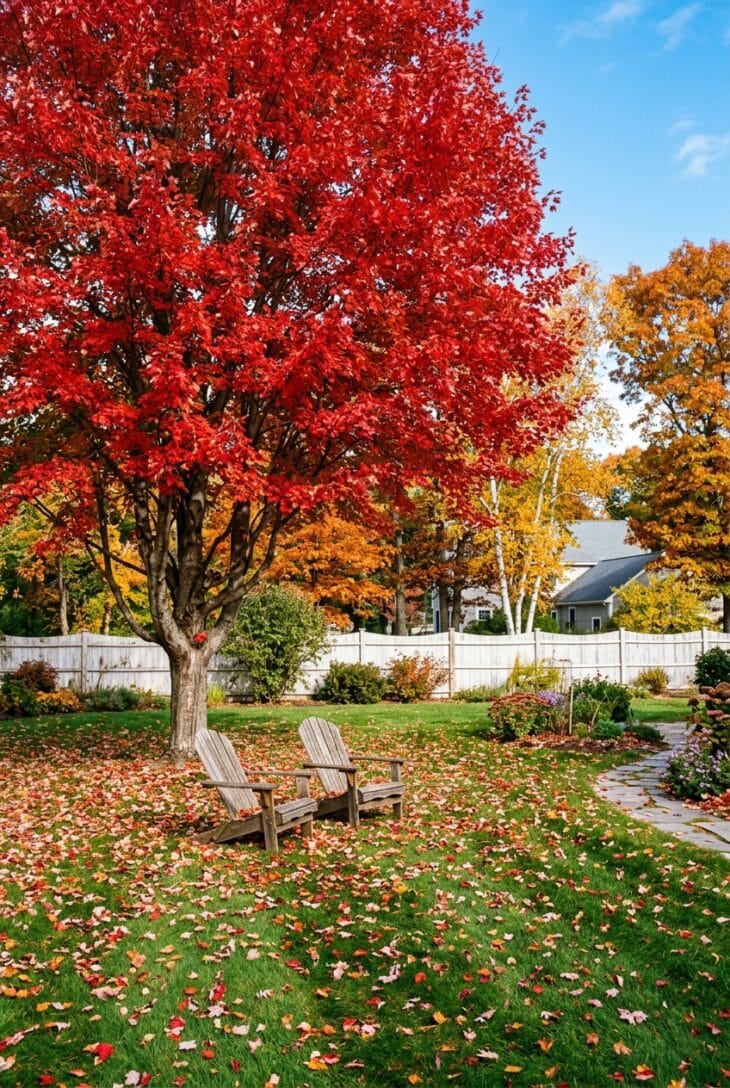
What you see A big, rounded maple in full scarlet, filling the sky above a green lawn. Its fallen leaves lie in a red circle under the canopy, and two wooden Adirondack chairs wait in the dappled shade. Smaller yellow and orange trees glow along a white fence behind.
Why it works A single large tree is the biggest fall color you can own, and it gives summer shade for decades on top. Red maples color reliably, grow fast for a hardwood and fit the scale of most backyard garden ideas. Planting in fall gives the roots two cool seasons to establish before the first real summer heat.
How to get it Choose a named red maple (Acer rubrum) such as ‘October Glory’ or ‘Red Sunset’, since seedlings vary and some turn only yellow. They grow 40 to 50ft (12 to 15m) tall in zones 4 to 9 and prefer acidic soil; in alkaline soil the leaves yellow in summer. Black gum (Nyssa sylvatica ‘Wildfire’) is an alternative with glossy scarlet fall color that handles wet ground, and in the South, crepe myrtle varieties such as ‘Natchez’ add orange-red leaves and peeling bark. Plant at least 20ft (6m) from the house and away from sewer lines. Dig the hole two to three times as wide as the root ball but no deeper, and water deeply every week through the first fall.
09. Plant a Grove of Gold
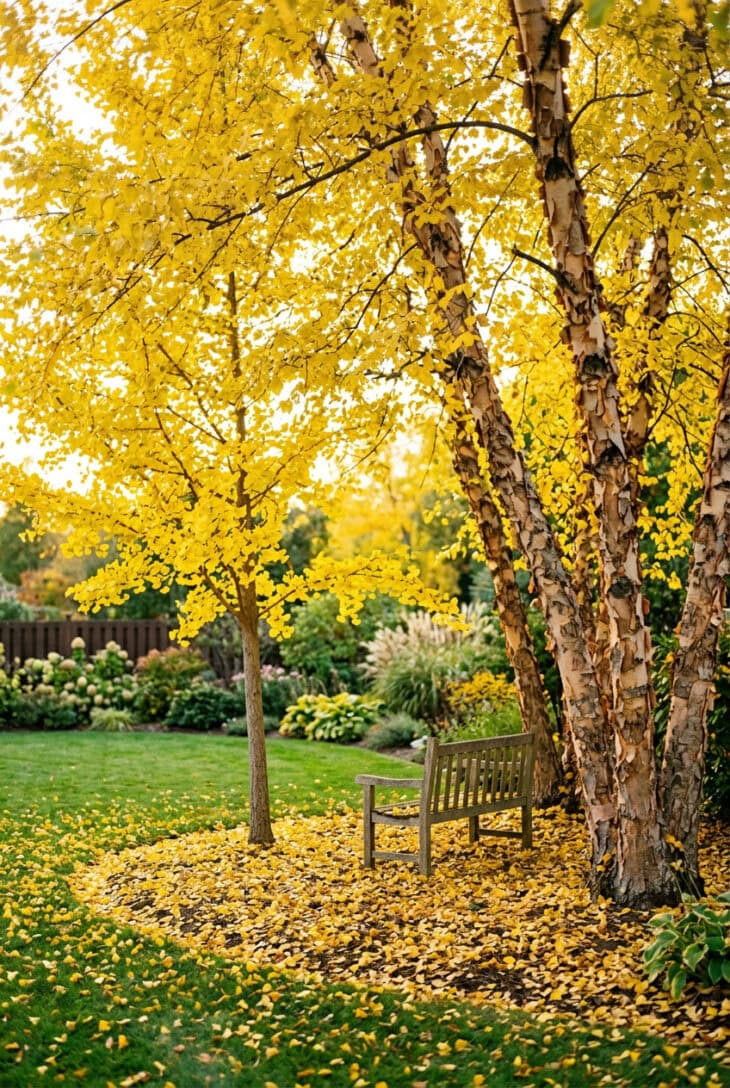
What you see A corner of the yard where everything has turned gold. Multi-stemmed birches with peeling cinnamon and cream bark stand in a loose group, a young ginkgo holds up fans of bright yellow leaves, and a carpet of fallen gold hides the ground. A plain wooden bench sits in the middle of the glow.
Why it works Yellow is the easiest fall color to see in shade or on a gray day, and a whole grove of it lights up a corner the way a lamp does a room. Several trees of one color feel calm and deliberate, where a mix of every shade can look busy. The birch bark and ginkgo form also keep the grove interesting through winter.
How to get it River birch (Betula nigra ‘Heritage’) is the tough choice for zones 4 to 9, handling heat and wet soil far better than white-barked birches. Pair it with ginkgo (Ginkgo biloba ‘Autumn Gold’), a male clone, so there is none of the foul-smelling fruit; ginkgos also drop nearly all their leaves in a single day. In cold zones 2 to 6, quaking aspen (Populus tremuloides) gives a trembling gold stand, though it suckers and is short-lived in hot summers. Plant birches in groups of three, about 8ft (2.4m) apart, and keep them watered in dry spells, since drought stress invites bronze birch borer.
10. Choose a Small Tree With Three Seasons
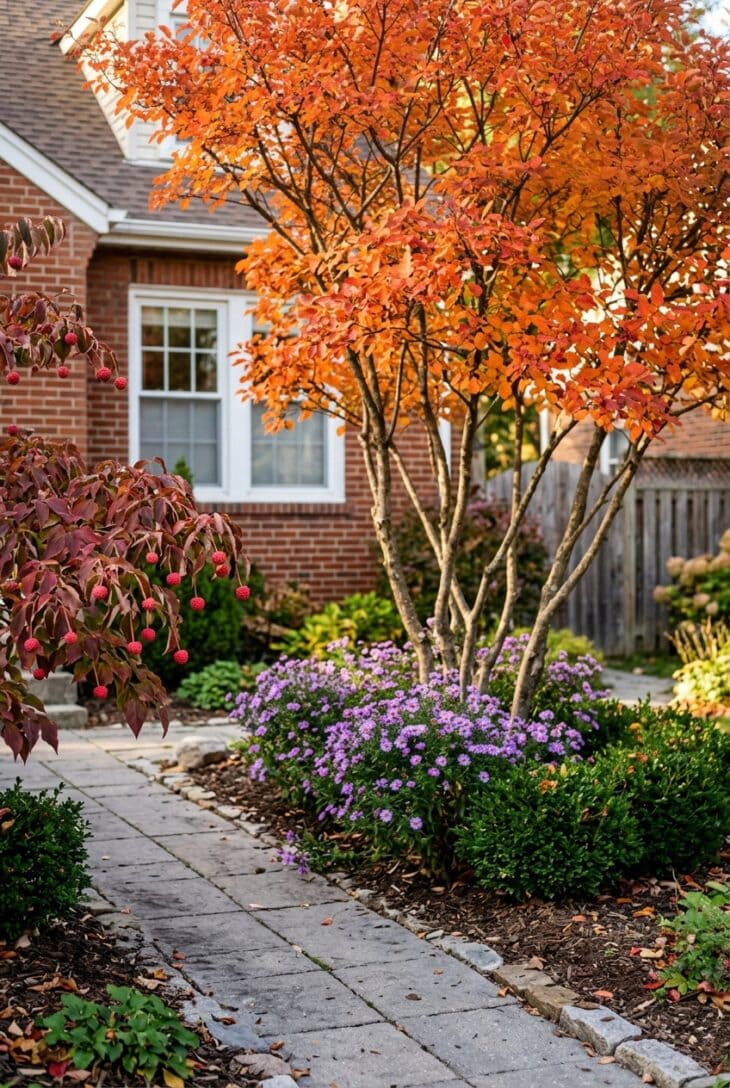
What you see Two small trees that fit the scale of a compact yard. A multi-stemmed serviceberry burns orange and red above purple asters, and beside it a kousa dogwood hangs round red fruits among reddish-purple leaves. A gray paver path and the corner of a brick house sit just behind.
Why it works In a small space every tree has to earn its place, and these two work for three seasons: spring flowers, summer fruit and fall color. Neither will outgrow a modest lot or shade out the whole yard. They are the kind of tree we reach for again and again in small garden ideas, where one good tree is the whole backbone.
How to get it Plant Allegheny serviceberry (Amelanchier laevis) or apple serviceberry (Amelanchier × grandiflora ‘Autumn Brilliance’), 15 to 25ft (4.5 to 7.5m) tall in zones 4 to 8; birds strip the June berries if you do not get there first. Kousa dogwood (Cornus kousa) grows about 20ft (6m) in zones 5 to 8, flowers in June and resists the anthracnose that troubles native flowering dogwood. Both like sun to part shade and moist, well-drained soil. Site each at least 10ft (3m) from the house so the canopy can spread evenly. Buy multi-stemmed forms for the most graceful shape.
11. Grow a Berry Border for the Birds
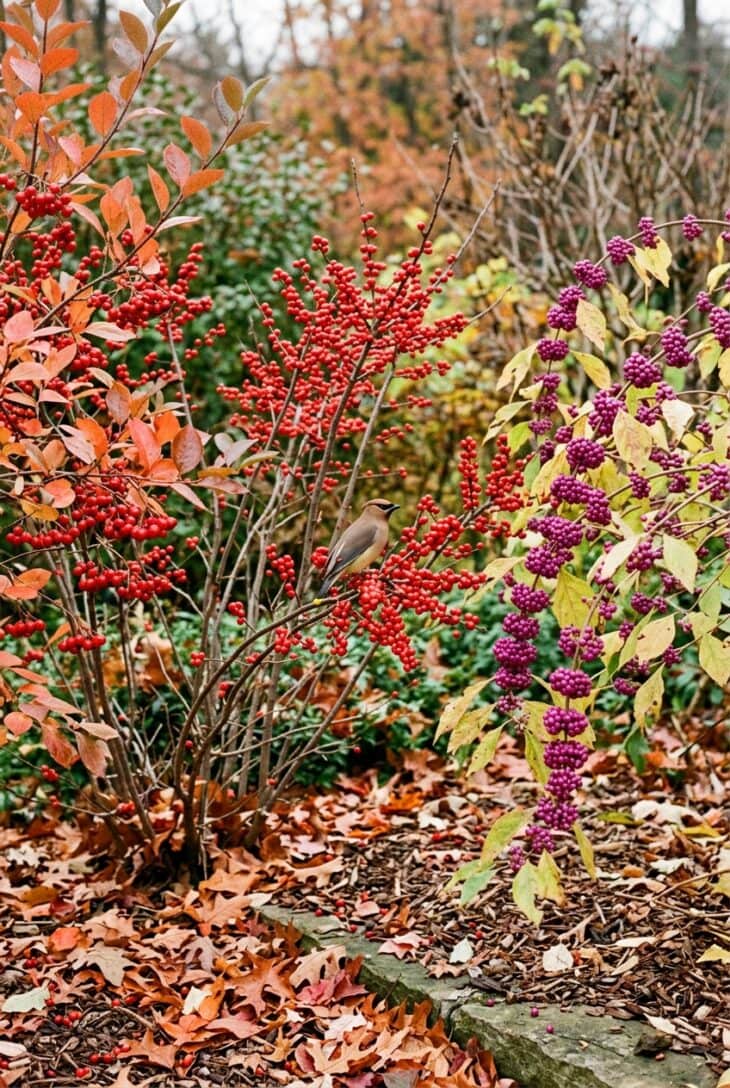
What you see A shrub border that has swapped flowers for fruit. Bare winterberry stems are crowded with glossy scarlet berries, beautyberry arches in rings of shocking magenta-purple, and chokeberry adds orange-red leaves and red fruit. A cedar waxwing sits on a branch, choosing its next berry.
Why it works Berries carry color long after the leaves have fallen, and they turn the garden into a feeding station for migrating and overwintering birds. The native shrubs here are adapted to local birds, which rely on their fat- and sugar-rich fruit in fall. It is one of the simplest wildlife garden ideas to put in place, and you get the show from the kitchen window.
How to get it Winterberry holly (Ilex verticillata ‘Red Sprite’) only fruits on female plants, so plant one male such as ‘Jim Dandy’ within 50ft (15m) of up to ten females; it suits zones 3 to 9 and wet soil. American beautyberry (Callicarpa americana) grows 4 to 6ft (1.2 to 1.8m) in zones 6 to 10 and flowers on new wood, so cut it back hard in late winter. Red chokeberry (Aronia arbutifolia ‘Brilliantissima’) adds the brightest leaf color and tolerates both wet and dry spots. Space shrubs 5ft (1.5m) apart in sun to part shade. Skip pruning in fall, or you cut off the berries.
12. Plant a Crabapple or Hawthorn for Winter Fruit
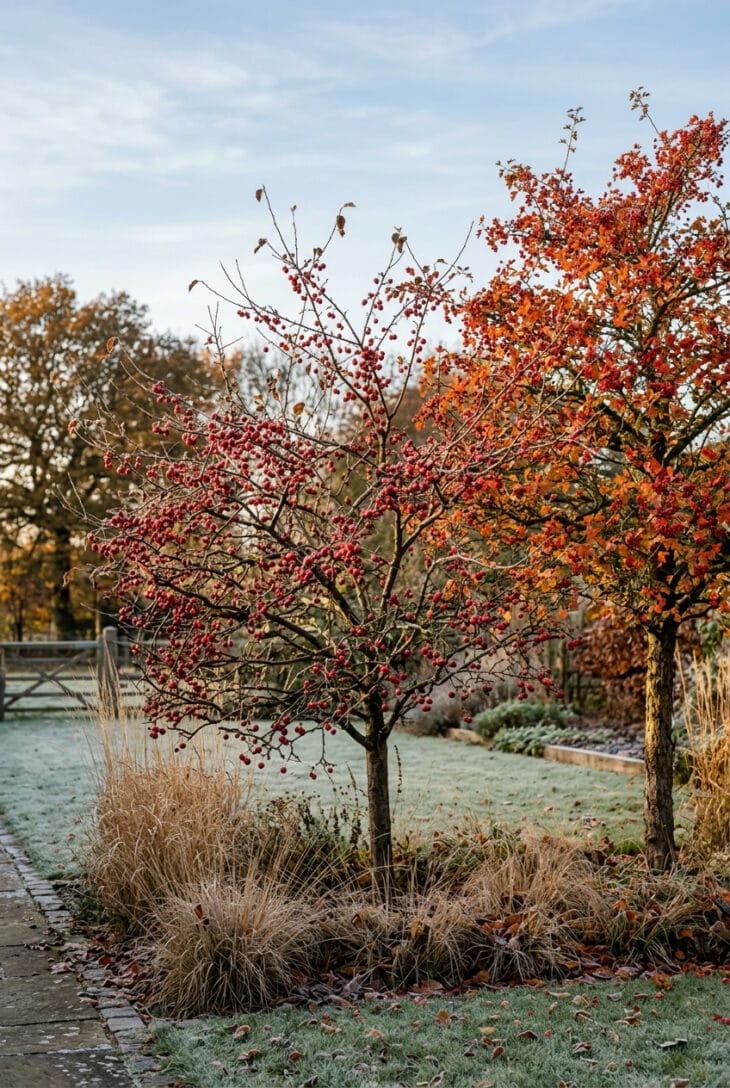
What you see A small crabapple, nearly bare, its branches beaded with hundreds of tiny glossy red fruits. Beside it a hawthorn still holds orange-red leaves and heavy bunches of scarlet haws. Frost whitens the lawn and tawny grasses at their feet, and the low morning sun makes the fruit shine.
Why it works These small trees give you spring blossom and then a second show of fruit that hangs on well into winter. Modern crabapples with small, persistent fruit do not drop a mess on the lawn, and birds strip them slowly through the cold months. A single tree dresses a corner for four or five months of the year.
How to get it Choose a disease-resistant crabapple with small fruit, such as ‘Sugar Tyme’ or ‘Prairifire’, or the compact Purple Prince crabapple (Malus ‘Purple Prince’); most grow 15 to 20ft (4.5 to 6m) in zones 4 to 8. Among hawthorn tree varieties, green hawthorn (Crataegus viridis ‘Winter King’) has few thorns and silver bark, and Washington hawthorn (Crataegus phaenopyrum) has the best orange fall color. Plant in full sun, where fruiting and disease resistance are best. Avoid older crabapple varieties with large fruit, which rot on the ground and draw wasps. Prune only in late winter, removing water sprouts and crossing branches.
13. Leave the Seedheads Standing
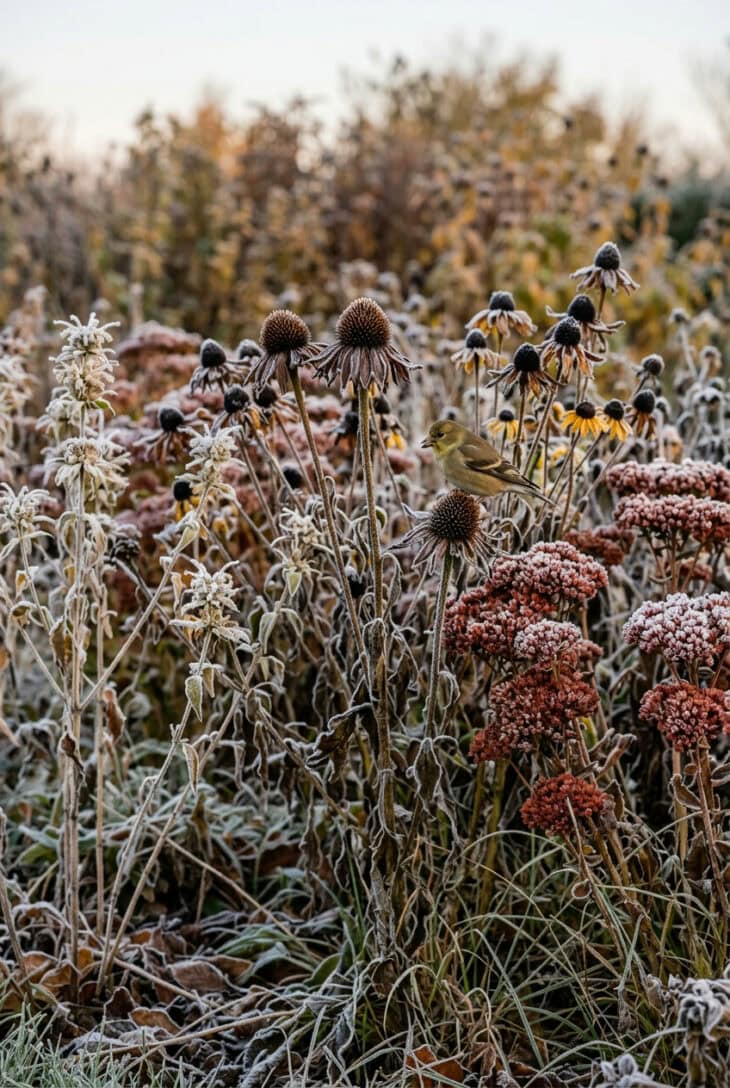
What you see A perennial bed that nobody has cut back. Dark coneflower cones stand on tall stems, black-eyed susans hold their brown buttons, sedum heads have turned brick red and pale bee balm stalks rise between them, all rimmed with frost. A goldfinch in olive winter plumage clings to one cone, picking out seeds.
Why it works Seedheads give the garden shape and a quiet palette of rust and bronze long after the color is gone. They feed finches and sparrows, and the hollow stems shelter native bees over winter. It is also less work: skipping the fall cleanup saves an afternoon and gives the garden something to look at until spring.
How to get it Plant perennials with sturdy stems and good seedheads: purple coneflower (Echinacea purpurea), black-eyed susan (Rudbeckia fulgida ‘Goldsturm’), autumn sedum (Hylotelephium ‘Herbstfreude’) and bee balm (Monarda fistulosa). Grow them in groups of at least three so the seedheads read as a mass. In fall, remove only diseased foliage, such as mildewed bee balm leaves. In spring, wait until daytime temperatures stay above 50°F (10°C), then cut stems back to 12 to 18in (30 to 45cm) rather than to the ground, since bees nest in the hollow stubs. New growth hides the stubs within weeks.
14. Turn Fallen Leaves Into Free Mulch
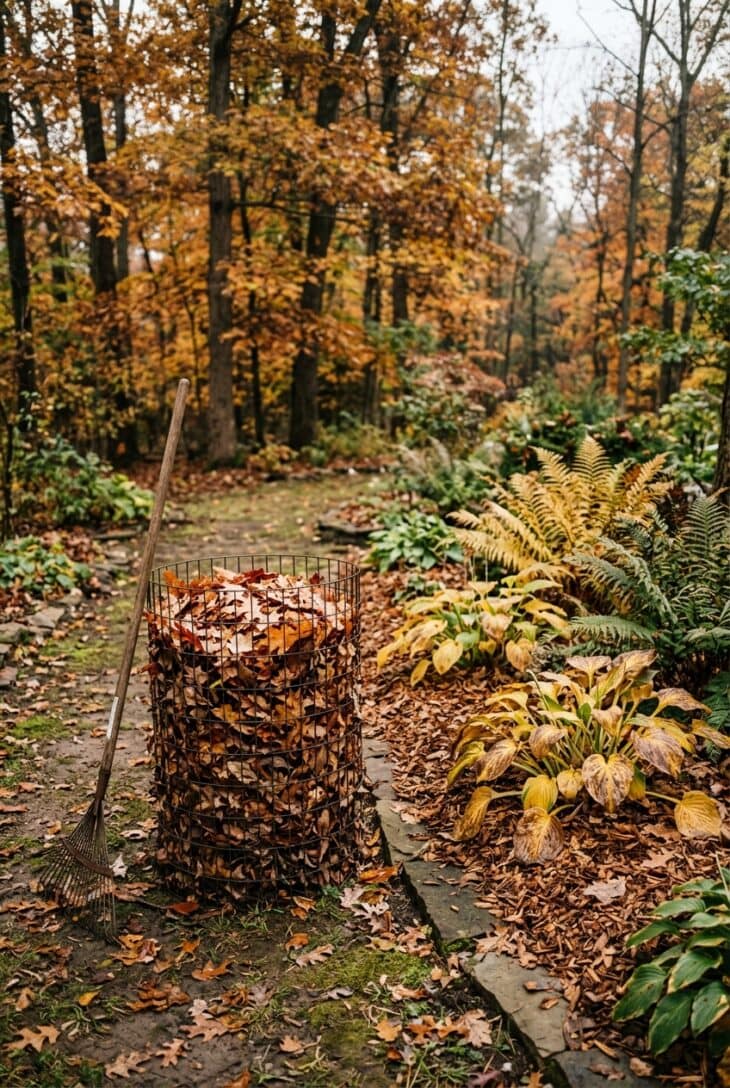
What you see A quiet corner where the fall leaves are put to work. A round wire bin is heaped with brown and orange leaves, a wooden rake leans against it, and the bed beside it is tucked under a layer of shredded leaves around yellowing hostas and ferns. Tall trees still hold a few orange leaves overhead.
Why it works Leaves are the free mulch that falls from the sky every fall. Shredded and spread on beds, they hold moisture, protect roots and rot down into the kind of soil woodland plants love. Piled in a bin, they become leaf mold, one of the best types of compost for improving soil structure, at no cost at all.
How to get it Run over leaves on the lawn with a mower two or three times to shred them; whole leaves, especially large maple leaves, mat down and smother plants. Spread 2 to 3in (5 to 8cm) of shredded leaves over beds, keeping it a few inches off stems and crowns. For leaf mold, build a bin of wire mesh about 3ft (90cm) across, fill it with damp leaves and leave it for one to two years. Oak leaves break down slowly, so mix them with other leaves. A thin layer on the lawn is fine, since mulched leaves feed the turf, but rake up any drift thick enough to hide the grass.
15. Cover a Wall in Crimson Boston Ivy
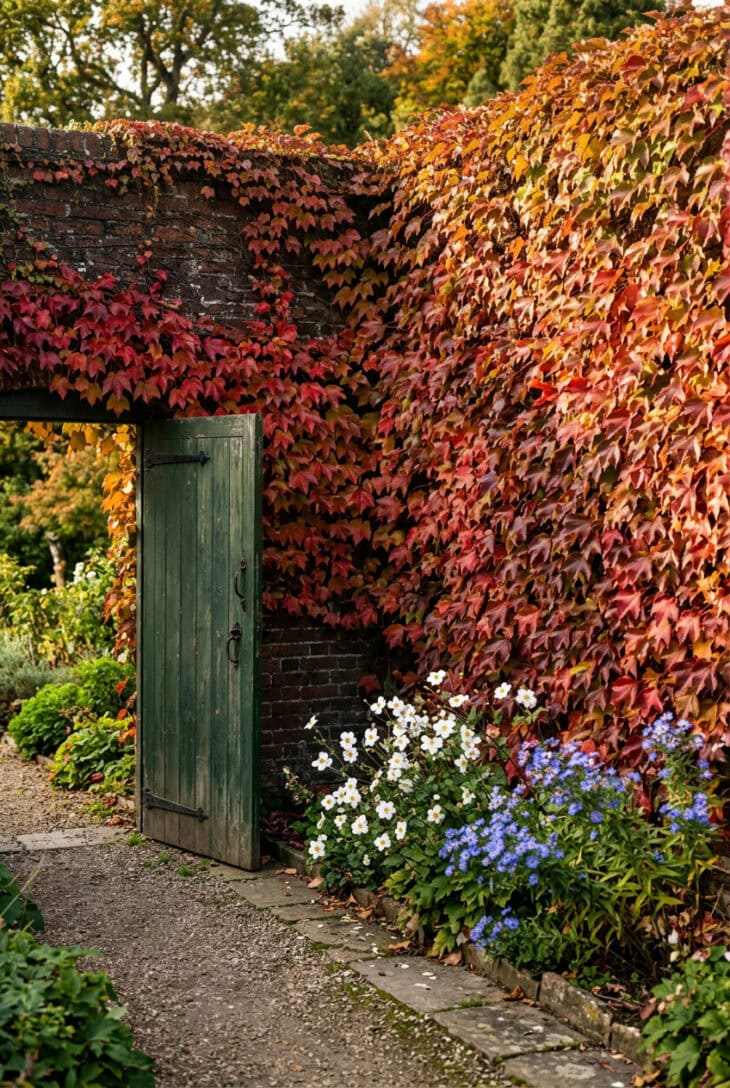
What you see A tall brick wall wrapped in a sheet of crimson, scarlet and burgundy leaves, overlapping like scales. A dark green wooden gate is set neatly into the vine, and a narrow bed of white anemones and blue asters runs along the base. Afternoon sun slides across the wall and lights up every leaf.
Why it works A vine turns a blank vertical surface into the biggest single block of fall color in the garden, while taking up almost no ground space. Boston ivy clings on its own, so there is no trellis to build. Along with other vertical garden ideas, it is the quickest way to soften a hard wall, garage or fence in a single season.
How to get it Plant Boston ivy (Parthenocissus tricuspidata) 12 to 18in (30 to 45cm) out from the base of a sound brick, stone or concrete wall; it is hardy in zones 4 to 8 and colors best in sun. The adhesive pads leave marks and can loosen old mortar, so keep it off wood siding, painted surfaces and soft brick. Native Virginia creeper (Parthenocissus quinquefolia) gives similar red and feeds birds with blue berries. Trim twice a year to keep it clear of windows, gutters and roof edges. One plant can cover 30ft (9m) of wall in a few years.
16. Train a Crimson Vine Over the Pergola
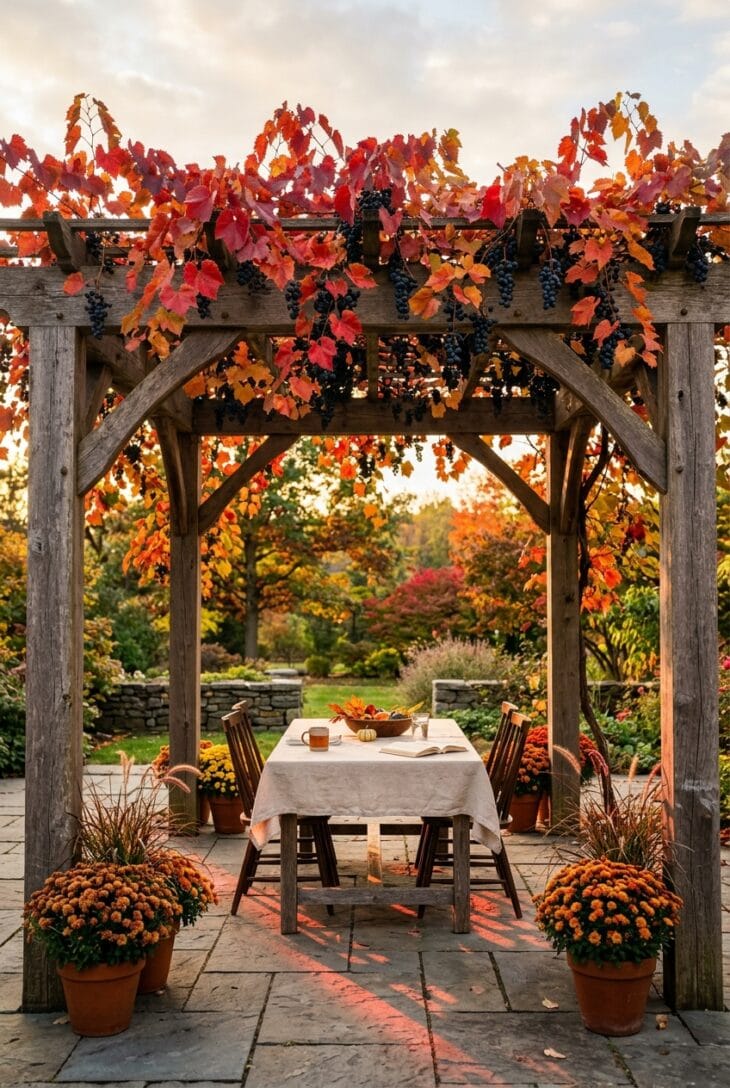
What you see A wooden pergola roofed in huge heart-shaped grape leaves turning crimson, scarlet and orange, with a few dark grape clusters hanging down. Warm red-tinted light filters through onto a table laid with linen and two chairs on the stone below. Pots of orange mums stand at the base of the posts.
Why it works An overhead vine gives shade in summer, then turns the ceiling of your outdoor room red in fall and lets winter sun through once the leaves drop. Sitting under it in October feels like sitting under a maple. It is one of the best upgrades for any of our patio garden ideas, because it adds color without taking floor space.
How to get it Crimson glory vine (Vitis coignetiae) has leaves up to 12in (30cm) across and the richest red, and is hardy in zones 5 to 9. For a native, riverbank grape (Vitis riparia) turns clear yellow and survives down to zone 3. Both are vigorous and heavy, so build the pergola with 6×6 posts and beams rather than light 4x4s. Plant at the base of a post in spring or fall and tie the main stem up until it reaches the top. Prune in midwinter, cutting side shoots back to two buds, since pruning in spring makes grapevines bleed sap.
17. Float a Pink Cloud of Muhly Grass
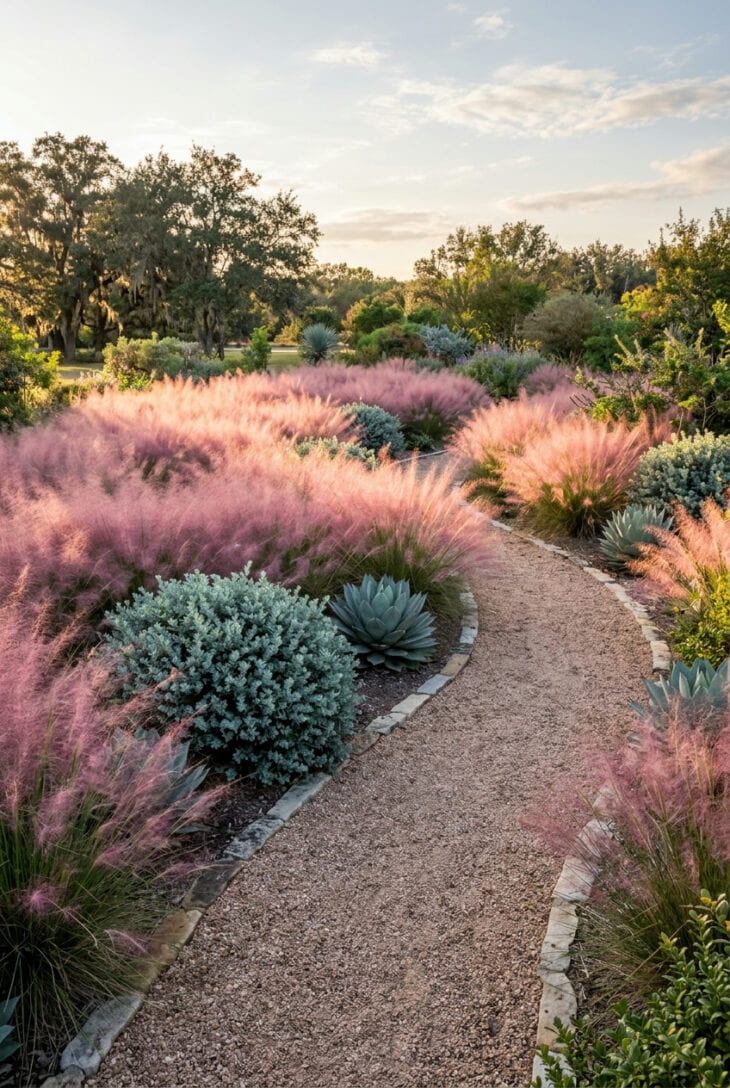
What you see A long ribbon of pink haze following a curving gravel path, so fine and airy it looks like mist caught in the garden. The low sun shines through the rosy plumes and sets them glowing. Rounded evergreen shrubs sit between the clumps like stepping stones.
Why it works Pink muhly is the South’s answer to fall color, where maples do little in the heat. It blooms in September and October, needs almost no water once settled, and shrugs off heat, humidity and poor soil. It sits naturally among drought-tolerant garden ideas, and planted as a mass rather than a single clump, it turns a whole bank or path edge into one soft sweep.
How to get it Plant pink muhly grass (Muhlenbergia capillaris) in full sun and sharp drainage in zones 6 to 10; it rots in heavy, wet clay. In zone 5, choose the hardier ‘Undaunted’ (Muhlenbergia reverchonii), which has ruby-pink plumes on a smaller plant. Set plants 2 to 3ft (60 to 90cm) apart, in drifts of seven or more, and plant in spring so roots are established before their first winter. Water weekly for the first summer, then only in long droughts. Comb out dead foliage with gloved hands in late winter, or cut back to 6in (15cm).
18. Cut Dahlias Until the First Frost
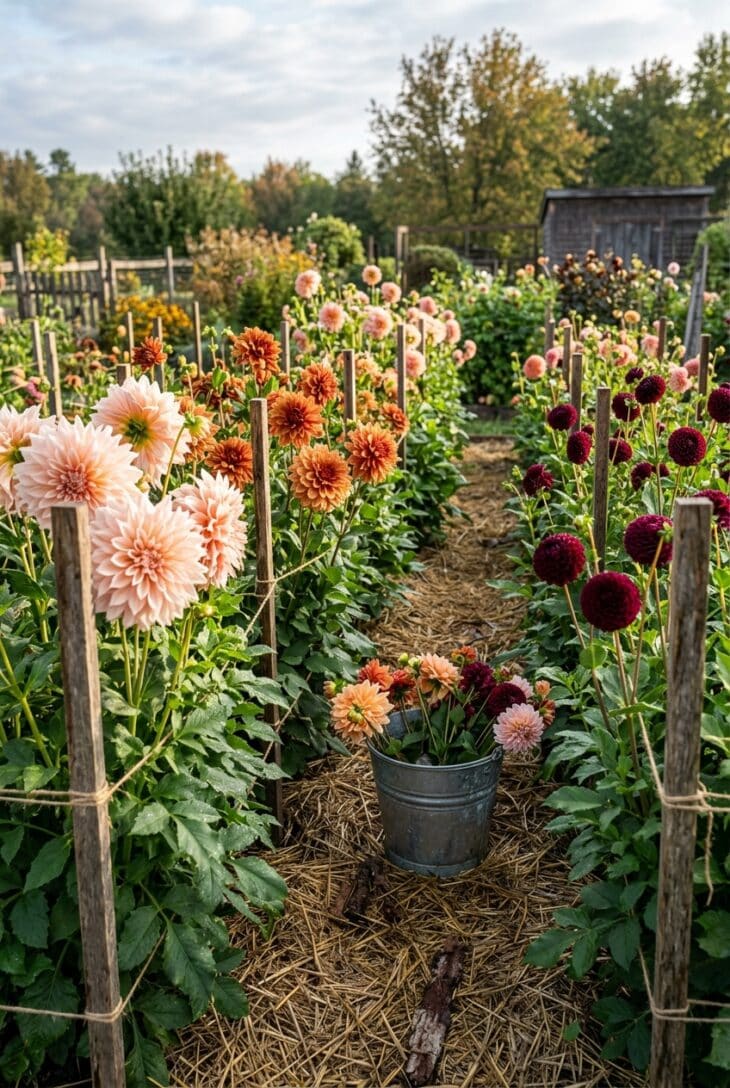
What you see Rows of staked dahlias at their very best, heavy with flowers in autumn’s own colors: blush-and-peach dinner plates, bronze and burnt orange decoratives, and small burgundy pompons. Dew clings to the petals, and a galvanized bucket of freshly cut stems waits on the straw path between the rows.
Why it works Dahlias peak as the nights cool, and the more you cut, the more they flower, right up to the first frost. A small bed gives armfuls of flowers every week from August to October. Choosing warm peach, bronze and burgundy varieties matches the season outdoors and in the vase, the way many cut flower garden ideas are planned around a palette.
How to get it Plant tubers of dahlia (Dahlia ‘Café au Lait’, ‘Cornel Bronze’ and ‘Labyrinth’) after the last frost, once the soil is about 60°F (16°C), 18in (45cm) apart and 4 to 6in (10 to 15cm) deep. Set a 5ft (1.5m) stake beside each tuber at planting so you do not spear it later. Pinch out the central shoot when plants are 12in (30cm) tall for more stems. Cut in the cool of morning, when flowers are three-quarters open. North of zone 8, dig the tubers once frost blackens the foliage, dry them for a few days and store them in slightly damp peat or wood shavings at 40 to 50°F (4 to 10°C).
19. Fill a Bed With Hot-Colored Annuals
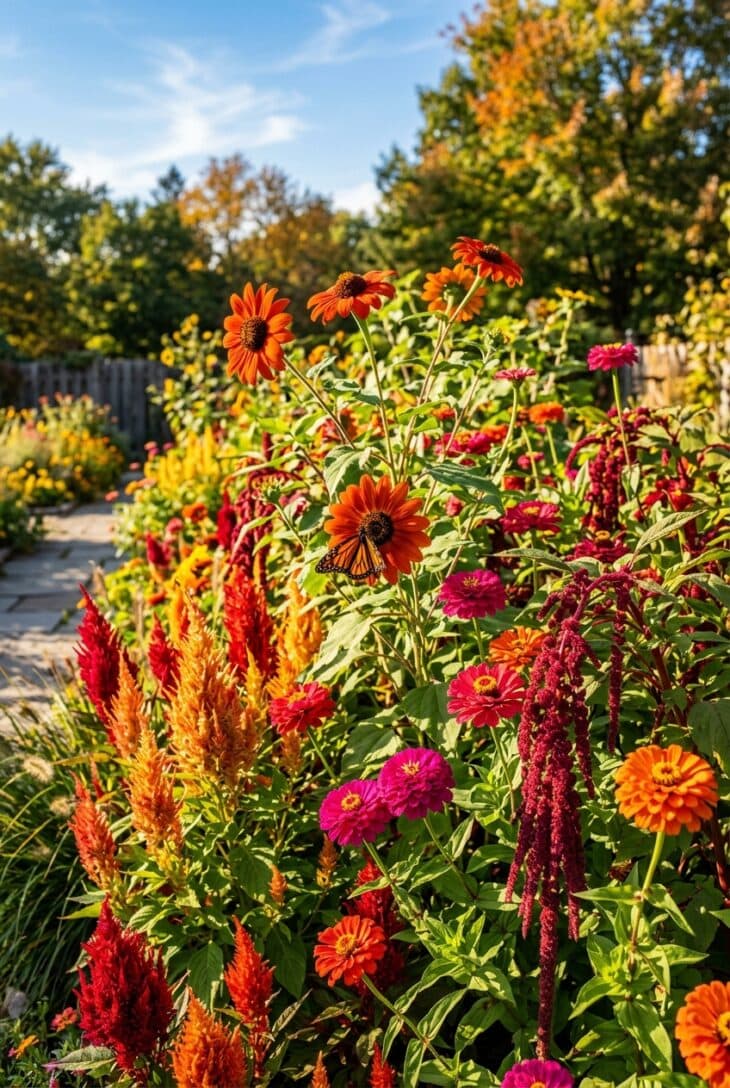
What you see A bed that looks like it is burning. Tall Mexican sunflowers hold up velvety orange blooms, with a monarch feeding on one. Plumes of celosia flicker red, orange and gold below, zinnias add magenta and scarlet, and crimson tassels of amaranth hang over the front.
Why it works Heat-loving annuals are at their tallest and fullest by September, and their colors match the maples coming into their own. They are cheap to grow from seed and give you a bold scheme to try without committing for years. The Mexican sunflowers are also a magnet for migrating monarchs, which makes this bed a natural fit with our butterfly garden ideas.
How to get it Sow Mexican sunflower (Tithonia rotundifolia) ‘Torch’ directly after the last frost; it reaches 4 to 6ft (1.2 to 1.8m), so put it at the back. In front, set plumed celosia (Celosia argentea var. plumosa), zinnia (Zinnia elegans ‘Benary’s Giant’) and love-lies-bleeding (Amaranthus caudatus). Space plants 12 to 18in (30 to 45cm) apart in full sun. Deadhead the zinnias and tithonia weekly to keep new flowers coming. Rich soil makes tithonia leggy, so skip the fertilizer.
20. Grow an Ornamental Edible Bed
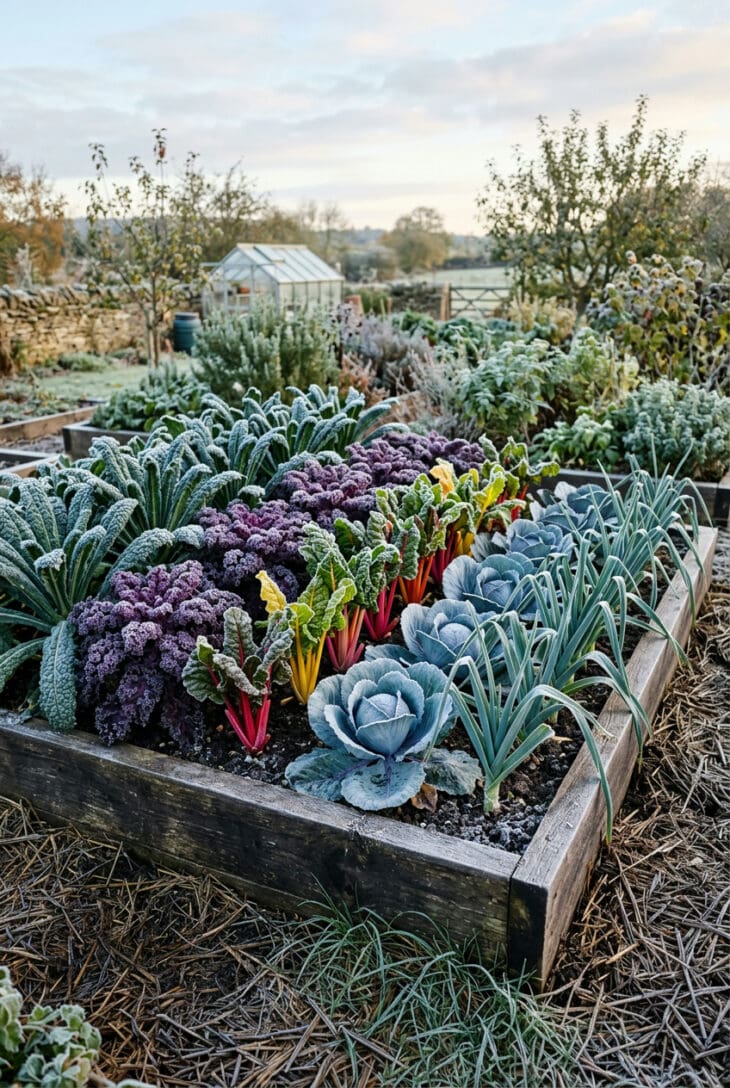
What you see A vegetable bed that looks as good as a flower border. Blue-green lacinato kale stands tall, frilled purple kale and red cabbages sit below it, rainbow chard glows red, yellow and pink, and a row of blue-green leeks lines the edge. A light frost dusts every leaf in the morning sun.
Why it works Cool-season crops are at their most colorful and tastiest in fall, since frost converts starch to sugar in kale and cabbage. Planted in blocks of color, they give you a harvest and a display at once. Any of our vegetable garden ideas can stretch into November this way, long after the tomatoes are gone.
How to get it Set out transplants six to eight weeks before your first frost: kale (Brassica oleracea ‘Lacinato’ and ‘Redbor’), Swiss chard (Beta vulgaris ‘Bright Lights’) and red cabbage ‘Red Express’. Winter-hardy leeks such as ‘Bandit’ (Allium ampeloprasum) need a spring start but stand in the ground until you need them. Space kale and cabbage 18in (45cm) apart and chard 12in (30cm). Plant in blocks of one color rather than mixed rows for the ornamental look, and see companion plants for kale for good neighbors. Harvest kale from the bottom leaves up, and keep the crown intact.
21. Light Up Shade With Golden Leaves
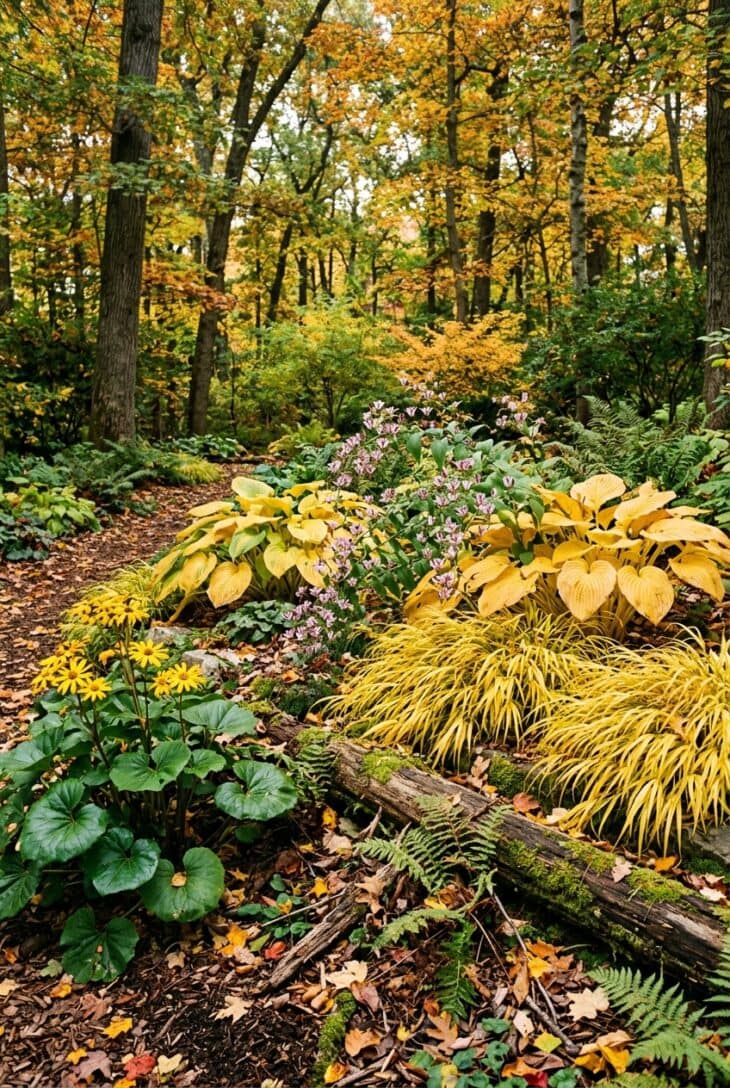
What you see A shady bed under tall trees that glows as if lit from within. Big hosta leaves have turned butter yellow, golden grass cascades over a mossy log, and toad lilies arch out with small spotted, orchid-like flowers. Glossy leopard plant adds bright yellow daisies, and dappled light falls through the canopy above.
Why it works Shade gardens often go dull in fall, but many shade plants color up gold as they head for dormancy, and gold is the color that reads best in low light. Adding a few late bloomers gives the eye flowers to find up close. It turns a dark corner, the subject of most of our shade garden ideas, into one of the brightest spots of October.
How to get it Plant Japanese forest grass (Hakonechloa macra) in drifts along the front, 18in (45cm) apart, and hosta (Hosta ‘Sum and Substance’), which turns clear gold. Add toad lily (Tricyrtis hirta ‘Miyazaki’), which blooms in September and October in zones 4 to 9. In zones 7 to 10, leopard plant (Farfugium japonicum) adds evergreen round leaves and yellow fall daisies. All want moist, humus-rich soil and protection from afternoon sun. Mulch with shredded leaves each fall to mimic the forest floor they come from.
22. Plant Bulbs That Bloom in Fall
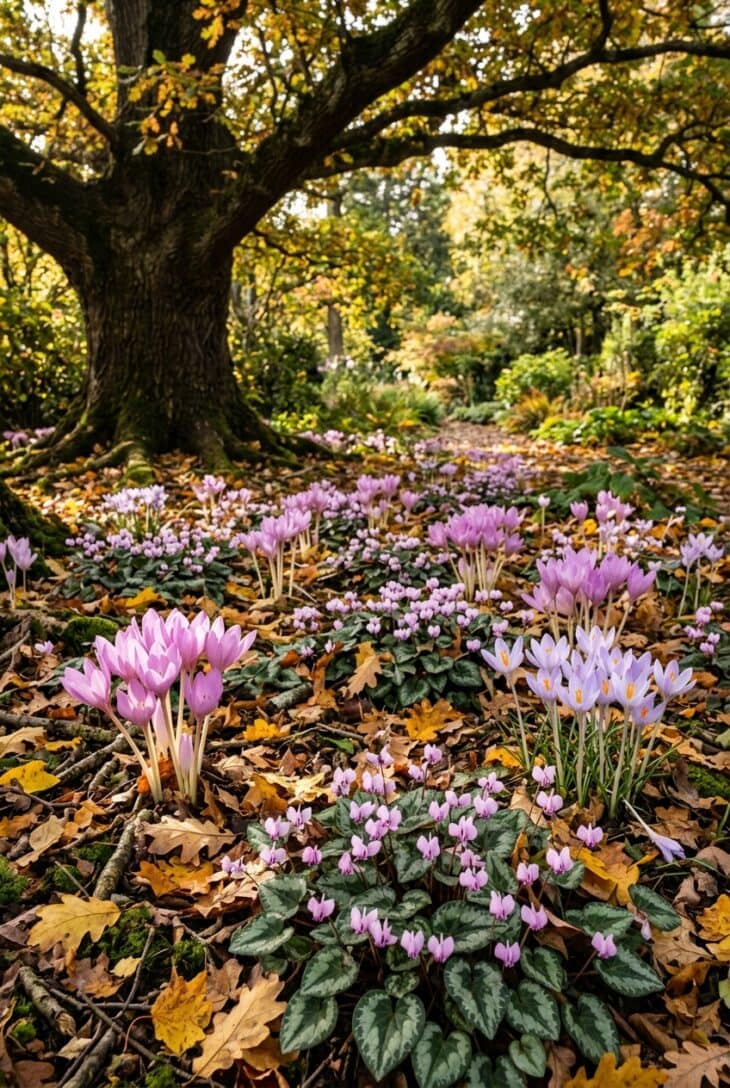
What you see Under an old tree, flowers push up through the fallen leaves as if it were spring. Rosy-lilac goblets of colchicum stand on bare stems, pale violet crocus open in drifts, and tiny pink cyclamen, with petals swept back, rise from mats of silver-marbled leaves. Golden leaves lie scattered all around.
Why it works Most people only know bulbs as spring flowers, so a carpet of crocus in October stops visitors in their tracks. These bulbs like the dry shade under deciduous trees, where little else will grow. They spread slowly into bigger drifts every year and need nothing from you once planted.
How to get it These bulbs are sold in late summer, so order in July and plant in August or early September for flowers the same fall. Plant colchicum (Colchicum ‘Waterlily’) 4in (10cm) deep, and fall crocus (Crocus speciosus) 3in (8cm) deep in groups of 20 or more. Hardy cyclamen (Cyclamen hederifolium) is planted just below the surface with the rounded side down, and suits zones 5 to 9. Colchicum is poisonous to people and pets and its big spring leaves flop as they die, so place it where that will not matter. Do not mow or cut the foliage until it yellows.
23. Layer Spring Bulbs in a Pot Now
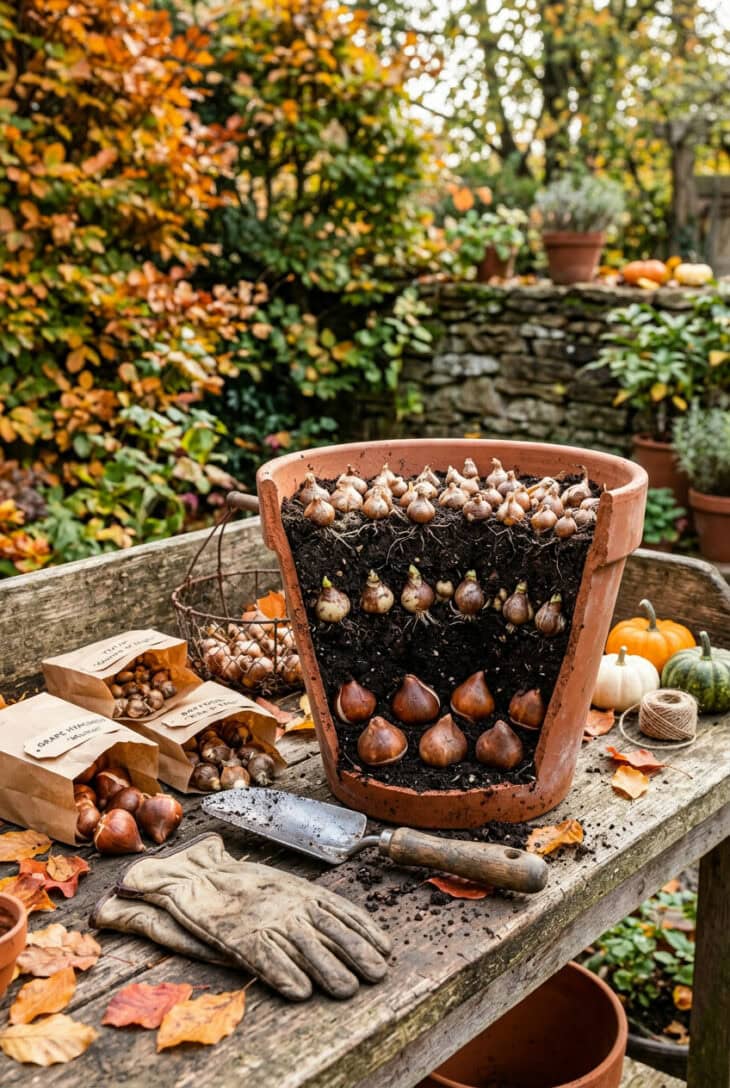
What you see A big terracotta pot on a weathered potting bench, half-filled with dark soil and bulbs laid out in layers: fat tulip bulbs at the bottom, daffodils above them and a sprinkle of small grape hyacinths near the top. Paper bags of bulbs, a trowel and worn gloves lie beside it among fallen orange leaves.
Why it works Fall is when next spring is planted, and a layered pot packs three waves of flowers into one container. Each layer blooms in turn from March to May, and the pot can sit in a sheltered corner all winter, then move to the front step when it starts to flower. It is a small, satisfying task for a cool October afternoon.
How to get it Use a pot at least 16in (40cm) wide and deep, with drainage holes. Put 3in (8cm) of potting mix in the base, add tulips (Tulipa ‘Ballerina’ or ‘Princess Irene’) nearly touching, cover with 2in (5cm) of mix, then add daffodils (Narcissus ‘Tête-à-Tête’), cover again, and top with grape hyacinth (Muscari armeniacum) and a final 2in (5cm) of mix. Plant once the soil has cooled, usually October to November. In zones 5 and colder, move the pot to an unheated garage or bury it in a bed for winter so the bulbs do not freeze solid. Water once at planting, then only if the mix dries out.
24. Let Hydrangeas Dry on the Shrub
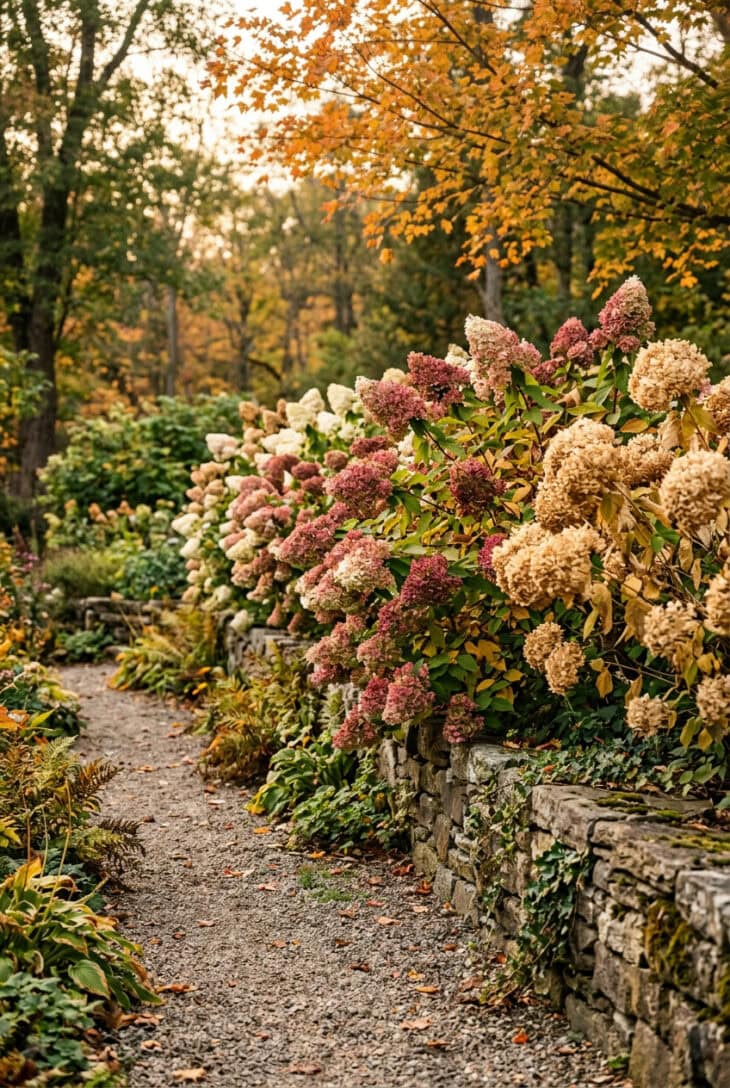
What you see Big cone-shaped hydrangea flowers that have faded from cream to antique pink, dusty rose and deep burgundy, lined up along a gravel path. Beside them, a smooth hydrangea holds round heads dried to papery parchment. A low stone wall and a maple turning orange complete the scene.
Why it works Hydrangeas give a second, quieter show in fall as their flowers age, and the heads hold on the shrub right into winter, catching snow. The vintage pinks and parchment shades suit the season far better than summer’s white. They are also free material for dried wreaths and arrangements.
How to get it For the pink-to-burgundy shift, plant panicle hydrangea (Hydrangea paniculata ‘Limelight’ or ‘Quick Fire’), 6 to 8ft (1.8 to 2.4m) tall in zones 3 to 8; these bloom on new wood, so prune in late winter. For papery tan heads, use smooth hydrangea (Hydrangea arborescens ‘Annabelle’), also called snowball hydrangea, and cut it back to 12 to 18in (30 to 45cm) in early spring. Both want full sun to part shade and steady moisture. Do not deadhead in fall. To dry heads indoors, cut them when they feel papery, strip the leaves and stand the stems in an inch of water until it evaporates.
25. Build a Border Around Smoke Bush Foliage
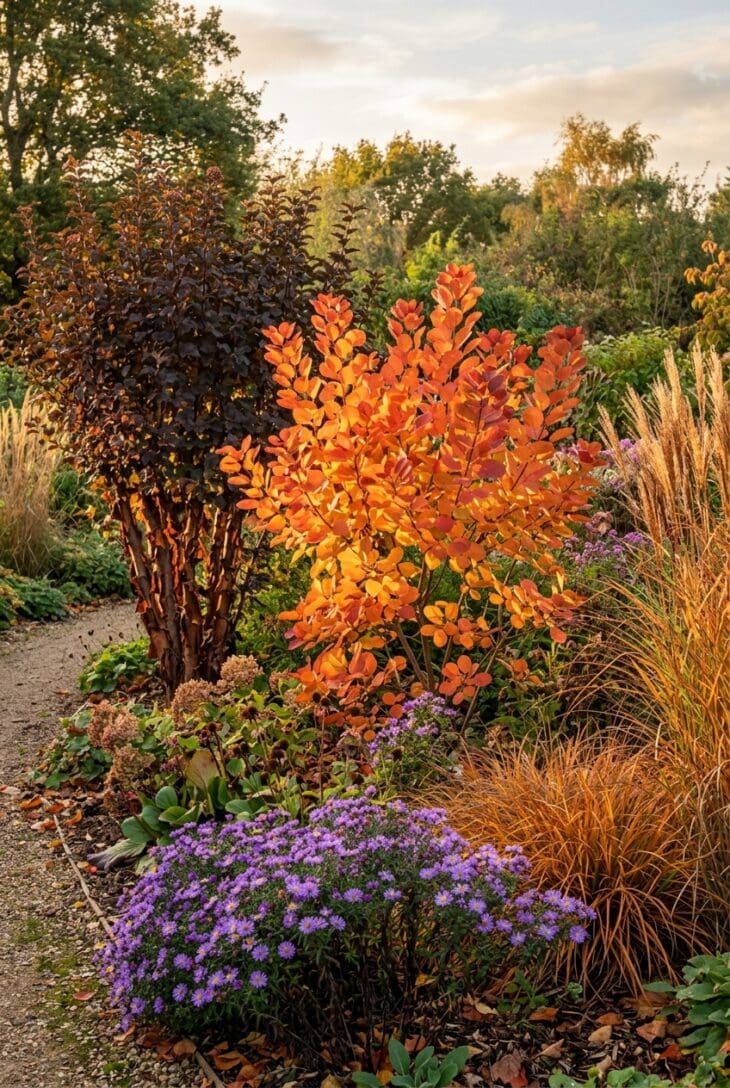
What you see A shrub border with a smoke bush at its heart, its round leaves backlit and glowing orange, scarlet and apricot like embers. Dark burgundy ninebark stands beside it, bronze sedge and tawny grass soften the front, and a few purple asters are still flowering at the edge.
Why it works Shrubs chosen for leaf color work from May to November, not just for the week they flower. Smoke bush is one of the most dramatic, going from blue-green or purple in summer to a blaze in fall. Mixed with dark and bronze foliage, it gives a garden border a strong, grown-up color scheme with very little upkeep.
How to get it Of the many smoke tree varieties, ‘Grace’ (Cotinus ‘Grace’) has the best fall color, from purple to orange-scarlet, and grows 10 to 15ft (3 to 4.5m) in zones 5 to 8. For bigger leaves on a smaller shrub, cut it back to 2ft (60cm) each late winter, though you lose the smoky flowers. Pair it with ninebark (Physocarpus opulifolius ‘Diabolo’), orange sedge (Carex testacea) and Frikart’s aster. Give everything full sun and well-drained soil. Space shrubs 6 to 8ft (1.8 to 2.4m) apart, and fill gaps with perennials for the first few years.
26. Plant a Corner for Fall Fragrance
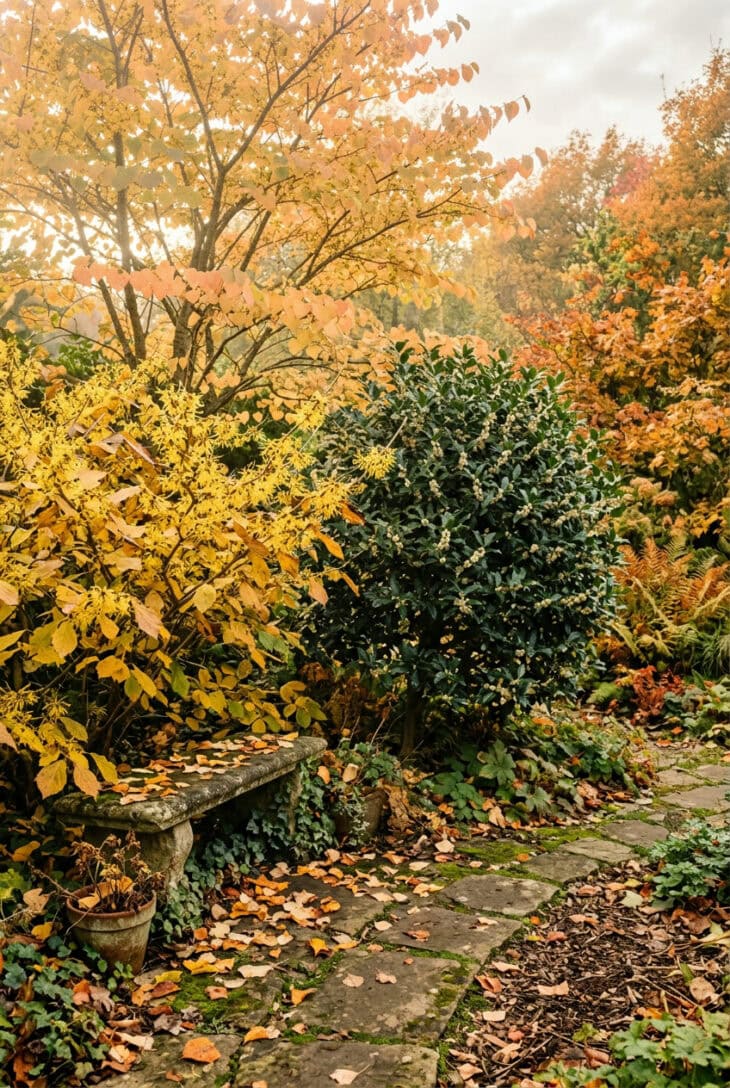
What you see A sheltered corner that smells as good as it looks. A witch hazel is hung with spidery ribbons of yellow flowers among its golden leaves, and a glossy dark osmanthus is dotted with tiny white blossoms. Above a stone bench, a katsura tree drops heart-shaped leaves in apricot and yellow.
Why it works Scent is the missing sense in most fall gardens. These three each bring a different note: the witch hazel is spicy, the osmanthus sweet like apricots, and fallen katsura leaves smell of burnt sugar or cotton candy. Put them near a bench or a path and the corner becomes a reason to walk outside on a cool evening.
How to get it Common witch hazel (Hamamelis virginiana) is a native that flowers in October and November, grows 15 to 20ft (4.5 to 6m) in zones 3 to 8 and takes part shade. Holly osmanthus (Osmanthus heterophyllus) is an evergreen for zones 6 to 9 that blooms in fall, and can be clipped into a hedge. Katsura tree (Cercidiphyllum japonicum) grows 40ft (12m) or more in zones 4 to 8, so plant it only where you have room, and keep it watered in drought, when it drops leaves early. Plant the shrubs within a few steps of where you sit, since fall scents carry only a short way in cool air.
27. Let a Gravel Garden Go Gold and Rust
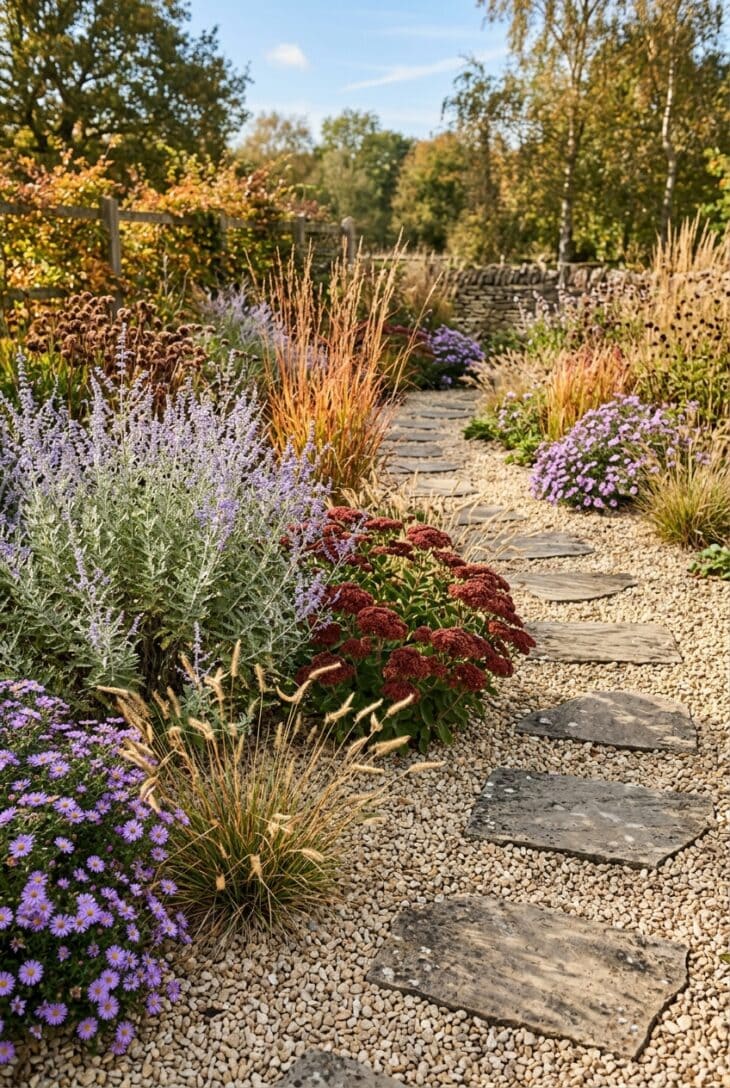
What you see A sunny gravel garden in autumn tones, with plants growing straight through the pale stone. Silvery Russian sage holds its last blue spikes, sedum heads have turned deep rust, blue grama grass waves golden eyelash seedheads and copper bluestem glows behind. Low purple asters fill the gaps beside flat stepping stones.
Why it works Dry-garden plants often look their best in fall, when their silver, rust and gold play against pale stone. Gravel reflects light up into the plants, keeps crowns dry over winter and smothers weeds. Like our other gravel garden ideas, it needs no watering once plants settle in, even in a hot, dry strip by the drive.
How to get it Plant Russian sage (Salvia yangii ‘Little Spire’), autumn sedum (Hylotelephium ‘Matrona’), blue grama (Bouteloua gracilis ‘Blonde Ambition’), little bluestem (Schizachyrium scoparium) and aromatic aster (Symphyotrichum oblongifolium). All suit full sun and lean, well-drained soil in zones 4 to 9. Plant small plants 18 to 24in (45 to 60cm) apart directly into the soil, then spread 2 to 3in (5 to 8cm) of angular gravel, about 3/8in (10mm), around them. Do not add compost or landscape fabric: poor soil keeps the plants compact and fabric fills with debris. Water for the first summer only.
28. Bring Fall Color to a Balcony
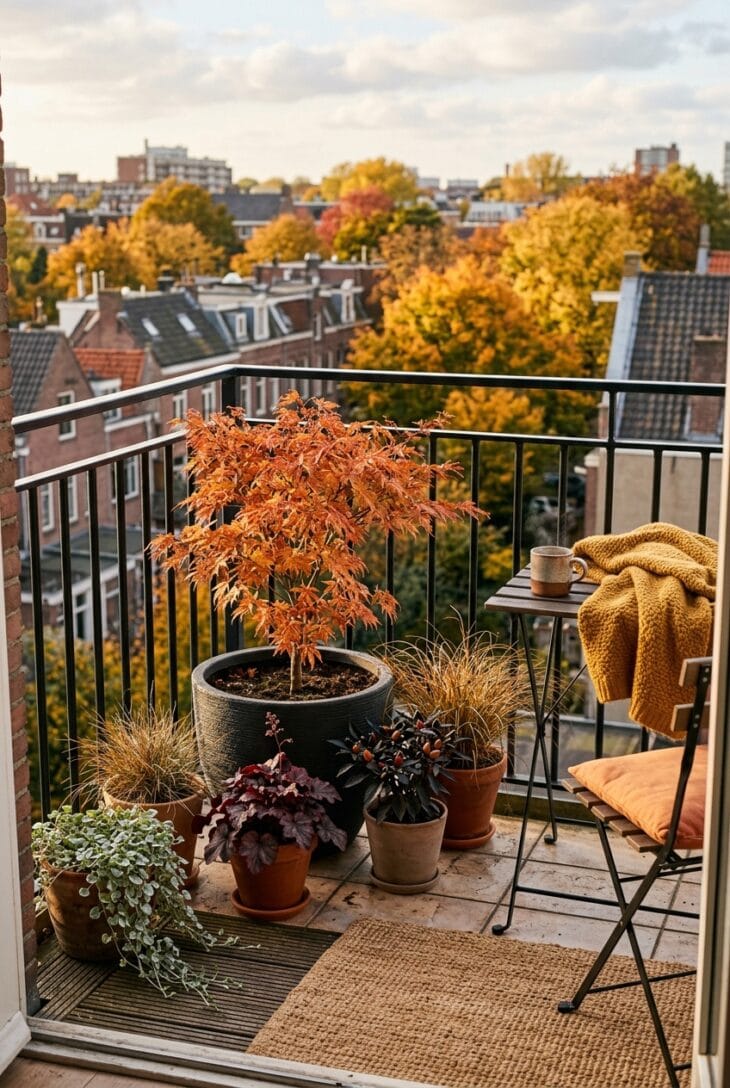
What you see A small balcony dressed for the season. A dwarf Japanese maple in a large charcoal pot glows orange-red, with smaller pots of burgundy heuchera, dark-fruited ornamental peppers, bronze sedge and trailing silver dichondra gathered around it. A bistro table holds a knitted throw and a mug, with city rooftops and golden treetops beyond the rail.
Why it works A single tree in a pot gives a balcony its own changing season, and a cluster of foliage plants around it keeps color going without flowers. Everything here is compact and handles cool nights, and lightweight pots keep the load safe. It is a simple way to carry fall into any of our balcony garden ideas, even with no ground at all.
How to get it Choose a dwarf Japanese maple such as ‘Beni-maiko’ or ‘Shaina’ (Acer palmatum), which stay under 6ft (1.8m) in a pot at least 20in (50cm) wide with drainage holes. Use fiberglass or resin pots, which weigh a fraction of terracotta, and check your building’s load rules. Around the maple, add heuchera (Heuchera ‘Forever Purple’), ornamental pepper (Capsicum annuum ‘Black Pearl’), orange sedge (Carex testacea) and silver dichondra (Dichondra argentea ‘Silver Falls’). Potted roots are less hardy than roots in the ground, so in zone 6 and colder, wrap the maple’s pot in burlap or bubble wrap for winter. Water until it runs from the base whenever the top 2in (5cm) is dry.
29. Create a Lantern-Lit Fall Seating Nook
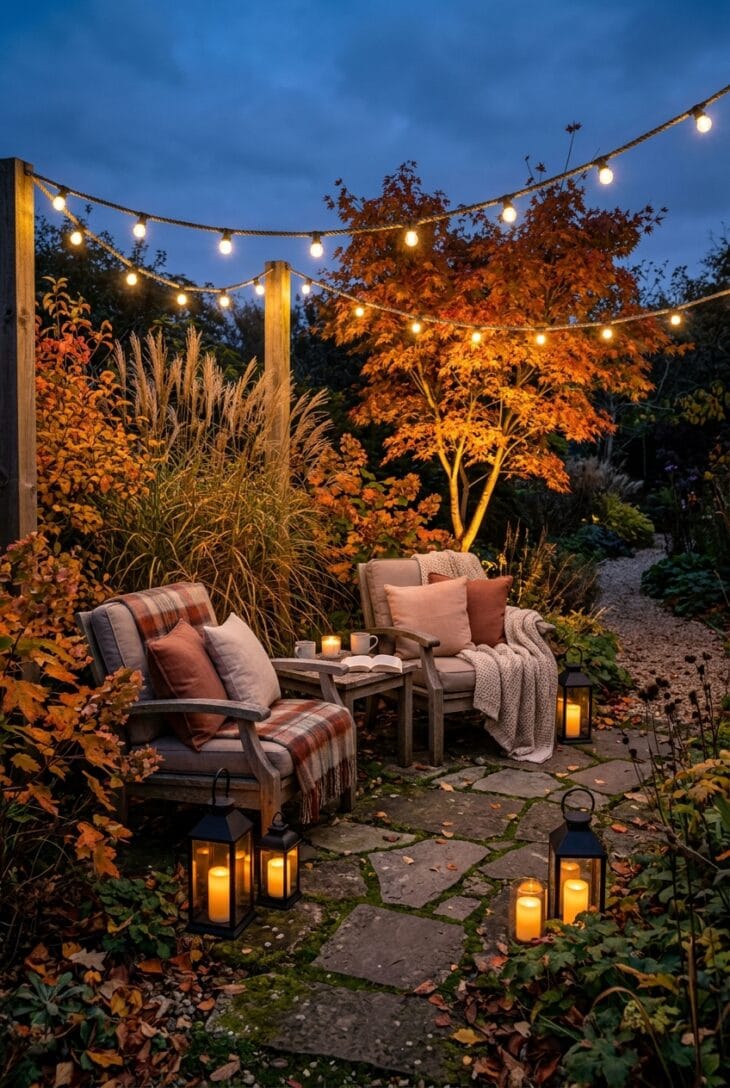
What you see A small flagstone terrace at dusk, tucked into tall tawny grasses and orange shrubs. Two cushioned chairs wait with wool blankets folded over the arms, warm string lights hang overhead, black lanterns flicker on the stone and a small maple glows orange from a light at its base. The sky has turned deep twilight blue.
Why it works Fall evenings get dark early, and lighting is what keeps the garden usable after 6pm. Uplighting a colored tree doubles its show, turning it into a glowing feature after sunset. Framing the seats with tall grasses makes the space feel sheltered, and the warm light suits the season. There are plenty more ways to do this in our garden lighting ideas.
How to get it Hang warm white string lights (2700K or lower) about 8ft (2.4m) above the seating, strung between posts set in concrete. Place a low-voltage LED spotlight 2 to 3ft (60 to 90cm) from the trunk of your best fall tree and aim it up into the canopy. Use LED candles in lanterns rather than real flames, since grasses are tinder-dry in fall. Plant switchgrass (Panicum virgatum) or feather reed grass (Calamagrostis × acutiflora ‘Karl Foerster’) around the seating for a 4 to 5ft (120 to 150cm) screen. Keep a lidded bin nearby for blankets and cushions so they stay dry.
30. Give the Garden an Evergreen Backbone
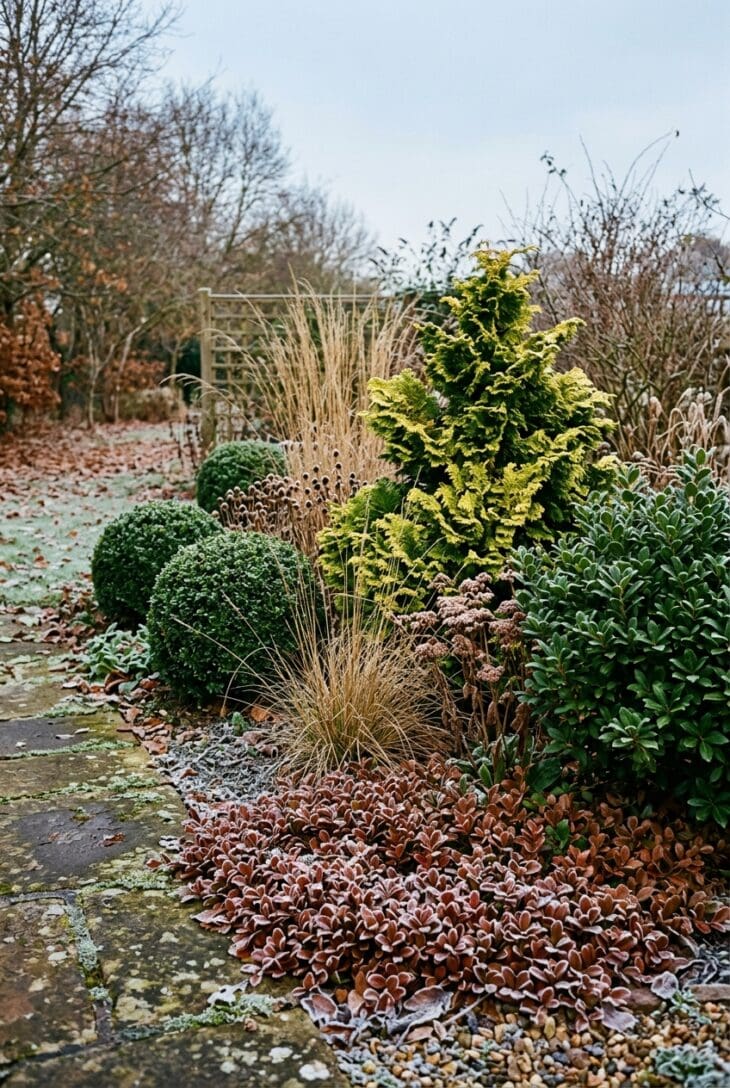
What you see A bed in late November, after the fireworks are over, still full of shape. Clipped boxwood balls and a dark inkberry holly anchor it, a golden dwarf hinoki shines yellow-green, and a low mat of bearberry has turned bronze-red at the front. Tawny grasses and seedheads stand between them in the frost.
Why it works Fall color is brief, and once the leaves drop, a garden with no evergreens collapses into bare soil. A framework of evergreens gives the eye something to rest on from November to April and makes all the fall color look planned. A rough rule is to make about a third of the woody plants evergreen, and the rest can then be as seasonal as you like.
How to get it Mix boxwood (Buxus ‘Green Velvet’), native inkberry holly (Ilex glabra ‘Shamrock’) and a golden dwarf hinoki cypress (Chamaecyparis obtusa) such as ‘Nana Lutea’, which grows slowly to about 3ft (90cm). For an evergreen groundcover that turns bronze-red in cold weather, plant kinnikinnick (Arctostaphylos uva-ursi), also called bearberry, in sandy, well-drained soil in zones 2 to 6. Space evergreens by their mature width so they do not crowd the seasonal plants. Water them deeply in late fall before the ground freezes, since winter wind dries out evergreens that go into winter thirsty.